What you'll learn
- How sociologists define the media and why theory matters.
- The main arguments of functionalist, Marxist, neo-Marxist, feminist, postmodernist and pluralist perspectives.
- How to apply each perspective to contemporary UK examples such as the BBC, newspapers, social media and influencer culture.
- How to evaluate perspectives using evidence, methods and comparison.
Starting point: what is “the media”?
The media are the organisations, technologies and platforms that produce and circulate messages to large audiences. This includes television, newspapers, radio, film, advertising, streaming services, gaming, podcasts and social media platforms such as TikTok, Instagram, YouTube and X.
A theoretical perspective is a broad way of explaining society. In this topic, each perspective asks: who controls the media, what messages are being spread, and how much power audiences have to accept, reject or reinterpret those messages?
Media perspective
A media perspective is a sociological viewpoint about how the media affects social life, especially socialisation, culture, identity, power and inequality.
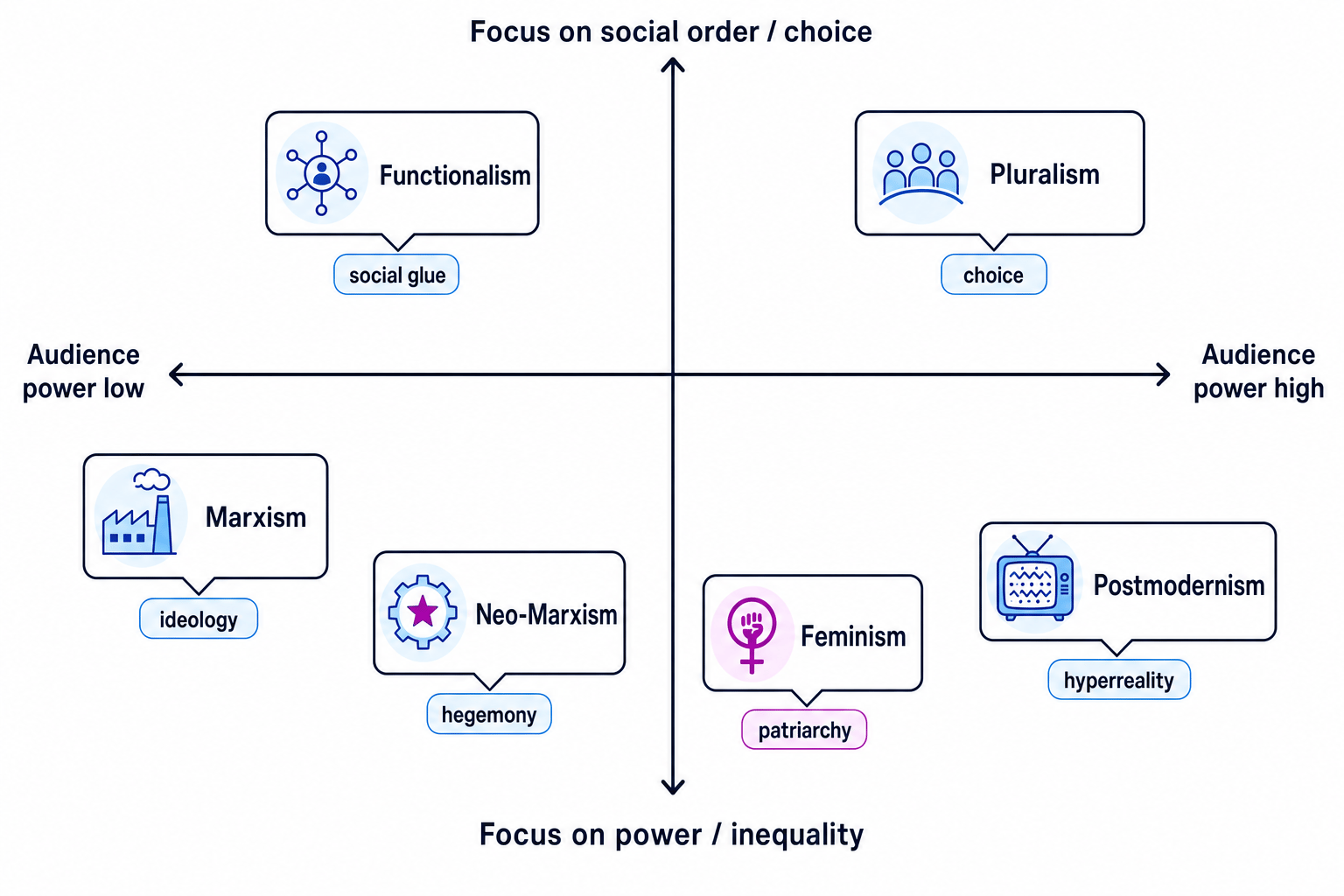
The perspectives differ mainly on two big questions: is the media helping society work smoothly, or reproducing inequality? And are audiences powerful and active, or shaped by owners, advertisers and dominant ideas?
This map helps you place the perspectives in relation to each other.
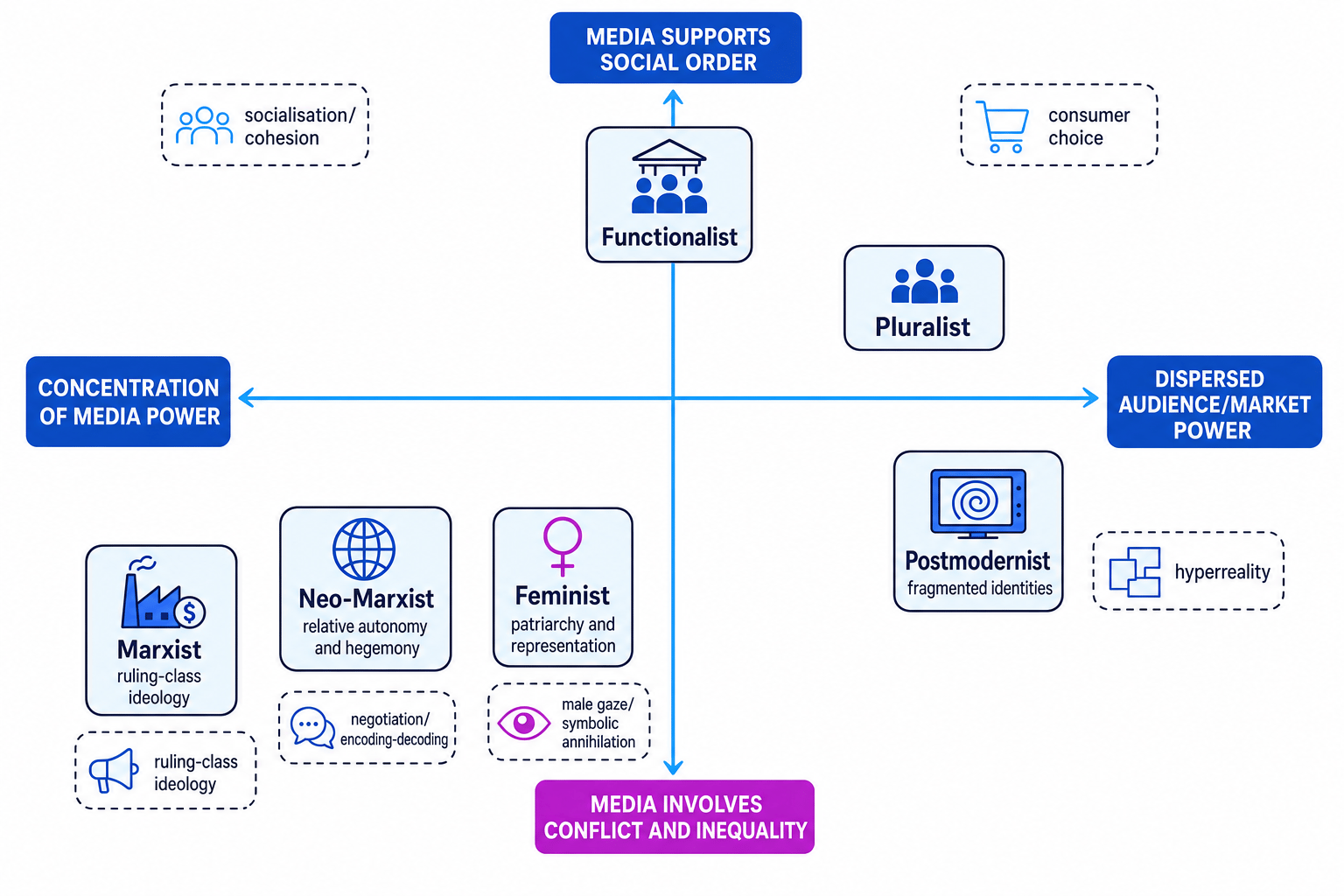
The core debate
For essays, keep returning to power: functionalists stress social order, pluralists stress choice, Marxists stress class control, feminists stress patriarchy, neo-Marxists stress hegemony and struggle, and postmodernists stress fragmentation and media saturation.
Functionalist perspective: media as social glue
Functionalism sees society as a system of connected parts that generally work together to maintain order. Functionalists such as Durkheim and Parsons are more associated with social order generally, while media theorists such as Lasswell and McQuail identify functions the media performs.
From this view, the media helps with socialisation, which means learning society’s norms and values. It also provides information, entertainment, shared national experiences and a sense of belonging.
For example, UK public service broadcasting such as the BBC can be seen as promoting shared knowledge through election coverage, public health messages and national events like royal ceremonies or major sporting occasions. Media can also act as surveillance, meaning it informs the public about events, risks and changes in society.
Applying functionalism to public service broadcasting
- Identify the social function: BBC news may provide shared information about elections, health advice or national emergencies.
- Link this to social order: if people receive common information, they may be better able to participate in democratic life and follow shared norms.
- Add evaluation: this works best when the media is trusted, but it becomes weaker if audiences see coverage as biased or turn to misinformation online.
Evaluation
Functionalism is useful for explaining why media institutions matter in national life, especially during crises such as the Covid-19 pandemic. However, it can be too optimistic. It may ignore how media messages can reinforce inequalities of class, gender and ethnicity. It also underestimates conflict: audiences do not all share the same values.
Marxist perspective: media as ruling-class ideology
Marxism argues that capitalist society is divided between the ruling class, who own the means of production, and the working class, who sell their labour. Applied to the media, Marxists argue that media owners and advertisers shape content in ways that support capitalism.
An ideology is a set of ideas and values that presents one group’s interests as normal, natural or common sense. Marxists argue that the media spreads ruling-class ideology by encouraging consumerism, individualism and respect for existing power structures. Althusser described institutions such as the media as part of the ideological state apparatus, meaning they help maintain capitalism through ideas rather than direct force.
UK examples include concentrated newspaper ownership. News UK, associated with Rupert Murdoch’s media empire, owns The Sun and The Times, while DMG Media owns the Daily Mail. Marxists argue this concentration matters because owners and advertisers can influence what is treated as important, respectable or threatening.
Applying Marxism to strike coverage
- Start with ownership and class: a Marxist would ask whether newspapers owned by wealthy corporations frame workers’ strikes from the viewpoint of business interests.
- Apply this to content: if coverage focuses on inconvenience to commuters rather than workers’ pay or conditions, it may make trade unions appear selfish or disruptive.
- Evaluate the claim: this is persuasive where patterns of coverage are repeated, but it should not assume every journalist is directly controlled by owners.
Evaluation
Marxism is strong on power and stratification because it highlights ownership, advertising and economic interests. However, critics argue it can treat audiences as too passive. It also struggles to explain why some media content criticises capitalism, exposes corporate wrongdoing or supports progressive causes.
Over-simplifying Marxism
Do not write “owners tell journalists exactly what to say” unless you can evidence it. A stronger answer says ownership, advertising and newsroom routines can create pressure towards certain viewpoints.
Neo-Marxist perspective: hegemony, negotiation and struggle
Neo-Marxism updates Marxism by giving more attention to culture, meaning and audience interpretation. Gramsci’s concept of hegemony means dominance through consent: powerful groups maintain control when their ideas become accepted as common sense.
Neo-Marxists argue that the media often supports capitalism, but not in a simple or automatic way. There is struggle over meaning. Stuart Hall’s encoding/decoding model says media producers encode preferred meanings into texts, but audiences may decode them in different ways: dominant, negotiated or oppositional.
Hall et al.’s Policing the Crisis (1978) argued that media coverage of “mugging” helped create a moral panic and supported tougher policing during a period of economic and political crisis. The Glasgow University Media Group, in Bad News (1976), examined how television news could favour official and employer viewpoints in industrial disputes.
Using encoding and decoding with protest coverage
- Identify the preferred meaning: a news item might encode a protest as disorderly by focusing on disruption, police lines and arrests.
- Consider audience readings: some viewers may accept this dominant reading, while others may make a negotiated reading such as “the protest is disruptive but the cause matters”.
- Add an oppositional reading: activists or sympathetic audiences may reject the framing and see the protest as necessary resistance to inequality.
Evaluation
Neo-Marxism improves on traditional Marxism because it recognises active audiences and conflict within the media. It is especially useful for analysing moral panics, immigration coverage or protest reporting. However, some neo-Marxist studies rely on interpretive readings of media content, which can be high in validity but harder to replicate reliably.
Feminist perspective: media and patriarchy
Feminism examines gender inequality. Patriarchy means a social system in which men as a group hold more power than women as a group. Feminists argue that media representations can normalise male dominance and narrow ideas of femininity and masculinity.
Tuchman used the term symbolic annihilation to describe how women are underrepresented, trivialised or stereotyped. Mulvey’s idea of the male gaze argues that visual media often present women as objects to be looked at from a heterosexual male viewpoint. Wolf’s The Beauty Myth argued that media pressure around appearance can become a form of social control.
More recent feminists such as Gill and McRobbie analyse postfeminist media culture, where women may be shown as empowered and choosing their identities, but still under pressure to be attractive, sexually confident and self-monitoring.
Applying feminism to influencer culture
- Identify the representation: beauty, fitness or lifestyle influencers may present highly edited images as normal everyday femininity.
- Link to patriarchy: feminist analysis would ask whether women’s value is being tied to appearance, desirability and self-discipline.
- Add complexity: social media can also give women platforms for activism, business and identity-building, as seen in #MeToo or body positivity movements.
Evaluation
Feminism is strong for analysing representation and identity, especially in advertising, music videos, reality TV and social media. A high-level answer should avoid treating all women as having the same experience. Intersectionality reminds us that gender intersects with class, ethnicity, sexuality, age and disability.
Pluralist perspective: media as choice and competition
Pluralism argues that power is spread across many groups rather than held by one ruling class. Pluralists see audiences as active consumers who choose media that reflects their interests.
This links to uses and gratifications theory by Blumler and Katz, which argues audiences use media for information, personal identity, social interaction and entertainment. From this view, media organisations must respond to audience demand. If people dislike a newspaper, TV channel or platform, they can switch to another.
Pluralists also point to regulation and diversity in the UK media landscape: the BBC has public service obligations, Ofcom regulates broadcasting, and the Online Safety Act 2023 increases duties on platforms regarding harmful content.
Applying pluralism to social media news choice
- Begin with audience agency: a pluralist would note that users can follow BBC News, The Guardian, GB News, independent journalists, campaign groups and creators.
- Link to competition: platforms and outlets compete for attention, so they must respond to what audiences engage with.
- Evaluate limits: algorithms, ownership concentration and digital literacy affect what people actually see, so choice is not completely equal.
Evaluation
Pluralism is useful because modern audiences really do have more choice than in the past. However, choice is uneven. Algorithms can create filter bubbles, and large corporations such as Meta, Google and TikTok hold enormous power over visibility, advertising and data.
Postmodernist perspective: media saturation and hyperreality
Postmodernism argues that contemporary society is fragmented, media-saturated and less shaped by one shared truth. Baudrillard argued that we increasingly live in hyperreality, where media images and simulations feel more real than reality itself. A simulacrum is a copy or representation with no clear original.
Postmodernists argue that media does not simply reflect reality; it helps create it. Identities become more fluid as people assemble lifestyles through brands, music, fashion, gaming, memes and online communities. Audiences are not just consumers but often prosumers, meaning they both produce and consume media content.
UK examples include TikTok political memes, influencer branding, deepfakes, celebrity activism and viral moral panics. In these cases, the boundary between news, entertainment, advertising and identity can become blurred.
Applying postmodernism to influencer politics
- Identify media blending: an influencer discussing politics may mix lifestyle content, sponsorship, humour and activism in one feed.
- Link to hyperreality: followers may experience the influencer’s curated online persona as more immediate and trustworthy than formal news.
- Evaluate material limits: postmodernism explains image and identity well, but it may underplay ownership, class inequality and platform regulation.
Evaluation
Postmodernism is highly relevant to social media, digital identities and fake news. Its weakness is that it can become too focused on signs, images and choice. Marxists and feminists would argue that real inequalities still shape who owns platforms, who is visible and who is targeted by harmful content.
Comparing perspectives in essays
A strong essay does not just list theories. It compares them.
- Functionalists ask: how does media create shared values and social cohesion?
- Marxists ask: how does media protect capitalism and ruling-class power?
- Neo-Marxists ask: how are meanings encoded, negotiated and contested?
- Feminists ask: how does media reproduce or challenge patriarchy?
- Pluralists ask: how much choice and influence do audiences have?
- Postmodernists ask: how does media blur reality, identity and representation?
A simple comparison sentence
Try: “Whereas Marxists emphasise ownership and class ideology, pluralists argue that audience choice and competition limit the power of owners.”
Evidence and methods: how do sociologists study media theories?
Sociologists often use content analysis, which means systematically studying media content, such as counting how often women appear as experts on news programmes. This can be reliable because categories can be repeated, but it may miss deeper meanings.
They also use audience research, such as interviews, focus groups and ethnography, to explore how people interpret media messages. This can produce valid detail, but samples may be small and less representative.
Online media research raises ethical issues too. If sociologists study public social media posts, they still need to consider privacy, informed consent, confidentiality and potential harm, especially when young people or vulnerable groups are involved.
In the exam
- Start each paragraph with a clear perspective and named concept, such as hegemony, male gaze, hyperreality or uses and gratifications.
- Apply it to a concrete UK example: BBC public service broadcasting, newspaper ownership, TikTok algorithms, influencer culture, protest coverage or Ofcom regulation.
- Evaluate by comparing with another perspective and by questioning evidence, audience agency, ownership, representation or contemporary relevance.
Check yourself
- Which perspective gives the most power to media owners, and which gives the most power to audiences?
- How is neo-Marxism different from traditional Marxism?
- How could a feminist and a postmodernist interpret the same Instagram influencer differently?