What you'll learn
- What social policy means when applied to the media.
- The main UK policy areas: broadcasting, online safety, press regulation, privacy, ownership and digital inclusion.
- How to apply sociological perspectives such as Marxism, feminism, pluralism and postmodernism.
- How to evaluate media policy using evidence, examples and exam-friendly AO3.
Starting point: what is social policy?
Social policy
Social policy means the laws, regulations, government decisions and public actions used to deal with social issues. In media, this includes rules about harmful content, children’s safety, privacy, ownership, public service broadcasting and online platforms.
The media are the institutions and technologies that create and distribute messages to audiences, such as television, newspapers, radio, film, social media, streaming platforms and search engines.
“Contemporary” simply means current or recent. In this topic, you are mainly thinking about modern UK society: Ofcom, the BBC, online platforms, data protection, misinformation, media ownership and debates about free speech.
The big idea
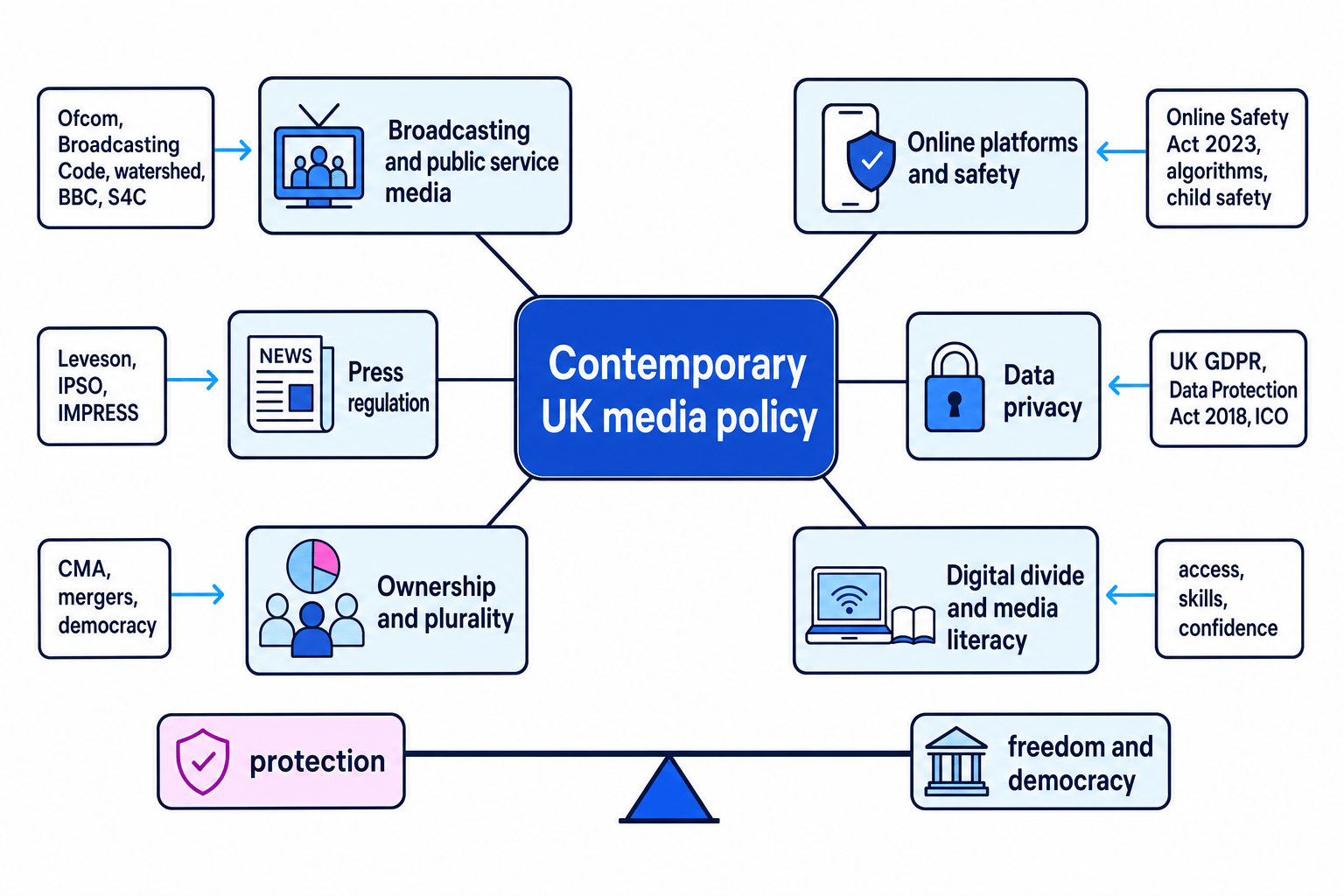
Media policy is always a balancing act: the state may want to protect people from harm, but it must also protect freedom of expression, privacy, democracy and cultural diversity.
Why does the media need policy?
Sociologists are interested in media policy because the media are not just entertainment. They help shape socialisation, meaning the process through which people learn norms, values and identities. Media messages can influence ideas about gender, ethnicity, class, sexuality, disability, age and nationhood.
Media policy is also about power and stratification. Some groups have more power to own media companies, influence news agendas, collect data or make themselves heard. Others may be stereotyped, excluded, targeted by online abuse or left out by the digital divide.
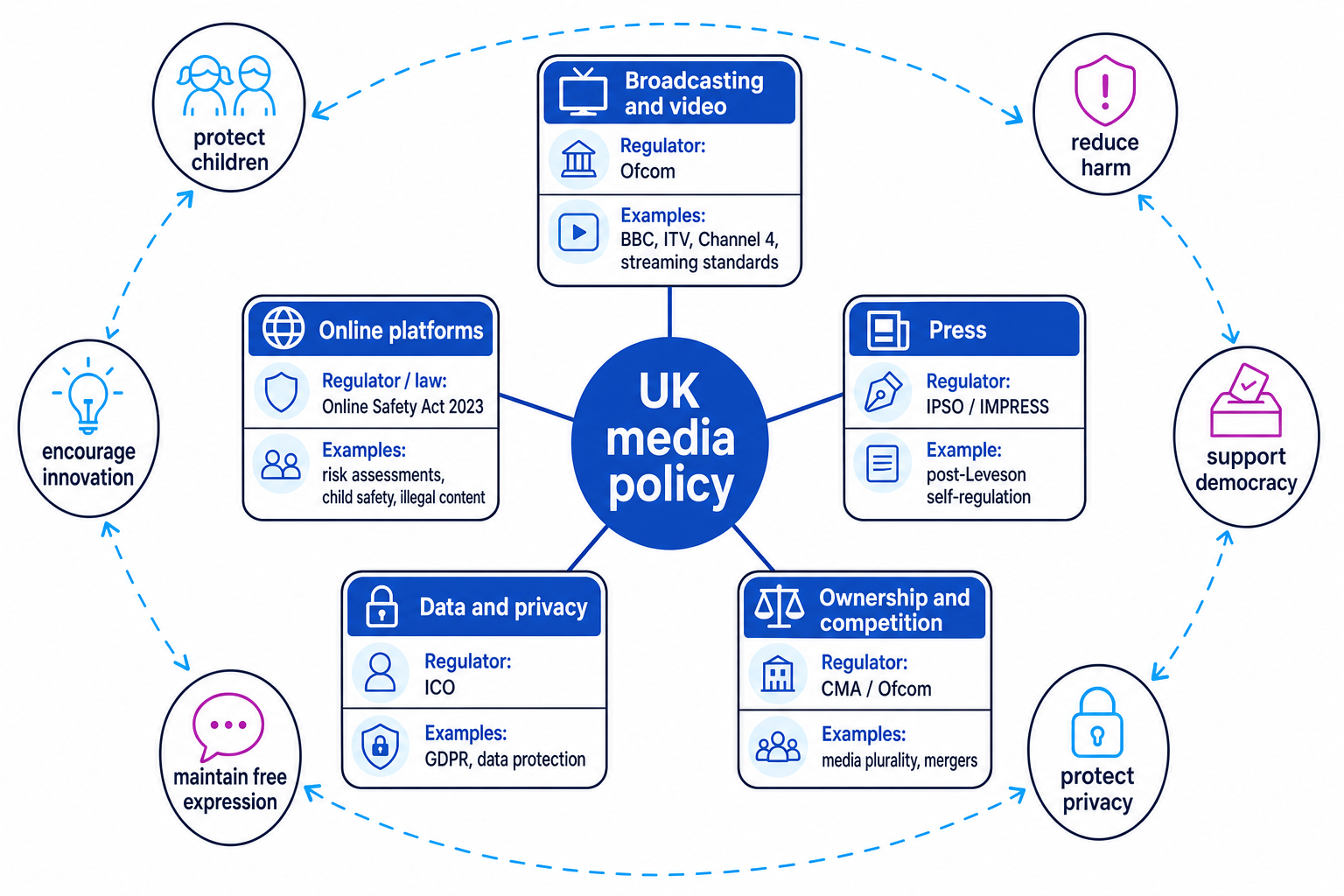
The diagram below maps the main areas of UK media policy.
Broadcasting and public service media
Regulator
A regulator is an official body that monitors an area of social life and enforces rules. In UK broadcasting, the main regulator is Ofcom, the Office of Communications.
Broadcasting includes television and radio. UK broadcasters must follow the Ofcom Broadcasting Code, which covers issues such as harm and offence, accuracy, due impartiality, elections, fairness and privacy.
A key concept is public service broadcasting, often shortened to PSB. This means broadcasting that serves the public interest, not just profit. The BBC, ITV, Channel 4, Channel 5 and S4C have public service responsibilities. S4C is especially useful for AO2 in Wales because it supports Welsh language and culture.
The watershed is the period after 9 pm when material unsuitable for children is more likely to be shown. This is a simple example of policy trying to protect children while still allowing adult content.
The Media Act 2024 updated rules around public service media, including making public service content easier to find on modern devices such as smart TVs and streaming interfaces.
Sociological application
A pluralist might argue that PSB supports democracy by giving citizens reliable information and a range of viewpoints. Habermas’ idea of the public sphere is useful here: democracy needs spaces where citizens can access information and debate public issues.
A Marxist would be more critical. They might argue that even public broadcasters operate within a wider capitalist society, where elite voices often receive more attention than working-class or marginalised voices.
Easy AO2 link
Use S4C as a strong example when discussing media policy, identity and culture. It shows how policy can protect minority-language culture, not just regulate harmful content.
Online platforms and the Online Safety Act
Online platform
An online platform is a digital service that connects users, hosts content or organises communication, such as TikTok, Instagram, YouTube, X, Facebook, Reddit or search engines.
Modern policy has shifted from traditional broadcasting to online media. The Online Safety Act 2023 gives Ofcom powers to regulate user-to-user services and search services. It focuses on illegal content, child safety duties, risk assessments, transparency and enforcement.
An algorithm is a set of digital instructions used to sort, recommend or prioritise content. Algorithms matter sociologically because they can amplify certain messages, identities or harms.
For example, the inquest into Molly Russell’s death raised public concern about algorithmically recommended self-harm content. This became part of the wider policy debate about platform responsibility and children’s safety.
Applying online safety policy to harmful content
-
Identify the social problem: A teenager may be repeatedly recommended self-harm or misogynistic content because the platform’s algorithm prioritises engagement.
-
Connect the policy: The Online Safety Act requires relevant platforms to assess risks and take steps to protect children from harmful content, with Ofcom able to issue codes and penalties.
-
Apply theory: A feminist analysis could focus on gendered online abuse and misogynistic content. A Foucauldian analysis could ask who gains power through monitoring, classifying and controlling digital behaviour.
-
Evaluate the limits: The policy may reduce some harms, but global platforms are difficult to regulate. There is also a risk of over-removal, where platforms take down legitimate discussion to avoid penalties.
Do not overstate the Online Safety Act
The Act does not simply ban everything harmful or offensive online. For adults, policy is more focused on illegal content, transparency and user controls than on removing every piece of legal but unpleasant speech.
Press regulation after Leveson
The press means newspapers, magazines and their online editions. The press is regulated differently from broadcasting because of the importance of a free press in a democracy.
Self-regulation
Self-regulation means an industry creates or funds its own regulatory system, rather than being directly controlled by the state.
After the phone hacking scandal, the Leveson Inquiry reported in 2012 on press ethics and regulation. It raised concerns about privacy, intrusion and the relationship between politicians, police and the press.
Most national newspapers are regulated by IPSO, the Independent Press Standards Organisation. Some publishers are regulated by IMPRESS, which is recognised by the Press Recognition Panel.
Treating all media as regulated the same way
Broadcast news must follow rules on due impartiality. Newspapers do not have the same legal impartiality requirement, so do not claim that Ofcom regulates newspaper political bias in the same way it regulates broadcasters.
AO3 evaluation is important here. Critics argue that self-regulation may be too close to the newspaper industry. Supporters argue that stronger state regulation could threaten investigative journalism and freedom of expression.
Data, privacy and surveillance
Datafication
Datafication means turning people’s actions, choices and relationships into digital data that can be stored, analysed and used by organisations.
Media policy now includes privacy and data protection. The UK GDPR and Data Protection Act 2018 set rules about how personal data can be collected and used. The Information Commissioner’s Office, or ICO, enforces data protection law.
The Age Appropriate Design Code, often called the Children’s Code, requires online services likely to be accessed by children to consider children’s privacy and best interests.
Foucault’s ideas about surveillance are useful here. Surveillance means monitoring people’s behaviour. Foucault argued that modern power often works through observation, classification and self-discipline. In media, this links to cookies, targeted advertising, platform analytics and personalised recommendations.
Zuboff’s idea of surveillance capitalism is also relevant: digital companies can profit from collecting behavioural data and predicting or shaping future behaviour.
Ownership, plurality and democracy
Media plurality
Media plurality means having a range of independently owned media voices, so that no single owner or small group dominates public debate.
Ownership matters because media companies can influence what stories are covered, whose voices are heard and how issues are framed. In the UK, the Competition and Markets Authority and Ofcom can be involved in assessing media mergers and plurality concerns.
Marxists argue that concentrated media ownership supports ruling-class power. Chomsky and Herman’s propaganda model suggests that media content is filtered through ownership, advertising, sourcing and dominant ideology. Curran and Seaton also argue that media power needs democratic scrutiny.
Pluralists respond that audiences now have more choice than ever through social media, streaming, podcasts and independent journalism. However, this can be challenged: digital choice does not necessarily mean equal power, especially if a few large platforms control visibility through algorithms.
Evaluating a media ownership concern
-
Define the issue: If one company owns several major news outlets, media plurality may weaken because fewer owners shape the range of public viewpoints.
-
Apply a conflict perspective: A Marxist would argue that concentrated ownership allows wealthy groups to protect their economic and political interests.
-
Add a counterargument: A pluralist could argue that online media gives audiences alternative sources, reducing the power of traditional owners.
-
Make a judgement: The pluralist point is stronger than it used to be, but platform algorithms and advertising power mean inequality of voice still remains.
Digital divide and media literacy
Digital divide
The digital divide means unequal access to digital technology, internet connection, skills and confidence. It often affects older people, poorer households, disabled people and some rural communities more strongly.
Media policy is not only about controlling content. It is also about helping people participate. Government broadband policy, social tariffs, school digital access and Ofcom’s media literacy duties all relate to this.
Media literacy means the ability to access, understand, evaluate and create media messages. Livingstone and Helsper’s work on digital inclusion is useful here because it shows that access alone is not enough; people also need skills and confidence. Buckingham’s work on media education is useful for arguing that young people should be taught to critically understand media rather than simply be protected from it.
This links strongly to stratification: if middle-class groups have better digital access and skills, they may gain more educational, cultural and economic advantages.
Using theories in essays
| Perspective | How it views media policy | Useful evaluation |
|---|---|---|
| Pluralism | Policy protects democracy, choice and citizens’ rights. | May underestimate inequalities in ownership, class and platform power. |
| Marxism | Policy may protect capitalist interests and elite control of ideology. | Can underplay audience agency and real limits placed on companies. |
| Feminism | Policy should tackle misogyny, harassment, stereotypes and unequal representation. | Some policies are gender-neutral on paper but unequal in impact. |
| Interactionism | Media labels and moral panics can shape policy responses. Cohen’s study of Mods and Rockers is useful. | Not all concerns are exaggerated; some media harms are real. |
| Postmodernism | Digital media are fragmented, global and fast-changing, making regulation harder. | Can overstate choice and ignore structured inequalities. |
Moral panic
A moral panic is an exaggerated social reaction to a group or behaviour seen as a threat to society. Cohen argued that media amplification can create “folk devils” and increase pressure for social control.
Hall et al.’s Policing the Crisis also shows how moral panics can be connected to wider power struggles. They argued that the “mugging” panic helped justify tougher social control during a crisis of capitalism.
Research methods angle
Media policy often uses evidence from Ofcom reports, official statistics, surveys, consultations, content analysis and academic research.
For AO3, evaluate the evidence behind policy:
- Practical issues: large-scale Ofcom surveys can identify trends, but fast-changing platforms make evidence quickly outdated.
- Ethical issues: research into children, harmful content or online abuse must avoid causing distress and protect confidentiality.
- Theoretical issues: positivists may value reliable statistics on media use, while interpretivists may prefer interviews that reveal how users understand media in everyday life.
In the exam
-
Name the policy area clearly: for example, Online Safety Act, Ofcom broadcasting rules, Leveson and press regulation, data protection, media ownership or digital inclusion.
-
Apply it to society: link the policy to children, democracy, identity, inequality, Welsh language culture, online harm, privacy or platform power.
-
Evaluate with perspectives: show the tension between protection and freedom, or between pluralist optimism and Marxist, feminist or postmodern criticism.
Check yourself
- How is broadcasting regulation different from press regulation in the UK?
- Why might Marxists and pluralists disagree about media ownership policy?
- How can the digital divide turn media access into an issue of power and stratification?