What you'll learn
- How sociologists define the role and function of religion.
- How functionalist, Marxist, feminist, Weberian and late-modern views explain religion.
- How to apply these ideas to contemporary UK society.
- How to evaluate religion essays using AO1, AO2 and AO3.
Starting point: what are sociologists asking?
Sociologists are not mainly asking whether religious beliefs are “true”. They are asking what religion does in society.
Religion can act as a source of comfort, identity, social rules, political power, protest, inequality or community. Different sociological perspectives disagree about whether these effects are mainly positive, negative, or mixed.
Religion, role and function
Religion is a set of beliefs, rituals and organisations connected to the sacred, the supernatural or ultimate questions about meaning. A role is the part religion plays in social life. A function is a consequence of religion for individuals, groups or society.
A useful extra term is dysfunction: a harmful or disruptive consequence. For example, religion may create community solidarity, but it may also reinforce gender inequality or conflict between groups.
The central question
For this topic, keep asking: does religion mainly integrate people, control them, empower them, divide them, or help them make meaning?
Distinguishing role from function in a faith school
- Identify the role: a faith school provides education within a religious ethos, including worship, moral teaching and community links.
- Trace a possible function: it may socialise pupils into shared values, giving them a sense of belonging and moral identity.
- Add a possible dysfunction: critics may argue that faith schools can separate children by religion, class or ethnicity, weakening wider social mixing.
Mapping the main perspectives
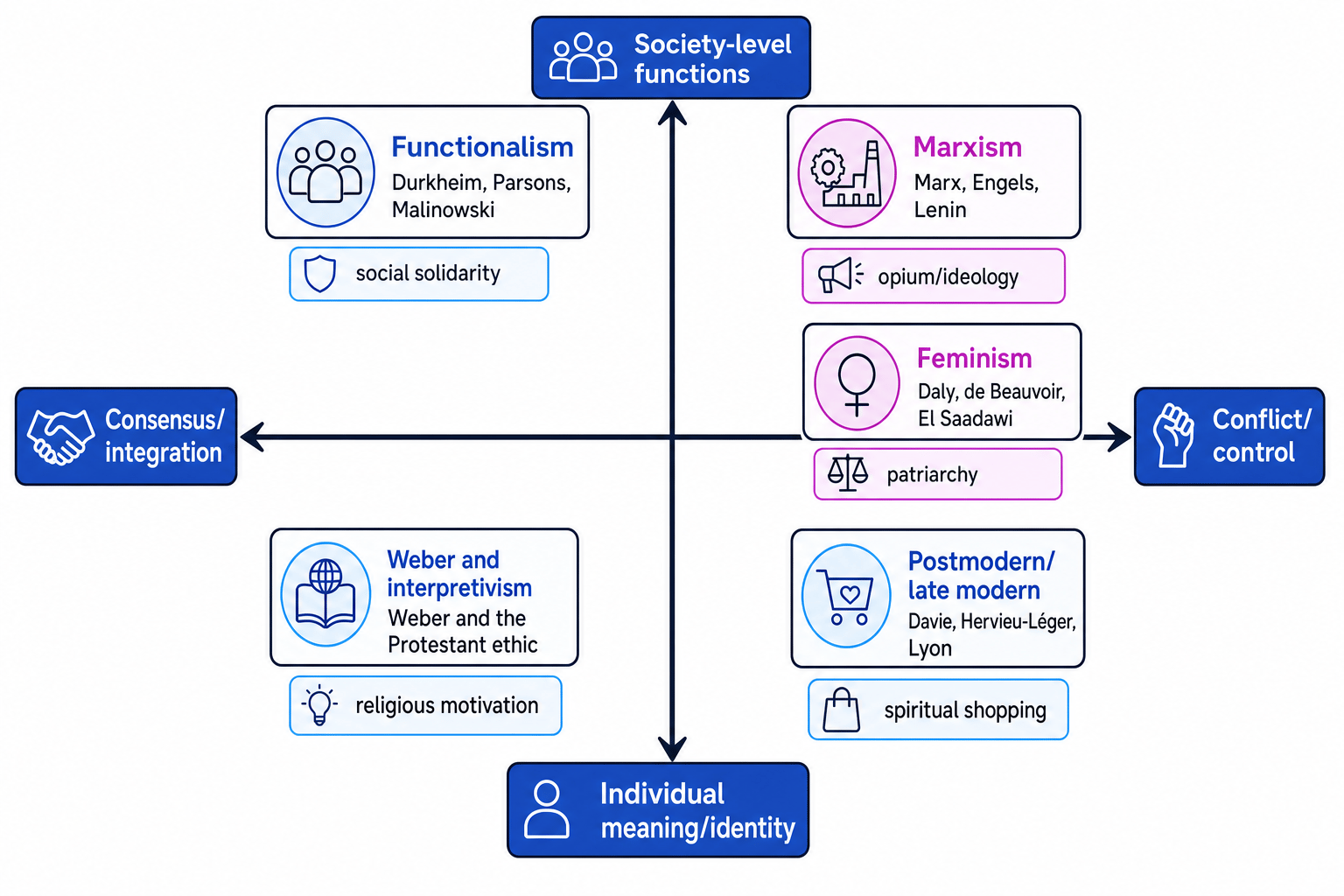
A good essay usually compares perspectives rather than listing them. The grid below helps you see how theories differ: some see religion as consensus and integration, while others see it as conflict and control; some focus on society-level functions, while others focus on individual meaning and identity.
Functionalism: religion as social glue
Functionalism
Functionalism is a consensus theory that sees society as a system of interdependent parts, such as family, education and religion, which help maintain social order.
Functionalists argue that religion helps create social solidarity, meaning a sense of unity and belonging. It also supports the collective conscience, which Durkheim defined as the shared moral beliefs and values that hold society together.
Durkheim, in The Elementary Forms of Religious Life (1912), studied totemism among Aboriginal Australian groups. He argued that when people worship sacred symbols, they are really worshipping society itself. Religion divides the world into the sacred — things treated as special and set apart — and the profane — ordinary everyday life.
Malinowski argued that religion helps people cope with uncertainty and life crises, such as death, illness or danger. Parsons argued that religion gives meaning to difficult experiences and reinforces core social values.
In contemporary UK society, functionalist ideas can be applied to events such as funerals, weddings, Remembrance Sunday, the 2023 Coronation, NHS chaplaincy, minutes of silence after tragedies, and faith-based charity work.
Applying functionalism to Remembrance Sunday
- Identify the ritual: Remembrance Sunday involves ceremonies, silence, poppies, hymns and public gatherings.
- Link it to solidarity: these shared symbols encourage people to feel part of a wider moral community.
- Explain the function: the ritual can strengthen collective memory, national identity and respect for sacrifice.
- Add evaluation: not everyone feels included in national rituals, so the same event may integrate some groups while marginalising others.
Assuming consensus is universal
Functionalists can overstate agreement. In a diverse society, religious and national rituals may not mean the same thing to everyone.
Marxism: religion as ideology and social control
Marxism
Marxism is a conflict theory that sees society as shaped by class inequality, especially the power of the capitalist ruling class over the working class.
Marxists argue that religion can work as ideology: a set of ideas that justifies the existing social order. Marx famously described religion as the “opium of the people”. He meant that religion can comfort the oppressed while distracting them from the real causes of their suffering.
For Marx, religion may encourage people to accept poverty or inequality by promising reward in the afterlife. Engels also saw religion as a way of easing suffering without challenging capitalism. Lenin called religion a kind of “spiritual gin”, suggesting that it dulls class consciousness.
In the UK, Marxists might point to links between religion and the establishment, such as bishops in the House of Lords, the monarch’s role as Supreme Governor of the Church of England, or religious messages that encourage obedience and patience.
However, religion does not always support the powerful. Liberation theology in Latin America used Christianity to criticise poverty and oppression. Religious movements have also supported civil rights, anti-racism, food banks and refugee support.
Religion can legitimate power or challenge it
A strong AO3 point is that religion is not automatically conservative. It can support ruling groups, but it can also inspire protest and social change.
Evaluating a Marxist view of religious charity
- Apply Marxism: a church food bank may reduce anger about poverty by helping people survive without challenging capitalism.
- Add a counterpoint: the same religious group might campaign against austerity, homelessness or low wages.
- Reach a balanced judgement: Marxism is useful for showing how religion may soften class conflict, but it underestimates religion’s potential as a source of resistance.
Feminism: religion and patriarchy
Patriarchy
Patriarchy means male dominance in society, including men’s greater power in families, religious organisations, politics and culture.
Feminists examine how religion can reproduce gender inequality. Many religions have historically had male leaders, male images of God, rules about women’s sexuality, and teachings that place women in caring or domestic roles.
Simone de Beauvoir argued that religion can compensate women for second-class status by promising spiritual reward. Mary Daly criticised Christianity as deeply patriarchal, arguing that male-centred religious language supports male power. El Saadawi argued that religion is often used to justify control over women’s bodies and sexuality, although she also stressed that patriarchy, not faith alone, is the key issue.
In contemporary society, debates about women priests, women bishops, female imams, abortion, contraception, modest dress and same-sex marriage all show how religion connects to gender and power. The Church of England first ordained women as priests in 1994 and consecrated its first woman bishop in 2015, showing both change and continuing debate.
However, feminists do not all see religion only as oppression. Linda Woodhead argues that religion can also give women identity, community and authority. For some women, religious dress or worship may be chosen as a form of belonging, dignity or resistance to sexualisation.
Evaluating a feminist argument about religious dress
- Apply a feminist concern: religious dress codes may be interpreted as controlling women’s bodies and sexuality.
- Add agency: some women may choose religious dress as an expression of identity, modesty, faith or resistance to racism.
- Consider power: the key issue is whether women have genuine choice, or whether family, community or institutional pressure limits that choice.
- Form a nuanced judgement: feminist analysis is strongest when it considers both patriarchy and women’s lived experiences.
Use intersectionality
When evaluating feminism, mention intersectionality: gender interacts with ethnicity, class, age and religion, so women’s experiences are not all the same.
Weber: religion as meaning and social change
Interpretivism
Interpretivism is an approach that focuses on meanings, motives and how people understand their own actions.
Weber argued that religion can shape social action. In The Protestant Ethic and the Spirit of Capitalism (1905), he claimed that Calvinist Protestant beliefs helped encourage disciplined work, saving and reinvestment. This supported the growth of modern capitalism.
Weber did not say religion was the only cause of capitalism. Instead, he suggested an elective affinity, meaning a close fit between certain religious values and economic behaviour.
Another useful Weberian idea is theodicy, which means a religious explanation for suffering or injustice. Theodicies help people make sense of pain, inequality or death.
In contemporary UK society, Weber’s approach can be applied to religiously motivated charity, ethical business, Islamic finance, Quaker business traditions, climate activism, Sikh langar, Christian Aid, Islamic Relief and CAFOD.
Using Weber to explain faith-based climate activism
- Identify the meaning: activists may see environmental care as a spiritual duty or stewardship of creation.
- Link meaning to action: this belief motivates protest, lifestyle change, fundraising or political campaigning.
- Evaluate the approach: Weber helps explain motivation, but wider factors such as media, law, class and political opportunity also shape activism.
Late modern views: choice, identity and diversity
Secularisation
Secularisation means a decline in the social significance of religion, shown through falling attendance, weaker religious authority or less influence over public life.
Contemporary UK society is more religiously diverse and less dominated by one church than in the past. The 2021 Census for England and Wales found that 46.2% identified as Christian, while 37.2% selected “No religion”. At the same time, minority religions such as Islam, Hinduism and Sikhism remain important sources of community and identity.
Grace Davie describes “believing without belonging”: people may hold religious or spiritual beliefs without regularly attending services. She also uses the idea of vicarious religion, where a small religious minority performs rituals on behalf of a wider population, such as funerals, national mourning or royal ceremonies.
Hervieu-Léger argues that religion in modern societies is often about individual choice, memory and identity. People may act as “spiritual shoppers”, selecting beliefs and practices that fit their lives. Lyon’s Jesus in Disneyland links religion to consumer culture, media and entertainment.
Interpreting Census data on religion
- Treat the Census carefully: it measures self-identified religion, not necessarily belief, attendance or strength of commitment.
- Apply it to secularisation: the rise of “No religion” supports the argument that traditional religious identity is declining.
- Add complexity: the same data also shows religious diversity, so religion may be changing form rather than simply disappearing.
- Evaluate validity: one person ticking “Christian” may mean regular church attendance, while another may mean family heritage or cultural identity.
Equating religion with church attendance only
Falling attendance may show institutional decline, but it does not prove that all belief, spirituality or religious identity has disappeared.
Religion, socialisation, culture and identity
Religion is an agent of socialisation, meaning it helps teach norms, values and identities. Families, faith schools, places of worship, youth groups and festivals can all transmit religious culture.
In the UK, religion can support ethnic and cultural identity, especially for some minority communities. For example, mosques, gurdwaras, churches and temples may provide language classes, welfare support, marriage networks, advice services and community leadership.
Religion also links to power and stratification. It may challenge inequality through charity and campaigning, but it may also reproduce inequalities of class, gender, sexuality or ethnicity. The Equality Act 2010 protects religion or belief as a characteristic, but debates continue around religious freedom, LGBTQ+ rights, gender equality and education.
Researching the role of religion
Sociologists use different methods to study religion. Surveys and official statistics, such as the Census or British Social Attitudes data, can show broad patterns and are often reliable and representative. However, they may lack validity because they cannot fully capture personal belief or spiritual meaning.
Interviews and ethnography can give richer insight into lived religion, identity and community. But they are usually smaller scale, harder to replicate and may face access issues, especially when researching private beliefs or closed religious groups.
In the exam
- Start with a clear judgement: religion may have several roles, so avoid saying it has only one function.
- Use named theorists precisely: Durkheim for solidarity, Marx for ideology, feminists for patriarchy, Weber for meaning and change, Davie for believing without belonging.
- Build AO3 throughout: compare perspectives, apply UK examples, and evaluate whether each theory still fits contemporary diverse society.
Check yourself
- How would a functionalist and a Marxist interpret the same religious charity project differently?
- Why might feminist sociologists disagree about whether religion is oppressive or empowering?
- What does “believing without belonging” suggest about religion in contemporary Britain?
