What you'll learn
- How functionalist, Marxist, feminist, postmodernist and New Right perspectives explain families and households.
- Key theorists and concepts you can use for AO1 knowledge.
- How to apply theories to contemporary UK family life for AO2.
- How to compare and criticise perspectives for AO3 evaluation.
Starting points: what is being explained?
A family is usually understood as a group of people connected by kinship, marriage, civil partnership, cohabitation, adoption or emotional commitment. A household is people living at the same address, whether or not they are related. This matters because sociologists do not only ask “what types of family exist?” They ask why family life takes particular forms and who benefits from those forms.
A nuclear family is a family made up of two parents and their dependent children. An extended family includes wider relatives such as grandparents, aunts, uncles or cousins. Other forms include lone-parent families, reconstituted families formed after separation and repartnering, same-sex families, cohabiting couples, single-person households and “living apart together” relationships.
Theoretical perspective
A theoretical perspective is a broad way of explaining social life: it gives you a set of assumptions about what matters most, such as social order, capitalism, patriarchy, individual choice or tradition.
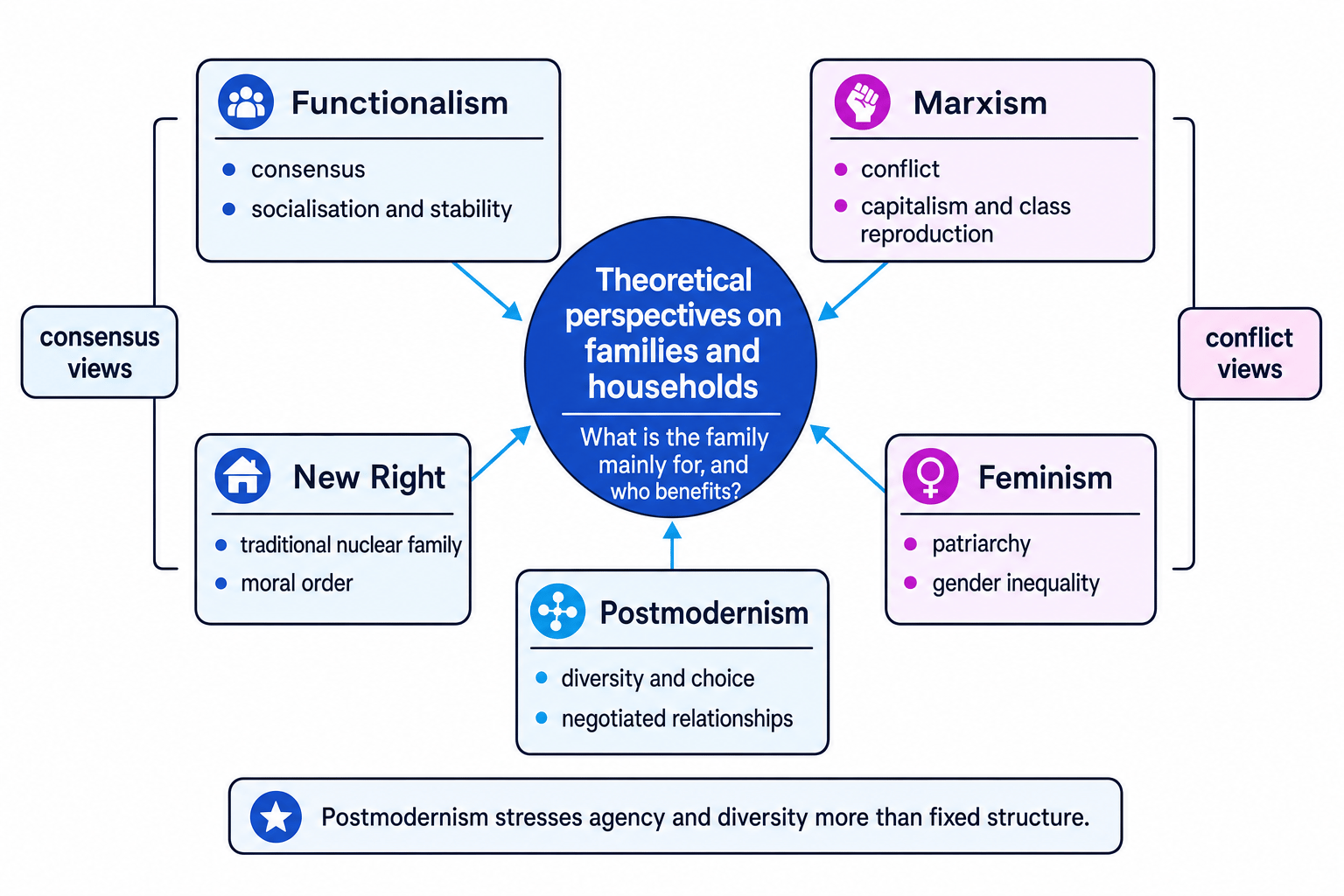
The diagram below maps the five perspectives you need for this sub-topic.
The big dividing lines
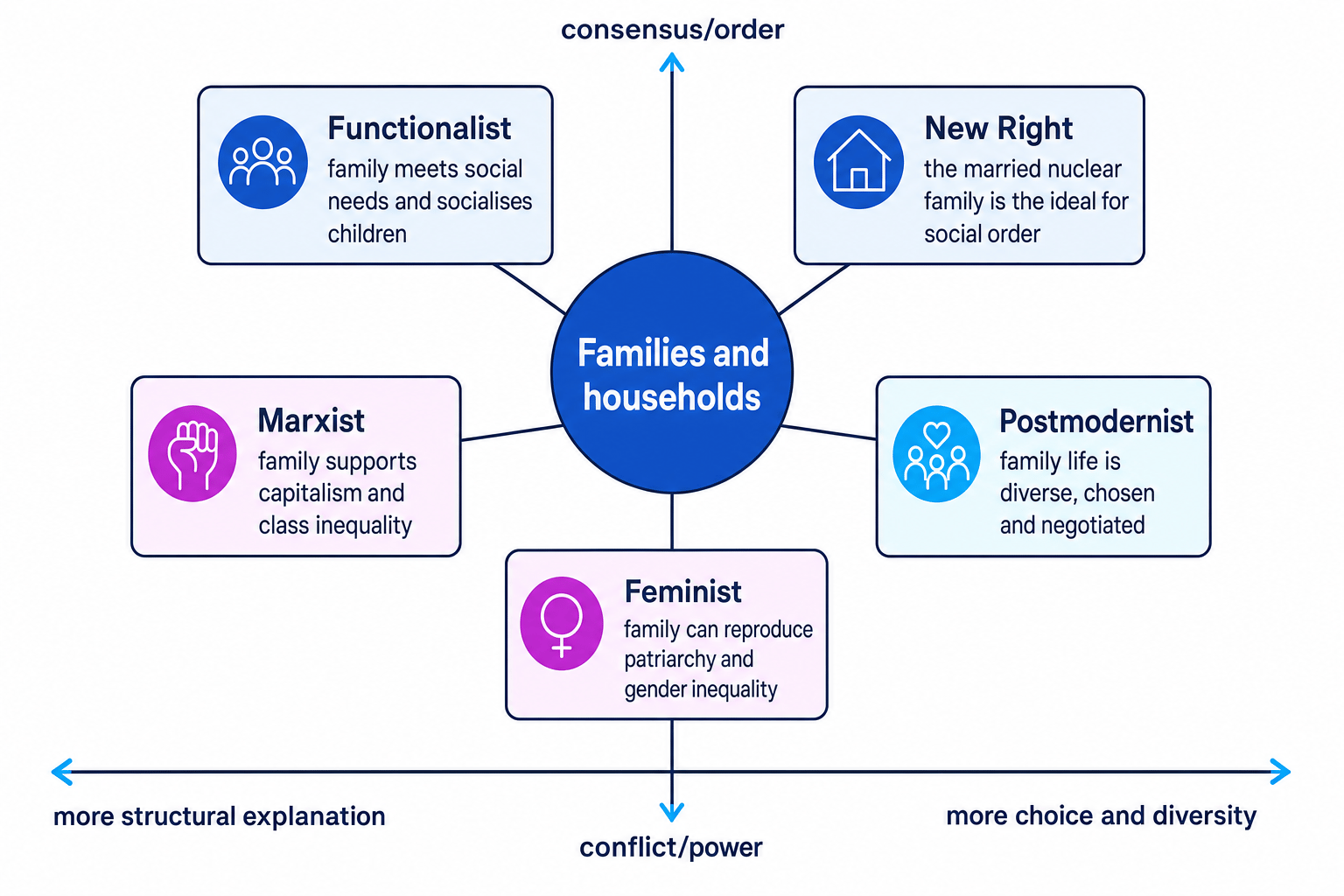
Two contrasts help you organise these theories.
A consensus theory sees society as held together by shared values and cooperation. A conflict theory sees society as shaped by inequality, power and competing interests.
A structural theory emphasises how institutions shape people’s behaviour. Agency means people’s capacity to make choices and create their own identities.
The main essay skill
Do not just list perspectives. Show how each one answers the same question differently: is the family mainly a source of stability, inequality, oppression, choice or moral order?
Interpreting cohabitation through different perspectives
-
Start with the same AO2 issue: many couples in the UK cohabit before marriage or instead of marriage, so family life is less automatically organised around legal marriage.
-
Apply a consensus view: a functionalist may ask whether cohabiting couples still provide socialisation, emotional support and economic cooperation, while a New Right writer is more likely to worry that weaker commitment may reduce stability for children.
-
Apply a conflict view: a feminist may ask whether cohabitation changes the gendered division of housework and childcare, while a Marxist may ask how housing costs and insecure work shape couples’ choices.
-
Add a postmodernist interpretation: cohabitation can be seen as evidence of individualisation, where people negotiate relationships rather than simply following tradition.
Functionalism: the family as useful for society
Functionalism is a consensus and structural perspective. It argues that social institutions, including the family, perform functions that help society survive.
George Murdock (1949) argued that the nuclear family is universal because it performs four essential functions: sexual regulation, reproduction, economic cooperation and education or socialisation. Socialisation means the process through which people learn norms, values, roles and identities.
Talcott Parsons (1955) argued that in industrial society the nuclear family has two “basic and irreducible” functions: primary socialisation of children and stabilisation of adult personalities, meaning emotional support for adults. Parsons also linked the nuclear family to industrialisation because a smaller family unit is geographically mobile and can move for work.
Ronald Fletcher (1966) argued that the modern family had not lost importance; rather, it performed its functions more effectively, helped by welfare, healthcare and education.
In AO2 terms, functionalists would point to families teaching language, manners, gender identities, religious traditions, national identity and everyday routines. During events such as COVID-19 lockdowns, families also became major sites of care, emotional support and home learning.
AO3 evaluation: functionalism can be criticised for presenting an idealised picture. It often ignores domestic abuse, gender inequality and conflict between generations. Feminists argue that Parsons’ “instrumental” male breadwinner role and “expressive” female caring role justify patriarchy. Historical evidence also challenges the idea that the nuclear family is timeless: family forms have always varied by class, region, ethnicity and life stage.
Functionalism is not just nostalgia
Functionalists focus on what families do for social order. The New Right are more openly moral and political, arguing that one particular family type should be promoted.
Marxism: the family as supporting capitalism
Marxism is a conflict and structural perspective. It sees society as organised around capitalism, an economic system where a wealthy ruling class owns the means of production and profits from workers’ labour.
Friedrich Engels (1884) argued that the monogamous family developed alongside private property. The family helped men pass property to legitimate heirs, so it supported class inequality and male control.
Louis Althusser described the family as part of the ideological state apparatus. An ideology is a set of ideas that makes inequality seem natural or acceptable. From this view, families teach children obedience, respect for authority and acceptance of hierarchy.
Eli Zaretsky (1976) argued that the family provides a “haven” from capitalism, but only in an illusory way. The family appears private and comforting, yet it also supports capitalism by reproducing workers and encouraging consumption.
AO2 examples include families buying homes, cars, holidays, toys and technology marketed as signs of a “good family life”. Inheritance, parental help with university or house deposits, and access to private tutoring can reproduce class advantage across generations.
AO3 evaluation: Marxism is powerful on power and stratification, especially class reproduction. However, it can be economically deterministic, meaning it reduces family life too much to capitalism. It may underplay love, care, personal meaning and cultural diversity. Feminists also argue that Marxists sometimes treat women’s oppression as secondary to class inequality.
Feminism: the family as a site of patriarchy
Feminism examines gender inequality. Patriarchy means a social system in which men as a group hold power over women as a group. Feminists do not all agree, but they share the view that family life can reproduce gender inequality.
Liberal feminists focus on legal equality and gradual reform. Ann Oakley (1974) argued that the “housewife” role is socially constructed rather than natural. Her research challenged the idea that women are naturally suited to domestic labour.
Marxist feminists connect women’s oppression to capitalism. Margaret Benston argued that women’s unpaid domestic labour benefits capitalism by maintaining the current workforce and raising the next generation of workers. Fran Ansley argued that wives may absorb men’s frustration from paid work, acting as a “safety valve” for capitalism.
Radical feminists see the family as a key site of male power. Christine Delphy and Diana Leonard (1992) argued that men benefit from women’s unpaid labour within the family. Radical feminists also highlight domestic abuse, sexual control and emotional labour.
Difference feminists argue that women’s experiences vary by class, ethnicity, sexuality, disability, age and migration status. For example, a middle-class professional woman, a working-class lone mother and a migrant grandmother in a multigenerational household may experience “family” very differently.
AO2 application is strong here. UK policies such as the Equal Pay Act 1970, Equality Act 2010, Shared Parental Leave 2015 and Domestic Abuse Act 2021 show that family and gender inequality are political issues, not just private matters. However, official equality does not automatically remove unequal unpaid care work.
AO3 evaluation: feminism is very useful for exposing hidden power inside the “private” family. Methodologically, Oakley’s qualitative interviews gave validity because they explored women’s lived experiences in depth. However, some feminist accounts can overgeneralise women’s oppression or underplay men’s changing roles, same-sex families and families where women hold significant economic power.
The New Right: the traditional nuclear family as ideal
The New Right is a conservative perspective that argues the married, heterosexual nuclear family is the best foundation for social order. It overlaps with functionalism in valuing stability, but it is more explicitly critical of family diversity.
Charles Murray argued that generous welfare can create dependency and an “underclass”, particularly criticising lone-parent families. Norman Dennis and George Erdos (1992) argued that father absence is linked to social problems because fathers provide discipline, role models and economic support.
AO2 links include political debates about welfare reform, child support, marriage tax allowances and concerns about educational underachievement or youth crime. New Right thinkers may view rising divorce, cohabitation and lone parenthood as evidence of moral decline.
AO3 evaluation: the New Right is often criticised for blaming individuals, especially lone mothers, while ignoring poverty, low wages, housing costs, domestic abuse and unequal access to childcare. A methodological issue is that statistics may show a correlation between lone parenthood and poorer outcomes, but this does not prove that lone parenthood causes those outcomes. Poverty may be the stronger factor.
Correlation is not causation
If a theory uses official statistics about family type and child outcomes, ask whether family structure itself is causing the outcome or whether class, income, housing, schooling and neighbourhood factors are involved.
Postmodernism: family diversity and choice
Postmodernism argues that contemporary society is marked by diversity, uncertainty and weaker traditions. In family life, this means people increasingly construct relationships through choice, negotiation and identity rather than simply following fixed rules.
Anthony Giddens argued that relationships are increasingly based on the pure relationship, where couples stay together because the relationship meets emotional needs rather than because of duty or tradition. Ulrich Beck and Elisabeth Beck-Gernsheim described the “normal chaos of love”: people seek intimacy, but relationships are less predictable because individuals have more choices. Judith Stacey argued that families are becoming more diverse and flexible, such as divorce-extended families. Jeffrey Weeks highlighted “chosen families”, especially among LGBTQ+ communities.
AO2 examples include same-sex marriage in England and Wales from 2014, increased cohabitation, reconstituted families, fertility treatment, surrogacy debates, online dating, transnational families and adults living with parents for longer because of housing costs.
AO3 evaluation: postmodernism is strong on diversity, identity and social change. However, it may exaggerate choice. Class, gender, ethnicity, disability, immigration status and housing markets still constrain what people can realistically do. Feminists would also argue that “choice” can hide unequal domestic labour.
Do not write ‘anything goes’
Postmodernists stress diversity and negotiation, but they do not mean people have unlimited freedom. Choices are still shaped by money, law, culture and power.
Quick comparison for essays
| Perspective | Core claim | Strong AO2 link | Main AO3 challenge |
|---|---|---|---|
| Functionalism | Family performs necessary functions for society | Primary socialisation and emotional support | Too positive; ignores conflict and diversity |
| Marxism | Family supports capitalism and class inequality | Inheritance, consumption, unpaid reproduction of labour | Reduces family life too much to economics |
| Feminism | Family can reproduce patriarchy | Gendered housework, childcare, domestic abuse policy | May overgeneralise women’s experiences |
| New Right | Married nuclear family is best for stability | Welfare, marriage and fatherhood debates | Blames family types rather than poverty |
| Postmodernism | Families are diverse, chosen and negotiated | Same-sex marriage, cohabitation, blended families | Overstates individual freedom |
Evaluating the nuclear family
-
Begin with the functionalist claim: the nuclear family can provide socialisation, emotional security and practical support, so it may contribute to social order.
-
Add the New Right comparison: New Right writers go further by treating the married nuclear family as morally preferable and warning that alternatives may create instability.
-
Challenge with conflict perspectives: feminists argue that the nuclear family can hide patriarchy, while Marxists argue that it reproduces class inequality through inheritance, consumption and labour power.
-
Weigh the argument using contemporary UK society: the nuclear family may work well for some people, but family outcomes depend heavily on resources, equality, safety and support, not simply on family structure.
In the exam
-
For AO1, name the perspective, define its key concept and use at least one theorist such as Parsons, Engels, Oakley, Murray or Giddens.
-
For AO2, apply the theory to a concrete UK example: cohabitation, divorce, same-sex marriage, welfare policy, unpaid care, inheritance or housing costs.
-
For AO3, compare perspectives directly: ask whether the theory overstates harmony, class, patriarchy, moral decline or individual choice.
Check yourself
- How would a functionalist and a Marxist explain the same nuclear family differently?
- Why might feminists criticise the idea that the family is a “private” institution?
- What is one strength and one weakness of the postmodernist view of family diversity?