What you'll learn
- What sociologists mean by youth culture and subculture.
- How the media, economic change and globalisation shape young people’s identities.
- Why class, gender and ethnicity affect access to youth cultures and how they are represented.
- How to evaluate this topic using named theorists, UK examples and research-methods awareness.
Start with the basics: what is a youth culture?
“Youth” is not just a biological age group. In sociology, youth is a socially constructed life stage between childhood and adulthood. What counts as “young” changes across time and society because education, work, law, family expectations and consumer culture all shape the transition to adulthood.
Youth culture
A youth culture is a shared set of meanings, norms, values, styles and practices associated with some young people. It may involve music, fashion, language, leisure spaces, online identities, political views or forms of resistance.
A subculture is a smaller group within wider society that has distinctive norms and values. For example, punks, ravers, goths, skaters, gamers, grime fans or K-pop fans can all be studied as subcultural or “scene-based” groups, depending on how fixed and organised they are.
The word formation matters. The topic is not just asking you to describe youth cultures; it asks you to explain why they emerge and what shapes them.
No single cause
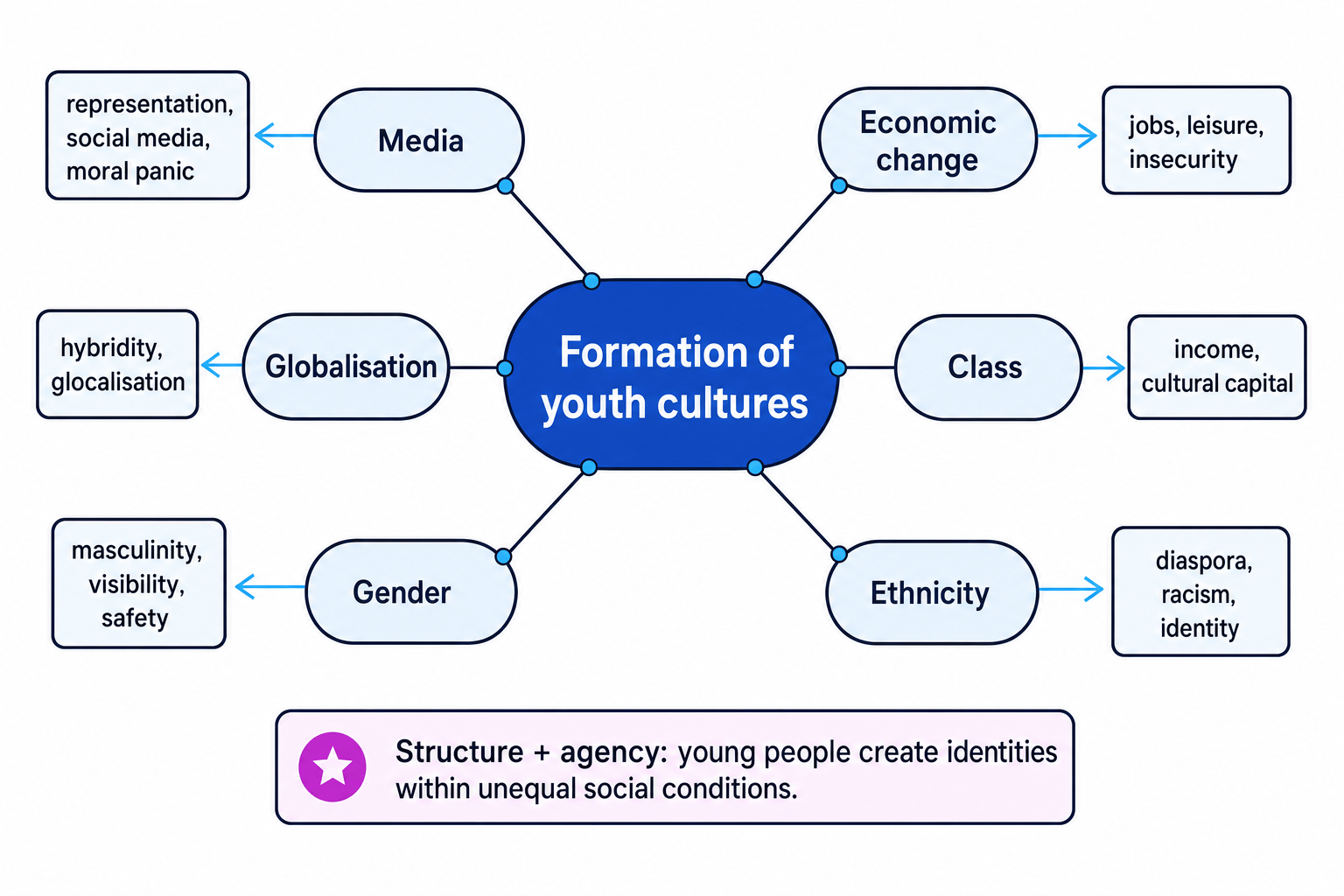
Youth cultures form through the interaction of structure — social forces such as class, racism, gender expectations and the economy — and agency — young people’s creativity, choices and identity work.
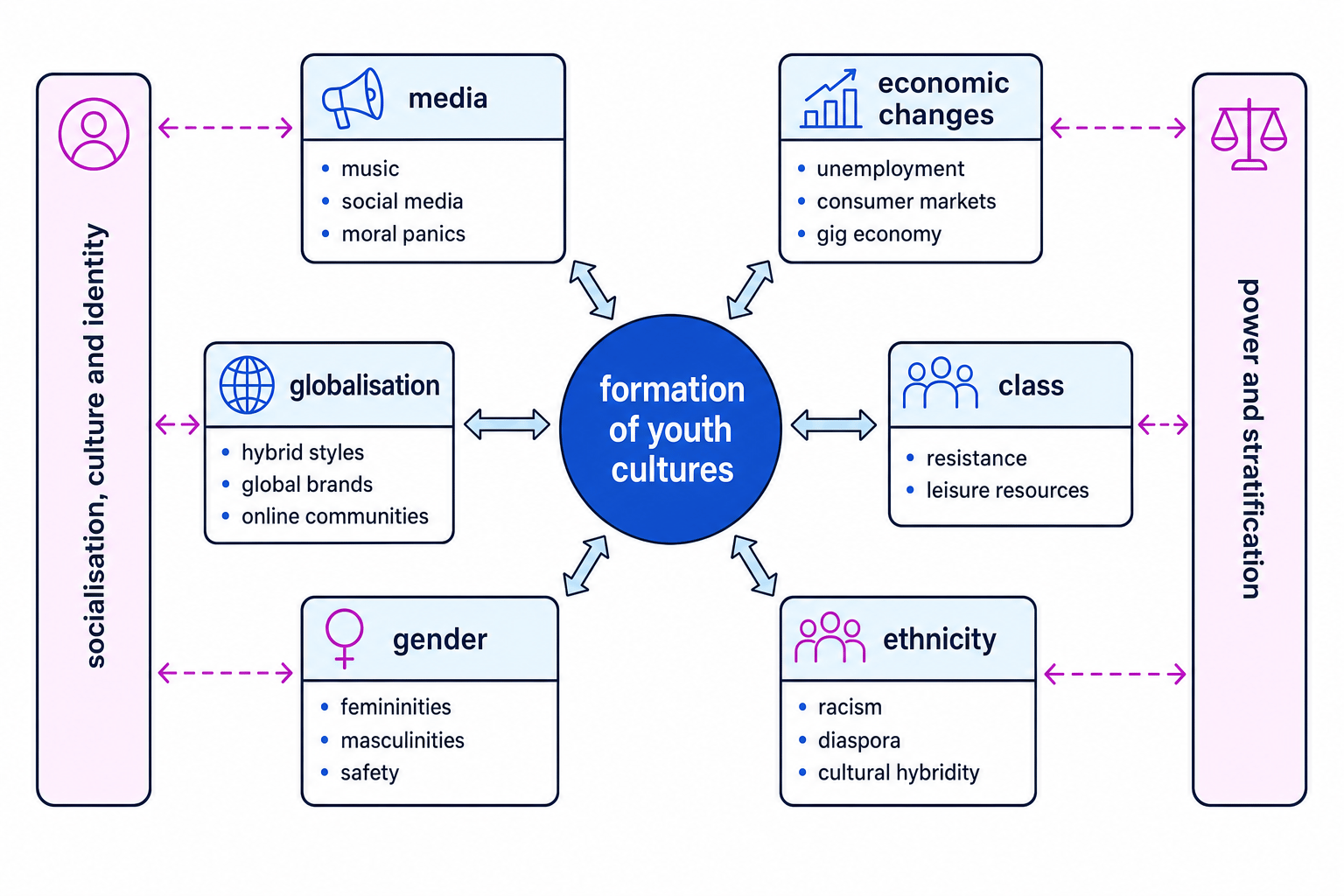
Use this map as a memory scaffold: each factor can shape youth cultures, but youth cultures can also influence wider media, markets, politics and public attitudes.
The main theoretical starting points
Functionalist views: youth culture as transition
Functionalists usually see society as based on consensus, meaning shared values and social order. Parsons argued that youth culture can act as a bridge between childhood dependency and adult roles. Eisenstadt (1956) similarly saw youth groups as helping young people move from family-based identities into adult society.
This gives you a useful AO1 point: youth cultures may help with socialisation, the process through which people learn norms, values and expected behaviour.
AO3 evaluation: this can be too harmonious. It underplays conflict, inequality and the fact that some youth cultures are formed partly in opposition to school, police, parents or employers.
Marxist and neo-Marxist views: youth cultures as resistance
The Centre for Contemporary Cultural Studies, or CCCS, studied spectacular working-class youth subcultures such as teddy boys, mods, skinheads and punks. Hall and Jefferson (1976), Phil Cohen (1972) and Hebdige (1979) argued that subcultures could be a form of symbolic resistance to class inequality, deindustrialisation and loss of community.
Hebdige used the idea of bricolage, where young people take existing objects and give them new meanings — for example, punk safety pins turning an everyday object into a sign of rebellion.
Willis (1977), in Learning to Labour, showed how working-class “lads” developed an anti-school culture. This gave them status among peers, but also helped reproduce their class position because they moved towards manual work.
AO3 evaluation: CCCS research is powerful for linking youth culture to class and power, but it has been criticised for focusing too much on white, male, spectacular subcultures and ignoring ordinary youth, girls and ethnic diversity.
Postmodern views: youth cultures as fluid lifestyles
Postmodernists argue that youth identities are now more flexible. Bennett (1999), drawing on Maffesoli’s idea of neo-tribes, suggests young people may move in and out of loose scenes rather than belonging permanently to one subculture. Thornton (1995) used the term subcultural capital to describe status gained from knowing the “right” music, clothes, language or venues.
This fits contemporary UK examples such as TikTok aesthetics, gaming communities, festival scenes, anime fandom, K-pop fandom and online micro-trends.
AO3 evaluation: postmodernism is useful for global and online youth cultures, but it can exaggerate choice. Not everyone has the same money, safety, internet access, leisure time or freedom from racism and sexism.
Structure plus agency
Strong essays avoid choosing between “young people freely choose styles” and “society determines everything”. The best answer usually shows how young people make creative choices within unequal social conditions.
Factor 1: the media
The media do more than report youth cultures. They can spread styles, create celebrity role models, connect young people online and label some groups as dangerous. Traditional media include newspapers, television and radio. New media include social media platforms, streaming sites, messaging apps and online forums.
Moral panic
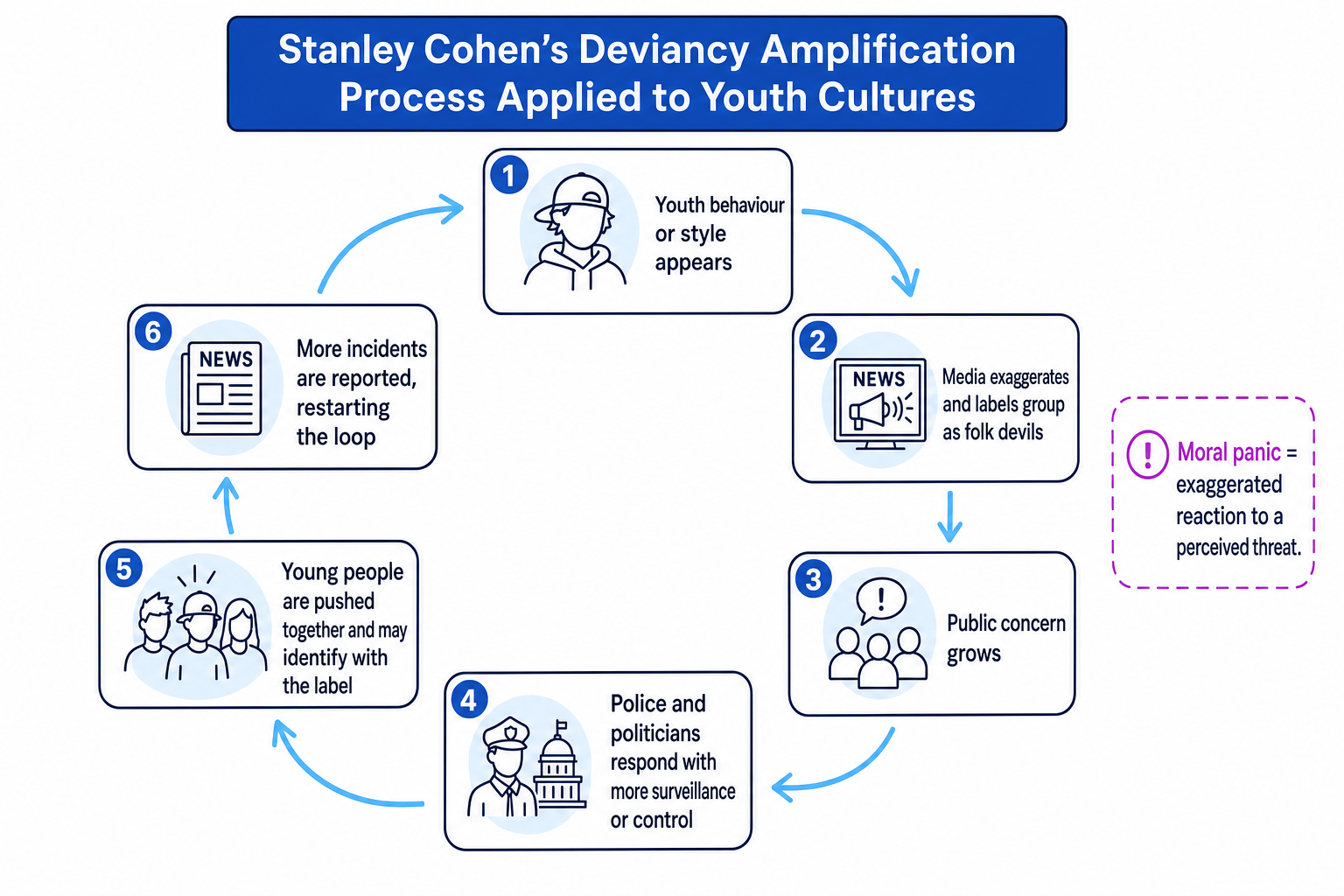
A moral panic is an exaggerated public reaction to a group or behaviour seen as a threat to social order. Stanley Cohen (1972) argued that the media turned mods and rockers into folk devils, meaning groups blamed for wider social problems.
Cohen’s idea also links to deviancy amplification, where labelling and control can make the behaviour seem more serious and may push young people further into the labelled identity.
Tracing deviancy amplification
- A youth style becomes visible in public, such as a music scene, fashion or gathering place.
- Media coverage selects dramatic examples and presents the group as threatening, so the issue appears larger than it may be.
- Public concern encourages police or political action, such as surveillance, dispersal powers or restrictions on venues.
- Some young people may feel rejected by mainstream society and identify more strongly with the group label, which can produce further reported incidents.
AO2 examples include UK press coverage of “hoodies”, rave culture, drill music, online challenges or “anti-social behaviour”. Policy links include the Criminal Justice and Public Order Act 1994, which targeted some rave gatherings, and later anti-social behaviour measures such as ASBOs and Public Spaces Protection Orders.
AO3 evaluation: media effects are not automatic. Young people are active audiences who may resist labels, use social media to create their own representations, or challenge racism and sexism online. However, platform algorithms and news values can still amplify stereotypes.
Factor 2: economic changes
Economic change shapes youth cultures by affecting work, money, leisure and hope for the future. In the post-war period, some young people had more disposable income, helping create a “teenage” consumer market for music, clothes, scooters, records and later clubbing.
Later changes such as deindustrialisation, youth unemployment, insecure work, student debt and the gig economy have shaped different youth identities. Furlong and Cartmel (1997) argue that late modern society can make life look like individual choice while class inequalities still structure young people’s opportunities. MacDonald and Marsh (2005), studying disadvantaged youth in Teesside, showed how insecure transitions between school, work, training and unemployment affected identity and local youth cultures.
AO2 examples include young people using side hustles, reselling trainers, creating content, working in delivery platforms, or joining low-cost online communities because some leisure spaces are expensive.
AO3 evaluation: economic factors are very important, but they do not mechanically create one youth culture. Young people in similar economic positions may respond differently depending on local area, gender, ethnicity, family support and media access.
Factor 3: globalisation
Globalisation
Globalisation is the increasing interconnectedness of societies through migration, trade, media, technology and cultural exchange.
Globalisation means youth cultures are rarely purely local. Hip-hop, K-pop, anime, streetwear, gaming, drill, dancehall and football fan cultures all move across borders. Robertson’s idea of glocalisation is useful: global cultural forms are adapted to local settings. For example, UK grime and UK drill draw on global Black Atlantic musical influences but develop distinctive local accents, slang, places and concerns.
Globalisation also produces cultural hybridity, where elements from different cultures mix. Diaspora communities — groups with connections to a homeland and a country of residence — may use youth culture to express complex identities, such as being British, Somali, Jamaican, Pakistani, Nigerian, Polish or mixed heritage.
AO3 evaluation: globalisation can expand identity choices, but it can also involve cultural appropriation, corporate branding and unequal power. Global brands profit from youth styles, while the young people who created those styles may still face poverty or policing.
Factor 4: class
Class affects youth cultures through income, education, housing, neighbourhood, leisure opportunities and relationships with authority. Bourdieu’s concepts are helpful here: cultural capital means valued knowledge, tastes and skills; habitus means deeply learned dispositions shaped by social background.
For example, a middle-class young person may have easier access to paid music lessons, private study space, festivals, travel or university scenes. A working-class young person may develop youth cultures around local estates, street spaces, free online platforms, football, grime, cars or mutual support networks — though you must avoid simplistic stereotypes.
CCCS writers saw working-class subcultures as symbolic resistance to class inequality. Postmodernists challenge this by arguing styles now cross class boundaries quickly through online consumption.
AO3 evaluation: class still matters, but it often works alongside other factors. A wealthy young person can buy streetwear associated with working-class or racialised cultures, but that does not mean they experience the same policing, housing conditions or labour-market insecurity.
Factor 5: gender
Gender
Gender refers to socially constructed expectations about masculinity, femininity and other gender identities. It is different from biological sex, although societies often connect the two.
McRobbie and Garber (1976) argued that girls were often invisible in classic subcultural research because researchers focused on public, male-dominated street cultures. They suggested girls’ youth cultures were more likely to be organised around bedrooms, magazines, friendship and music because of parental control, domestic expectations and safety concerns.
Connell’s idea of hegemonic masculinity helps explain why some male youth cultures value toughness, risk-taking, heterosexual status or control of public space. However, contemporary youth cultures also include feminist, LGBTQ+, non-binary and online communities that challenge traditional gender expectations.
AO2 examples include young women’s participation in gaming, football and music scenes; girls using TikTok or Instagram for style and activism; and LGBTQ+ youth finding support through online networks.
AO3 evaluation: do not portray girls only as passive victims or boys as all the same. Gender is shaped by class, ethnicity, sexuality, religion, disability and locality.
Factor 6: ethnicity
Ethnicity refers to cultural identity linked to ancestry, language, religion, history and shared traditions. Sociologists also study racialisation, the process through which groups are given meanings based on perceived “race”.
Hall et al. (1978), in Policing the Crisis, argued that Black youth were constructed through a media and political panic about “mugging” during a period of economic crisis. Gilroy (1993) showed how Black Atlantic cultures connect music, identity and resistance across national borders. Research on Asian youth, such as Alexander (2000), warns against simplistic stereotypes such as the “Asian gang”.
Ethnicity can shape youth cultures through racism, diasporic identity, religion, language, music, food, fashion and policing. UK examples include grime, drill, bhangra, modest fashion, anti-racist activism and hybrid slang in multicultural urban areas.
Avoid stereotyping
Never write as if all young people from one ethnic group share the same youth culture. Ethnicity intersects with class, gender, religion, migration history, region and individual agency.
Bringing the factors together: intersectionality
Intersectionality
Intersectionality, associated with Crenshaw, means that social divisions such as class, gender and ethnicity overlap. A young person’s experience cannot be understood by examining only one identity in isolation.
Analysing UK drill as a youth culture
- Start with media: YouTube, TikTok and streaming platforms spread music, visual style and slang, while some news coverage frames drill as a threat.
- Add economic and class context: lyrics and identities may reflect deprivation, exclusion, local conflict and limited opportunities, though not every participant has the same background.
- Add globalisation and ethnicity: UK drill adapts influences from US drill, Caribbean sounds, African diasporic cultures and local British urban identities.
- Add gender: some performances draw on hegemonic masculinity, but women, LGBTQ+ listeners and wider audiences may participate in different ways.
- Evaluate: a postmodern view highlights online choice and scene participation, while structural approaches remind you that poverty, racism, policing and platform power limit that choice.
Treating factors as separate
In essays, avoid writing six disconnected paragraphs. The strongest answers show interaction: for example, media labels may intensify policing, which may affect ethnic minority working-class boys more than middle-class youth.
How sociologists study youth cultures
Youth cultures are often studied using ethnography, interviews, observation, media analysis and official statistics. Ethnography, such as Willis’s research, can produce high validity because it explores meanings from the inside. However, it may have small samples, access problems and ethical issues, especially with minors or illegal activity.
Media analysis can reveal patterns of representation, but it cannot prove how audiences interpret messages. Official statistics on youth unemployment, education, crime or deprivation can show structural patterns, but they may miss identity, meaning and informal culture.
A strong methods evaluation considers:
- Practical issues: access to groups, time, cost, sampling and online anonymity.
- Ethical issues: consent, confidentiality, harm, safeguarding and researcher responsibility.
- Theoretical issues: positivists may prefer reliable patterns; interpretivists may prefer valid understanding of lived experience.
In the exam
- Define the factor clearly, then link it directly to the formation of youth cultures.
- Use named evidence: for example, Cohen on moral panics, Willis on class, McRobbie and Garber on gender, or Thornton on subcultural capital.
- Apply to contemporary UK society with a concrete example such as drill, gaming, TikTok trends, raves, grime, festival culture or anti-racist activism.
- Evaluate by comparing perspectives: structural theories explain inequality, while postmodern theories explain fluid choice and online scenes.
- Keep returning to the two big themes: socialisation, culture and identity and power and stratification.
Check yourself
- How might the media both create opportunities for youth identity and produce moral panics?
- Why is class still relevant even when youth styles spread globally online?
- How would an intersectional approach improve an essay on gender or ethnicity in youth cultures?