What you'll learn
- How social change has affected relationships between partners, parents, children and wider kin.
- Why sociologists disagree about whether family life has become more equal.
- How to use named studies such as Parsons, Young and Willmott, Oakley, Duncombe and Marsden, Finch and Mason, and Dobash and Dobash.
- How to build AO1, AO2 and AO3 into essay-style answers.
Starting point: family relationships and social change
In Sociology, family relationships means the patterned ways people in families interact: their roles, responsibilities, emotional expectations, power, care, conflict and support. A household is one person or a group of people living at the same address; not all households are families, and not all family relationships happen inside one household.
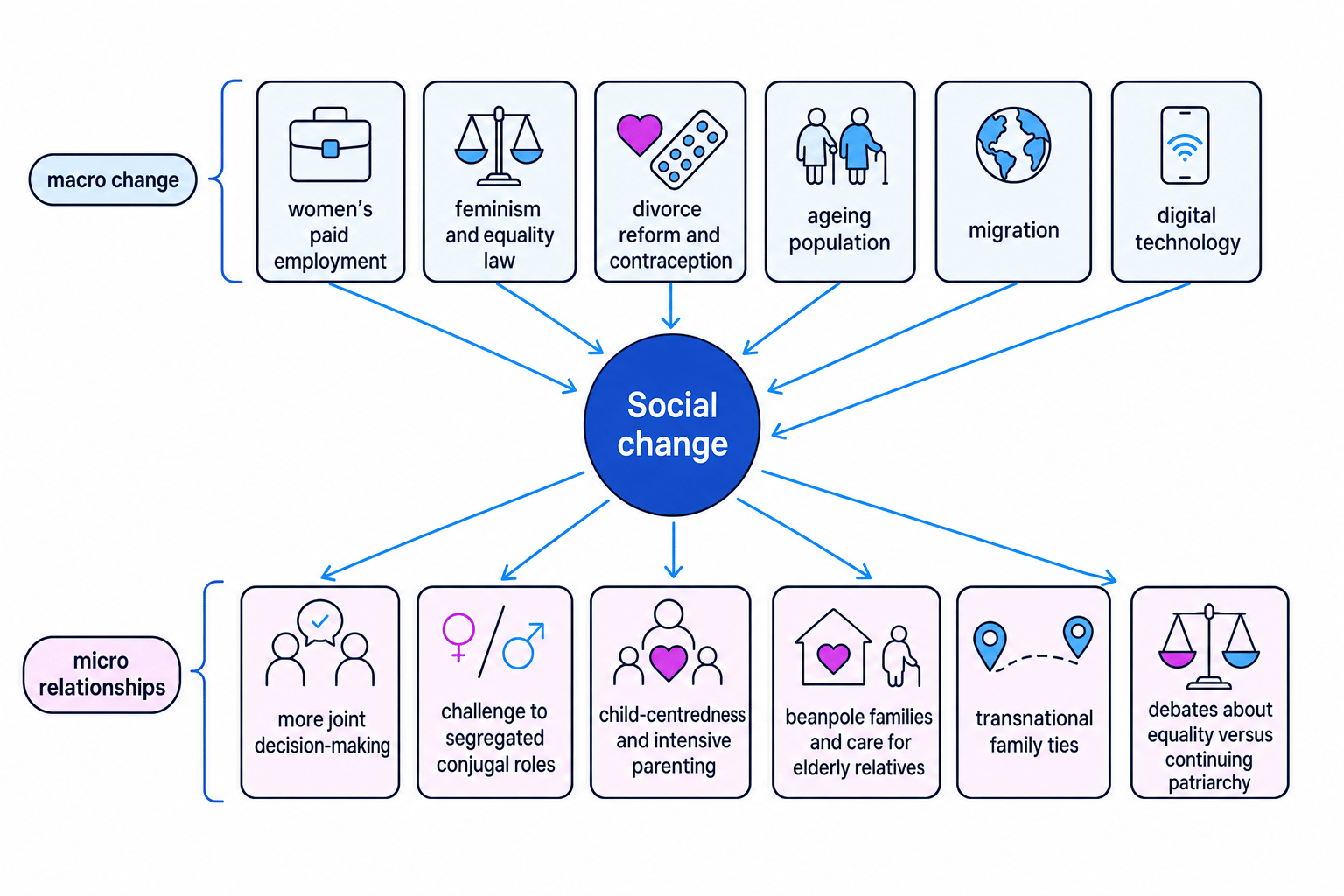
Social change means long-term shifts in society’s institutions, laws, norms, values, technology and economic arrangements. For this topic, you need to connect big social changes — such as women’s employment, divorce law, feminism, contraception, ageing and digital technology — to everyday family life.
Family relationships with reference to social change
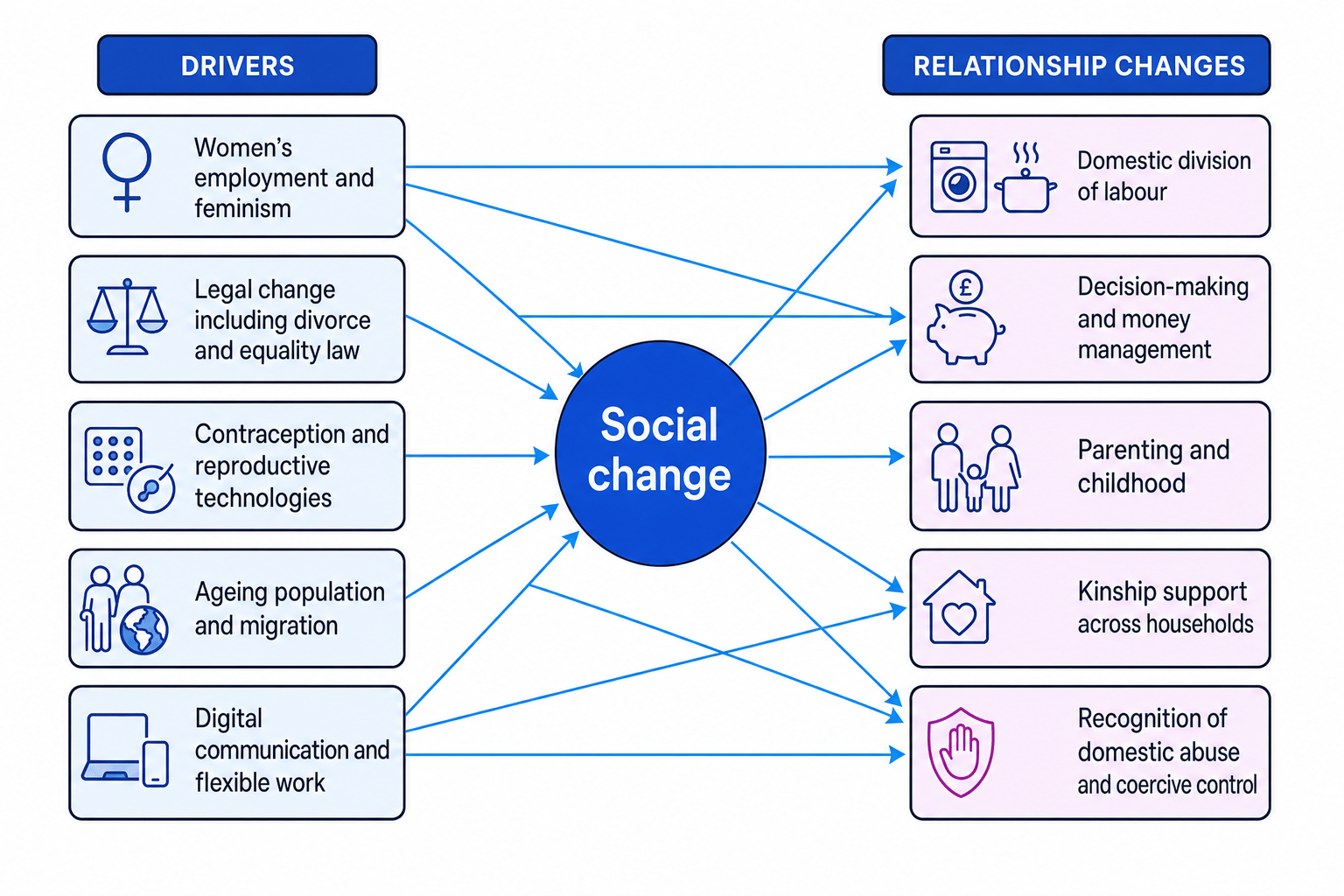
This topic asks you to explain how relationships inside and around families have changed over time, and to evaluate whether those changes have produced greater equality, choice and emotional fulfilment — or whether old inequalities of gender, class, age and power continue.
Think micro and macro
A strong answer links macro-level change — law, work, welfare, gender norms, technology — to micro-level relationships — housework, childcare, money, intimacy, authority and care.
Conjugal roles: partners, work and housework
Conjugal roles are the roles carried out by partners in a marriage or cohabiting relationship. They include paid work, housework, childcare, emotional support and decision-making.
Functionalist sociologist Parsons argued that the modern nuclear family worked best with segregated conjugal roles: men performed the instrumental role of breadwinner, while women performed the expressive role of caring and emotional support. This reflects a traditional gendered division of labour.
However, social change has challenged this. Women’s increased paid employment, feminism, contraception, divorce reform and equality legislation — such as the Equal Pay Act 1970, Sex Discrimination Act 1975 and Equality Act 2010 — have all weakened the idea that women should automatically be dependent housewives.
Young and Willmott argued that the family was moving towards the symmetrical family, where partners share housework, childcare and leisure more equally. They linked this to rising living standards, smaller families and a more home-centred lifestyle.
Symmetrical family
A symmetrical family is a family in which partners’ roles become more similar, with more joint decision-making, shared domestic tasks and shared leisure.
Feminist sociologist Oakley criticised Young and Willmott for exaggerating equality. In The Sociology of Housework (1974), she found that men’s “help” was often limited and irregular. Later research by Duncombe and Marsden argued that many women experience a triple shift: paid work, housework/childcare, and emotion work — the labour of managing feelings and relationships.
Evaluating the symmetrical family claim
-
Start with the claim: Young and Willmott argue that social change has made partners’ roles more equal, especially through women’s paid work and smaller families.
-
Test it against feminist evidence: Oakley found that men’s participation in housework was often overstated, so “helping” is not the same as equal responsibility.
-
Add a contemporary application: in many UK dual-earner households, both partners may work, but women often still take more responsibility for childcare, school communication and organising family life.
-
Reach a balanced judgement: family roles have changed, but change does not automatically mean equality; gender norms and economic inequalities still shape who does what.
Change is not the same as equality
Do not write as if women entering paid work automatically made family life equal. It may create a dual burden, where women do paid work and still do more unpaid domestic labour.
Money, decision-making and power
Power means the ability to influence others, control resources or shape decisions. In families, power can appear in obvious decisions, such as where to live, and hidden decisions, such as who feels entitled to leisure time.
Studies by Edgell found that husbands were more likely to make major decisions about finance, moving house and cars, while wives made more routine decisions about food and children’s clothing. Pahl and Vogler studied money management and distinguished between systems such as the allowance system, where one partner gives the other a set amount, and pooling, where income is shared.
Social change has altered this because more women have their own earnings and bank accounts. However, income gaps, motherhood penalties and part-time work mean financial power is still unequal in many households.
AO2 examples include debates around Shared Parental Leave 2015, which aimed to let parents divide leave more equally, but uptake has been limited partly because fathers often earn more and workplaces may still treat mothers as the “natural” carers.
Domestic abuse and coercive control
Domestic relationships are not always supportive. Domestic abuse includes physical violence, sexual abuse, emotional abuse, economic abuse, intimidation and coercive control. Coercive control means a repeated pattern of domination, isolation and monitoring that restricts someone’s freedom.
Radical feminists argue that domestic abuse reveals the family as a site of patriarchy, meaning male power over women. Dobash and Dobash (1979) argued that violent husbands often used violence when wives challenged male authority, showing that abuse is connected to gendered power rather than just individual “bad temper”.
Social change has increased public recognition of abuse. Important policy changes include the Serious Crime Act 2015, which criminalised coercive control in England and Wales, and the Domestic Abuse Act 2021, which strengthened the legal definition of domestic abuse.
Recorded abuse is not the same as real levels of abuse
If police-recorded domestic abuse rises, this may mean more reporting, better recording or changed definitions — not necessarily that abuse itself has increased. Use official statistics carefully.
Methodologically, domestic abuse is difficult to research. Surveys such as the Crime Survey for England and Wales can identify patterns, but victims may under-report because of fear, shame or dependence. Interviews may produce richer validity, but researchers must manage confidentiality, consent and risk of harm.
Parent-child relationships and child-centredness
Child-centredness means children are seen as emotionally precious, needing protection, investment and care. Sociologists such as Ariès argued that childhood is socially constructed: ideas about what children need vary across history and culture.
Modern UK families are often more child-centred because of smaller family sizes, compulsory education, child protection law, contraception and changing parenting norms. The Children Act 1989 emphasised children’s welfare, while schools, health visitors and social services increased state involvement in family life.
However, child-centredness can create pressure, especially on mothers. Intensive parenting means parents are expected to invest large amounts of time, money and emotion into children’s development. This links to stratification: middle-class parents may have more resources for tutoring, activities and technology, while working-class families may be judged more harshly by professionals.
Kinship, care and support beyond the household
Kinship means family connections through blood, marriage, partnership or social recognition. Social change has not simply destroyed extended family ties; it has often reorganised them.
Finch and Mason argued that family responsibilities are negotiated over time. People do not automatically help relatives; they build obligations through past relationships, affection, need and practical possibility. This is useful for analysing modern families because support may cross households through childcare, money, lifts, emotional support and digital contact.
An ageing population has also produced more beanpole families: long, thin family structures with more living generations but fewer siblings, aunts and uncles. Grandparents may provide childcare, while adults may also care for elderly parents — sometimes called the sandwich generation.
Migration and technology also reshape kinship. Families may be transnational, maintaining relationships across countries through remittances, WhatsApp, video calls and visits. This shows that household boundaries do not capture all family relationships.
Diversity, identity and chosen relationships
Social change has widened public recognition of family diversity. The Civil Partnership Act 2004, Marriage (Same Sex Couples) Act 2013 and equality law have changed the legal status of LGBTQ+ relationships.
Sociologists such as Weeks discuss families of choice, where people build supportive networks through friendship, partnership and community rather than only through biology or marriage. Dunne’s research on lesbian households suggested that some same-sex relationships may divide domestic labour more equally because they are less tied to traditional male breadwinner/female homemaker roles.
AO3 evaluation is important: greater legal recognition does not remove all inequalities. Homophobia, poverty, housing insecurity, racism and immigration status can still limit people’s choices.
Big sociological debate: more equality or continuing inequality?
Functionalists tend to emphasise adaptation. Parsons saw specialised roles as useful for social stability, while Young and Willmott saw family relationships becoming more companionate and symmetrical.
Feminists are more critical. Liberal feminists point to progress through education, employment and law, but radical feminists highlight patriarchy, domestic abuse and unpaid labour. Marxist feminists add that unpaid domestic labour benefits capitalism by reproducing the workforce cheaply.
Late modern theorists such as Giddens and Beck argue that relationships are increasingly based on choice, negotiation and intimacy rather than fixed tradition. Giddens describes the pure relationship, where people stay together because the relationship meets emotional needs. But critics argue that “choice” is easier for people with money, secure housing and supportive communities.
A strong essay line
Use this judgement often: family relationships have changed, but the extent and experience of change varies by gender, class, ethnicity, sexuality, age and access to resources.
Researching family relationships
Evidence on family relationships comes from interviews, time-use studies, official statistics and surveys. Each has strengths and weaknesses.
- Official statistics from the Census or ONS are large-scale and useful for trends, but categories may hide meanings and inequalities inside households.
- Time-use diaries can show who does housework and childcare, but people may forget tasks or under-record emotional labour.
- Qualitative interviews can reveal feelings, conflict and meanings, but samples are often smaller and access to private family life can be difficult.
- Ethical issues are especially important when researching children, domestic abuse or financial dependence.
In the exam
-
Build each paragraph around a clear relationship: partners, parents and children, money, abuse, or kinship.
-
Link every study to social change: explain what changed in society and how it affected family life.
-
Evaluate with balance: show progress, then test it using gender, class, ethnicity, sexuality, age or methodological limitations.
Check yourself
- How would Oakley criticise Young and Willmott’s idea of the symmetrical family?
- Why might domestic abuse statistics be difficult to interpret sociologically?
- In what ways can family relationships exist beyond one household?