What you'll learn
- How functionalist, Marxist, interactionist, feminist, New Right and postmodernist perspectives explain education.
- How to apply each theory to UK education examples such as exams, league tables, subject choice and school labels.
- How to evaluate theories using AO3 comparison, evidence and research-methods critique.
- How the themes of socialisation, culture, identity, power and stratification run through education essays.
First: what is a theoretical perspective?
Theoretical perspective
A theoretical perspective is a broad way of explaining social life. It tells you what to focus on, what questions to ask, and what kind of evidence seems important.
In education, perspectives ask questions like: Do schools bring society together? Do they reproduce inequality? Do teachers’ labels shape pupils’ identities? Do schools reflect patriarchy?
A social institution is a major organised part of society, such as the family, education, religion or the economy. Education is an institution because it helps organise socialisation, qualifications, work, citizenship and identity.
Two axes that help you compare theories
A consensus theory sees society as held together by shared values. A conflict theory sees society as shaped by struggles between unequal groups.
A macro theory focuses on large-scale structures such as capitalism, patriarchy or the education system. A micro theory focuses on face-to-face interaction, meanings and everyday classroom processes.
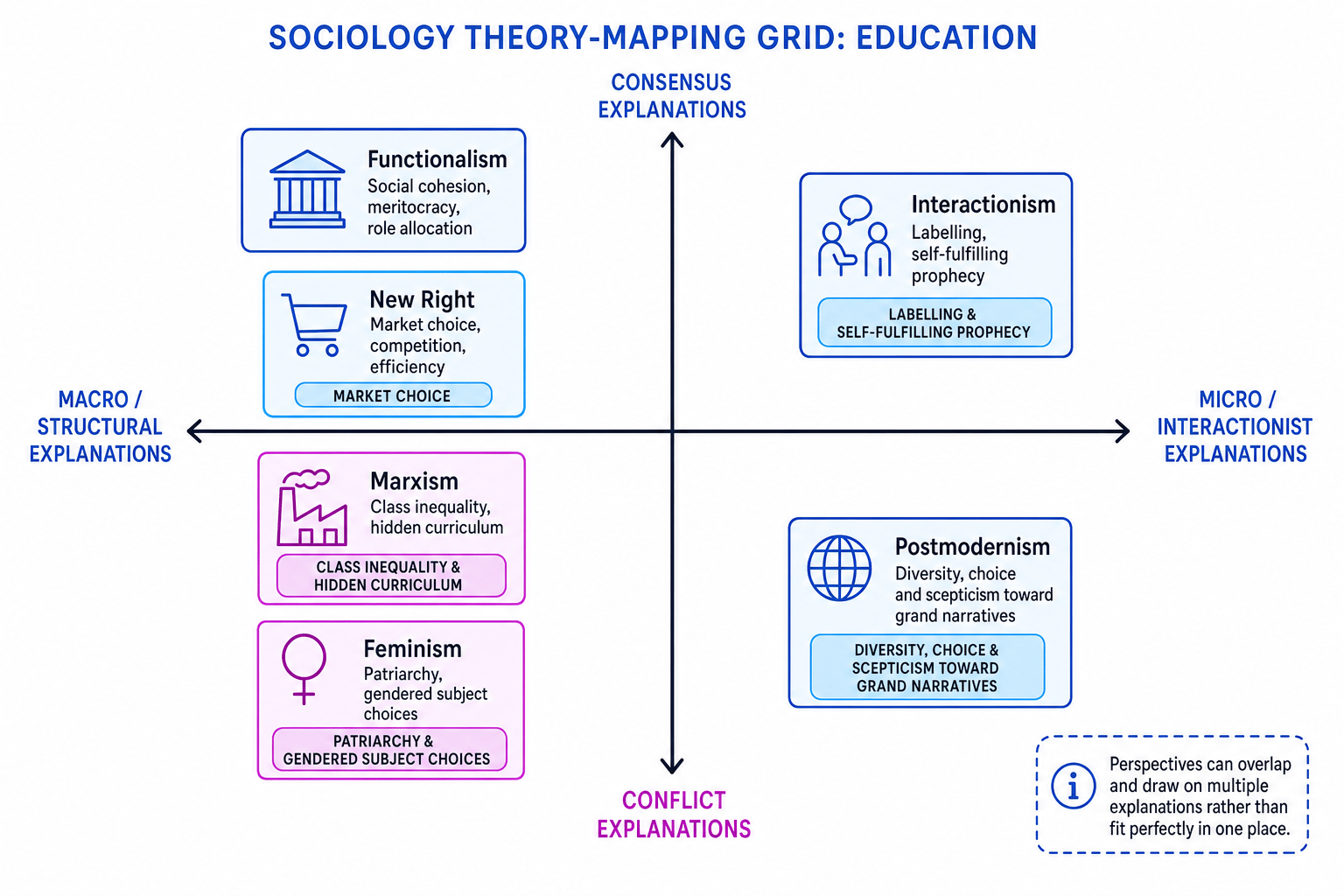
The diagram below maps the main perspectives. It is a simplification, but it helps you see what each theory tends to emphasise.
Placing a perspective on the map
- Decide whether the theory mainly sees education as helping society work or as serving unequal power interests. Functionalism stresses shared values, so it fits closer to consensus.
- Decide whether the explanation focuses on the whole system or everyday classroom meanings. Functionalism focuses on institutions and society, so it is macro.
- Combine the two judgements: functionalism belongs near macro-consensus, while interactionism belongs nearer the micro side because it studies labels, meanings and pupil identities.
Functionalism: education creates social order
Functionalists see education as a positive institution that helps society work smoothly. Durkheim argued that schools create social solidarity, meaning a sense of belonging to a wider community. This happens through shared rules, assemblies, citizenship education and a common curriculum.
Parsons argued that schools are a bridge between the family and wider society. In families, children may be judged by particularistic standards, meaning standards based on personal relationships. In school, they are judged by universalistic standards, meaning the same rules are supposed to apply to everyone.
Meritocracy
A meritocracy is a system where people are rewarded according to talent, effort and achievement rather than inherited privilege.
Davis and Moore argued that education helps with role allocation, meaning sorting people into the jobs most suited to their abilities. Qualifications are treated as evidence of skill.
AO2 examples include GCSEs, A levels, university entry, apprenticeships, behaviour policies and citizenship lessons. Functionalists would argue these help prepare young people for adult roles.
Applying functionalism to qualifications
- Link qualifications to the social need for skilled workers: modern societies need doctors, engineers, teachers, carers and technicians.
- Explain that exams appear to use universalistic standards because pupils sit the same assessments and receive formal grades.
- Apply role allocation: higher grades open access to more selective routes, such as university courses or competitive apprenticeships.
- Evaluate the claim by asking whether all pupils really compete equally, given class differences in tutoring, housing, school funding and parental knowledge.
AO3: Functionalism is useful for explaining why education seems important for social cohesion and employment. However, it can be too positive. Marxists, feminists and interactionists argue that schools do not treat everyone equally and often reproduce inequalities of class, gender and ethnicity.
Marxism: education reproduces class inequality
Marxists see education as linked to capitalism, an economic system based on private ownership, profit and class inequality. The ruling class are the powerful owners and employers who benefit most from this system.
Althusser argued that education is an ideological state apparatus, meaning it spreads ideas that make inequality seem normal or fair. Bowles and Gintis argued that schools prepare pupils for capitalist workplaces through the correspondence principle: school routines mirror workplace routines, such as hierarchy, punctuality, obedience and external rewards.
Hidden curriculum
The hidden curriculum means the unofficial lessons pupils learn at school, such as obedience, competition, gender expectations, punctuality and acceptance of authority.
Bourdieu argued that middle-class pupils often possess more cultural capital, meaning valued knowledge, language, tastes and habits that schools recognise as “high ability”. Willis studied working-class “lads” and found they resisted school authority, but this resistance still led them towards working-class jobs.
Analysing the hidden curriculum
- Start with a school routine, such as strict uniform checks or silent corridors.
- Ask what unofficial lesson it teaches. A Marxist might say it trains pupils to accept authority and external discipline.
- Connect that lesson to the workplace: many jobs require punctuality, rule-following and acceptance of managers’ power.
- Evaluate by adding agency: pupils and teachers may challenge rules, and some school routines may also support safety and learning.
Marxism is not a conspiracy theory
Do not write as if individual teachers are secretly plotting for capitalism. Marxists usually argue that the structure of education reproduces inequality, often without people consciously intending it.
AO3: Marxism is strong on power and stratification, especially class inequality. But it can be economically deterministic, meaning it may overstate how far capitalism controls education. Evidence of working-class success, anti-racist education, critical thinking and teacher resistance complicates the theory. Methodologically, studies such as Willis’ ethnography offer high validity but are based on small samples.
Interactionism: labels shape school careers
Interactionism is a micro perspective focusing on everyday meanings and interactions. In education, it explores how teachers and pupils create identities through labels.
Labelling
Labelling means attaching a meaning or category to someone, such as “bright”, “troublemaker”, “lazy” or “gifted”, which can affect how others treat them and how they see themselves.
Becker argued that teachers may judge pupils against an “ideal pupil” image. Rosenthal and Jacobson found that teacher expectations could influence pupil progress, a process called the self-fulfilling prophecy. Hargreaves showed how streaming can shape pupil subcultures and identities.
Tracing a self-fulfilling prophecy
- A teacher sees a pupil as “low ability” because of previous grades, behaviour or setting.
- The pupil receives less demanding work, fewer questions or less encouragement, which changes their classroom experience.
- The pupil may internalise the label and lower their own expectations, affecting effort and confidence.
- Later results appear to “confirm” the original label, even though the label helped produce the outcome.
AO2 examples include predicted grades, behaviour points, special educational needs categories, gifted-and-talented schemes and setting. AO3: Interactionism is excellent for analysing identity and everyday classroom life. However, it can underplay structural inequalities such as poverty, racism and patriarchy. Many interactionist studies use observation, which can produce rich validity but may have smaller samples and observer effects.
Feminism: education and patriarchy
Feminists focus on gender inequality and patriarchy, meaning social systems where men as a group hold more power than women as a group.
Earlier feminist work criticised male dominance in classrooms, textbooks and subject choices. Spender argued that boys often received more teacher attention. Stanworth studied gendered teacher expectations. Kelly explored how science education could feel male-dominated. More recent writers such as Francis, Archer and Mirza examine gender alongside class, ethnicity and identity.
Feminists disagree with each other. Liberal feminists emphasise progress through equal opportunities, such as the Equality Act 2010 and girls’ improved attainment. Radical feminists stress ongoing male power, including sexual harassment and control of girls’ bodies. Intersectional feminists argue that gender cannot be separated from class, ethnicity, religion, sexuality and disability.
Explaining gendered subject choices
- Identify the pattern: fewer girls may choose some STEM subjects, while fewer boys may choose care-related subjects.
- Apply gender socialisation: pupils may learn from family, media and peers which subjects are seen as “masculine” or “feminine”.
- Add school processes: teacher expectations, peer pressure and curriculum examples can reinforce or challenge these ideas.
- Evaluate with change: girls’ high attainment and women entering professions show progress, but subject segregation and harassment show patriarchy has not disappeared.
AO3: Feminism is strong on power, identity and culture. A limitation is that some accounts can treat “girls” and “boys” as internally similar groups. Intersectional approaches improve this by showing how, for example, middle-class girls, working-class boys, Black Caribbean pupils or Muslim girls may experience school differently.
New Right: choice, competition and standards
The New Right is a conservative and neoliberal perspective. It agrees with functionalism that education should create social order, but argues that state schools improve when parents have choice and schools compete.
Marketisation
Marketisation means making public services work more like a market, using competition, choice, league tables and performance measures.
Chubb and Moe argued that parental choice and competition raise standards. UK policy examples include the Education Reform Act 1988, the National Curriculum, league tables, Ofsted inspections, academies and free schools.
New Right thinkers argue that schools should be accountable and efficient. Parents act like consumers, choosing the “best” schools, while weaker schools are pressured to improve.
Reading league tables through two lenses
- From a New Right view, league tables give parents information, helping them choose schools and encouraging competition.
- From a Marxist view, league tables may advantage middle-class families who can move house, understand admissions systems or pay for tutoring.
- Compare the assumptions: the New Right assumes fair consumer choice, while Marxism asks who has the power and resources to use that choice.
- Evaluate using evidence: choice may raise pressure on schools, but it can also encourage cream-skimming, teaching to the test and unequal access.
AO3: Critics such as Ball and Gewirtz argue that marketisation benefits middle-class parents, who often have more cultural and economic capital. New Right theory can also ignore poverty, special educational needs, local housing markets and unequal access to transport.
Postmodernism: diversity, choice and uncertainty
Postmodernists argue that society is increasingly diverse, fragmented and shaped by choice, media and rapid change. Lyotard described postmodernism as scepticism towards grand narratives, meaning big theories that claim to explain society as a whole, such as Marxism or functionalism.
In education, postmodernists point to flexible learning routes, online education, lifelong learning, identity choice, vocational qualifications, multicultural curricula and changing work patterns. Education is not just about producing workers; it is also about constructing identities.
Using postmodernism to analyse online learning
- Identify the educational change: pupils and adults can learn through online courses, videos, apps and blended learning.
- Apply diversity and choice: learners can build personalised pathways rather than following one fixed school-to-work route.
- Link to identity: people may use education to reshape themselves, retrain or join new communities.
- Evaluate materially: digital access, quiet study space and parental support are unequal, so class and power still matter.
AO3: Postmodernism is useful for contemporary education because society is more diverse than in the past. However, Marxists and feminists argue it can underplay continuing structural inequalities. Qualifications, school reputation, class background, gendered expectations and racism still shape life chances.
Pulling the theories together
The big comparison
Functionalism and the New Right usually see education as potentially beneficial for society. Marxism and feminism focus on how education reproduces inequality. Interactionism zooms in on classroom processes. Postmodernism questions whether one single theory can explain education today.
For essay writing, keep linking theory to the two big Eduqas themes:
- Socialisation, culture and identity: schools transmit values, labels, gender norms, class cultures and national identity.
- Power and stratification: schools can open opportunities, but they can also reproduce class, gender and ethnic inequalities.
Build evaluative paragraphs
A strong paragraph usually does three jobs: AO1 explains the theory or study, AO2 applies it to education, and AO3 evaluates it by comparison, evidence, method or contemporary relevance.
In the exam
- Start each theory paragraph with a clear claim, such as “Marxists argue that education reproduces class inequality.”
- Use at least one named theorist or study per major perspective, then apply it to a concrete education example such as setting, exams, league tables, subject choice or Ofsted.
- Evaluate throughout: compare perspectives, question evidence, mention methodological limits, and consider whether the theory still fits contemporary UK education.
Check yourself
- Which perspectives see education mainly as a source of social order, and which see it mainly as a source of inequality?
- How would a Marxist, an interactionist and a feminist each explain underachievement differently?
- Why might marketisation increase standards for some pupils but deepen inequality for others?