What you'll learn
- The main roles the media plays in contemporary UK society.
- Key models of media effects, from passive audience theories to active audience approaches.
- How moral panics, new media and globalisation connect to power, culture and identity.
- How to evaluate media theories using evidence, examples and methodological critique.
1. Starting point: what counts as “the media”?
Before you can analyse the media’s role, you need to be clear about what “media” means. In sociology, the media is not just “the news”. It includes the institutions, technologies and messages through which information, entertainment and culture are produced and circulated.
Media and audience
- Media refers to channels of communication such as television, newspapers, radio, film, advertising, websites, streaming platforms and social media.
- Mass media means media that can reach large audiences, such as the BBC, ITV, The Sun, Netflix or TikTok.
- An audience is the group of people receiving, interpreting or interacting with media content.
In contemporary society, media is woven into everyday life. You may receive breaking news on your phone, learn political opinions through social media, build identity through music and fashion content, and watch global entertainment on streaming platforms.
2. The main roles of the media
The media has several important social roles. These are useful for essay introductions because they show that the media is not just about “effects” — it is also about socialisation, culture, identity, power and stratification.
Informing and educating
The media gives people information about politics, crime, health, the economy and global events. For example, UK audiences may rely on BBC News, Sky News, newspapers, podcasts or social media to understand elections, NHS strikes or the cost-of-living crisis.
Socialisation and identity
Socialisation is the process through which people learn norms, values and expected behaviour. Media contributes to this by showing repeated images of gender, class, ethnicity, age, sexuality and nationality.
For example, representations of masculinity in sport, femininity in beauty advertising, or “Britishness” in royal events can shape how people understand themselves and others.
Entertainment and consumer culture
Media provides entertainment through film, sport, gaming, celebrity news and streaming. It also supports consumer culture, where identity is linked to buying goods, brands and lifestyles.
Political role and power
The media can act as a watchdog, holding powerful groups to account. Investigative journalism can expose political scandals or corporate wrongdoing. However, sociologists also ask: who owns the media, whose voices are heard, and whose interests are protected?
Media as a constructor of reality
The media does not simply reflect society like a mirror. It selects, frames and repeats certain versions of reality, so it can influence what people see as normal, threatening, desirable or important.
Applying media roles to a news item
Imagine a news story about rising food bank use in the UK.
- Apply the information role: the media may report statistics, interview charities and explain links to wages, benefits and inflation.
- Apply the identity role: coverage may shape how audiences see people in poverty — as deserving support, personally irresponsible, or victims of wider inequality.
- Apply the power role: you can ask whose voices dominate: politicians, experts, food bank users, campaigners or newspaper columnists.
- Evaluate the framing: different outlets may frame the same issue differently, for example as a welfare problem, an economic crisis or a failure of government policy.
3. Models of media effects
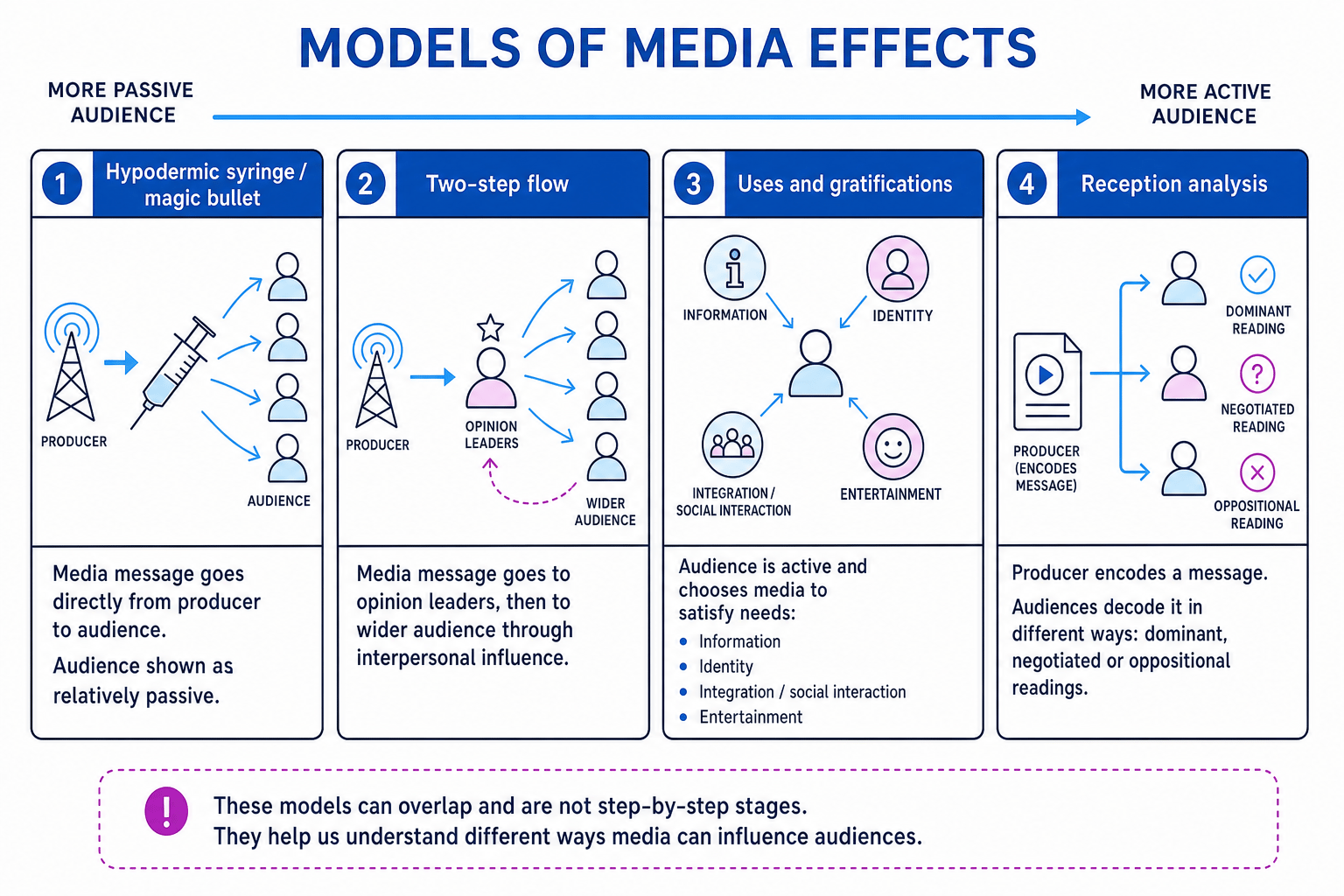
A media effects model is a theory about how media messages influence audiences. The big debate is whether audiences are mainly passive, meaning easily influenced, or active, meaning they interpret and use media in their own ways.
The hypodermic syringe model
The hypodermic syringe model, also called the magic bullet model, suggests that media messages are injected directly into passive audiences. It assumes people absorb the same message in the same way.
This model is often linked to early concerns about propaganda, advertising and media violence. For example, a simple hypodermic argument might claim that violent video games directly cause violent behaviour.
AO3 evaluation: this model is easy to understand but too deterministic. It ignores social class, gender, ethnicity, family background, education, peer groups and individual interpretation.
Social learning theory
Bandura’s social learning theory suggests people may learn behaviour by observing role models, especially if those behaviours appear rewarded. His Bobo doll experiments are often used in debates about media violence.
AO3 evaluation: laboratory experiments can be reliable because they are controlled, but they may lack validity because real-life media use is more complex than children watching a short clip in an artificial setting.
Cultivation theory
Gerbner argued that long-term exposure to television can gradually shape people’s worldview. This is called cultivation theory. For example, heavy exposure to crime dramas and crime news might make audiences believe society is more dangerous than it really is.
AO2 application: this can be linked to fear of crime. Older people may fear street crime even when official statistics show they are less likely to be victims than some younger groups.
Two-step flow model
Katz and Lazarsfeld’s two-step flow model argues that media influence often passes through opinion leaders. These are people who interpret media messages and influence others, such as journalists, celebrities, influencers, religious leaders or politically engaged friends.
This model is useful today because social media influencers often filter news, fashion, health advice or political content for their followers.
Uses and gratifications model
Katz, Blumler and Gurevitch developed the uses and gratifications model, which sees audiences as active. People choose media to satisfy needs such as:
- Information — finding out what is happening.
- Personal identity — exploring who they are.
- Integration and social interaction — feeling connected to others.
- Entertainment — relaxation, escapism and enjoyment.
Reception analysis
Hall’s reception analysis argues that media producers encode messages, but audiences decode them in different ways. A dominant reading accepts the intended message, a negotiated reading partly accepts it, and an oppositional reading rejects it.
Morley’s study of audiences watching Nationwide found that readings varied depending on social background and occupation. This shows that class, culture and identity affect interpretation.
Choosing a media-effects model
Suppose a young person sees political content about a UK general election on TikTok.
- Test a passive model: if the answer claims the video directly changes their vote, that fits a hypodermic-style argument, but it may be too simplistic.
- Apply two-step flow: if the young person trusts the creator because they are an influencer or admired public figure, the content may influence them through opinion leadership.
- Apply uses and gratifications: if they actively follow politics content to gain information or express identity, this shows audience choice.
- Apply reception analysis: if they agree with some points but reject others because of their class, values or family background, this is a negotiated reading.
Treating one model as the only answer
Do not write as if the hypodermic syringe model is “what the media does”. In stronger essays, you compare models and explain that media influence depends on context, audience characteristics and wider social power.
4. Moral panics and folk devils
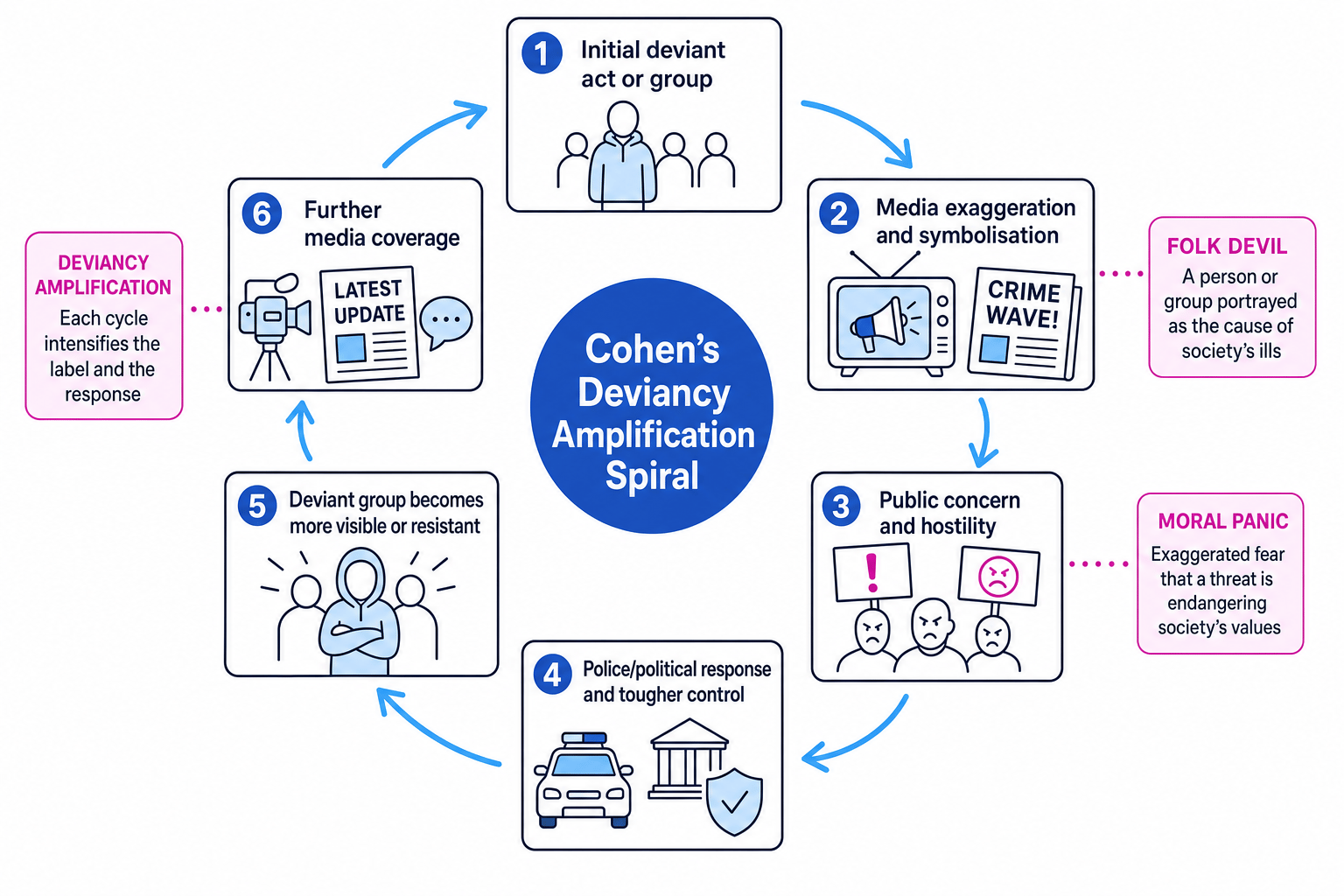
A moral panic happens when a person, group or behaviour is portrayed as a serious threat to society’s values. The group blamed for the threat is called a folk devil.
Cohen’s classic study Folk Devils and Moral Panics (1972) examined media coverage of Mods and Rockers. He argued that the media exaggerated youth disorder, creating public fear and encouraging stronger social control.
Deviancy amplification
Deviancy amplification means media attention and official reaction can make deviance worse by increasing visibility, labelling and hostility. This links to labelling theory: once a group is labelled deviant, they may be treated suspiciously and pushed further into that identity.
Hall et al. in Policing the Crisis (1978) argued that the 1970s “mugging” moral panic helped distract from capitalism’s economic and political crisis. This is a Marxist view because it links media panic to ruling-class power and social control.
Tracing a moral panic about drill music
Take media concern about drill music and youth violence.
- Identify the folk devil: young, often working-class and racialised male artists may be presented as symbols of danger.
- Identify exaggeration or symbolisation: headlines may treat lyrics, clothing or music videos as evidence of a wider “crime wave”.
- Identify social control: police, politicians or platforms may respond through video removals, surveillance or restrictions on performances.
- Evaluate the explanation: a strong answer asks whether the panic ignores structural causes such as poverty, exclusion, racism, school exclusion and lack of youth services.
AO3 evaluation: moral panic theory is powerful because it links media, labelling and social control. However, not every public concern is automatically a moral panic. Some risks, such as online child exploitation or extremist grooming, are real; the sociological question is whether media coverage is proportionate and whose interests it serves.
5. New media and globalisation
New media and globalisation
New media refers to digital, interactive and networked media such as social media, streaming, smartphones, search engines and online gaming. Globalisation is the increasing interconnectedness of societies across national borders.
New media has changed the role of the media because audiences are no longer only consumers. They can also be producers through posts, videos, livestreams, memes, reviews and podcasts. This is sometimes called user-generated content.
Jenkins describes this as participatory culture, where fans and users create, remix and share content. Castells argues that we live in a network society, where power operates through global information networks.
Global culture and identity
McLuhan’s idea of the global village suggests media connects people across the world. UK audiences can follow Korean pop music, American politics, Premier League football, Bollywood, anime or global climate activism in real time.
This can produce cultural mixing, but it can also raise concerns about cultural imperialism, where powerful Western or American media companies dominate global culture.
Algorithms, platforms and power
An algorithm is a set of automated rules used by platforms to sort, recommend or hide content. Algorithms shape what people see on TikTok, YouTube, Instagram, Google and X.
Zuboff uses the term surveillance capitalism to describe how technology companies collect user data and turn it into profit through targeted advertising and prediction.
AO2 application: in the UK, debates around the Online Safety Act 2023 show concerns about harmful content, misinformation, abuse and platform responsibility. Ofcom now has an expanded role in regulating online safety.
Audiences are active, but not equally powerful
New media gives users more choice and voice, but this does not mean everyone has equal power. Platforms, algorithms, ownership, digital skills, social class and regulation still shape what people can access and say.
6. Perspectives on the media’s role
Pluralist view
Pluralists argue the media reflects audience demand. Because audiences have choice, media companies must provide varied content. From this view, new media increases democracy by allowing citizen journalism, online campaigning and alternative voices.
AO2 example: campaigns such as #MeToo, Black Lives Matter and Marcus Rashford’s free school meals campaign show how digital media can amplify voices and pressure governments.
Marxist view
Marxists argue the media often supports capitalist interests. Owners, advertisers and elite sources have more power to shape content. Herman and Chomsky’s propaganda model argues that media filters encourage support for dominant political and economic interests.
AO3 evaluation: this explains ownership and ideology well, but can underestimate audience resistance and the diversity of digital media.
Feminist view
Feminists examine how media represents gender and reinforces patriarchy. They may criticise sexualised images of women, online misogyny, abuse of women in public life and narrow beauty standards.
However, feminists also note that new media can support resistance, such as feminist blogs, survivor testimony and online campaigns against harassment.
Postmodern view
Postmodernists argue that media-saturated society blurs reality and representation. Baudrillard used the idea of hyperreality, where signs and images can feel more real than reality itself.
AO2 example: celebrity culture, influencer lifestyles and edited online identities can make it difficult to separate authentic life from performance.
7. How sociologists study media influence
Sociologists use different research methods to study media. Content analysis examines patterns in media texts, such as how often certain groups appear in news stories. Surveys can measure audience attitudes. Interviews and focus groups can explore how people interpret media. Digital trace data can examine likes, shares and platform behaviour.
Each method has strengths and weaknesses. Content analysis can be reliable if categories are clear, but it may miss the meanings audiences attach to texts. Interviews can produce valid insight into interpretation, but samples may be small and less representative. Studying online communities raises ethical issues around consent, privacy and harm.
Easy AO3 method link
When evaluating media effects, ask: does the evidence prove causation, or only correlation? For example, a link between violent media use and aggression does not automatically prove that media caused the aggression.
8. Pulling it together for essays
For Eduqas essays, avoid a one-sided answer. The best line of argument is usually balanced: the media can influence audiences, but audiences also interpret and use media actively. New media has increased participation, but power inequalities remain.
A strong essay might argue:
- media informs and socialises people;
- media can create effects, especially through agenda-setting, cultivation and moral panics;
- audiences are active and interpret messages differently;
- global digital media creates new opportunities and new forms of control;
- power, ownership, algorithms and inequality shape whose voices are heard.
In the exam
- Use named theories precisely: link Cohen to moral panics, Hall to reception analysis, Katz and Lazarsfeld to two-step flow, and Katz, Blumler and Gurevitch to uses and gratifications.
- Apply to contemporary UK examples: use social media, Ofcom, the Online Safety Act, streaming, elections, misinformation, influencers or campaigns such as #MeToo.
- Evaluate throughout: compare passive and active audience models, consider methodological problems, and link media power to class, gender, ethnicity and age.
Check yourself
- Can you explain the difference between the hypodermic syringe model and reception analysis?
- How does Cohen’s concept of moral panic link media coverage to social control?
- In what ways has new media increased audience power, and in what ways do platforms still control users?
