What you'll learn
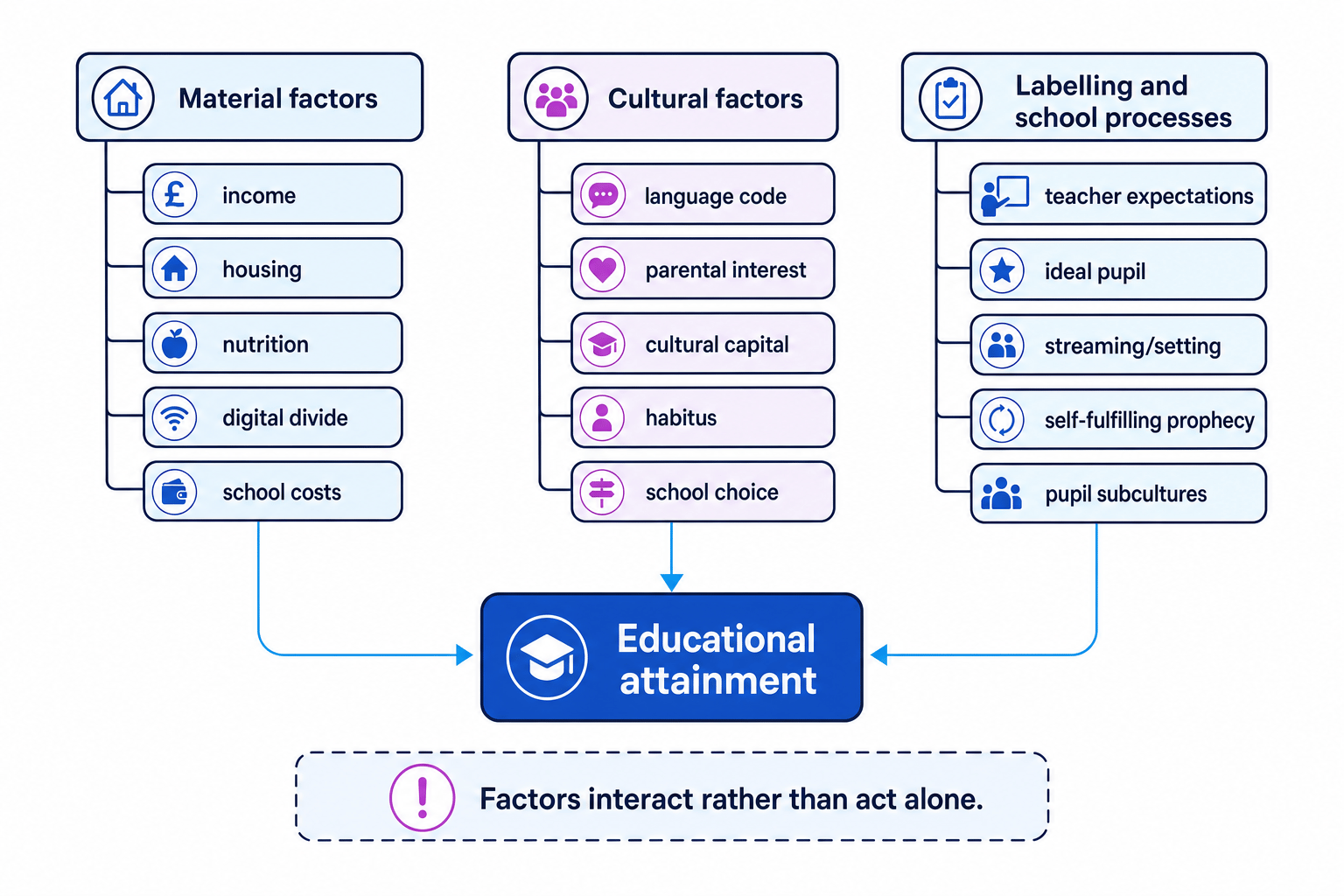
- How material factors such as income, housing and school costs affect educational attainment.
- How cultural factors such as language, values and cultural capital shape pupils’ experiences of school.
- How labelling and school processes can create or reinforce attainment patterns.
- How to evaluate these explanations using named sociologists, UK examples and research-methods points.
The big picture: why attainment patterns happen
Educational attainment
Educational attainment means the level of success a pupil reaches in education, usually measured through grades, qualifications, attendance, progression to further/higher education, or later outcomes such as employment.
Sociologists are interested in patterns and trends in attainment: regular differences between social groups. In the UK, attainment is strongly linked to social class, but also intersects with gender, ethnicity, disability, region and school type.
A useful starting distinction is between external factors and internal factors. External factors come from wider society, such as family income or parental education. Internal factors happen inside schools, such as teacher expectations, setting and pupil subcultures.
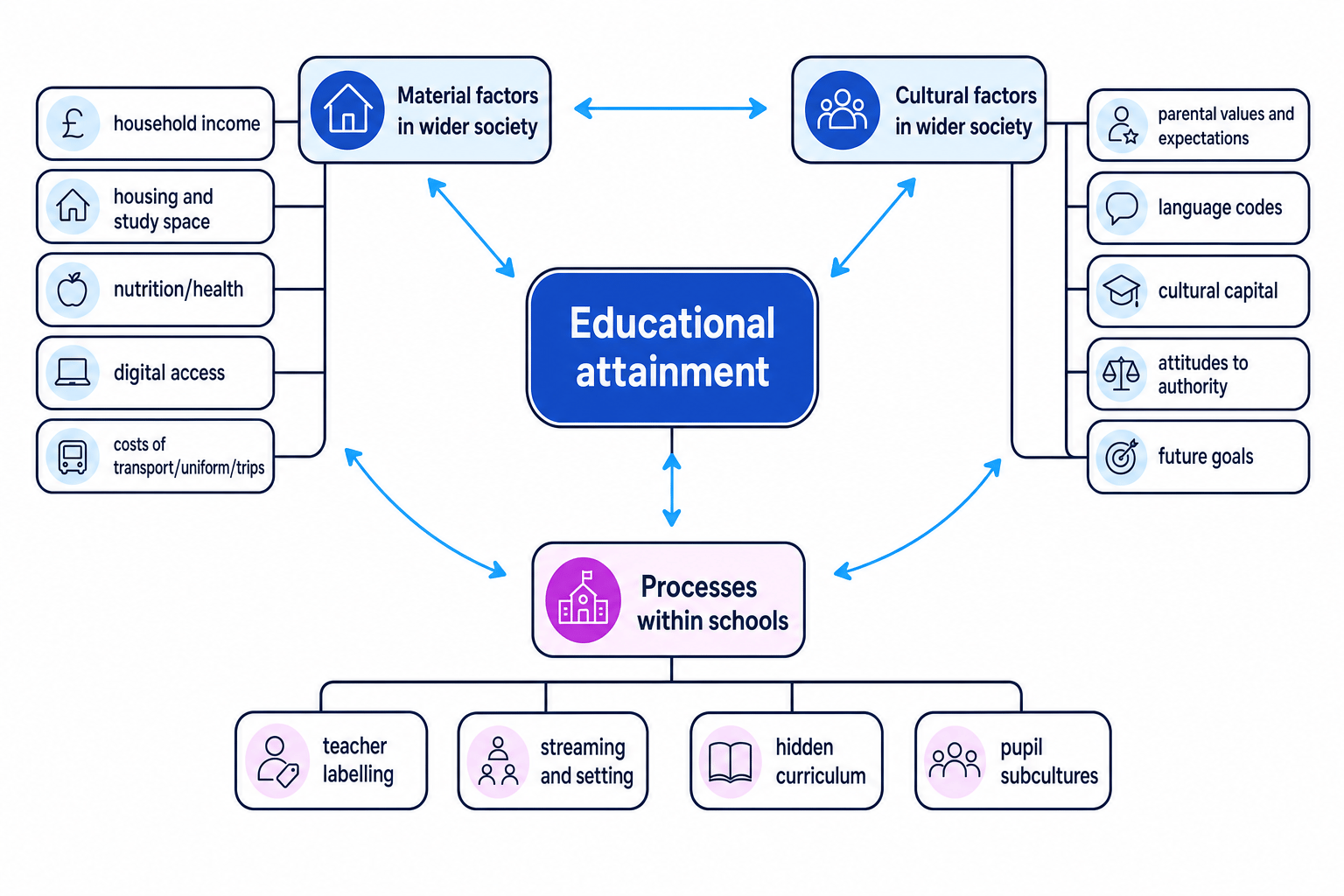
The simplest way to understand this topic is to see material, cultural and in-school processes as interacting rather than competing explanations.
Core argument
Educational attainment is not just about individual ability. Sociologists ask how resources, culture, identity and power shape pupils’ chances before they even enter the exam hall.
Material factors: resources and living conditions
Material deprivation
Material deprivation means lacking the physical and economic resources needed for a decent standard of living, such as secure housing, food, heating, transport, digital access and money for school-related costs.
Material explanations focus on what money can buy. Pupils from poorer households may face overcrowded housing, fewer quiet study spaces, poorer nutrition, less reliable internet access, and difficulty paying for uniforms, trips, revision guides or transport.
In UK education, Free School Meals eligibility is often used as an indicator of disadvantage, although it is imperfect. Policies such as the Pupil Premium in England and the Pupil Development Grant in Wales are designed to reduce the attainment gap by giving schools extra funding for disadvantaged pupils.
Named studies help you anchor AO1. Halsey, Heath and Ridge (1980) found that class background strongly affected educational outcomes. Smith and Noble (1995) argued that poverty affects achievement through factors such as low income, poor housing and limited educational resources. Lupton (2004) showed that schools in disadvantaged areas often face extra challenges linked to pupils’ wider social conditions.
Material factors also matter in contemporary examples. During Covid-19 lockdowns, pupils without laptops, quiet space or stable broadband were less able to access online learning. This highlighted the digital divide, which means unequal access to digital technology and internet connection.
Explaining a deprivation gap
- Start with the material condition: a pupil lives in overcrowded housing and shares one device with siblings, so revision time and online homework access are restricted.
- Connect it to school performance: missed homework, weaker revision routines and tiredness may reduce classroom confidence and exam preparation.
- Link it to a pattern: if many pupils in low-income households face similar barriers, this can help explain why disadvantaged pupils may, on average, achieve lower grades than more advantaged pupils.
Evaluating material explanations
Material explanations are strong because they are supported by large-scale official statistics showing persistent links between poverty and attainment. However, official statistics can be limited: Free School Meals data may miss families just above the threshold or those who do not claim.
Material factors are also not deterministic. Some working-class pupils achieve highly, and some middle-class pupils underachieve. Material explanations may also struggle to explain why girls often outperform boys across many groups, or why some minority ethnic groups achieve above national averages despite economic disadvantage.
Material is not the same as cultural
Do not write “parents do not value education” as a material factor. That is a cultural claim. Material factors are about money, resources and physical conditions.
Cultural factors: values, language and capital
Culture
Culture means the shared meanings, values, norms, language, knowledge and ways of behaving that people learn through socialisation.
Cultural explanations focus on how family background and identity shape pupils’ attitudes to school. Early cultural deprivation theorists argued that some working-class pupils may be socialised into values that fit less well with school success.
Douglas (1964) argued that parental interest influenced educational achievement. Sugarman (1970) suggested that some working-class subcultures encouraged fatalism, immediate gratification and present-time orientation, making long-term educational planning harder. Bernstein (1971) argued that middle-class pupils were more likely to use an elaborated code, a language style with explicit, complex meanings, while working-class pupils were more likely to use a restricted code, which depends more on shared context. Schools, he argued, reward the elaborated code.
These claims are controversial because they can sound as if working-class culture is “deficient”. Keddie (1973) criticised cultural deprivation theory as a “myth”, arguing that pupils are not culturally deprived; rather, schools devalue their culture.
Cultural capital and habitus
Cultural capital
Cultural capital, associated with Bourdieu (1977), means the knowledge, tastes, language, confidence and qualifications that are valued by powerful institutions such as schools.
Bourdieu argued that schools appear neutral but actually reward middle-class culture. This links education to power and stratification: middle-class pupils often arrive with the “right” vocabulary, confidence with professionals, familiarity with books, museums, music lessons or university routes, and parents who know how to navigate the system.
A related term is habitus, meaning a person’s deeply learned sense of what is normal, possible and “for people like us”. Reay (1998) showed how middle-class mothers often had the confidence and knowledge to support school choice and homework. Ball, Bowe and Gewirtz (1995) found that middle-class parents were often more skilled at using education markets.
Applying cultural capital to school choice
- Compare two families choosing secondary schools: one parent has time, confidence and knowledge to read inspection reports, attend open evenings and challenge admissions decisions; the other is unsure how the system works.
- Apply Bourdieu: the first family has more cultural capital because their knowledge and communication style fit what schools reward.
- Explain the outcome: the child may gain access to a higher-status school or more academic pathway, turning cultural advantage into educational advantage.
Evaluating cultural explanations
Cultural capital is useful because it avoids simply blaming families: it shows how schools value some cultures over others. However, it can be difficult to measure precisely. It may also underplay pupil agency, because young people can reject or transform the expectations placed on them.
Be careful with ethnicity. Some explanations point to cultural differences in parental expectations, but this can become stereotypical. Ethnicity is shaped by racism, class, migration history, language, religion and school treatment. For example, Sewell (1997) examined Black boys, masculinity and schooling, while Archer et al. (2010) explored how working-class minority ethnic identities could be both ambitious and constrained by racism and class inequality.
Best essays combine factors
A high-level answer usually shows interaction: poverty may limit resources, cultural capital may shape confidence with schools, and teacher labelling may convert these differences into classroom outcomes.
Labelling: how schools can create outcomes
Labelling
Labelling is the process where teachers or others attach meanings to pupils, such as “bright”, “troublemaker”, “lazy” or “ideal pupil”, which can affect how pupils are treated and how they see themselves.
Labelling theory is an interactionist approach. Interactionists study small-scale social interactions and how meanings are created in everyday life. In education, they ask how teacher expectations shape pupil identity and attainment.
Becker (1971) found that teachers judged pupils against an “ideal pupil” image, often linked to middle-class appearance, speech and behaviour. Rist (1970) found that pupils were grouped partly according to teacher perceptions linked to social class. Rosenthal and Jacobson (1968) argued that teacher expectations could become a self-fulfilling prophecy.
Self-fulfilling prophecy
A self-fulfilling prophecy happens when a prediction or label changes people’s behaviour in ways that make the prediction come true.
The labelling process often works through everyday treatment: who gets praised, who is challenged, who is ignored, who is entered for higher-tier exams, and who is seen as having “potential”.
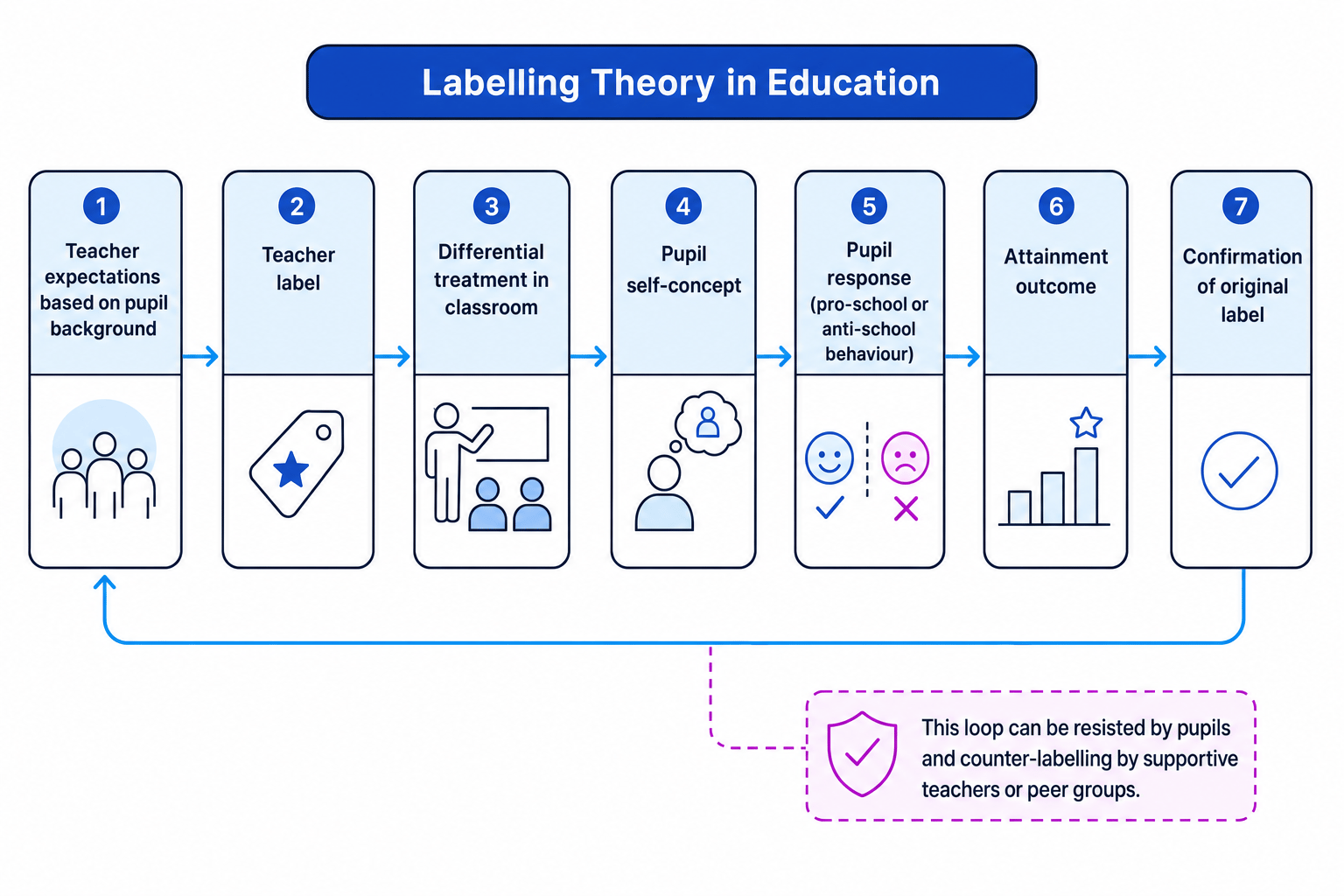
Tracing a self-fulfilling prophecy
- A teacher labels a working-class pupil as unlikely to succeed because of accent, uniform, behaviour or family background.
- The teacher gives fewer challenging questions, less encouragement and lower expectations, so the pupil receives fewer opportunities to demonstrate ability.
- The pupil may lose confidence, join an anti-school peer group, or stop trying; lower attainment then appears to “confirm” the original label.
Streaming, setting and pupil subcultures
Streaming and setting
Streaming places pupils into broad ability groups for most or all subjects. Setting places pupils into ability groups for individual subjects.
Labelling becomes more powerful when it is built into school organisation. Ball (1981) studied Beachside Comprehensive and found that banding affected teacher expectations and pupil identity. Gillborn and Youdell (2000) argued that schools under pressure to improve league-table results may use educational triage, focusing resources on pupils seen as likely to achieve key benchmark grades.
A pupil subculture is a peer-group set of values and behaviours within school. Willis (1977) studied working-class “lads” who rejected school authority and saw manual work as masculine. Their resistance felt active and meaningful, but it helped reproduce class inequality because they moved towards the same kinds of jobs as their fathers.
However, labels are not always accepted. Fuller (1984) found that Black girls could reject negative teacher labels and still work hard. Mirza (1992) similarly showed that Black girls developed strategies to succeed despite racism and low teacher expectations.
Evaluating labelling explanations
Labelling theory is strong because it shows how inequality can be produced inside schools, not only imported from families. It also links to identity: pupils may come to see themselves as academic, non-academic, rebellious, gifted or “not university material”.
Methodologically, many labelling studies use classroom observation or interviews, giving rich validity because they capture meanings and interactions. But they may have smaller samples, so representativeness can be limited. There are also ethical issues: Rosenthal and Jacobson’s study involved deceiving teachers, which raises questions about informed consent.
Labelling also cannot explain everything. It may not fully explain where teachers’ stereotypes come from, or why structural inequalities exist before school begins. Marxists would argue that labelling reflects wider class power, while feminists and critical race theorists would examine gendered and racialised expectations.
Bringing it together for essays
The strongest argument is usually not “material versus cultural versus labelling”. It is how they combine.
For example, a low-income pupil may lack quiet study space, have parents who feel less confident contacting teachers, and then be placed in a lower set after early difficulties. The school may interpret this as low ability, even though the starting point was unequal access to resources.
This challenges meritocracy, the idea that success is based mainly on talent and effort. Functionalists tend to see education as selecting people fairly for roles, while Marxists and interactionists are more likely to argue that education reproduces inequality through class advantage, cultural capital and labelling.
In the exam
- Define the factor clearly, then link it to a specific attainment pattern such as class, ethnicity, gender or deprivation.
- Use named evidence: for example, Smith and Noble for material deprivation, Bourdieu for cultural capital, and Becker or Gillborn and Youdell for labelling.
- Evaluate by showing interaction, limits and methods: ask whether the evidence is representative, whether pupils resist labels, and whether the explanation blames individuals or exposes structural power.
Check yourself
- How is material deprivation different from cultural deprivation?
- Why might Bourdieu say schools reward middle-class culture while appearing neutral?
- How can labelling lead to a self-fulfilling prophecy, and why might some pupils resist it?