What you'll learn
- How ownership and control shape what appears in newspapers, TV, radio and online media.
- How media professionals, news values and newsworthiness affect story selection.
- What agenda setting means, and why it matters for power, culture and identity.
- How to evaluate pluralist, Marxist, feminist and postmodern views in essay answers.
Why ownership and control matter
The media is not just a neutral “window” onto society. It is a set of institutions that select, package and distribute meanings. This matters because media content can influence how people understand class, gender, ethnicity, politics, crime, welfare, immigration and national identity.
Ownership and control
Ownership means who legally or financially owns media organisations, such as newspaper groups, broadcasters, streaming services or social media platforms. Control means who has the power to influence decisions about staffing, budgets, editorial line, story selection and presentation.
Ownership is closely linked to power and stratification because some individuals and corporations have much more ability than others to shape public debate. It also links to socialisation, culture and identity because repeated media messages help people learn what is “normal”, “respectable”, “dangerous” or “desirable”.
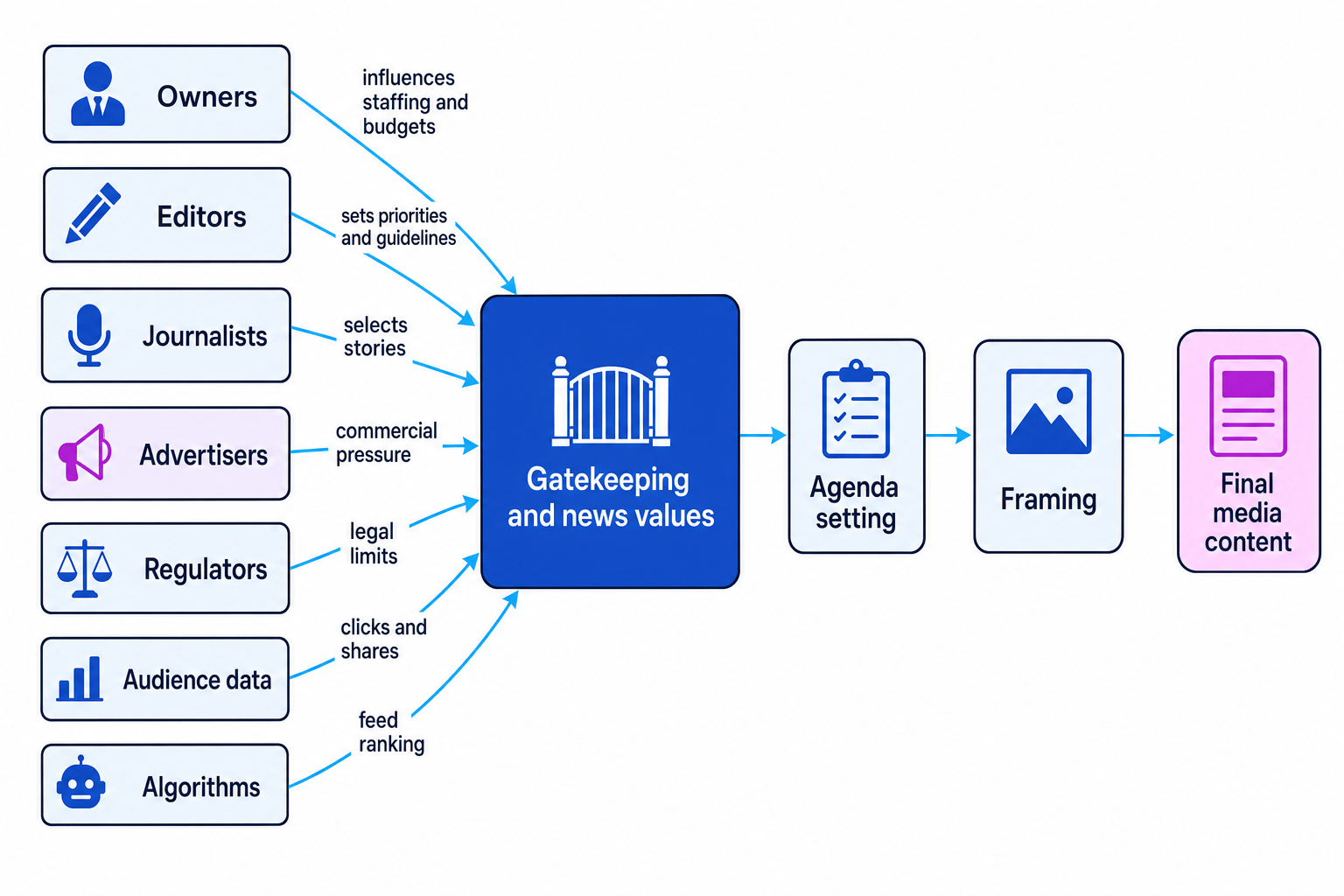
This diagram shows the main influences on media content: owners matter, but so do editors, journalists, advertisers, regulators, audiences and algorithms.
Patterns of media ownership
A key issue is concentration of ownership, where a small number of companies own a large share of the media market. In the UK, national newspapers are owned by a limited number of groups, including News UK, DMG Media, Reach plc and the Guardian Media Group. Broadcasting includes public service organisations such as the BBC, commercial broadcasters such as ITV and Sky, and digital platforms such as YouTube, TikTok, Instagram and X.
A media conglomerate is a large company that owns different types of media, sometimes across several countries. Convergence means the merging of media technologies and industries: for example, a newspaper brand may also run websites, podcasts, video channels and social media accounts.
Ownership is not the same as writing every headline
Owners usually do not personally choose every story. Their influence is more often indirect: they appoint senior managers, set budgets, shape organisational culture, influence political stance and prioritise profit, audience growth or public service duties.
Marxist and neo-Marxist views
Marxist approaches argue that media ownership reflects wider capitalist power. Ideology means a set of ideas that makes a social order seem natural or fair. From this view, media content often supports the interests of powerful groups by normalising capitalism, consumerism and inequality.
Miliband argued that media owners tend to share the values of the economic elite. Curran and Seaton argue that media concentration gives private owners too much power over public debate. Herman and Chomsky’s propaganda model suggests that news is filtered through ownership, advertising, official sources, criticism or “flak”, and dominant ideology.
A useful UK application is the way some newspapers frame tax, welfare and trade unions. Wealth may be presented as individual success, while benefit claimants or striking workers may be framed as problems. This can reinforce class inequality.
Pluralist views
Pluralists argue that media power is more widely spread. They claim audiences have choice, different outlets compete, and journalists have professional standards. Public service broadcasting, Ofcom regulation and online citizen journalism all limit owner control.
For example, the BBC has a public service remit and is expected to be impartial. The Guardian’s ownership structure through the Scott Trust is different from a profit-maximising private owner. Social media also allows pressure groups, activists and ordinary users to challenge mainstream narratives.
The evaluation point is that pluralists are right to notice media diversity, but Marxists are right to question whether all voices have equal resources, reach and credibility.
Comparing ownership explanations
-
Apply the Marxist view by asking how the owner’s economic interests might shape the outlet’s priorities. A commercial newspaper may favour content that attracts advertisers, protects business interests and appeals to a target readership.
-
Apply the pluralist view by comparing that outlet with alternatives. If audiences can access BBC News, Channel 4 News, podcasts, independent websites and social media, owner influence may be challenged.
-
Evaluate by weighing reach and power. A small activist account may offer an alternative view, but a national newspaper group or major platform can still set the terms of debate for millions of people.
The role of media professionals
Media professionals are people who produce media content, such as journalists, editors, producers, researchers, photographers, presenters and content moderators. They act as gatekeepers, meaning they decide what enters the media agenda and what is left out.
Journalists are shaped by routines: deadlines, space, audience expectations, legal risks, editorial policies and access to sources. Hall et al. argued that journalists often rely on primary definers: powerful sources such as police, government officials, business leaders and experts. This can make elite viewpoints appear more authoritative.
The Glasgow University Media Group found that news coverage can favour official and employer perspectives, for example in reporting industrial conflict. Nick Davies used the term churnalism to describe journalism that relies heavily on press releases, agency copy and public relations material, often because of cost-cutting and time pressure.
Do not treat journalists as puppets
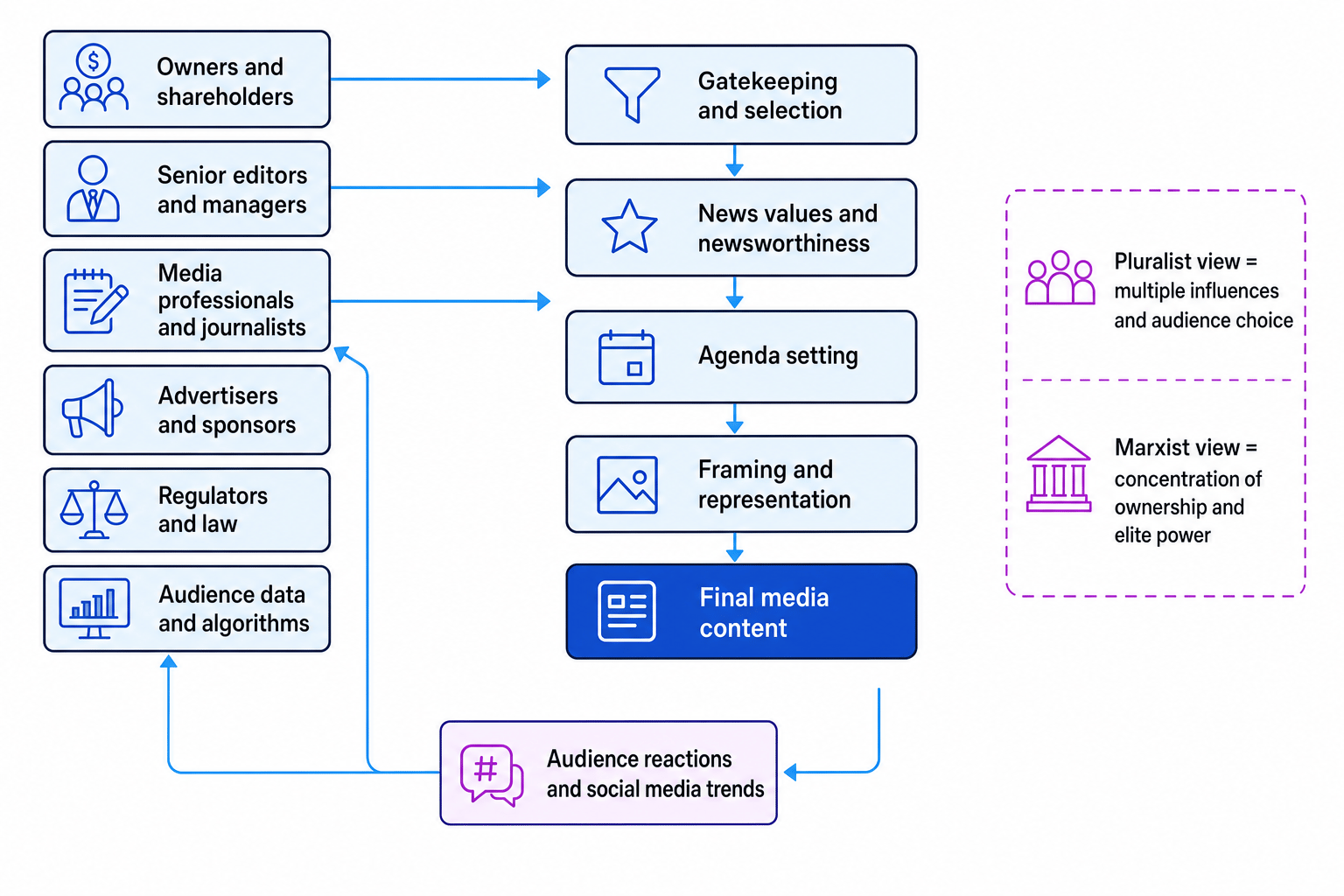
A strong answer avoids saying “owners simply control everything”. Better answers explain layers of control: owners set broad conditions, editors make strategic choices, journalists use professional routines, and audiences and platforms feed back through clicks, complaints and shares.
News values and newsworthiness
News values and newsworthiness
News values are the informal criteria journalists use to decide whether an event is worth reporting. Newsworthiness means how likely an event is to be selected and presented as news.
Galtung and Ruge identified news values such as negativity, threshold or scale, unexpectedness, continuity, personalisation, and reference to elite people or elite nations. Harcup and O’Neill later updated this for modern journalism, adding values such as celebrity, entertainment, visual appeal and shareability.
Common news values include:
| News value | Meaning | Example |
|---|---|---|
| Negativity | Bad news attracts attention | violent crime, war, scandal |
| Proximity | Closer events feel more relevant | UK floods over similar floods abroad |
| Personalisation | Stories focus on individuals | a named victim or celebrity |
| Elite people | Powerful people are treated as important | prime ministers, royals, CEOs |
| Conflict | Disagreement creates drama | strikes, elections, culture-war debates |
| Continuity | Once a story is running, it keeps being updated | a high-profile court case |
News values shape media content because they make some social issues more visible than others. Street crime may receive more attention than corporate crime because it is dramatic, personal and visual, even though corporate harm can affect far more people.
Judging newsworthiness
-
Compare the event with key news values. A celebrity court case has personalisation, elite people, conflict and continuity, so it is highly newsworthy for many outlets.
-
Compare it with a less dramatic issue. Long-term poverty has major social importance, but it may lack suddenness, novelty and clear visuals, so it can receive less daily coverage.
-
Add evaluation. This does not mean journalists think poverty is unimportant; it shows how professional routines and audience expectations can make some problems easier to turn into “news” than others.
Agenda setting and framing
Agenda setting
Agenda setting means the media’s ability to influence which issues people think are important. It does not always tell audiences what to think, but it can strongly influence what they think about.
McCombs and Shaw’s study of the 1968 US presidential election found a link between issues emphasised by the media and issues voters saw as important. Bernard Cohen made the famous point that the press may be less successful in telling people what to think, but very successful in telling them what to think about.
Framing goes one step further. It means the angle or interpretation used to present an issue. For example, immigration can be framed as a labour-market benefit, a humanitarian issue, a pressure on public services, or a border-control problem. Each frame encourages a different moral and political response.
Agenda setting is especially relevant to contemporary UK society. Topics such as small boat crossings, NHS waiting lists, knife crime, climate protest, trans rights and the cost-of-living crisis can rise or fall in public importance depending on media attention.
Tracing agenda setting in a news cycle
-
Identify the issue being repeatedly covered. If several front pages and TV bulletins focus on small boat crossings, the issue becomes highly visible.
-
Analyse the dominant frame. If reports repeatedly use images of border patrols and political conflict, audiences may interpret the issue mainly through security and control.
-
Evaluate with audience agency. Some audiences accept the frame, but others challenge it using charities, alternative news, personal experience or social media counter-narratives.
Control in the digital age
Digital media has changed ownership and control rather than removing them. Algorithms now act as gatekeepers by ranking, recommending and hiding content. An algorithm is a set of automated instructions used by platforms to sort information, such as deciding which posts appear in your feed.
This creates new forms of power. Platforms such as Google, Meta and TikTok do not usually produce news in the traditional sense, but they can influence which news is seen, shared and monetised. Advertising revenue, search rankings and engagement metrics can push outlets towards sensational, emotional or polarising content.
Postmodernists argue that audiences now experience fragmented media worlds, with many identities and realities circulating at once. However, critics reply that digital diversity can coexist with corporate concentration: a user may see thousands of voices, but the platform infrastructure is still owned and governed by a few powerful companies.
Regulation, policy and limits on control
UK media is not completely unregulated. Ofcom regulates broadcasting and has rules on accuracy, harm, offence and impartiality. The BBC has a public service role, although its funding and independence are often politically debated. The Leveson Inquiry followed the phone-hacking scandal and raised questions about press ethics. IPSO regulates many newspapers, though critics argue press self-regulation remains too weak.
The Online Safety Act 2023 also shows the state trying to regulate harmful digital content. This is useful for evaluation: media owners are powerful, but they operate within legal, political and public pressures.
Using evidence well
For AO1, know the concepts: ownership, control, gatekeeping, news values, newsworthiness, agenda setting and framing. For AO2, apply them to real media examples, such as the BBC, tabloids, social media algorithms or coverage of strikes and immigration. For AO3, compare perspectives and judge how far each explains modern media.
Research methods can strengthen evaluation. Content analysis can measure how often groups or issues appear, making it useful for reliability. Discourse analysis explores meanings and frames in depth, giving stronger validity. Interviews with journalists can reveal professional routines, but access may be difficult and respondents may protect their organisation’s reputation.
In the exam
-
Build your answer in layers: ownership first, then editors and journalists, then news values, then agenda setting and audience response.
-
Use named theorists accurately: Galtung and Ruge for news values, McCombs and Shaw for agenda setting, Hall et al. for primary definers, and Herman and Chomsky or Curran and Seaton for ownership power.
-
Evaluate throughout by asking: “Does this overstate owner control?” and “Do digital media and active audiences weaken or simply change media power?”
Check yourself
- How is ownership different from control?
- Which news values help explain why some stories become headlines while others are ignored?
- Why might agenda setting be more subtle than simply “brainwashing” audiences?