What you'll learn
- What sociologists mean by the distribution of political participation.
- How partisan de-alignment has changed voting and party loyalty.
- How class, gender, age and ethnicity shape political voice in the UK.
- How to add AO3 evaluation using evidence, methods and perspective comparisons.
1. Start with political participation
Political participation means more than voting. It includes any action intended to influence political decisions, power or public policy: voting, joining a party, contacting an MP, donating, campaigning, signing petitions, protesting, joining pressure groups, or using digital activism.
Distribution of political participation
The distribution of political participation means the pattern of who participates, how often, and through which forms of political action across different social groups.
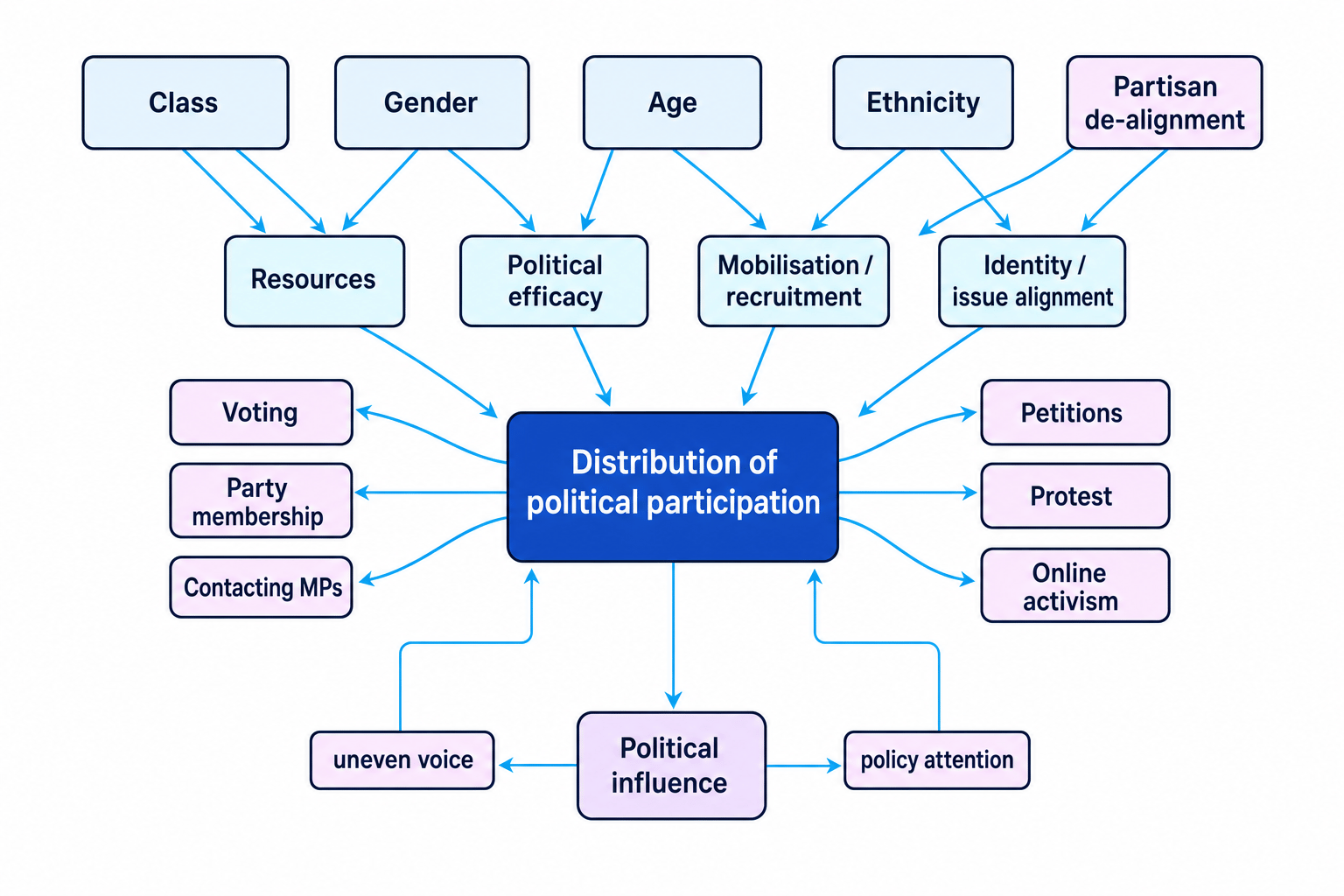
A key sociological point is that political participation is linked to power and stratification. If some groups participate more than others, politicians are more likely to hear their interests. This can create a feedback loop: groups with more political voice gain more policy attention, which can strengthen their sense that participation is worthwhile.
The diagram below shows the main explanations in this topic and the mechanisms that often connect them to participation.
Participation is uneven
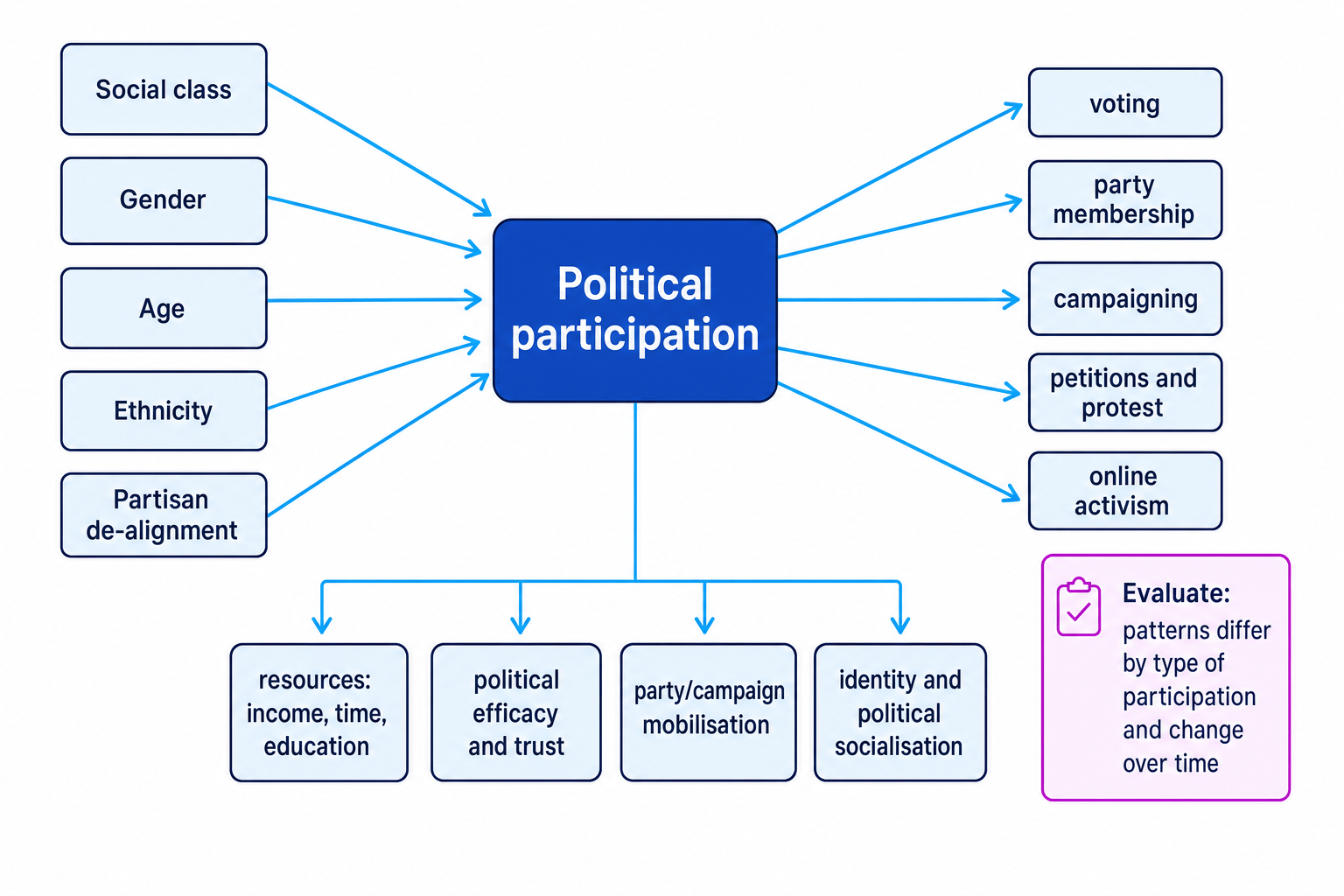
The strongest answers do not simply say “some groups vote more”. They explain why: resources, socialisation, political efficacy, party mobilisation and identity all shape whether people feel able, invited and motivated to participate.
2. The core model: resources, efficacy and mobilisation
A useful starting point is the civic voluntarism model associated with Verba, Schlozman and Brady (1995). They argue that people participate when they have:
- Resources: time, money, education, confidence and civic skills.
- Engagement: interest in politics and a belief that issues matter.
- Recruitment: being asked or encouraged by parties, unions, community groups, families or campaigns.
Political efficacy
Political efficacy is the belief that you can understand politics and that your actions can influence political outcomes. Internal efficacy means confidence in your own political ability; external efficacy means trust that the political system will respond.
Pattie, Seyd and Whiteley (2004) found that citizenship norms, social trust and community involvement were important for understanding participation in Britain. This links politics to the wider course themes of socialisation, culture and identity: families, schools, workplaces, peer groups and media all teach people whether politics feels “for people like us”.
Tracing a participation pattern
A student is asked to explain why a young private renter may sign online petitions but not vote in a general election.
-
Separate the forms of participation: signing a petition is quick, issue-based and often digital, while voting requires registration, knowledge of polling arrangements and belief that parties offer meaningful choices.
-
Link the pattern to resources: private renters and students may move address more often, making electoral registration less stable; they may also have less time, income and confidence to engage with formal politics.
-
Add efficacy and identity: the person may care strongly about climate change or housing, so online activism feels relevant, but they may feel parties ignore younger renters.
-
Evaluate the explanation: this does not prove young renters are “apathetic”; it shows participation may shift from conventional politics to cause-based politics.
3. Measuring participation: quick methods awareness
Official turnout data, Electoral Commission reports and survey data such as the British Election Study are useful because they allow broad comparisons over time. However, they have limits.
Surveys may suffer from social desirability bias, where people over-report voting because voting is seen as responsible. Some groups are harder to reach, creating problems of representativeness. Small samples can hide differences between ethnic groups, age groups or regions. Interpretivists would add that interviews can reveal the meanings people attach to politics, while positivists value large-scale survey patterns for reliability.
Do not treat non-voting as the same as apathy
A person may reject voting but still be highly political through protest, mutual aid, trade unions, community organising, consumer boycotts or online campaigns.
4. Partisan de-alignment
Partisan de-alignment
Partisan de-alignment is the weakening of long-term attachment to political parties. People become less likely to identify strongly with one party across their lifetime.
In the mid-twentieth century, UK voting was more strongly linked to class and family socialisation. Butler and Stokes (1969) argued that party identification was often inherited through family and class communities: many manual workers supported Labour, while many middle-class voters supported the Conservatives.
From the 1970s onwards, writers such as Crewe, Särlvik and Alt (1977) identified partisan de-alignment. Explanations include rising education, media influence, decline of trade unions, deindustrialisation, weaker class communities and greater individualisation. Dalton (2000) links this to cognitive mobilisation: better-educated voters may rely less on party loyalty and more on issues, leaders and performance.
De-alignment can reduce party membership, weaken habitual voting and increase electoral volatility. In UK politics, Brexit, Scottish independence, climate politics and immigration show how issue-based identities can cut across old party loyalties. The 2019 general election also showed that class alone could not explain voting, especially in former Labour “Red Wall” seats.
Applying de-alignment to issue voting
A voter from a traditionally Labour family votes Conservative in 2019 because of Brexit.
-
Identify the old alignment: family and class background would traditionally predict Labour support.
-
Identify the new issue cleavage: Brexit becomes more important to the voter than inherited party loyalty.
-
Link this to de-alignment: the voter is not necessarily becoming less political; they are choosing based on a specific issue rather than lifelong party identity.
-
Evaluate with re-alignment: this may be a new alignment around values, age, education, nation and identity rather than a simple collapse of political loyalty.
5. Class and political participation
Social class
Social class refers to a person’s position in systems of economic inequality, often linked to occupation, income, wealth, education and life chances.
Class affects participation through resources. Middle-class people are more likely to have higher educational qualifications, occupational confidence, stable housing, professional networks and time to engage in formal politics. Bourdieu’s ideas of cultural capital and habitus help explain why formal politics may feel natural to some groups but distant or alienating to others.
Working-class participation has historically been mobilised through trade unions and Labour Party links. However, deindustrialisation and declining union density have weakened some of these routes. Marxist approaches argue that unequal participation reflects wider class power: wealthy groups can influence politics through donations, lobbying and access, not just voting.
AO3 evaluation: class remains important, but it is no longer a simple Labour-versus-Conservative predictor. Education, housing tenure, region, age and cultural values now interact with class. Be careful not to use neighbourhood turnout data to make assumptions about every individual in that area.
6. Gender and political participation
Gender refers to socially constructed expectations about masculinity and femininity. Feminist sociologists connect gendered participation to patriarchy, meaning male dominance embedded in social institutions. Walby (1990) argues that patriarchy operates in both public and private life, including paid work, culture, violence and the state.
Historically, women were excluded from formal politics until the Representation of the People Acts of 1918 and 1928. Today, the gender gap in voting turnout is not usually as large as class or age differences, but gender still matters in representation and political opportunity. Women remain under-represented in many senior political roles, and female politicians often face gendered media scrutiny and online abuse.
Policies such as all-women shortlists and the Equality Act 2010 reflect attempts to tackle under-representation. Phillips (1995) argues for a politics of presence: who represents us matters, because lived experience can shape political priorities.
AO3 evaluation: do not treat women as one identical group. Crenshaw’s idea of intersectionality reminds you that gender overlaps with ethnicity, class, religion, disability and age.
7. Age and political participation
Age is one of the clearest predictors of electoral participation. Older people are more likely to vote, partly because they have stronger voting habits, more stable residence, greater contact with public services and higher external efficacy. Parties also tend to target older voters because they are more reliable at elections.
Younger people are often less likely to vote, but this does not mean they are apolitical. Henn, Weinstein and Wring (2002) argue that many young people are interested in issues but alienated from formal party politics. Youth participation may appear more strongly in climate strikes, Black Lives Matter protests, tuition-fee campaigns, petitions and online activism.
There is an important AO3 distinction between life-cycle effects and cohort effects. A life-cycle explanation says people vote more as they get older. A cohort explanation says generations shaped by different historical experiences may keep distinctive political values.
8. Ethnicity and political participation
Ethnicity
Ethnicity refers to shared cultural identity, often linked to ancestry, language, religion, nationality, migration history and experiences of racialisation.
Ethnicity can shape participation through trust, discrimination, community mobilisation and party identification. Research linked to the Ethnic Minority British Election Study, including work by Heath and colleagues, shows that minority ethnic voters are not a single bloc. Patterns vary between, for example, Black Caribbean, Black African, Indian, Pakistani, Bangladeshi, Chinese, mixed and other groups.
Some minority ethnic citizens may be mobilised by churches, mosques, temples, community organisations, anti-racist movements or campaigns such as Operation Black Vote. At the same time, racism, under-representation, policing issues, the Windrush scandal, Islamophobia and immigration politics can reduce trust in the state for some groups.
The Elections Act 2022 introduced voter ID requirements for UK parliamentary elections, raising concerns that groups less likely to hold accepted photo ID could be discouraged from voting. This is a useful policy example, but evaluate carefully: the impact must be assessed with evidence, not assumed.
Use the mechanism chain
For any factor, build your paragraph as: social factor → mechanism → form of participation → UK example → evaluation.
9. Bringing the explanations together
The best essays avoid single-factor explanations. For example, a young working-class woman from a minority ethnic background may experience politics through age, class, gender and ethnicity at the same time. Partisan de-alignment then changes how these identities connect to parties.
Pluralists may argue that participation has diversified beyond voting into pressure groups and digital campaigns. Marxists and feminists are more critical, arguing that unequal resources and institutional power still shape whose voices count. Late modern approaches linked to Beck and Giddens emphasise individualisation and issue-based identity politics.
In the exam
-
Define political participation broadly before discussing voting patterns.
-
Compare at least two explanations, such as age and class, rather than listing factors separately.
-
Use concrete UK examples: Brexit, the 2019 general election, climate protests, voter ID, trade unions or all-women shortlists.
-
Evaluate by asking whether the factor affects all forms of participation equally and whether patterns are changing over time.
Check yourself
- Why might younger people vote less but participate more in protests or online campaigns?
- How can partisan de-alignment reduce party loyalty without ending political participation?
- Why is it risky to write about “ethnic minority voters” as if they are one identical group?