What you'll learn
- How sociologists distinguish religious participation, religiosity, belief and belonging.
- The main UK trends in religion, including secularisation, believing without belonging and religious diversity.
- How participation varies by social class, gender, ethnicity and age.
- How to turn patterns into strong AO1, AO2 and AO3 essay paragraphs.
1. Start with the key terms
A pattern is a difference between groups at a point in time, such as older people attending religious services more than younger people. A trend is a change over time, such as the long-term decline in Church of England attendance.
Participation, religiosity and belief
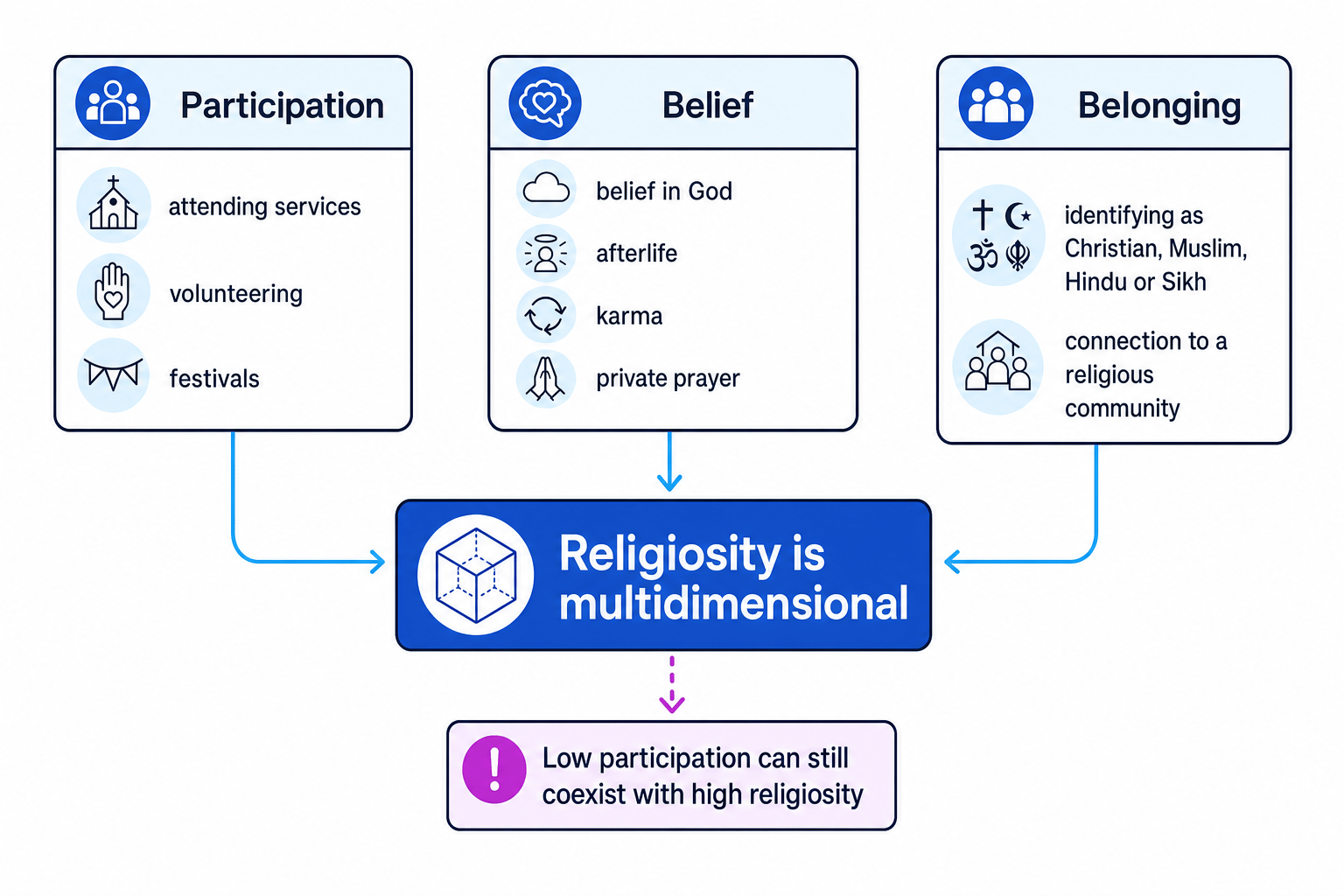
- Religious participation means observable involvement in religious life, such as attending services, praying with others, volunteering, joining a denomination, going on pilgrimage or taking part in festivals.
- Religiosity means the degree of religious commitment or importance religion has in someone’s life. This can include belief, practice, experience, knowledge and moral behaviour.
- Belief means what someone accepts as religiously true, such as belief in God, the afterlife, karma or sacred texts.
- Belonging means identifying with a religion or religious community, even if participation is limited.
Sociologists such as Glock and Stark (1965) argue that religiosity is multidimensional: someone may rarely attend a place of worship but still pray privately, believe strongly, or use religion to guide moral decisions.
Separating participation from religiosity
- Imagine a survey respondent says: “I do not attend church, but I pray every week and religion is important to my identity.”
- Their participation in organised religion is low because they do not attend services.
- Their religiosity may still be high because they pray regularly and see religion as meaningful.
- A strong sociological answer would avoid saying they are simply “not religious”; instead, it would discuss a possible shift from institutional religion to private or individual religion.
Treating attendance as the only measure
Do not assume that low attendance automatically means low religiosity. Attendance measures organised participation, but not private prayer, spiritual belief, online worship, festivals, or religious identity.
2. The broad UK trend: decline, diversity and change
A key debate is whether Britain is becoming more secular.
Secularisation
Secularisation means the declining social significance of religion. This may involve lower attendance, weaker religious belief, less influence over institutions such as education and politics, or religion becoming more private.
Sociologists such as Wilson and Bruce (2002) argue that Britain has experienced secularisation. Evidence often used includes falling church attendance, declining Christian identification, and the rise of people selecting “no religion” in surveys. The 2021 Census for England and Wales found that fewer than half of the population described themselves as Christian, while “no religion” increased substantially.
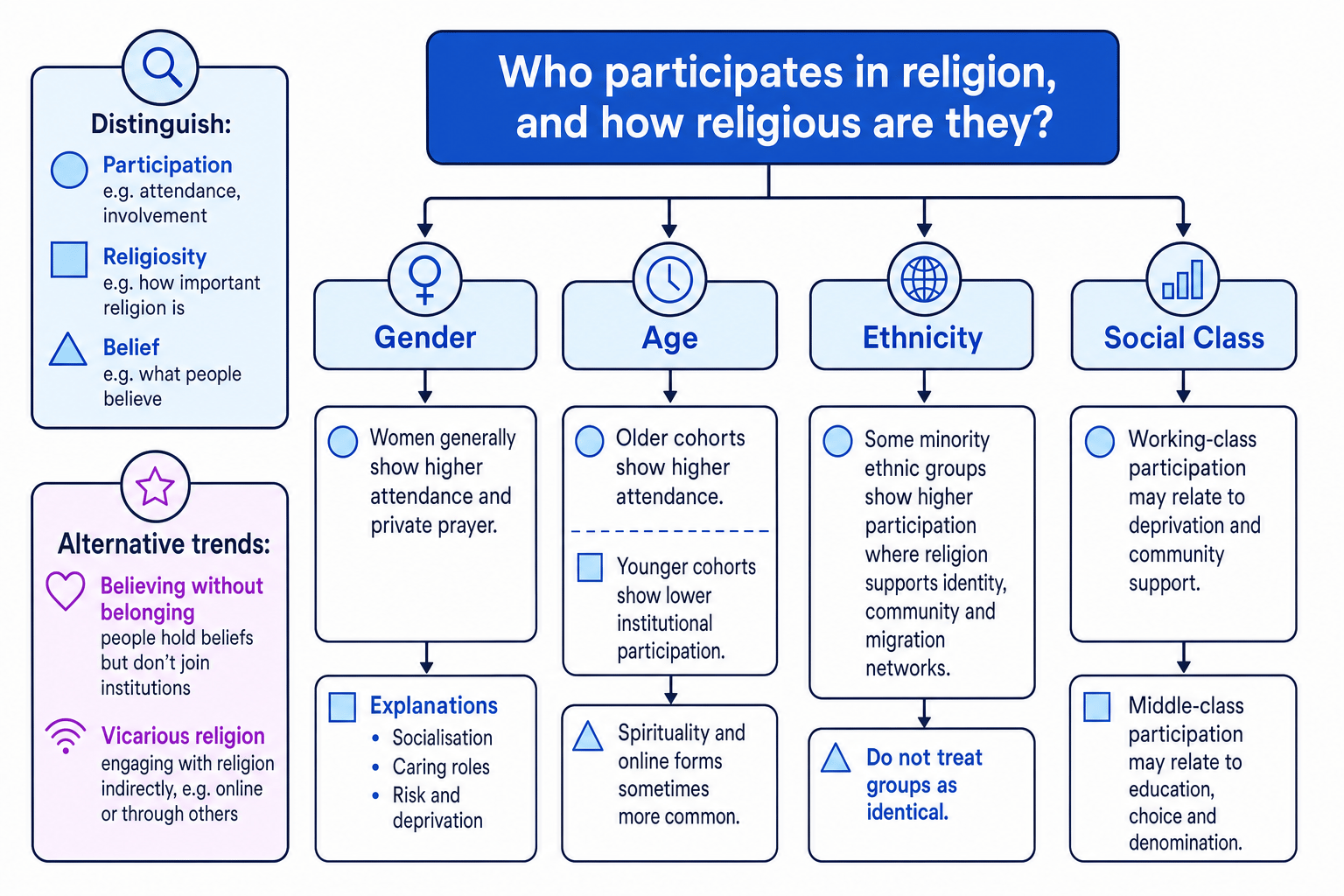
However, secularisation is not the same as religion disappearing. Davie (1994) described Britain as showing “believing without belonging”: some people retain religious or spiritual beliefs without joining religious institutions. Later, Davie (2007) used the idea of vicarious religion, where a minority practise religion on behalf of a larger population, for example at national ceremonies, funerals, Remembrance events or royal occasions.
The main debate
The strongest answers do not simply say “religion is declining”. They ask: which religion, which group, which measure, and which form of participation?
3. Gender and religiosity
In many UK studies, women show higher levels of religiosity than men, especially in church attendance, private prayer and involvement in religious volunteering.
Explanations
One explanation is gender socialisation. Girls are often encouraged to be caring, expressive and family-focused, which may make religious values of compassion, service and community feel more familiar.
A second explanation is linked to caring roles. Women are still more likely to be involved in childcare, elder care, funerals, school rituals and community support. These life events can connect them to religious institutions.
Miller and Hoffmann (1995) suggest women may be more religious because they are more risk-averse; if religion offers possible rewards such as salvation, belief may appear less risky than unbelief. This is controversial because it can sound biologically deterministic.
Stark and Bainbridge (1985) argue that religion can provide compensators, meaning promised rewards when people experience deprivation or powerlessness. Feminist sociologists might apply this to women’s unequal status in patriarchal societies.
The Kendal Project by Heelas and Woodhead (2005) found women were especially involved in the holistic milieu, such as alternative spirituality, healing and self-development. They linked this to women’s “expressive” roles and dissatisfaction with traditional institutions.
Evaluation
Gender patterns are not fixed. Some religions are strongly patriarchal, which may alienate women, especially where leadership roles are restricted. At the same time, religious communities can give women social networks, identity and authority in informal roles.
Gender evaluation
A useful AO3 move is to say: women may participate more, but this does not automatically mean religion empowers women. Participation can provide support while also reproducing patriarchy.
4. Age and religiosity
Older people are generally more likely than younger people to attend religious services, identify with a religion and say religion is important.
Life-cycle or cohort?
A life-cycle effect means people become more religious as they age, perhaps because of illness, bereavement, retirement or thinking about death.
A cohort effect means older people are more religious because they were socialised in a more religious period. Voas and Crockett (2005) argue that generational replacement is important: each generation in Britain has tended to be less religious than the one before, and young people are not necessarily becoming much more religious as they age.
Distinguishing life-cycle and cohort explanations
- If 70-year-olds attend church more than 20-year-olds, first identify the pattern: older people show higher participation.
- A life-cycle explanation would argue that the 20-year-olds may become more religious later as they face ageing, death or family responsibilities.
- A cohort explanation would argue that the 70-year-olds were socialised when Christianity had more social influence, while the 20-year-olds grew up in a more secular and diverse society.
- To evaluate, compare over-time evidence: if younger cohorts remain less religious as they age, the cohort explanation is stronger.
Young people and alternative forms
Lower attendance among young people does not always mean total rejection of religion. Some young people engage through online sermons, Islamic apps, Christian TikTok, meditation, astrology, yoga or spiritual wellbeing. However, exam answers should distinguish religion from broader spirituality, because not all spirituality involves organised belief in a sacred power.
5. Ethnicity and religiosity
In Britain, some minority ethnic groups show higher levels of religious participation than the white British majority. For example, many Muslim, Hindu, Sikh and Black Christian communities have high levels of religious identification and community involvement.
Religion as identity and community
Modood et al. (1997) found that religion was especially important for many South Asian communities in Britain. Jacobson (1998) showed how Islam could be central to identity for young British Pakistanis, sometimes becoming stronger in response to racism or exclusion.
Bruce (2002) uses the ideas of cultural defence and cultural transition. Cultural defence means religion helps a group preserve identity when it feels under threat. Cultural transition means religion helps migrants adjust to a new society by providing community networks, practical help and moral support.
Pryce (1979) studied African Caribbean communities in Bristol and argued that Pentecostalism could provide support, dignity and identity in the context of racism and social disadvantage.
Application to contemporary UK society
Places of worship are not only religious spaces. Mosques, gurdwaras, temples and churches may provide language support, food banks, youth activities, marriage networks, elder care and political mobilisation. This links religion to power and stratification: religion can help minority groups resist marginalisation, but it can also draw boundaries around identity.
Overgeneralising ethnicity
Do not write as if all minority ethnic groups are “more religious” in the same way. Ethnicity intersects with religion, migration history, age, gender, class and experiences of racism.
6. Social class and religious participation
Class patterns are more complex than age, gender or ethnicity.
Social class
Social class refers to a person’s position in the economic and status hierarchy, often linked to occupation, income, education, wealth and cultural capital.
Historically, established denominations such as the Church of England have often been associated with respectability, tradition and middle-class status. Some forms of private education, cathedral worship and village church life can reflect middle-class cultural capital.
However, sects and some evangelical or Pentecostal movements may appeal to people experiencing deprivation. Troeltsch distinguished between churches and sects, while Wallis (1984) argued that sects often attract the marginalised because they offer certainty, discipline and community. Stark and Bainbridge (1985) would say religion can compensate for economic or social disadvantage.
From a Marxist view, Marx saw religion as an ideology that could comfort oppressed groups while discouraging challenge to inequality: religion as the “opium of the people”. By contrast, Weber (1905) argued that religious ideas could help shape economic behaviour, as in the Protestant ethic and capitalism.
Norris and Inglehart (2004) argue that religion tends to be stronger where people experience lower existential security, meaning less protection from poverty, illness and uncertainty. This helps explain why deprivation may be linked to religiosity, although Britain’s welfare state and secular culture complicate the picture.
Evaluation
Class alone rarely explains participation. A working-class white British young man, a middle-class Muslim woman, and an older Caribbean Pentecostal woman may have very different religious experiences. The best answers therefore use intersectionality, meaning the way social characteristics combine rather than acting separately.
Intersectionality matters
Gender, age, ethnicity and class do not operate in isolation. Strong sociology explains how they overlap to shape identity, opportunity, community and power.
7. Evaluating the evidence
Sociologists use several sources: the Census, British Social Attitudes surveys, attendance counts, membership records, interviews and ethnographies.
Each has strengths and weaknesses. The Census is large and useful for identifying broad trends, but the religion question is voluntary and measures identity more than belief or practice. Attendance records can show participation, but they may miss private religion, online worship, festivals, or groups without centralised records. Interviews can reveal meaning and identity, but they are harder to generalise from.
Policy also matters. Religion or belief is a protected characteristic under the Equality Act 2010, so data on religion can affect schools, workplaces, healthcare, local services and responses to hate crime.
A simple paragraph structure
For each social factor, build your paragraph like this: state the pattern → explain it with a study or theory → apply it to UK society → evaluate by showing complexity or contradictory evidence.
In the exam
- Define your key measure first: are you discussing attendance, belief, identity, private prayer, or institutional membership?
- Use named evidence selectively: for example, Davie for believing without belonging, Voas and Crockett for generational decline, Modood or Jacobson for ethnicity, and Heelas and Woodhead for gender and spirituality.
- Evaluate every pattern by adding complexity: avoid “all women”, “all young people” or “all ethnic minorities”; show how class, gender, ethnicity and age intersect.
Check yourself
- What is the difference between religious participation and religiosity?
- Why might older people appear more religious than younger people?
- How can religion support minority ethnic identity in contemporary Britain?