What you'll learn
- What differential attainment and differential participation mean in education.
- The main UK patterns linked to social class, gender and ethnicity.
- How sociologists explain these differences using concepts such as cultural capital, labelling and institutional racism.
- How to turn patterns into strong AO1, AO2 and AO3 essay points.
The big idea: education is not experienced equally
Sociologists study education because it is one of the main ways society distributes opportunities, qualifications, status and eventually income. However, students do not all have the same chances of success or the same likelihood of staying in education.
Differential attainment
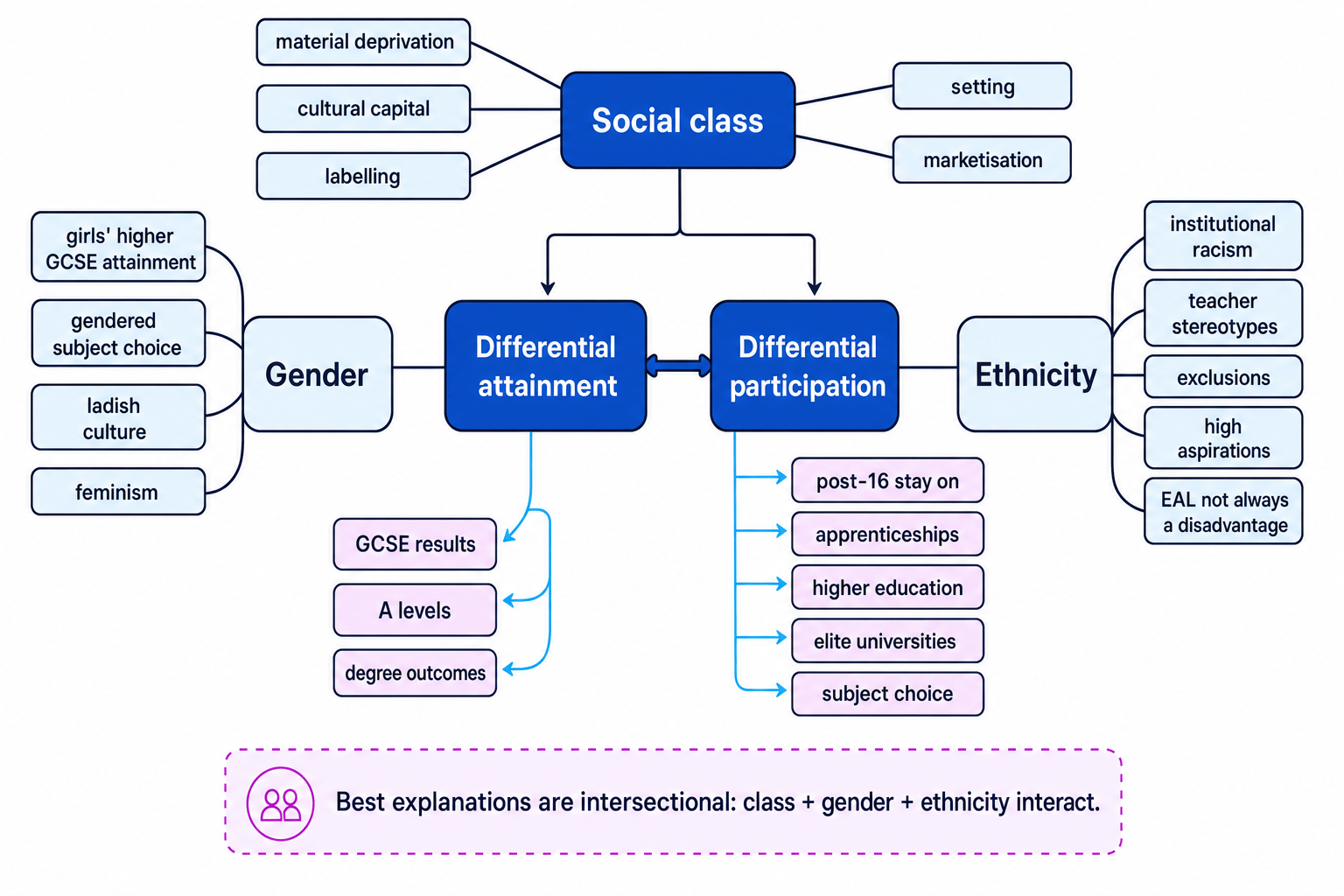
Differential attainment means systematic differences in educational achievement between social groups. In education, attainment is usually measured through outcomes such as GCSE results, A level grades, vocational qualifications, university entry and degree outcomes.
Differential participation
Differential participation means systematic differences in who takes part in education, where they participate, and what routes they follow. This can include staying on after 16, entering higher education, attending elite universities, choosing particular subjects, or being excluded from school.
A pattern is a repeated difference between groups at a particular time. A trend is how that pattern changes over time. For example, a pattern might be that pupils eligible for free school meals tend to achieve lower average results than other pupils; a trend might be whether that gap is narrowing or widening.
The core argument
Do not write as if social class, gender or ethnicity automatically determine someone’s achievement. Sociologists look for probabilistic patterns: group trends that are real and important, but never explain every individual case.
Social class and education
The pattern
In the UK, social class remains one of the strongest predictors of educational attainment and participation. Broadly, middle-class pupils tend to achieve higher average results, are more likely to enter higher education, and are especially more likely to access high-status universities.
Working-class pupils, particularly those experiencing poverty, are more likely to face lower attainment, school absence, exclusions, limited subject choices and reduced participation in post-16 or higher education.
Social class
Social class refers to a person’s position in the social hierarchy, usually linked to occupation, income, wealth, education and status.
A common contemporary indicator is free school meal eligibility, which is often used in official statistics as a proxy for economic disadvantage. It is useful, but imperfect: not all low-income families claim it, and it does not capture wealth, housing, parental education or cultural resources.
External explanations: home and wider society
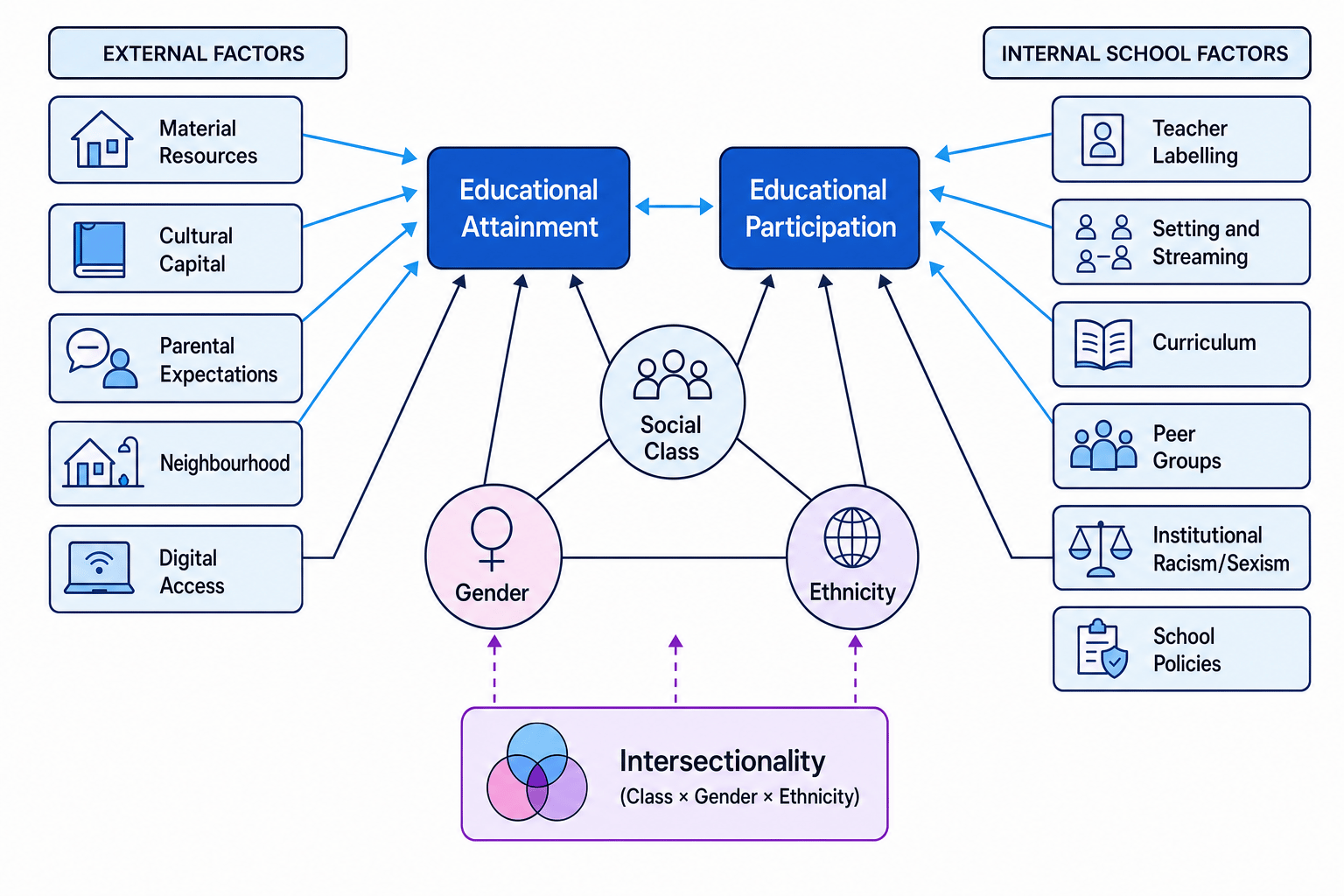
Some explanations focus on factors outside school. Material deprivation means lacking money and resources that support learning, such as a quiet study space, reliable internet, books, transport, nutritious food or private tutoring.
Bourdieu argued that middle-class families often possess more cultural capital: valued knowledge, language, tastes and behaviours that schools reward. For example, confidence in speaking to teachers, familiarity with university pathways, or knowing how to choose “facilitating” subjects can all help middle-class students.
Cultural capital
Cultural capital means the knowledge, language, skills, tastes and qualifications that are valued by powerful institutions, including schools and universities.
Bernstein linked class to language codes, arguing that schools tend to reward the more formal, context-independent language associated with middle-class homes. Older studies such as Douglas also emphasised parental encouragement, though this can be criticised for blaming families rather than examining poverty and school practices.
Internal explanations: what happens inside school
Class differences are also produced inside schools. Labelling theory suggests teachers may attach meanings to pupils, such as “bright”, “troublemaker” or “low ability”. These labels can affect how pupils are taught and how they see themselves.
Setting and streaming can reinforce inequality if working-class pupils are over-represented in lower groups. Gillborn and Youdell described educational triage, where schools under pressure to improve results may focus attention on students seen as most likely to help league-table performance.
Willis showed how some working-class boys developed a counter-school culture that rejected academic success as “unmasculine” or pointless. However, Willis should not be used to claim all working-class pupils reject education — many strongly value it.
Using social class evidence in an explanation
- Begin with the pattern: working-class pupils, especially those in poverty, tend to have lower average attainment and lower participation in high-status educational routes.
- Link an external factor to the pattern: material deprivation may limit access to revision space, digital resources, enrichment activities and private support.
- Add a sociological concept: Bourdieu would argue that middle-class pupils often have more cultural capital that matches school expectations.
- Evaluate the explanation: this is stronger when combined with internal school factors, because teacher labelling, setting and market pressures may convert class differences into different educational outcomes.
Blaming working-class families
Avoid saying working-class parents “do not care” about education. A more sociological answer asks how poverty, school expectations and unequal power shape what families can realistically do.
Gender and education
The pattern
Since the late twentieth century, girls have generally overtaken boys in many measures of school attainment, especially at GCSE. Girls are also highly represented in higher education participation. However, gender inequality has not disappeared.
Subject choice remains strongly gendered. Boys are more likely to dominate areas such as physics, computing and engineering, while girls are often more represented in subjects linked to care, education, health, languages and the arts. These choices matter because they connect education to the gendered labour market.
Gender
Gender refers to socially constructed expectations about masculinity and femininity. It is different from biological sex because it focuses on learned identities, roles and norms.
Explanations for girls’ improved attainment
External changes include feminism, anti-discrimination law, women’s changing employment opportunities and shifting expectations. Sharpe found that girls’ priorities changed over time, with later cohorts placing more emphasis on careers and independence.
Inside schools, girls may benefit from stronger teacher expectations, better organisation, and a closer match between school rules and conventional femininity. Some sociologists argue that boys are more likely to be affected by “laddish” anti-school peer cultures, where effort is mocked.
Mitsos and Browne suggested that girls often develop better literacy and communication skills earlier, which may help across subjects. Mac an Ghaill and later work on masculinities show that there are multiple forms of masculinity, not just one “male attitude” to school.
Evaluation
Gender explanations must be intersectional. Middle-class boys often do very well, while working-class girls may still face major barriers. There is also a danger of moral panic about “failing boys”, which can ignore girls’ continued disadvantages in subject choice, sexual harassment, confidence in STEM and later workplace inequality.
Explaining gendered subject choice
- Identify the pattern: boys and girls may achieve well overall but still cluster into different subjects.
- Apply socialisation: children often learn gendered ideas early, such as science and technology being coded as masculine, or care work as feminine.
- Link school to wider society: subject choices can reflect labour-market expectations, media stereotypes and teacher or peer reactions.
- Evaluate with policy: equal access through the National Curriculum and Equality Act 2010 matters, but formal equality does not automatically remove informal stereotypes.
Gender essays
Separate attainment from participation. Girls may outperform boys in many results, while still participating less in some high-status or high-payoff subjects.
Ethnicity and education
The pattern
Ethnic differences in attainment and participation are complex. Some minority ethnic groups, such as many Chinese and Indian pupils, often achieve high average outcomes. Some groups, including Gypsy, Roma and Traveller pupils, have faced very low average attainment and participation. Black Caribbean boys and White working-class boys have often been discussed as groups facing particular educational barriers, though patterns vary by class, region and generation.
Many minority ethnic groups have high participation in higher education, but this does not always mean equal advantage. There can be differences in access to elite universities, degree outcomes, graduate employment and experiences of racism.
Ethnicity
Ethnicity refers to shared cultural identity, which may include ancestry, language, religion, nationality, history and community belonging. Ethnic categories are socially constructed and can change over time.
External explanations
Ethnicity often overlaps with class. Some ethnic minority families are more likely to experience poverty, overcrowded housing or insecure employment due to wider racism in society. At the same time, high aspirations and strong family support can challenge simplistic “cultural deprivation” explanations.
Language can matter, but English as an additional language should not be treated as automatically negative. Some pupils with EAL make rapid progress, and bilingualism can be a resource.
Internal explanations
Institutional racism means racism built into the routines, assumptions and policies of institutions, even when individuals do not intend to be racist. In education, this may involve biased expectations, curriculum exclusion, unfair discipline or disproportionate exclusions.
Gillborn argues that racism is deeply embedded in the education system and that apparently neutral policies can have unequal effects. Wright found that some Asian pupils experienced teacher stereotypes and exclusion from classroom interaction. Mirza showed how Black girls could develop strategies of resistance and achievement despite low teacher expectations.
Sewell focused on Black boys, masculinity and peer groups, but his work is debated because it can underplay structural racism if used too narrowly.
Ethnic categories are broad
Do not treat “Asian”, “Black” or “White” pupils as single uniform groups. Differences by class, gender, religion, migration history and region can be very large.
Participation: more than staying in school
Participation includes whether students stay in education after 16, enter apprenticeships, go to university, attend selective or high-status institutions, and choose particular subjects.
The UK has seen expansion in post-16 and higher education, helped by policies such as raising the participation age and widening participation schemes. However, expansion does not remove inequality. Middle-class students may be more able to navigate applications, afford relocation, take unpaid internships, or access advice about Russell Group universities.
Ball, Bowe and Gewirtz argued that marketisation advantages middle-class parents as “skilled choosers” who know how to compare schools, use league tables and move into desirable catchment areas. Policies such as the Pupil Premium aim to reduce class gaps, while the Equality Act 2010 requires schools and universities to tackle discrimination. Their impact is debated.
Studying trends: using official statistics carefully
Official statistics from sources such as the Department for Education, UCAS, HESA/Jisc and the Office for National Statistics are useful because they cover large populations and allow comparisons over time.
A positivist sociologist may value these statistics because they can reveal broad patterns and correlations. An interpretivist would argue that statistics do not explain meanings, identities or classroom experiences, so interviews, observations and ethnographies are also needed.
AO3 methods point
Statistics can show that a gap exists, but they cannot fully explain why it exists. Strong evaluation combines quantitative patterns with qualitative evidence about labelling, identity, racism, poverty and school culture.
Intersectionality: the best answers combine factors
Intersectionality
Intersectionality, associated with Crenshaw, means that inequalities such as class, gender and ethnicity interact. A student is not just “working-class” or “female” or “Black”; these identities combine to shape experiences.
This is essential for Eduqas essays. For example, “boys underachieve” is too broad. Which boys? Middle-class boys may have strong educational advantages, while some working-class boys may face poverty, low teacher expectations and anti-school peer pressure. Similarly, “ethnic minority pupils” is too broad because different groups have very different outcomes and experiences.
Reading an intersectional pattern
- Start with the broad trend: girls often outperform boys in many attainment measures.
- Complicate it using class: middle-class boys may outperform working-class girls, so gender alone cannot explain the pattern.
- Add ethnicity: some minority ethnic girls may achieve highly despite racism, while some groups face low participation due to exclusion, poverty or discrimination.
- Reach a balanced conclusion: the strongest explanation treats class, gender and ethnicity as interacting forms of power and identity.
In the exam
- Define the key term first: say whether you are discussing attainment, participation, or both.
- Use a clear chain: pattern → evidence/example → sociological explanation → evaluation.
- Avoid one-factor answers. Bring in class, gender and ethnicity, then evaluate through intersectionality.
- Add named sociologists selectively: Bourdieu for cultural capital, Gillborn for racism, Ball for marketisation, Sharpe or Mac an Ghaill for gender.
- Use official statistics carefully: mention trends without pretending every individual fits the group average.
Check yourself
- What is the difference between differential attainment and differential participation?
- Why is social class still central to explaining educational inequality?
- How does intersectionality improve an answer on gender or ethnicity in education?