What you'll learn
- What sociologists mean by socialisation, culture, norms, values and roles.
- How primary socialisation happens through families and carers.
- How secondary socialisation happens through peers, education, religion, media and work.
- How formal and informal social control shape behaviour — and how different sociological perspectives evaluate this.
The starting point: what is socialisation?
Socialisation
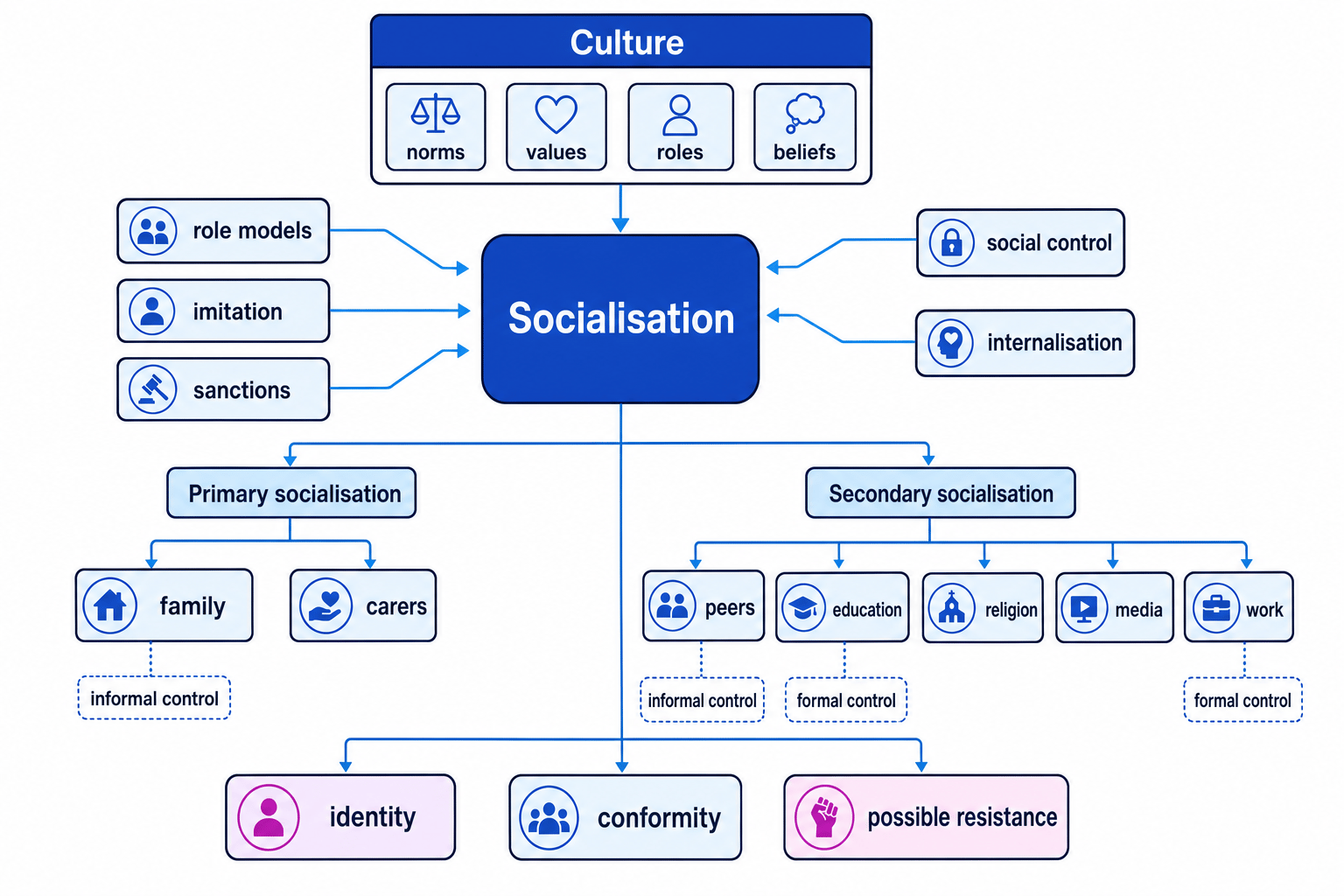
Socialisation is the lifelong process through which people learn the culture of their society, including its norms, values, roles, beliefs and expected ways of behaving.
A culture is the shared way of life of a group or society. It includes everyday things such as language, food, clothing, manners, celebrations, religious beliefs, music, humour and ideas about what is “normal”.
A norm is an expected pattern of behaviour, such as saying “please” and “thank you”. A value is a belief about what is important, such as respect, achievement, equality or obedience. A role is a set of expectations attached to a social position, such as “student”, “parent”, “friend”, “teacher” or “employee”.
Socialisation matters because humans are not born knowing how to behave in a particular society. We learn it through interaction with others.
The big idea
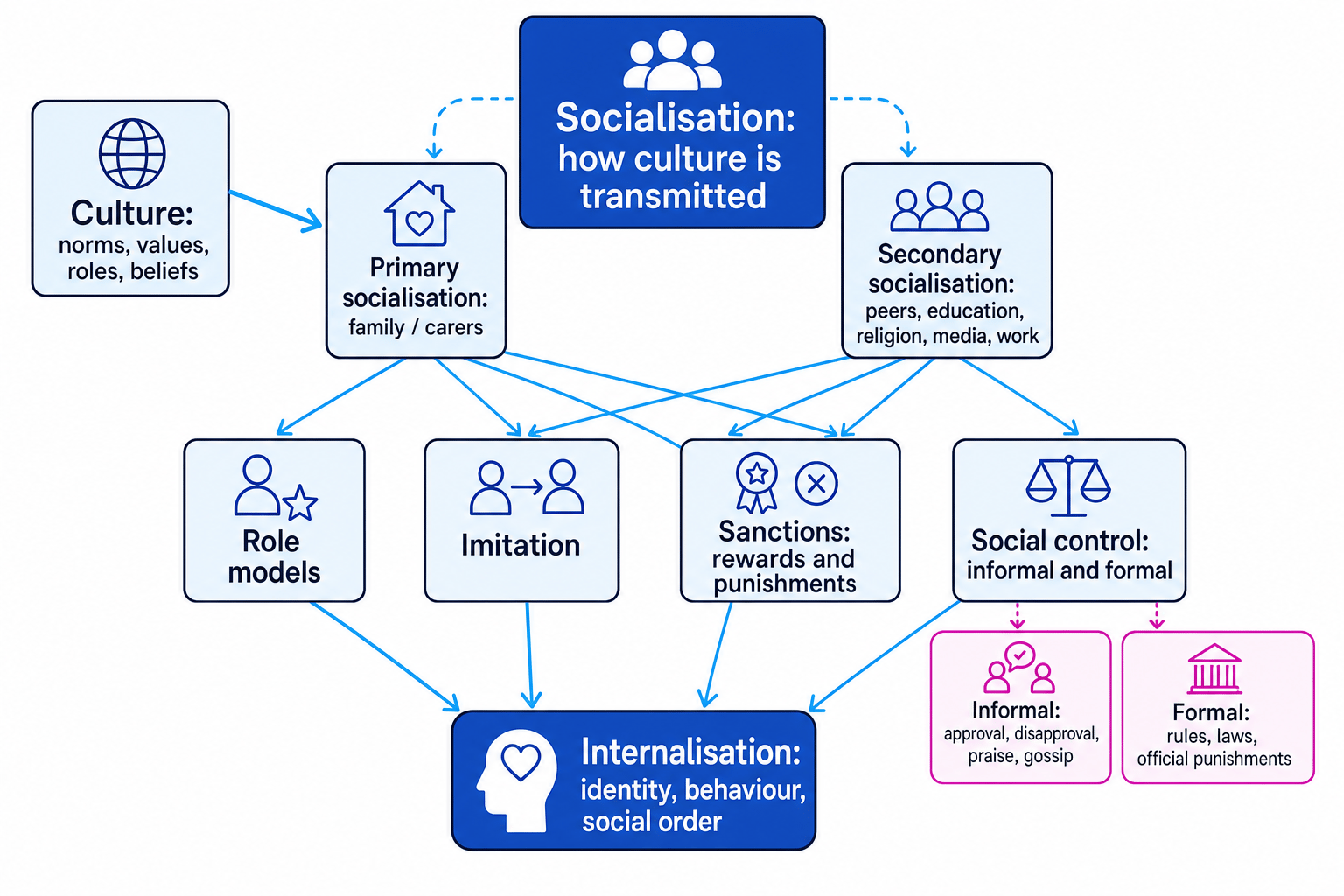
Socialisation is the link between culture and identity: society teaches you ways of thinking and behaving, but you also interpret, resist and reshape those messages.
Cultural transmission and internalisation
Cultural transmission means passing culture from one generation or group to another. For example, children may learn a home language, religious traditions, gender expectations, class-based tastes, or ideas about politeness from those around them.
Internalisation happens when people absorb norms and values so deeply that they feel natural or “just common sense”. For instance, you may not need to be told not to shout in a library because the norm of quiet behaviour has become internalised.
This is where power matters. If the culture being transmitted mainly reflects the interests of powerful groups, socialisation may reproduce inequality rather than simply create harmony.
How socialisation happens
Role models and imitation
A role model is someone whose behaviour is copied or used as a guide. Imitation means copying another person’s behaviour, language, style or attitude.
This can happen consciously or unconsciously. A child may copy a parent’s accent, a teenager may copy a celebrity’s fashion, or a new employee may copy how experienced colleagues speak to managers.
Bandura’s social learning theory, developed from studies such as the Bobo doll experiments, is useful here because it shows how people can learn behaviour by observing others, especially when that behaviour appears rewarded.
Sanctions: rewards and punishments
Sanctions
Sanctions are responses to behaviour that encourage people to conform to social expectations. Positive sanctions reward behaviour, while negative sanctions discourage it.
Examples of positive sanctions include praise, smiles, good grades, promotions and likes on social media. Examples of negative sanctions include being told off, being laughed at, detention, exclusion, fines or dismissal from work.
Sanctions do not have to be dramatic. Often, tiny reactions — a raised eyebrow, silence, embarrassment, approval from friends — are enough to guide behaviour.
Social control
Social control
Social control refers to the ways society regulates people’s behaviour and encourages conformity to norms and values.
Informal social control happens through everyday relationships and unofficial reactions, such as praise, gossip, teasing, peer pressure, family disapproval or social media comments.
Formal social control happens through official rules and organisations, such as schools, workplaces, the police, courts, prisons, government agencies and written policies.
Applying socialisation processes to school behaviour
Imagine a Year 12 student starts arriving late to lessons after joining a friendship group that treats lateness as funny.
- The agency of socialisation is the peer group because the student is being influenced by friends outside the family.
- The group provides role models: other students act as examples of how to behave, making lateness seem acceptable.
- The student may use imitation by copying the group’s behaviour to gain belonging and status.
- Informal sanctions may come from peers laughing and approving, while formal sanctions may come from the school through attendance warnings or detentions.
- Sociologically, this shows a conflict between agencies: peer culture may encourage behaviour that school culture tries to control.
Primary does not mean 'most important forever'
Primary socialisation means early socialisation, usually through family or carers. It is often very powerful, but later agencies such as peers, media, education and work can also strongly shape identity.
Primary socialisation: families and carers
Primary socialisation
Primary socialisation is the first stage of socialisation, usually taking place in early childhood through families, carers and close household relationships.
Families transmit culture in very practical ways: language, table manners, hygiene, religious practices, gender expectations, emotional expression, ideas about education, and attitudes towards authority.
Parsons argued that the family performs the function of primary socialisation, teaching children the basic norms and values needed for social order. From a functionalist view, this helps society work smoothly because people learn shared expectations.
However, feminist sociologists argue that family socialisation can reproduce patriarchy. Oakley described gender socialisation through processes such as encouraging different toys, activities and forms of behaviour for boys and girls. For example, girls may be praised for being caring, while boys may be encouraged to be tough or independent.
Bourdieu’s concept of habitus is also useful. Habitus means deeply learned habits, tastes and dispositions linked to social class. A middle-class child may grow up seeing university as “normal”, while a working-class child may receive different messages about work, authority or ambition — not because one family cares more, but because families occupy different class positions.
Tracing primary socialisation in a family
A child is praised at home for speaking politely to older relatives and is corrected when interrupting adults.
- The value being transmitted is respect for elders, while the norm is waiting your turn before speaking.
- The agency is the family, so this is primary socialisation because it occurs early in close household relationships.
- Praise works as a positive informal sanction, while correction works as a negative informal sanction.
- If the child later behaves politely without being reminded, the norm has become internalised.
- Evaluation: this may create social order, as functionalists argue, but it may also teach obedience to authority, which conflict theorists would question.
Secondary socialisation: beyond the family
Secondary socialisation
Secondary socialisation is the lifelong process of learning norms, values and roles through agencies outside the family, such as peers, education, religion, media and work.
Peers
A peer group is a group of people of similar age or status. Peers are especially important in youth identity because they influence music taste, slang, fashion, relationships, risk-taking and ideas of popularity.
Willis’s study of working-class “lads” showed how peer culture can resist school authority. This is useful because it reminds you that socialisation is not always about passive conformity. Young people may create their own subcultures and reject adult expectations.
Education
Schools socialise students through the formal curriculum, meaning official subjects and lessons, and the hidden curriculum, meaning the unofficial lessons learned through school routines, rules and relationships.
Durkheim argued that education creates social solidarity by teaching shared values. Parsons saw schools as a bridge between family and wider society, teaching achievement and universal standards. For example, students are judged by grades rather than by family background — at least in theory.
Marxists such as Bowles and Gintis argue that schools prepare students for capitalist work through the correspondence principle: school routines mirror workplace expectations, such as punctuality, obedience, hierarchy and external rewards.
In contemporary UK society, examples include school rules on uniform, attendance, behaviour policies, anti-bullying rules, RSE/RSHE, safeguarding, and assemblies promoting shared values. These all socialise students into expected forms of citizenship and conduct.
Religion
Religion can transmit beliefs about morality, family life, gender, sexuality, community and authority. Religious socialisation may happen through worship, prayer, festivals, dress codes, dietary rules, rites of passage and religious education.
For example, a young person raised in a Muslim, Christian, Hindu, Sikh, Jewish or Buddhist household may learn specific practices and moral frameworks. Religion can also provide community identity and informal social control through approval, shame or expectations of duty.
Evaluation is important: secularisation theorists argue that religion has become less influential in many areas of UK life, but religion still matters for many communities and can shape identity strongly, especially around life events, schooling and family traditions.
Media
The media include television, film, newspapers, advertising, music, gaming, streaming platforms and social media. Media socialisation is powerful because it offers role models, lifestyles and repeated images of gender, class, ethnicity, age, sexuality and disability.
For example, influencers may shape beauty standards, fitness ideals, political views or consumer habits. News coverage can influence ideas about crime, immigration, protest or poverty. Social media algorithms can intensify this by repeatedly showing similar content.
However, audiences are not simply brainwashed. Interactionist and postmodern approaches stress that people actively interpret media messages. Two people can watch the same programme and take completely different meanings from it.
Work
Work socialises people into occupational roles. An occupation is a paid job or profession, and occupational socialisation means learning the expected behaviour, language, dress, hierarchy and values of a workplace.
Examples include learning how to speak to customers, follow health and safety rules, accept supervision, meet deadlines and fit into workplace culture. Formal control may involve contracts, policies and disciplinary procedures. Informal control may involve workplace jokes, gossip, praise, exclusion or pressure to “fit in”.
Foucault’s ideas about surveillance are useful here: people often regulate themselves because they know they might be observed, assessed or recorded.
Formal and informal social control compared
| Type of control | Who carries it out? | Examples | Why it matters sociologically |
|---|---|---|---|
| Informal social control | Family, friends, peers, neighbours, online communities | Praise, gossip, embarrassment, peer pressure, approval | Shows how everyday interaction shapes identity and conformity |
| Formal social control | Schools, workplaces, police, courts, government | Detention, exclusion, fines, prison, dismissal | Shows how institutions use official power to enforce rules |
Quick distinction
If the response comes from everyday relationships, it is usually informal. If it comes from an official organisation using written rules, it is usually formal.
Key sociological debates
Consensus versus conflict
Functionalists such as Durkheim and Parsons see socialisation mainly as positive. It creates shared values, cooperation and social order.
Conflict theories disagree. Marxists argue that socialisation can reproduce class inequality by teaching people to accept capitalism. Feminists argue that it can reproduce gender inequality by normalising patriarchy. These perspectives ask: whose norms and values are being transmitted?
Structure versus agency
Structure means the wider social forces that shape people’s lives, such as class, gender, ethnicity, institutions and laws. Agency means people’s ability to make choices and act independently.
Socialisation shows both. You are shaped by family, school, media and work, but you are not a robot. You can question, resist, reinterpret and combine different cultural messages.
Researching socialisation
Sociologists may study socialisation using observations, interviews, questionnaires, content analysis of media, or official statistics on patterns such as school exclusions or employment.
There are practical, ethical and theoretical issues. Observing families or schools may produce valid, detailed data, but access and consent can be difficult, especially with children. Surveys may be more reliable and easier to repeat, but they may miss the meanings people attach to their behaviour. Interpretivists often prefer methods that capture lived experience, while positivists may prefer methods that identify patterns across larger groups.
In the exam
- Define the key term first: if asked about socialisation, start with culture, norms, values and agencies rather than jumping straight to examples.
- Use the agency-process link: name the agency, explain the process, then apply it — for example, “media use role models and informal sanctions through likes and comments”.
- Evaluate with perspectives: functionalists stress social order; Marxists stress class power; feminists stress patriarchy; interactionists stress active interpretation and identity negotiation.
Check yourself
- What is the difference between primary and secondary socialisation?
- How can the same behaviour be shaped by both informal and formal social control?
- Why might Marxists and feminists criticise functionalist views of socialisation?