What you'll learn
- How to distinguish personal identity from social identity.
- How socialisation shapes gender, class, ethnic and national identities.
- How to apply sociological theories and studies to contemporary UK examples.
- How to evaluate: identity is powerful, but people also resist, reinterpret and change it.
Starting point: what is socialisation?
Socialisation
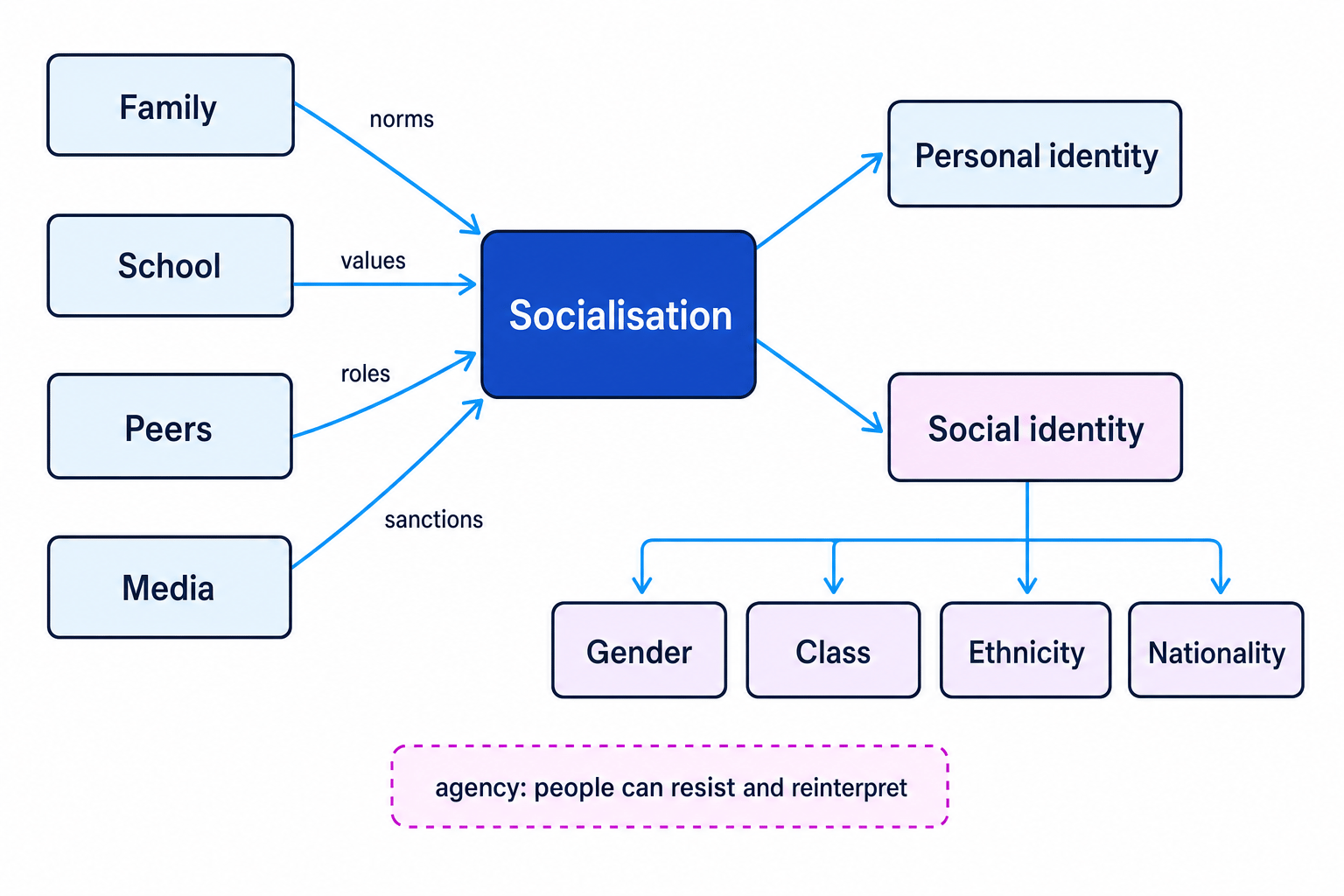
Socialisation is the lifelong process through which people learn the norms, values, roles and expectations of their society or social group.
A norm is an expected pattern of behaviour, such as saying “please” or dressing appropriately for school. A value is a deeper belief about what is important, such as respect, success, equality or loyalty. A role is a set of expectations attached to a position, such as “student”, “parent”, “friend” or “citizen”. Sanctions are rewards or punishments that encourage conformity, such as praise, teasing, exclusion or school discipline.
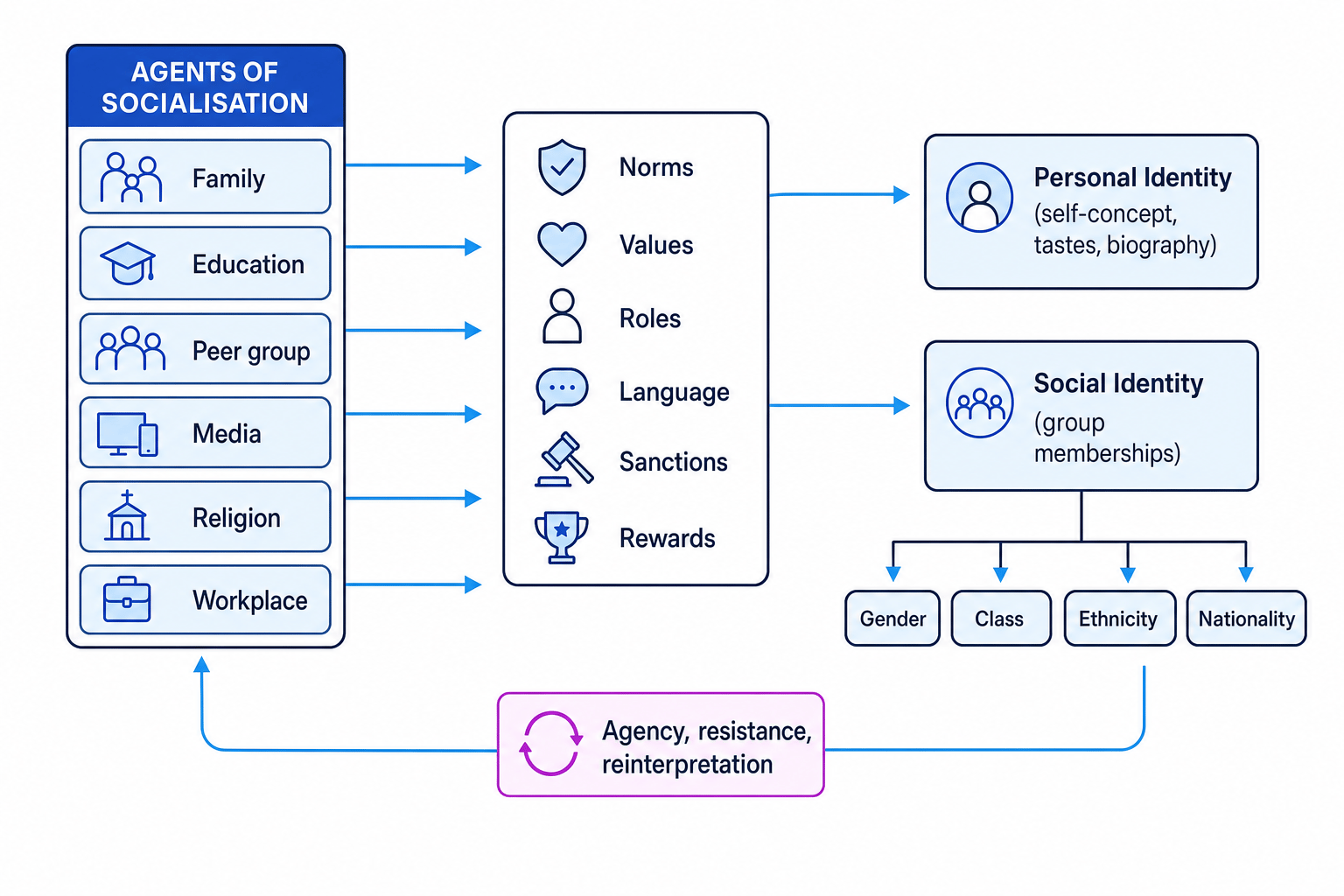
Sociologists often distinguish primary socialisation, which happens in early childhood mainly through the family, from secondary socialisation, which happens through schools, peers, media, religion, work and wider society. Socialisation does not simply “program” you: people have agency, meaning the capacity to make choices, resist expectations and reinterpret meanings.
This diagram shows the basic sociological chain: agents of socialisation pass on norms and values, which shape both personal and group identities.
Identity is learned and negotiated
Your identity is partly shaped by social forces, but it is not fixed. Sociology is interested in the tension between structure — the patterns and inequalities that shape people — and agency — people’s ability to respond creatively.
Personal and social identity
Identity means your sense of who you are. It includes how you see yourself and how others see you.
Personal identity refers to the features that feel individual to you: your personality, memories, tastes, ambitions and life story. Social identity refers to the groups you belong to or are seen as belonging to, such as gender, class, ethnicity, nationality, religion, sexuality or age.
Some identities are linked to ascribed status, meaning positions largely given at birth, such as family background or ethnicity. Others are linked to achieved status, meaning positions gained through action or choice, such as occupation, qualifications or political identity.
Symbolic interactionists such as Mead (1934) argue that the self develops through interaction: we learn to see ourselves from the viewpoint of others. Cooley (1902) called this the “looking-glass self”: we build self-concepts by imagining how others judge us.
Tracing personal and social identity
- A student describes herself as “Welsh, Muslim, working-class, confident, sporty and into K-pop”. “Welsh”, “Muslim” and “working-class” are mainly social identities because they connect her to recognised groups.
- “Confident”, “sporty” and “into K-pop” are closer to personal identity, but they are still socially shaped: confidence may be encouraged by family, sport by school, and music taste by peer groups and media.
- A sociological explanation would link the identity claim to agents of socialisation: family may pass on religion, school may promote Welsh identity, peers may influence taste, and media may shape style.
- An evaluation would add that she is not passively shaped. She may combine these influences in a unique way, showing agency and a hybrid identity.
Gender identity
Sex usually refers to biological categories, while gender refers to the socially learned expectations attached to being seen as masculine, feminine, both or neither. Gender identity is a person’s sense of themselves in relation to gender.
Feminist sociologists argue that gender identity is strongly shaped by socialisation. Oakley (1972) identified ways families produce gender roles: canalisation means directing children towards gender-typed toys and activities; verbal appellations means using labels such as “pretty girl” or “brave boy”; manipulation means encouraging gendered appearance or behaviour; and different activities means expecting boys and girls to do different tasks.
Schools may reinforce gender through uniform rules, subject expectations, sport, teacher attention and peer policing. Media can promote idealised femininities and masculinities through influencers, advertising, gaming, music and reality TV. Connell (1995) argued that societies often privilege hegemonic masculinity, a dominant model of manhood associated with toughness, heterosexuality, authority and emotional control.
Treating gender as simply biological
In sociology, do not reduce gender identity to biology. You can mention biology if relevant, but the focus here is on how social expectations are learned, rewarded, challenged and changed.
Explaining gender identity through socialisation
- If a boy is praised for being “strong” but mocked for crying, family and peer groups are using sanctions to connect masculinity with emotional control.
- If school sport gives more status to football than dance, the school may reproduce a gendered hierarchy of activities, making some identities seem more “normal” or respected than others.
- If social media influencers link femininity to beauty work, consumption and body image, media socialisation may shape how girls understand acceptable femininity.
- AO3 evaluation: this influence is powerful, but not total. Equality policies such as the Equality Act 2010, feminist campaigns, LGBTQ+ visibility and individual agency can challenge traditional gender socialisation.
Class identity
Social class refers to social divisions based on economic position, occupation, education, wealth, lifestyle and power. Class identity is not only about income; it is also about accent, taste, confidence, neighbourhood, school experience and expectations for the future.
Bourdieu (1984) argued that class is reproduced through different forms of capital. Economic capital means money and assets. Cultural capital means valued knowledge, tastes, qualifications and ways of speaking. Social capital means useful networks and connections. Bourdieu also used the term habitus to mean the deeply learned dispositions — habits, tastes and expectations — that feel natural to us because of our social background.
For example, a middle-class child may be socialised into feeling comfortable speaking to teachers, visiting museums or expecting university as normal. A working-class child may develop different strengths, loyalties and forms of cultural knowledge, but these may be less valued by schools and employers.
Willis (1977) studied working-class “lads” who developed an anti-school culture. Their peer-group identity gave them status in the short term, but it also helped reproduce class inequality because it pushed them towards working-class jobs.
Applying class socialisation
- A student with parents who attended university may hear higher education discussed as ordinary, so university becomes part of their expected future identity.
- A student from a family with insecure work may be socialised into valuing immediate earnings, practical skills or loyalty to local networks, shaping a different class identity.
- Bourdieu helps explain why the first student’s cultural capital may be rewarded in school interviews, essays and confidence with authority.
- AO3 evaluation: class socialisation matters, but it is not destiny. Scholarships, teachers, peer groups, online learning and personal ambition can disrupt class patterns.
Ethnic identity
Ethnicity refers to a shared cultural identity linked to ancestry, language, religion, traditions, history and sometimes experiences of migration or racism. It is not the same as “race”. Many sociologists see race as a socially constructed category, while racialisation means the process by which people are given racial meanings and treated differently because of them.
Ethnic identity is often socialised through family stories, food, language, religious practice, names, clothing, festivals and community networks. For example, a British Pakistani teenager may learn Urdu or Punjabi phrases at home, attend mosque, celebrate Eid and also share youth culture through TikTok, school and friends.
Hall (1996) argued that cultural identities are not fixed essences; they are produced through history, representation and difference. This is useful because ethnic identities in the UK are often hybrid: people may be Black British, British Asian, Welsh Somali, Irish Traveller, mixed heritage, or identify differently depending on context.
Ethnic identity can also be shaped by power. Racism, Islamophobia, antisemitism or stereotyping can force people to become more aware of their ethnicity. Goffman (1963) used the idea of stigma to describe how some identities are socially discredited. However, ethnic identity can also be a source of pride, resistance and community solidarity.
Nationality and national identity
Nationality can mean legal membership of a state, such as citizenship, but national identity means a sense of belonging to a nation, such as Welsh, Scottish, English, British or another national community.
Anderson (1983) described nations as “imagined communities” because most members will never meet, yet they imagine themselves as connected through shared symbols, history, language and media. Billig (1995) used the term banal nationalism for everyday reminders of nationhood, such as flags, passports, weather maps, sporting events, national anthems and news language like “we” or “our country”.
In Wales, national identity may be socialised through the Welsh language, local history, rugby, the Eisteddfod, place-based belonging and schooling. In the wider UK, citizenship education, Remembrance events, the monarchy, political debates and media coverage can all shape British identity. Globalisation, migration and social media complicate this: people may feel attached to more than one nation.
Distinguishing ethnicity and nationality
- A student who identifies as “Black Welsh” is combining an ethnic identity with a national identity; the two are connected but not identical.
- Their ethnic identity may be socialised through family history, racialised experiences, music, food, religion or community networks.
- Their Welsh national identity may be socialised through school, language, sport, local place and public symbols such as the Senedd or St David’s Day.
- AO3 evaluation: this shows why identity is intersectional. A simple label like “Welsh” may hide differences of ethnicity, class, gender and power.
Bringing the identities together: intersectionality
Intersectionality means that identities and inequalities combine rather than operating separately. The term is associated with Crenshaw (1989). For example, the socialisation of a middle-class white girl may differ from that of a working-class Black girl, even though both experience gender socialisation.
This matters for AO3 because it helps you avoid one-factor explanations. Gender, class, ethnicity and nationality overlap in real lives. A strong answer should show how socialisation shapes identity while recognising diversity, conflict and agency.
Build an AO1–AO2–AO3 chain
For each paragraph, link an agent of socialisation to a mechanism, then to an identity outcome, then evaluate. For example: family expectations → gendered sanctions → feminine identity → challenged by peer culture or feminist media.
Researching identity: a quick methods link
Sociologists use different methods to study identity. Interviews and ethnography can give high validity, meaning they capture meanings in depth, but small samples may reduce representativeness. Questionnaires and official statistics can show broad patterns, but they may simplify complex identities into fixed categories.
Methodological evaluation is useful in essays. Willis’s ethnography gives rich insight into class identity, but it was based on a small group of boys in a particular context. Census categories can help track ethnic and national identification, but categories change over time and may not match how people describe themselves.
Identity categories are not neutral
Categories such as “class”, “ethnicity” and “nationality” are useful for analysis, but they are also socially constructed. Always be careful not to treat them as fixed, natural or the same for everyone.
In the exam
- Define the identity dimension clearly, then name at least one agent of socialisation shaping it.
- Use specific UK examples: schools, social media, Welsh identity, classed accents, religious festivals, sport, or the Equality Act 2010.
- Evaluate by adding agency, diversity, intersectionality, or a comparison between theories such as feminism, interactionism and Bourdieu’s class analysis.
Check yourself
- Can you explain the difference between personal identity and social identity using your own example?
- How might family, school and media each shape gender identity differently?
- Why is it too simple to explain someone’s identity using only class, ethnicity, gender or nationality on its own?