What you'll learn
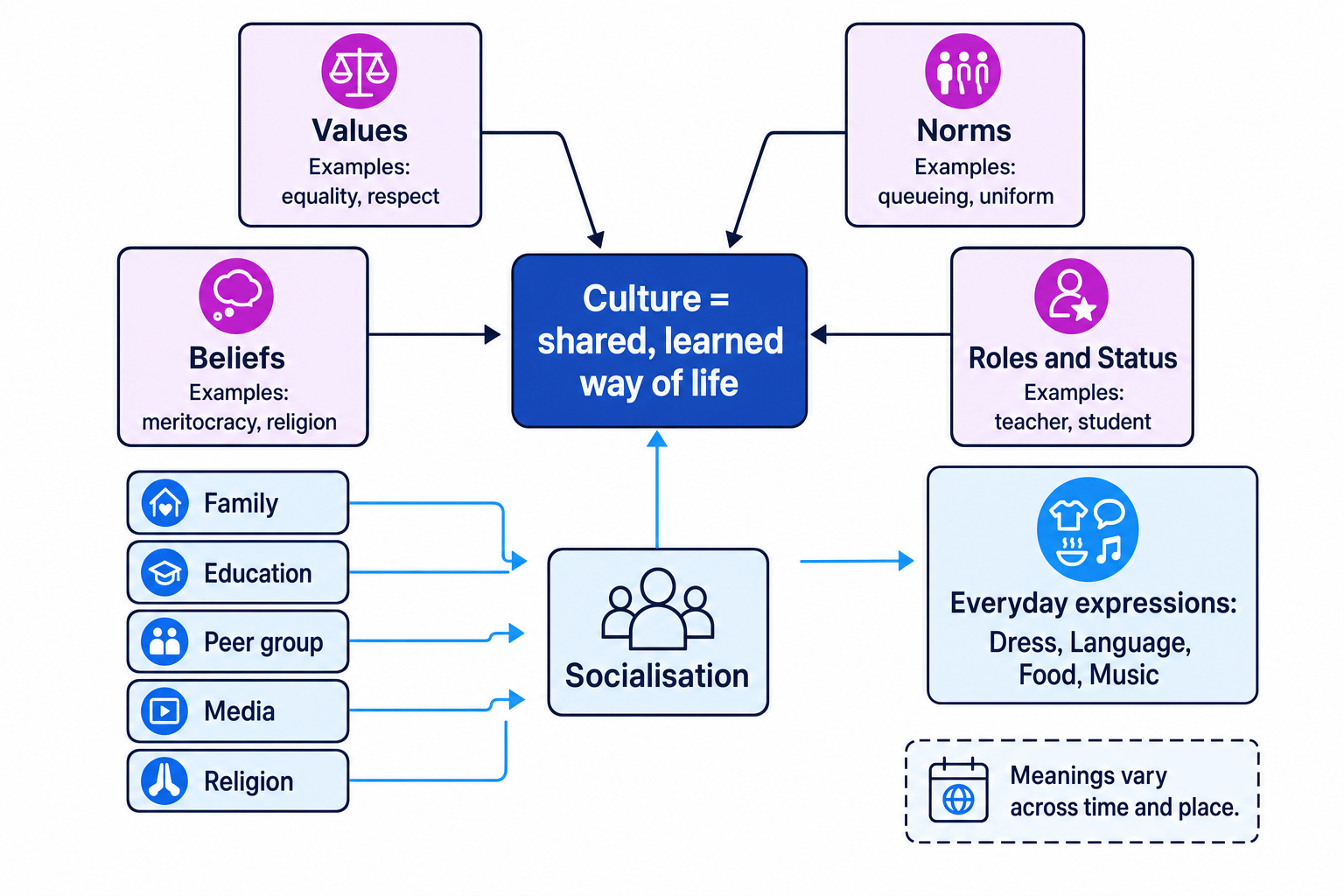
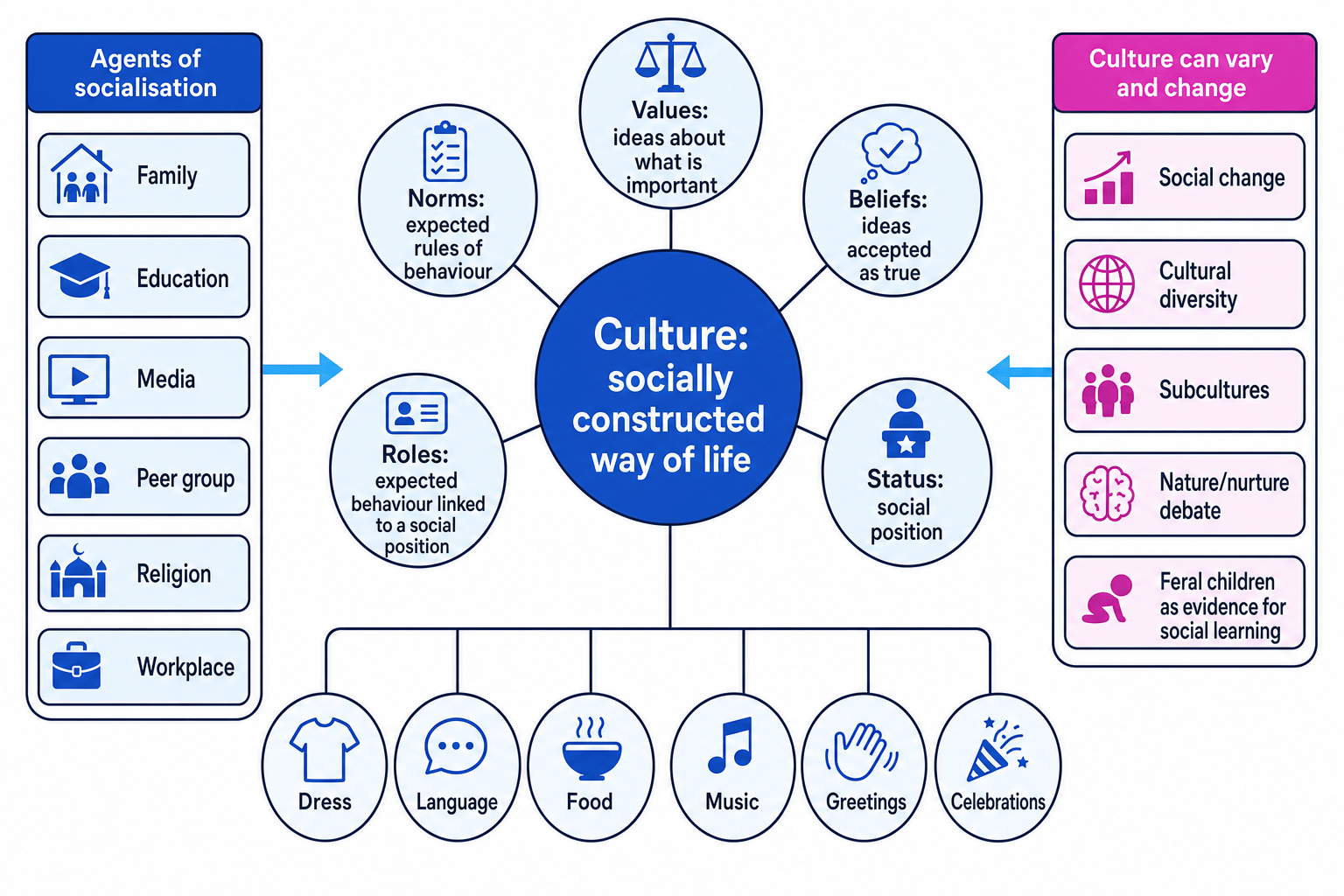
- How sociologists define culture, norms, values, beliefs, roles and status.
- Why culture is described as socially constructed, not simply natural or biological.
- How dress, language, food and music show cultural diversity in contemporary UK society.
- How to evaluate culture using evidence from socialisation, feral children, subcultures and the nature/nurture debate.
Start with culture as a “way of life”
In everyday conversation, people sometimes use “culture” to mean art, theatre or classical music. In sociology, it is much broader. Culture means the whole learned way of life of a group: how people speak, dress, eat, celebrate, worship, work, show respect and make sense of the world.
Raymond Williams described culture as a “whole way of life”. This is useful for A-Level Sociology because it reminds you that culture is not just “high culture” such as opera or museums. It includes ordinary everyday practices, like queueing, school uniforms, slang, takeaway food, football chants, TikTok trends and wedding traditions.
Culture
Culture means the shared and learned way of life of a social group, including its behaviour, language, symbols, values, norms and beliefs.
A social group is any collection of people who share some form of identity or interaction, such as a family, school, religious community, nation, workplace or youth group. A symbol is something that carries shared meaning, such as a flag, wedding ring, school badge, hairstyle or emoji.
Culture is learned through socialisation, which means the process by which people learn the norms and values of society. Primary socialisation happens early in life, mainly through family or close carers. Secondary socialisation happens later through institutions such as education, peer groups, media, religion and the workplace. A social institution is an organised part of society that shapes behaviour, such as the family, school system or media.
The big idea
Culture is not something people are born knowing. Sociologists argue that people learn culture through socialisation, and then often treat it as if it is “normal” or “natural”.
The building blocks of culture
To write clearly about culture, you need a few core concepts.
| Concept | Meaning | Example |
|---|---|---|
| Values | General ideas about what is important, good or desirable. | Equality, achievement, independence, respect for elders. |
| Norms | Expected rules of behaviour in a group or society. | Saying “please”, wearing uniform, not pushing into a queue. |
| Beliefs | Ideas that people accept as true. | Religious beliefs, belief in meritocracy, belief that education improves life chances. |
| Roles | Expected behaviour attached to a social position. | A teacher is expected to teach; a student is expected to learn. |
| Status | A social position someone occupies. | Student, parent, doctor, teenager, friend, employee. |
A sanction is a reward or punishment used to encourage people to follow norms. Sanctions can be formal, such as school detentions or laws, or informal, such as praise, gossip, embarrassment or being excluded from a friendship group.
Linking values, norms, roles and status
-
Start with the value: many schools value discipline, achievement and respect.
-
That value becomes norms: students are expected to arrive on time, complete work, follow dress codes and listen when others speak.
-
These norms attach to a status: the status “student” comes with the role of learner, class member and exam candidate.
-
Sanctions reinforce the culture: praise, grades and rewards encourage conformity, while detentions or teacher disapproval discourage rule-breaking.
Norms and values are not the same
A value is a broad idea, such as respect. A norm is the specific behaviour expected because of that value, such as listening when someone else is speaking.
Aspects of culture: dress, language, food and music
Culture becomes visible through everyday practices.
Dress
Dress is cultural because clothing carries social meanings. A suit may suggest professionalism; a school blazer may suggest membership; religious dress may express faith and identity. What counts as “smart”, “modest”, “rebellious” or “appropriate” varies across societies and over time.
Language
Language is not just communication. It also marks identity, belonging and power. Accent, slang, dialect and code-switching can show region, class, ethnicity, age or peer-group membership. In Wales, the Welsh language is also linked to national identity and cultural preservation.
Food
Food is cultural because societies attach meanings to what, when and how people eat. Examples include halal diets, vegetarianism, veganism, Sunday roasts, school meals, food at religious festivals and regional foods. Food can also link to stratification, because income affects diet, choice and access to healthy food.
Music
Music can express identity and group belonging. Genres such as grime, drill, punk, bhangra, metal, K-pop or gospel can be linked to youth culture, ethnicity, religion, class, politics or resistance. Music is also shaped by media industries and streaming platforms, so it links culture to power and capitalism.
What does “social construction” mean?
A social construction is something that people create, define and give meaning to through social interaction. It does not mean it is imaginary or unimportant. It means its meaning is made by society rather than fixed by nature.
Social construction
Social construction means the process by which meanings, categories and practices are created, learned and treated as real through social interaction and social institutions.
For example, all humans have bodies, but ideas about “appropriate” clothing for men, women, adults, children, workers or students are socially constructed. They change across time and place. Pink was not always seen as a “girls’ colour”, and many schools and workplaces now debate gender-neutral uniform policies.
Analysing school uniform as socially constructed
-
Separate the biological need from the cultural meaning: humans need clothing for warmth and protection, but a blazer, tie or branded jumper is not biologically required.
-
Identify the shared meanings: uniform can symbolise school membership, discipline, equality, respectability and the student role.
-
Show variation and change: different schools, countries and time periods have different uniform rules, and some schools have changed policies around gender, religion or cost.
-
Evaluate power: uniform may create belonging and reduce visible class differences, but it can also discipline bodies, restrict self-expression and create financial pressure for low-income families.
Socially constructed does not mean fake
Money, gender roles, school rules and national borders are socially constructed, but they still have very real effects on people’s lives.
Nature, nurture and feral children
The nature/nurture debate asks how far human behaviour is shaped by biology or by social environment. Nature means biological or genetic influences. Nurture means learning, upbringing, socialisation and environment.
Sociologists usually emphasise nurture. This does not mean biology is irrelevant. Humans have biological needs, such as food, sleep and communication. However, culture shapes how those needs are organised and understood. People need food, but whether they eat with chopsticks, hands, knives and forks, or avoid certain foods for religious reasons is cultural.
Feral children are often used to illustrate the importance of socialisation. A feral child is a child who has had very limited human contact and has not experienced normal socialisation. Cases such as “Genie” in the United States, studied by Susan Curtiss in the 1970s, and Oxana Malaya in Ukraine suggest that language, emotional development and social behaviour depend heavily on early human interaction.
Feral children evidence is limited
Feral children are rare case studies, meaning detailed investigations of one person or situation. They cannot be ethically repeated, and it is difficult to separate the effects of isolation, trauma, abuse, disability and lack of education.
Ann Oakley’s work on gender socialisation is also useful here. Oakley argued that children learn gender roles through processes such as encouragement, toys, language and different expectations. This supports the idea that many behaviours people call “natural” may actually be culturally taught.
Cultural diversity and subcultures
Not everyone in a society shares exactly the same culture. Cultural diversity means the existence of different cultural practices, beliefs and identities within or between societies. Contemporary UK society includes diversity by ethnicity, religion, class, gender, sexuality, age, region, disability and nationality.
Cultural diversity and subculture
Cultural diversity means variety in cultural practices and identities. A subculture is a group within wider society that has distinctive norms, values, language, dress or behaviour.
Examples of subcultures include goths, punks, football supporter groups, gamers, religious youth groups, LGBTQ+ communities, skateboarding cultures and music-based groups. A counterculture is a subculture that openly challenges dominant norms and values, such as some protest movements.
A dominant culture is the culture treated as mainstream or “normal”, often because it is backed by powerful institutions such as education, media, law and government. This links culture to power and stratification, because some groups’ language, dress and lifestyles are given higher status than others.
Pierre Bourdieu’s concept of cultural capital is helpful here. Cultural capital means the knowledge, tastes, language and behaviour that are valued by powerful institutions. For example, middle-class speech styles, confidence with formal interviews, or familiarity with certain books and activities may be rewarded in education and employment.
Deciding whether a group is a subculture
-
Identify distinctive cultural features: a grime music scene may have particular slang, fashion, performance spaces, online platforms and musical conventions.
-
Connect these features to shared meanings: members may use the music to express local identity, youth experience, racialised inequality or resistance.
-
Compare with wider society: if the group’s style and values differ from mainstream expectations, it can be analysed as a subculture.
-
Evaluate power and labelling: media or police responses may stigmatise the group, while commercial industries may also profit from its style.
Use cultural relativism
Cultural relativism means trying to understand a culture in its own context rather than judging it by your own culture’s standards. The opposite is ethnocentrism, which means judging other cultures as inferior or strange because they differ from your own.
How different sociological perspectives view culture
Functionalism
Functionalists such as Durkheim and Parsons see shared culture as important for social order. Durkheim argued that societies need a collective conscience: shared beliefs and moral values that bind people together. Parsons argued that socialisation creates value consensus, meaning broad agreement about society’s main values.
Evaluation: This explains why shared norms can create stability, but it can underplay conflict and ignore whose values dominate.
Marxism and conflict approaches
Marxists argue that culture can support inequality. The ruling class may promote ideas that make capitalism seem natural or fair. For example, the belief in meritocracy can encourage people to see success as purely individual, even when class background affects life chances.
Evaluation: This highlights power, ideology and stratification, but it can make people seem too passive and may underestimate resistance, creativity and cultural diversity.
Feminism
Feminists argue that culture often constructs gender roles in ways that support patriarchy, meaning male dominance in society. Cultural expectations around appearance, caring, sexuality and emotion can shape what is seen as “normal” for women and men.
Evaluation: This is strong for analysing gender socialisation, but feminists also debate differences by class, ethnicity, sexuality and age.
Interactionism
Interactionists such as Mead and Goffman focus on everyday meanings. Mead argued that the self develops through interaction with others. Goffman argued that people perform roles in social situations, like actors managing impressions.
Evaluation: This is useful for understanding identity and face-to-face behaviour, but it may pay less attention to large-scale inequalities.
A quick methods link
Sociologists study culture using different methods. Qualitative methods, such as interviews and observation, can produce high validity, meaning they capture detailed meanings and experiences. However, they may have lower representativeness, meaning the people studied may not reflect the wider population.
Official statistics, meaning government-collected data such as the Census, can show broad patterns in language, religion, ethnicity and national identity. They can be reliable, meaning consistent and repeatable, but they may simplify fluid identities into fixed categories.
A positivist approach favours measurable, reliable patterns, while an interpretivist approach prioritises meanings, experiences and context. For culture, interpretivist methods are often valuable because culture is about meaning.
In the exam
-
Define key terms precisely before applying them: culture, norms, values, beliefs, roles, status, social construction, cultural diversity and subculture.
-
Use concrete examples from contemporary UK society, such as school uniform, Welsh language, food practices, music scenes, religious dress or youth subcultures.
-
Evaluate by comparing perspectives: functionalists stress shared values, while Marxists, feminists and interactionists ask whose culture dominates and how meanings are negotiated.
Check yourself
- How would you explain the difference between a norm and a value using one everyday example?
- Why do feral children support the importance of socialisation, and why is this evidence methodologically limited?
- How can a subculture both create identity and be affected by power or labelling?