What you'll learn
- What sociologists mean by development, and why it is more than “getting richer”.
- The core ideas in modernisation theory, Marxist theory, dependency theory and world-systems theory.
- How to apply these theories to examples such as UK aid, trade, colonialism, debt, TNCs and global supply chains.
- How to evaluate each theory for essay-style answers using AO1, AO2 and AO3.
Starting point: what is “development”?
In World sociology, development is about long-term social, economic and political change. It usually refers to improvements in living standards, health, education, rights, technology, political stability and life chances.
It is not neutral. Different theories disagree about what “progress” means and who benefits from it.
Development
Development means the process through which societies experience improvements in economic production, living standards, health, education, political rights and social wellbeing. Sociologists debate whether development should be measured mainly by wealth, human wellbeing, equality or sustainability.
You will often see the terms Global North and Global South. These are broad labels for patterns of global inequality: the Global North usually refers to richer, more industrialised countries, while the Global South usually refers to poorer or historically colonised countries. They are not perfect labels because there is poverty in rich countries and wealth in poorer countries.
Treating countries as one single type
Avoid writing as if “developed” and “developing” countries are two simple boxes. Countries differ hugely by region, class, gender, ethnicity, state policy, colonial history and position in the global economy.
Measuring development
A common economic measure is Gross Domestic Product, or GDP, meaning the total value of goods and services produced in a country. A wider measure is the Human Development Index, or HDI, used by the United Nations to combine income, education and life expectancy.
Official statistics
Official statistics are numerical data collected by governments or international organisations, such as the World Bank, United Nations or Office for National Statistics. They can be useful for comparing countries, but they may miss informal work, unpaid care, corruption, regional inequality and quality of life.
For Eduqas, this is also a methods issue. GDP data may be reliable because it is collected regularly and can be compared over time, but it may lack validity if it does not really capture people’s lived experience.
Choosing a development indicator
- If you want to compare the size of national economies, GDP is useful because it focuses on production and income.
- If you want to compare life chances, HDI is stronger because it includes education and life expectancy as well as income.
- If you are analysing inequality, neither GDP nor HDI is enough on its own because national averages can hide class, gender, ethnic and regional stratification.
Four big explanations
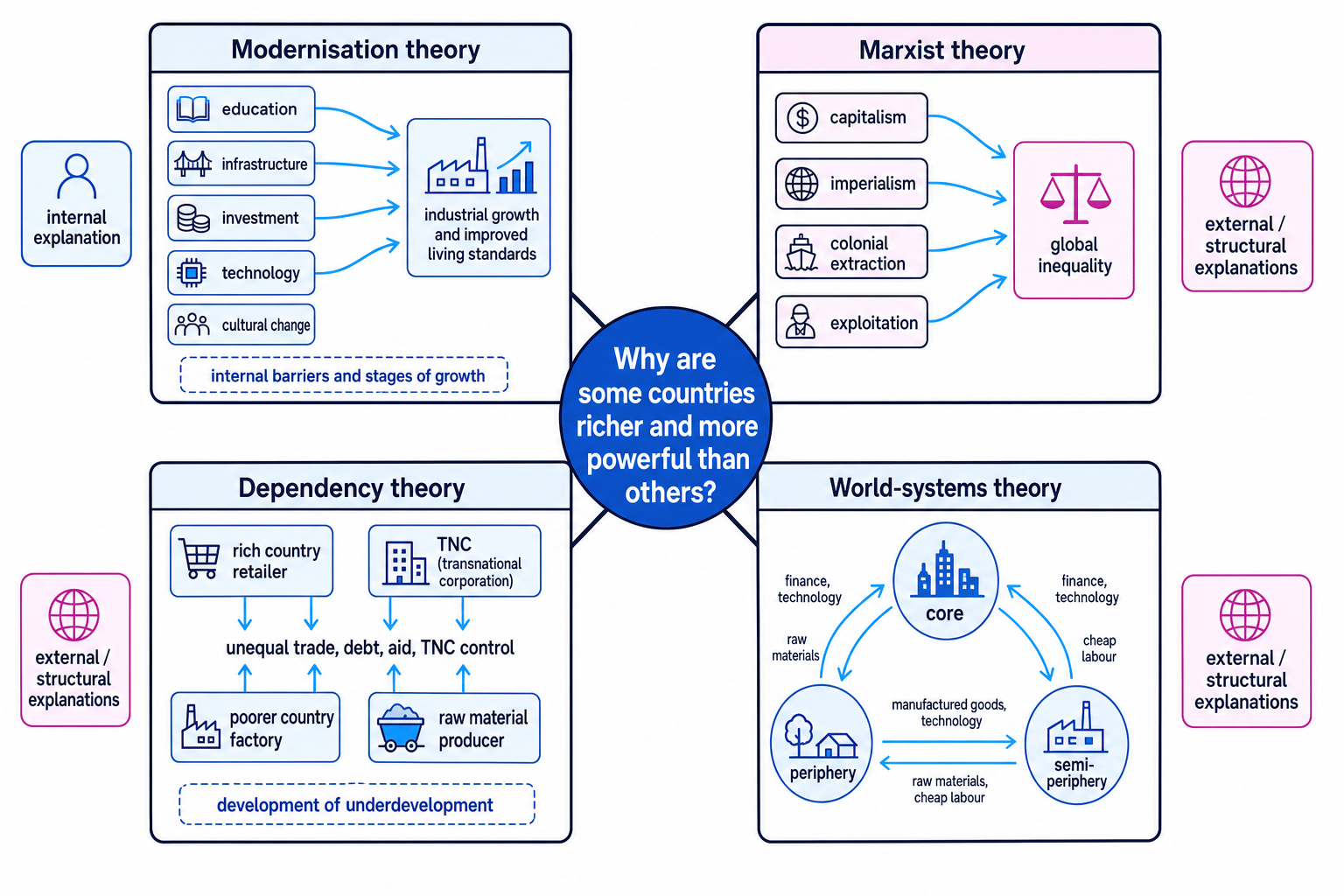
The four theories in this topic ask the same basic question: why are some countries richer and more powerful than others?
Modernisation theory
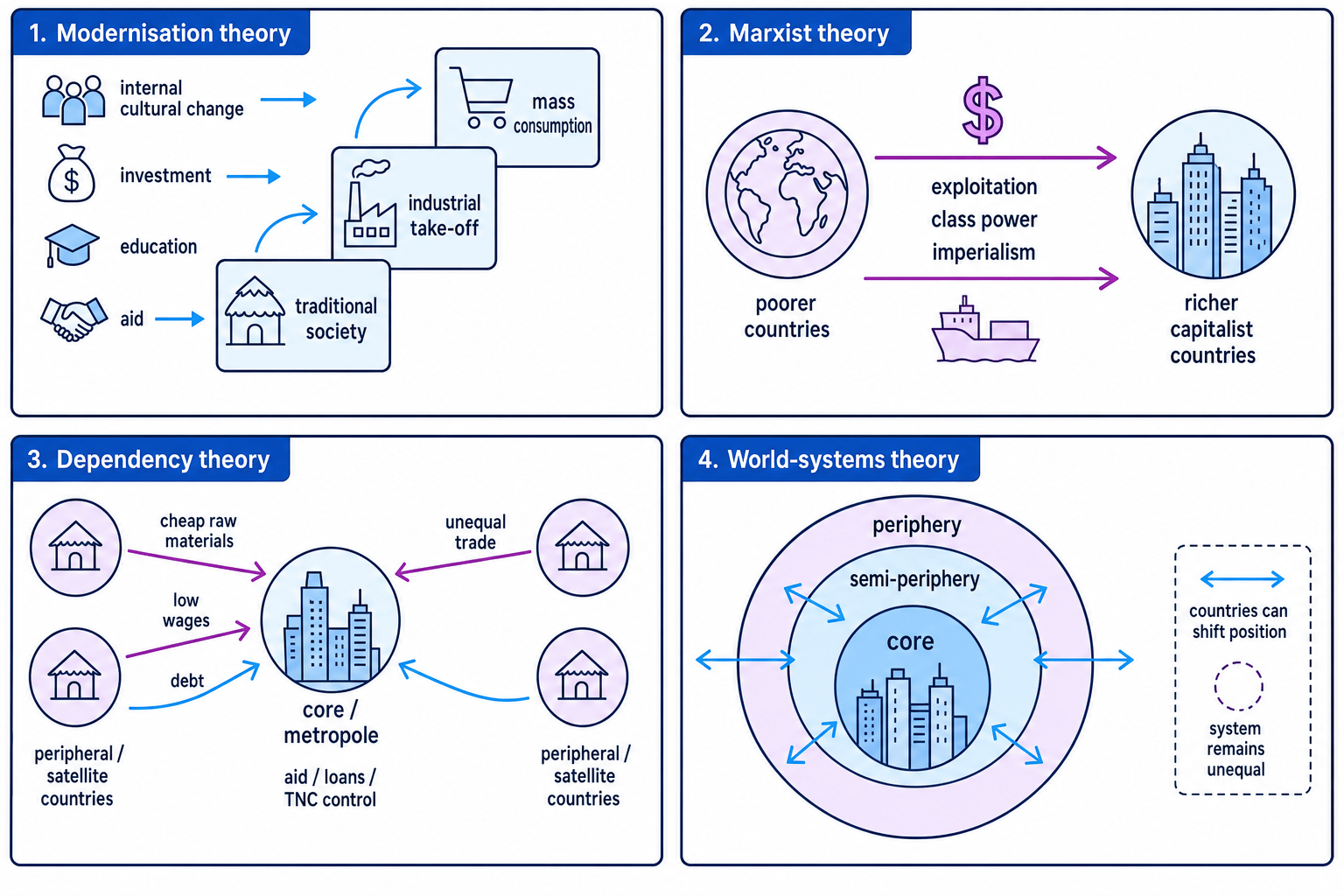
Modernisation theory argues that poorer countries are underdeveloped mainly because they have not yet adopted the economic systems, technologies, institutions and values associated with modern industrial societies.
Modernisation theory
Modernisation theory is a broadly functionalist explanation of development which claims societies move from “traditional” to “modern” through industrialisation, education, investment, science, democracy and cultural change.
The key theorist is Rostow (1960), who argued that countries pass through stages of economic growth. His best-known stage is take-off, where industrialisation becomes self-sustaining and rapid growth begins.
Modernisation theorists often link development to values. Parsons argued that traditional societies are based more on ascribed status, where social position is fixed by birth, family or caste. Modern societies are based more on achieved status, where people gain position through education, work and individual effort.
This connects to the cross-cutting theme of socialisation, culture and identity. Modernisation theory says development requires people to be socialised into modern values such as achievement, individualism, rational planning, entrepreneurship and openness to change.
AO2 examples include UK-funded education projects, vaccination programmes, infrastructure projects, or international aid that promotes schooling for girls. These can be interpreted as attempts to build the skills and institutions needed for development.
Using modernisation theory to explain an aid programme
- A UK-funded programme that builds schools, roads and digital infrastructure can be interpreted as creating the “preconditions for take-off”.
- Modernisation theorists would argue that education and infrastructure increase skills, productivity, communication and investment.
- A critical evaluation would ask whether the programme gives local people control, or whether it spreads Western priorities and donor influence.
Evaluating modernisation theory
Modernisation theory is useful because it highlights real factors that often matter: education, health, infrastructure, stable government and technological innovation. Countries such as South Korea and Singapore are sometimes used as examples of rapid industrial development.
However, it is criticised as ethnocentric, meaning it judges other societies using Western standards. It can imply that poorer countries are responsible for their own poverty because of “traditional” culture, while ignoring colonialism, slavery, unequal trade and global power.
Modernisation in one sentence
Modernisation theory explains development as an internal journey from traditional to modern society, helped by aid, education, investment and cultural change.
Marxist explanations of development
Marxist theory begins with capitalism, an economic system based on private ownership, wage labour and production for profit. Marxists argue that development and underdevelopment are linked because capitalism expands by exploiting labour, land and resources.
Imperialism
Imperialism means domination by one country or group over another, often through empire, military power, trade control, political pressure or economic dependency.
For Marxists, European colonial powers did not simply “help” poorer countries modernise. They extracted raw materials, land, labour and profit. Lenin (1917) described imperialism as a stage of capitalism where powerful capitalist states search for markets, resources and investment opportunities abroad.
Baran (1957) argued that colonialism distorted the economies of poorer countries by making them serve the needs of richer capitalist countries. This links directly to power and stratification: global inequality is not accidental, but produced by class power, state power and ownership of capital.
AO2 examples include Britain’s colonial links with India, the Caribbean and parts of Africa; the role of British companies in global extraction; and contemporary supply chains where cheap labour in poorer countries produces goods sold in richer consumer markets.
Evaluating Marxist explanations
Marxist theory is strong at showing how development is connected to exploitation, colonial history and unequal power. It challenges the modernisation idea that poorer countries simply need to copy the West.
However, critics argue that Marxist accounts can be too economically deterministic. They may underplay culture, religion, gender, ethnicity, corruption, environmental factors and the role of local political elites. Some countries have used capitalism and global trade to increase incomes, which complicates a simple “capitalism always blocks development” argument.
Link Marxism to the essay question
If the question asks about inequality, power, colonialism, TNCs, debt or exploitation, Marxist ideas are usually very useful for AO3 comparison.
Dependency theory
Dependency theory is a neo-Marxist theory, meaning it develops Marxist ideas but applies them specifically to global inequality between countries.
Dependency theory
Dependency theory argues that poorer countries are underdeveloped because they are tied into an unequal global economic system that benefits richer countries through colonialism, trade, debt, aid and transnational corporations.
The key theorist is Frank (1966). He argued that capitalism causes the development of underdevelopment. This means poverty is not a natural starting point; it is actively produced by the way richer countries extract wealth from poorer countries.
Frank described a metropolis-satellite relationship. The metropolis is the powerful core area, while the satellites are dependent areas that supply cheap labour and raw materials. Wealth flows from satellite to metropolis.
Dependency theorists also focus on transnational corporations, or TNCs. These are large companies that operate across national borders. TNCs may bring jobs and investment, but they can also extract profits, avoid tax, influence governments and keep wages low.
AO2 examples include clothing production in Bangladesh for Western retailers, cocoa farmers in West Africa supplying global chocolate companies, or mining companies extracting minerals used in phones and electric vehicles. UK consumers benefit from cheap goods, while workers and communities in poorer countries may face low pay, unsafe conditions or environmental harm.
Interpreting a global supply chain
- If a UK retailer sells cheap clothing made in a low-wage factory overseas, dependency theory focuses on the unequal relationship between the retailer, factory owners and workers.
- The theory explains low prices as partly dependent on cheap labour, weak bargaining power and pressure from global competition.
- Evaluation should consider whether the jobs still provide income and skills, or whether most profit and decision-making remain in the richer core economy.
Evaluating dependency theory
Dependency theory is powerful because it puts colonialism, trade and capitalism at the centre of development. It explains why aid and investment may not solve poverty if the wider system stays unequal.
But it can be too pessimistic. Cardoso and Faletto (1979) argued that some countries may experience dependent development, where they grow economically while still remaining shaped by external powers. The rise of the “Asian Tigers”, China and India suggests that some states can use global capitalism strategically rather than simply being trapped by it.
Saying dependency theory rejects all contact
Dependency theorists do not simply say “all trade is bad”. Their main argument is that trade, aid and investment are often structured unequally, so the benefits are distributed unfairly.
World-systems theory
World-systems theory, associated with Wallerstein (1974), is also influenced by Marxism, but it is more flexible than dependency theory.
World-systems theory
World-systems theory argues that capitalism operates as a single global system divided into core, semi-periphery and periphery zones, each with different levels of power, wealth and control over production.
The core includes the richest and most powerful economies, such as the UK, USA, Germany and Japan. Core countries dominate finance, technology, high-value manufacturing, military power and global institutions.
The periphery includes poorer countries or regions that often provide raw materials, cheap labour and low-value production.
The semi-periphery includes countries in between, such as China, Brazil, India and South Africa. These countries may exploit poorer regions while also being pressured by richer core states.
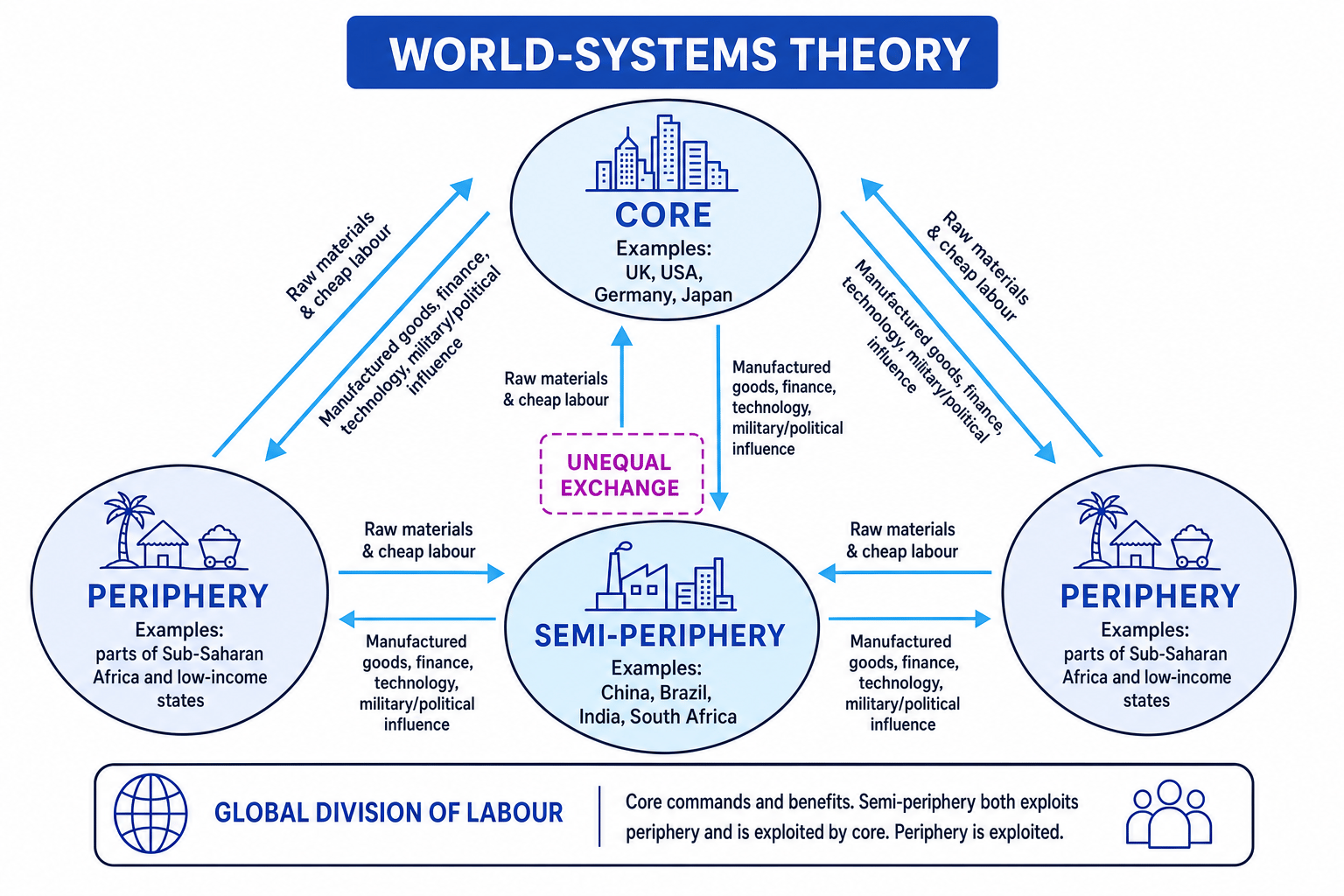
A key concept is the global division of labour. This means different parts of the world specialise in different types of work: some control finance and technology, while others provide cheap labour, agricultural goods, minerals or assembly work.
Classifying a country in world-systems theory
- A country with strong finance, advanced technology, high political influence and powerful TNCs would be classified as core.
- A country with rapid industrial growth but continued inequality and reliance on global markets may fit the semi-periphery.
- A country mainly exporting raw materials with little control over prices or technology is more likely to be placed in the periphery.
Evaluating world-systems theory
World-systems theory is useful because it explains movement and complexity better than simple dependency theory. It can account for countries such as China moving from low-wage production towards advanced manufacturing, finance and global influence.
However, it can still overgeneralise. Calling a whole country “core” or “periphery” may hide internal inequality. For example, the UK is a core economy, but it still contains poverty, regional deprivation and racialised inequalities. The theory may also underplay gender, culture, identity, religion and environmental limits such as climate change.
Comparing the theories
Modernisation theory mainly blames internal barriers such as traditional values, lack of technology and weak institutions. Marxist, dependency and world-systems theories focus more on external exploitation and global capitalism.
A strong essay usually compares them directly:
- Modernisation: development comes through Western-style industrialisation, education, aid and cultural change.
- Marxism: capitalism and imperialism create global inequality through exploitation.
- Dependency: poorer countries are kept dependent through trade, debt, aid and TNC control.
- World-systems: countries occupy changing positions in a global capitalist hierarchy of core, semi-periphery and periphery.
The big debate
The central debate is whether underdevelopment is caused mainly by internal features of poorer societies or by external relationships of global power and exploitation.
Policy links
These theories lead to different policy solutions.
Modernisation theory supports aid, education, infrastructure, technology transfer and market reforms. This influenced many post-war development programmes and still appears in UK aid priorities such as girls’ education, health and economic growth.
Dependency theory supports fairer trade, debt cancellation, regulation of TNCs, local ownership and sometimes delinking, meaning reducing dependence on the global capitalist economy.
World-systems theory suggests that isolated national policies are limited because inequality is built into the global system. It points towards reform of trade rules, climate justice, global taxation, stronger labour rights and fairer international institutions.
AO3 evaluation should ask whether policies genuinely empower poorer countries or mainly reproduce donor control. For example, IMF and World Bank loans may provide financial support, but structural adjustment programmes have been criticised for forcing privatisation, cuts to public spending and market liberalisation.
In the exam
- Start by defining development and the theory named in the question, then link it to power, inequality and global stratification.
- Use AO2 examples such as UK aid, colonial history, TNC supply chains, debt, IMF/World Bank policies, China’s rise or climate inequality.
- Evaluate by comparing perspectives: modernisation stresses internal change, while Marxist, dependency and world-systems theories stress unequal global structures.
Check yourself
- How would Rostow explain a country moving from agriculture to industrial production?
- Why does Frank argue that underdevelopment is actively produced rather than natural?
- What is the difference between the core, semi-periphery and periphery in Wallerstein’s theory?