What you'll learn
- How sociologists move from a target population to a manageable sample.
- The difference between representative and non-representative sampling.
- How to explain key techniques: simple random, stratified random, systematic random, quota, snowball, volunteer, purposive and opportunity sampling.
- How to evaluate sampling using practical, ethical and theoretical issues.
Why sampling matters
Sociologists usually cannot study everyone who is relevant to their research question. Instead, they select a smaller group and use evidence from that group to make claims about a wider group.
Sampling is not just a technical detail. It affects validity — whether the research measures what it claims to measure — and representativeness — whether the people studied reflect the wider group. It also links to power and stratification, because some groups are easier to reach than others, and some are regularly left out of research.
Sampling
Sampling is the process of selecting a smaller group of people, cases or organisations from a wider group that the researcher wants to study.
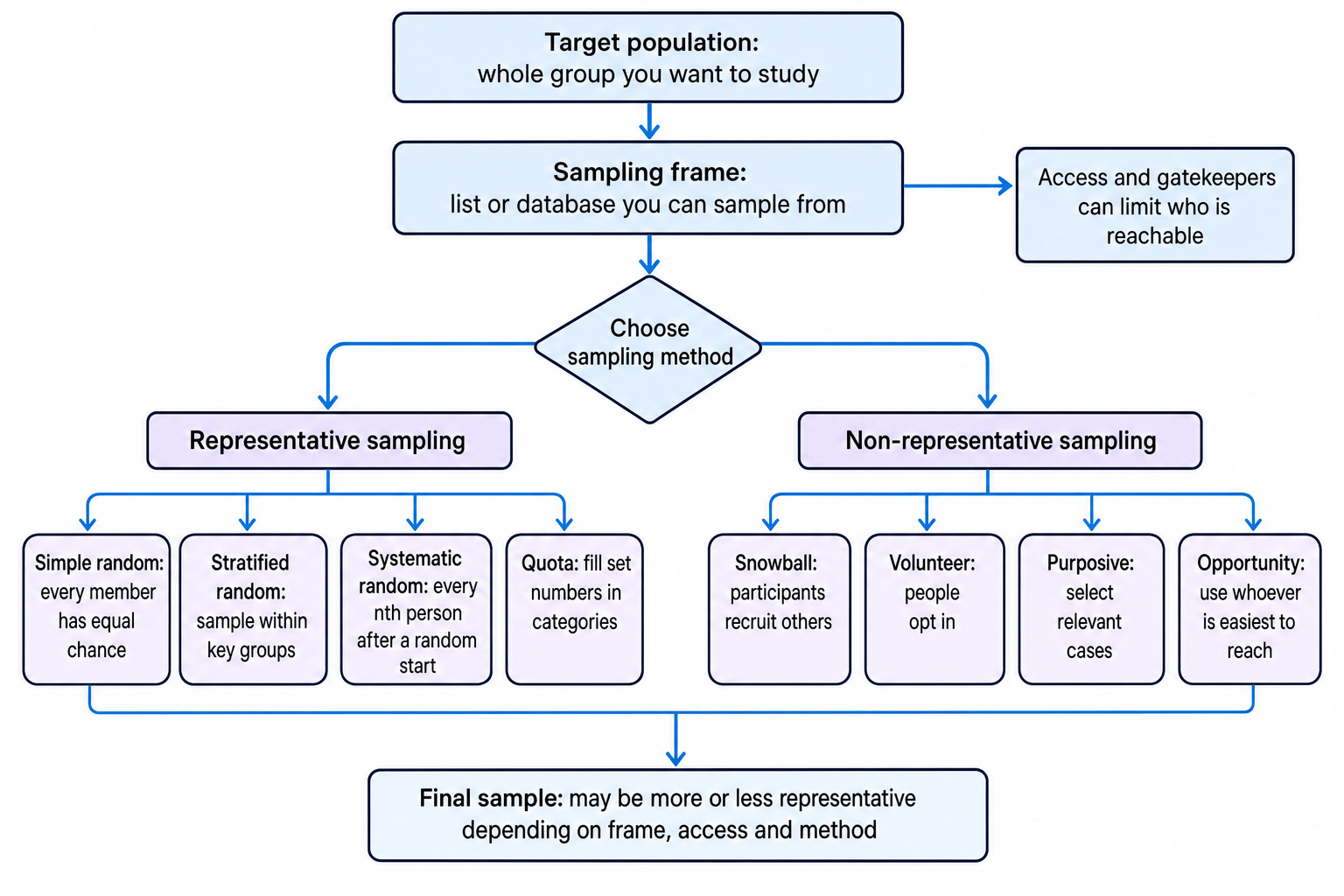
The diagram below gives you the big picture before we slow down and unpack each part.
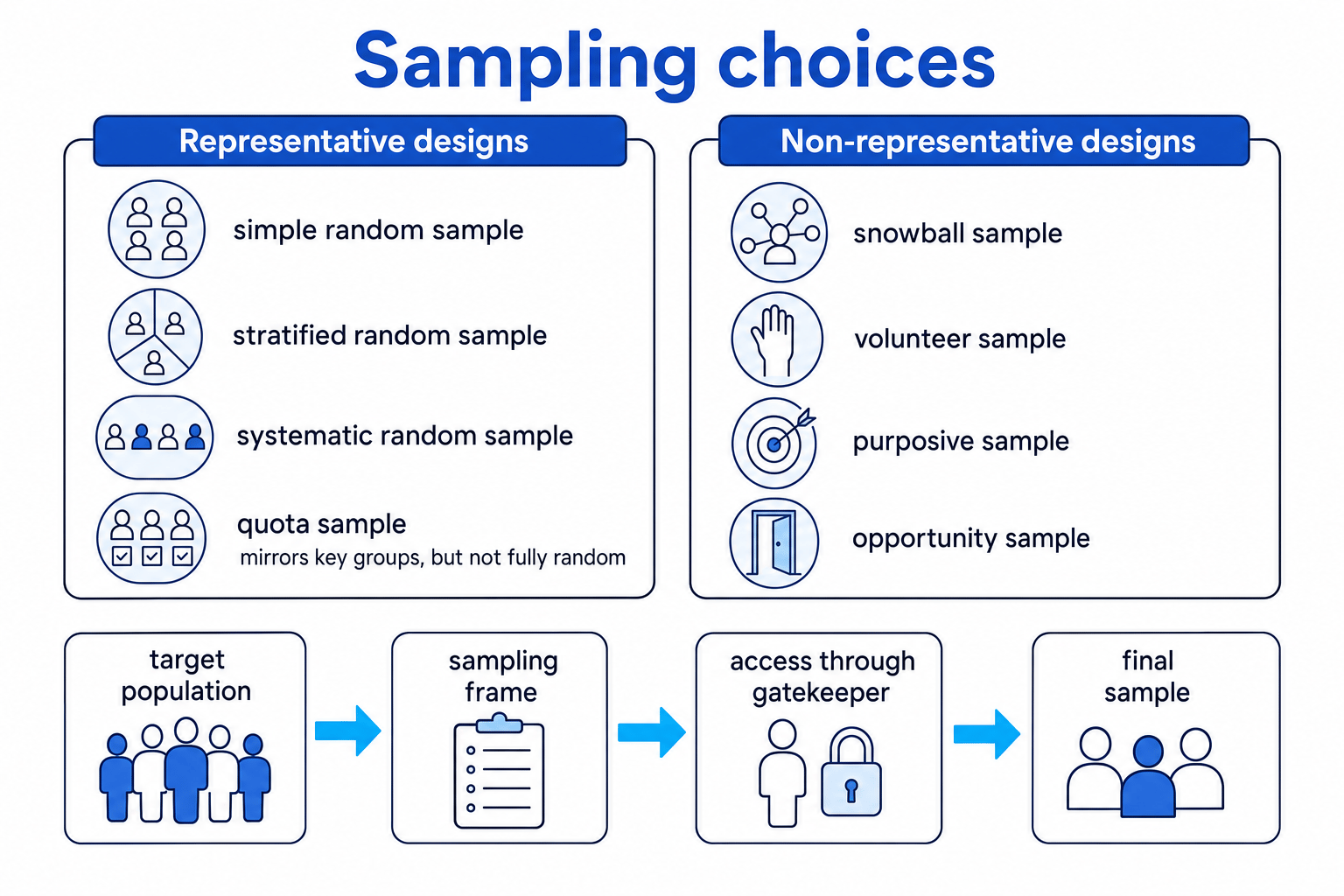
The basic sampling sequence
Before choosing a technique, a researcher must be clear about who they are actually trying to study.
Key sampling terms
- The target population is the whole group the researcher wants to make claims about, such as “Year 12 students in Wales” or “adults who have experienced stop and search in England and Wales”.
- A sample is the smaller group actually included in the research.
- A sampling frame is a list or database from which a sample can be selected, such as a school register, electoral roll or staff list.
- Access means the practical ability to reach participants and gain permission to carry out research.
- A gatekeeper is a person or organisation that controls access to potential participants, such as a headteacher, prison governor, charity manager or employer.
A good sampling plan usually moves like this: define the target population, find or create a sampling frame, choose a sampling method, negotiate access, then deal with refusals or non-response.
Defining the target population and frame
-
If your research question is about Welsh sixth-form students’ attitudes to university debt, you must decide whether the target population includes only school sixth forms or also further education colleges.
-
If you include schools and colleges, your sampling frame might need enrolment lists from several institutions, not just your own school’s register.
-
Because those lists are controlled by schools and colleges, headteachers or principals become gatekeepers. Their refusal could limit access and make the sample less representative.
-
If students from lower-income areas are less likely to respond, the final sample may under-represent class-based experiences of debt, weakening validity and representativeness.
A biased frame creates a biased sample
A random sample from an incomplete sampling frame can still be unrepresentative. For example, a sample drawn only from the electoral register may miss people who are not registered, including some young adults, renters and people without stable housing.
Representative sampling
A representative sample reflects the key characteristics of the target population. These characteristics might include age, gender, social class, ethnicity, region, disability, religion or educational setting.
Representative sampling is especially important in large-scale quantitative research, such as surveys, where the researcher wants to generalise — apply findings from the sample to the wider population.
Representative does not just mean large
A huge sample can still be biased if it leaves out important groups. A smaller sample can be stronger if it is carefully selected to reflect the target population.
Representative sampling is often linked to positivism, the view that sociology should seek reliable, measurable patterns in social life. Positivist researchers tend to value sampling methods that reduce researcher bias and allow comparison across groups.
Simple random sampling
A simple random sample gives every member of the sampling frame an equal chance of being selected. This might involve a random number generator choosing names from a school register.
Its strength is that it reduces researcher bias: the researcher is not hand-picking people. Its weakness is that it needs a complete sampling frame, and it can still miss small but important groups by chance.
Stratified random sampling
A stratified random sample divides the target population into important subgroups, called strata, and then randomly samples from each group. For example, a researcher might sample students by year group, gender, ethnicity or school type.
This is useful when social divisions matter. In Component 3 topics such as power and stratification, a stratified sample might make sure that working-class, middle-class and minority ethnic respondents are not accidentally under-represented.
Its strength is strong representativeness for known groups. Its weakness is that the researcher must already know the proportions of those groups and must choose which characteristics matter.
Systematic random sampling
A systematic random sample selects people at regular intervals from a sampling frame, after a random starting point. For example, a researcher might choose every tenth name on a list.
It is quicker than simple random sampling, especially with long lists. However, it can become biased if the list has a hidden pattern. For example, if a school list is organised by tutor group and every tenth name falls into the same type of grouping, the sample may be distorted.
Quota sampling
A quota sample is designed to include set numbers of people with particular characteristics, such as age, gender or region. Interviewers then find people who fit each category until the quota is filled.
Eduqas lists quota sampling under representative sampling because it aims to mirror key features of the target population. However, it is not fully random, because the interviewer chooses people within each quota.
Quota sampling is cheaper and faster than probability sampling, so it is common in market research and opinion polling. Its weakness is interviewer bias: researchers may approach the most available or approachable people.
Choosing a representative sampling method
-
Imagine a researcher wants to study attitudes to stop and search among 16–18-year-olds in a large city. Experiences may differ by ethnicity, gender and neighbourhood.
-
A simple random sample from all school and college lists might be fair in principle, but smaller ethnic groups could still be under-represented by chance.
-
A stratified random sample would be stronger because the researcher could make sure key groups are included in suitable proportions.
-
If schools and colleges refuse to share lists, quota sampling may be more practical, but the researcher should evaluate it as less random and more vulnerable to selection bias.
Random is not the same as casual
In sociology, “random” means selected by chance using a clear method. It does not mean grabbing whoever happens to be nearby.
Non-representative sampling
A non-representative sample does not fully reflect the target population, or cannot prove that it does. This is not automatically “bad”. It depends on the research aim.
Non-representative samples are often used in qualitative research, where the researcher wants depth, meanings and lived experience rather than broad statistical generalisation. This links to interpretivism, which values understanding people’s subjective meanings.
Snowball sampling
Snowball sampling starts with one or a few participants, who then help the researcher contact others. The sample grows through social networks.
This is useful for hidden, stigmatised or hard-to-reach groups, such as undocumented migrants, some drug users, homeless people, elite networks or members of closed youth subcultures. Research influenced by Becker’s work on deviance and labelling often faces this issue: the groups being studied may not appear on official lists.
The strength is access. The weakness is network bias: participants may recruit people similar to themselves, so the sample may miss isolated or different voices.
Volunteer sampling
A volunteer sample, also called a self-selecting sample, is made up of people who choose to take part after seeing an advert, email, social media post or invitation.
It can be useful for sensitive topics because participants come forward willingly. However, it risks volunteer bias, where people with strong opinions or personal experiences are more likely to respond.
For example, an online survey about school exclusions might attract parents who feel especially angry or harmed by the system, while less affected families ignore it.
Purposive sampling
A purposive sample is deliberately selected because participants have particular characteristics or experiences relevant to the research question.
This is common in qualitative sociology. Willis’s study Learning to Labour (1977), for example, focused closely on a small group of working-class “lads”. The sample was not representative of all pupils, but it produced rich insight into masculinity, class culture and resistance to schooling.
The strength is depth and relevance. The weakness is limited generalisability.
Opportunity sampling
An opportunity sample, also called a convenience sample, uses people who are easiest to access at the time. For example, a researcher might survey students in a canteen or shoppers in a town centre.
It is quick and cheap, so it can be useful for a pilot study — a small trial run of research before the main study. However, it is usually weak for representativeness because availability shapes who is included.
Sampling a hidden population
-
Suppose a researcher wants to study homeless young adults’ experiences of healthcare. There is no complete sampling frame because not all homeless young people are registered with services.
-
Snowball sampling could help because one participant may know others who avoid official agencies.
-
A charity worker may act as a gatekeeper, improving trust and access, but this may skew the sample towards young people already connected to support services.
-
The researcher might use purposive sampling alongside snowballing to include different experiences, such as sofa-surfing, hostel living and rough sleeping.
Access, gatekeepers and power
Sampling is shaped by social power. Researchers often need permission from institutions before they can reach participants. Schools, prisons, hospitals, workplaces and charities can all act as gatekeepers.
Gatekeepers can protect vulnerable people from harm, but they can also restrict research. A school might allow research only with high-achieving pupils, or an employer might block access to workers who are critical of management. This affects validity because the final sample may present a more positive picture than reality.
Ethically, researchers must avoid pressuring people through gatekeepers. If a teacher asks pupils to take part, students may feel they cannot refuse. Good research requires informed consent, confidentiality and the right to withdraw.
Evaluating sampling choices
In methods questions, you should evaluate sampling through three lenses.
Use PET to evaluate sampling
Think Practical, Ethical, Theoretical: practical issues include time, cost, access and response rates; ethical issues include consent, confidentiality and harm; theoretical issues include representativeness, reliability, validity, and whether the approach fits positivist or interpretivist aims.
For AO2 application, use real UK examples. The Census aims to collect information from the whole population, but it still faces non-response and undercounting. The Crime Survey for England and Wales uses a large household sample and is useful for estimating many types of victimisation, but household surveys may miss groups such as people in prisons, care homes or without stable accommodation.
That matters sociologically. If marginalised groups are excluded from sampling frames, research can understate inequality. This connects to stratification: class, ethnicity, gender, disability and housing status all affect whether people are visible to researchers.
For AO3 evaluation, do not simply say “representative is good” and “non-representative is bad”. A stratified random sample may be excellent for measuring national patterns, but poor for understanding private meanings. A purposive or snowball sample may lack generalisability, but may produce higher validity when researching sensitive identities, deviance or exclusion.
In the exam
-
Name the sampling method precisely, then link it to the research aim: is the researcher trying to generalise, gain access, or understand meanings in depth?
-
Apply your answer to the item or context. Mention the target population, sampling frame, gatekeepers and likely response problems where relevant.
-
Evaluate with balance: representative samples support generalisation and reliability, while non-representative samples may improve access, trust and validity.
Check yourself
- What is the difference between a target population and a sampling frame?
- Why is quota sampling not fully random, even though it can aim to be representative?
- When might snowball sampling be a better choice than stratified random sampling?