What you'll learn
- What sociologists mean by ethical issues in research.
- How to explain key safeguards: informed consent, confidentiality, anonymity, privacy, withdrawal and protection from harm.
- Why ethics often creates a tension between getting valid data and treating people fairly.
- How to evaluate ethical problems using examples such as Milgram, Humphreys and Patrick.
Why ethics matters in sociology
Sociology studies real people: their families, identities, beliefs, inequalities, workplaces, schools, health, crime, poverty and power relationships. Because of this, research can affect people’s dignity, safety, reputation and trust.
A sample is the group of people selected for research. A participant or respondent is someone who takes part. Ethical issues are especially important when the sample is vulnerable, the topic is sensitive, or the researcher has more power than the people being studied.
Ethical issues
Ethical issues are moral questions about whether research is conducted in a responsible way, especially whether it respects participants’ rights and avoids unnecessary harm.
In the UK, sociologists are guided by professional principles such as the British Sociological Association (BSA) Statement of Ethical Practice. These are not just “rules to memorise”: they help you evaluate research methods in essays.
The core ethical balance
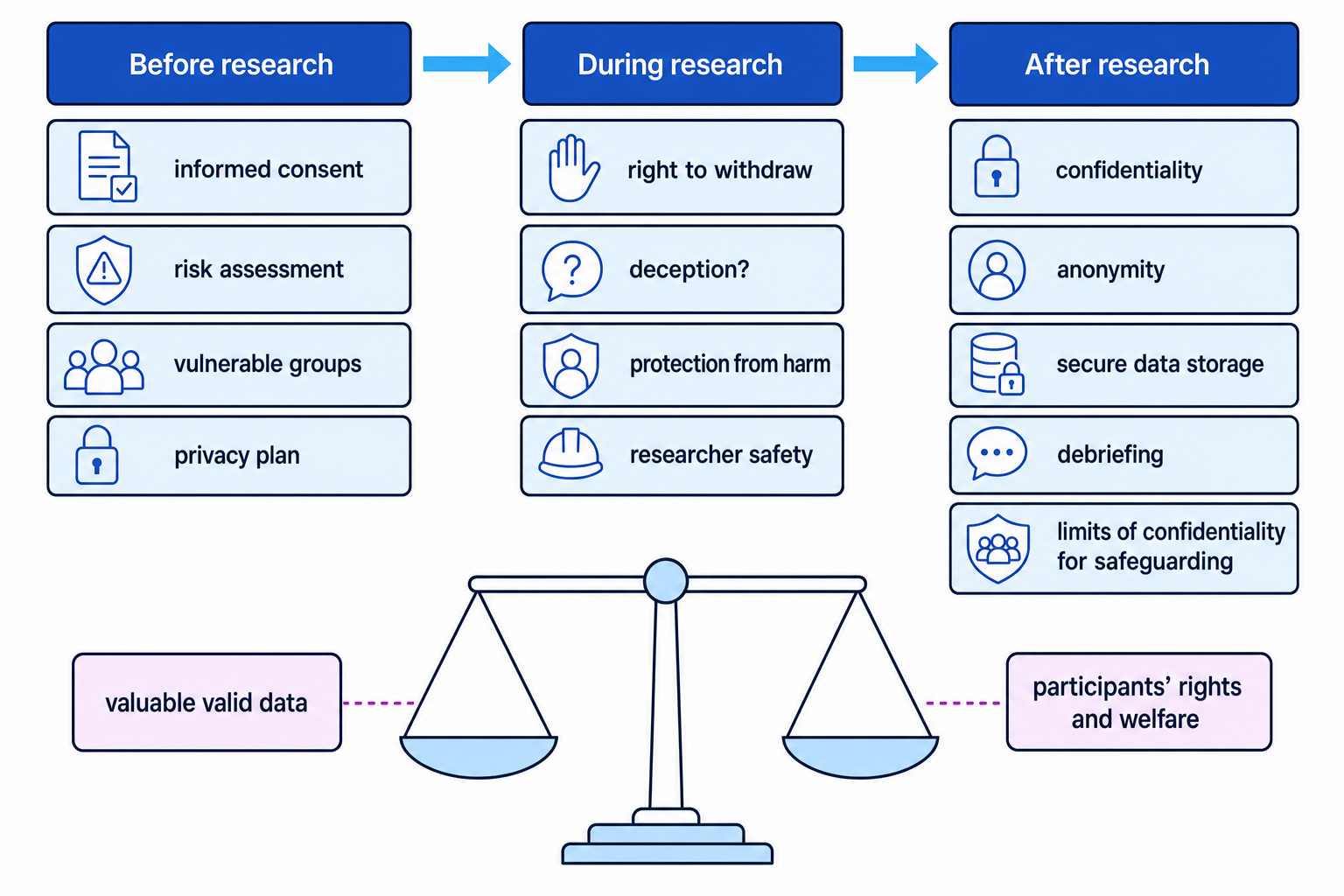
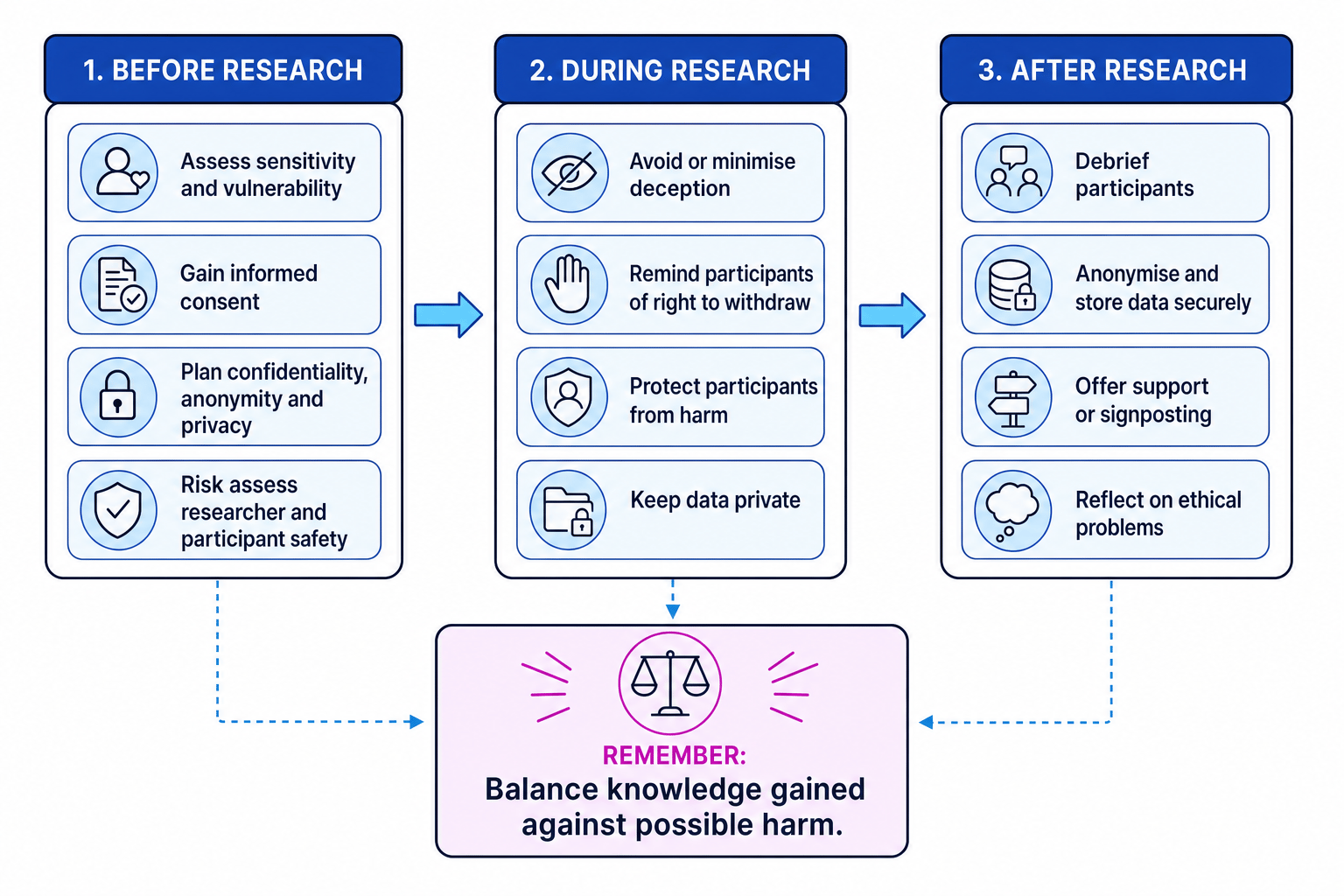
Sociologists often have to balance the possible value of the knowledge gained against the possible harm caused to participants, researchers and wider society.
Ethics applies before, during and after a research project.
Informed consent, vulnerability and the right to withdraw
Informed consent means participants freely agree to take part after being told what the research involves. This includes the topic, what they will be asked to do, how their data will be used, and any likely risks.
Vulnerability means a person may have reduced power or capacity to make a fully free choice. This can include children, some disabled people, people in institutions such as prisons or hospitals, victims of abuse, or people who depend on a gatekeeper. A gatekeeper is someone who controls access to a research setting, such as a headteacher, employer, prison governor or charity worker.
The right to withdraw means participants should be able to leave the research without penalty. In many studies, they should also be able to ask for their data to be removed, at least up to a stated point.
Gaining consent from pupils
- Identify the power relationships: pupils may feel pressured because the research takes place in school, and teachers are authority figures.
- Build separate layers of consent: the researcher may need school permission, parental consent where appropriate, and the pupil’s own agreement or assent.
- Protect withdrawal: pupils should be told they can skip questions, stop the interview, or withdraw data before it is anonymised, without affecting grades or teacher treatment.
Treating consent as a signature only
Consent is not just a form. It must be informed, voluntary and ongoing, especially if the research changes direction or becomes more sensitive.
There is an AO3 evaluation point here: strong consent can make research more ethical, but it may reduce validity if participants change their behaviour because they know they are being studied. Validity means how far research captures what it claims to capture.
Deception
Deception means misleading participants or withholding important information about the research. This is common in debates about covert research, where the researcher’s identity or purpose is hidden.
Deception is ethically risky because participants cannot give fully informed consent. It can also damage trust in sociology. However, some sociologists argue that deception may be justified if open research would be impossible or would produce false behaviour.
A classic example is Milgram’s obedience study (1963). Participants were misled into believing they were giving electric shocks to another person. The study produced important evidence about authority, but it raised serious concerns about deception, stress and whether participants felt genuinely free to withdraw.
Judging whether deception is justified
- Consider the access problem: if a researcher openly studies a hidden racist group or criminal subculture, members may refuse access or perform a false version of themselves.
- Compare the harms: deception removes informed consent and may expose participants to reputational, legal or emotional risks if identities are revealed.
- Evaluate alternatives: interviews with former members, anonymous online surveys or secondary data may reduce deception, though they may produce less detailed data.
Evaluation phrase
A useful phrase is: covert methods may increase validity but weaken informed consent and trust.
Another example is Patrick’s study of a Glasgow gang (1973), where covert participant observation created rich data about youth deviance but raised issues of deception, safety and possible involvement in illegal activity.
Sensitivity and protection from harm
A sensitive topic is one that may cause distress, embarrassment, stigma or danger if discussed or revealed. In sociology this includes domestic abuse, poverty, disability, sexuality, racism, religion, crime, mental health, family breakdown and experiences of state institutions.
Harm can be physical, psychological, social, legal or economic. For example, a participant could be emotionally upset by an interview, lose privacy, be labelled by others, or face consequences if illegal behaviour is disclosed.
This links directly to the cross-cutting themes of culture and identity and power and stratification. Research on marginalised groups may be valuable because it gives voice to inequality, but the same research can also expose people who already have less power.
Researching domestic abuse experiences
- Assess the likely harm: asking about abuse may trigger trauma, and unsafe contact from the researcher could alert an abuser.
- Adapt the method: use carefully trained interviewers, safe recruitment routes, private settings and participant control over which questions they answer.
- Add safeguards: provide support information, stop the interview if distress becomes clear, and avoid collecting unnecessary identifying details.
Safeguarding limits confidentiality
If a participant reveals serious risk of harm to themselves or others, especially involving children or vulnerable adults, researchers may have to break confidentiality to follow safeguarding duties.
In AO3 terms, interpretivist methods such as unstructured interviews can produce high-validity accounts of lived experience, but they may create more emotional risk than a short anonymous questionnaire.
Confidentiality, anonymity and privacy
Confidentiality means information given by participants is not shared in ways they have not agreed to. Anonymity means individuals cannot be identified from the published research. Privacy means people have a right to control access to their personal lives and personal information.
These terms are related, but not identical. A researcher may know who a participant is, so the participant is not anonymous to the researcher, but the researcher can still keep the data confidential and anonymise the final report.
In the UK, data protection is also shaped by the Data Protection Act 2018 and UK GDPR principles, which require personal data to be handled lawfully, securely and only for clear purposes.
Anonymising a small community study
- Identify indirect identifiers: in a small Welsh village, “the only female GP aged 45” may identify someone even if her name is removed.
- Reduce identifiability: change or generalise details such as job role, location and family structure, while keeping the sociological meaning of the data.
- Manage data securely: store names separately from transcripts, restrict access, and explain any limits to confidentiality before data collection.
Confusing anonymity with confidentiality
If a researcher records names but promises not to reveal them, that is confidentiality, not full anonymity.
This is particularly important in research on power and stratification. For example, people discussing benefits, immigration status, workplace exploitation or crime may face real consequences if they are identifiable.
Protection from harm for the researcher
Ethics is not only about the sample. Researchers can also be harmed. Fieldwork may involve physical danger, emotional stress, legal risk or pressure to participate in harmful behaviour.
Researcher safety is especially relevant in studies of gangs, drug markets, domestic violence services, prisons, protests, online extremism or highly distressed groups. Risk assessment means identifying possible dangers before the research and planning how to reduce them.
Planning researcher safety in gang research
- Identify the risk environment: meeting active gang members may involve violence, police attention, intimidation or pressure to prove loyalty.
- Change the design: use safer interview locations, work with support organisations, avoid lone visits and set check-in procedures with a supervisor.
- Set boundaries: the researcher should not take part in crimes or carry messages, because this increases legal risk and compromises the research.
Patrick’s gang study is useful here: it gave detailed insight into deviant youth culture, but it also shows how covert research can place the researcher in unpredictable and dangerous situations.
Ethical issues across different methods
Ethical issues vary depending on the method chosen. This gives you easy AO3 evaluation in methods essays.
| Method | Main ethical risks | Evaluation point |
|---|---|---|
| Questionnaires | Privacy, informed consent, secure data storage | Usually low harm, but may be poor for noticing distress or explaining sensitive questions |
| Structured interviews | Consent, confidentiality, pressure to answer | More control than unstructured interviews, but still needs sensitivity |
| Unstructured interviews | Emotional harm, over-disclosure, dependency | High validity, but potentially intrusive |
| Overt observation | Privacy, consent, Hawthorne effect | More ethical than covert observation, but behaviour may change |
| Covert observation | Deception, lack of consent, researcher safety | May access hidden behaviour, but creates serious ethical problems |
| Official statistics | Privacy, re-identification, political use of data | Less direct contact with participants, but data can still label groups or areas |
The Hawthorne effect means people change their behaviour because they know they are being observed. This is why some researchers are tempted by covert methods, even though deception is ethically problematic.
Official statistics are data collected by government or official bodies, such as the Office for National Statistics. Even though the sociologist may not meet participants directly, there can still be ethical issues if data is used to stigmatise deprived areas, minority groups or people receiving welfare.
Named studies you can use
Milgram (1963)
Milgram’s obedience study is a strong example for deception, distress and withdrawal. Participants were told the study was about learning, not obedience, and many showed signs of stress.
AO3: Milgram did debrief participants, but critics argue this did not fully remove the harm caused during the study.
Humphreys (1970)
Humphreys’ Tearoom Trade study involved covert observation of men having sex in public toilets in the USA. He recorded identifying information and later interviewed some men under another pretext.
AO3: The study revealed hidden sexual behaviour and challenged stereotypes, but it is heavily criticised for deception, invasion of privacy and lack of informed consent.
Patrick (1973)
Patrick’s covert participant observation of a Glasgow gang shows the access advantage of covert research, but also raises deception, harm and researcher safety issues.
AO3: It is useful for evaluating whether valuable data about deviance can justify ethical risks.
How to turn ethics into essay evaluation
A strong methods answer should not just list ethical issues. You need to connect them to the research context.
For AO1, define the ethical issue accurately. For AO2, apply it to the group, topic or method in the item. For AO3, explain the consequence: does it reduce validity, limit access, create harm, require a different method, or make the research unacceptable?
Ethics is contextual
The same method can be ethical in one study and unethical in another. An interview about shopping habits is very different from an interview about self-harm, racism or domestic abuse.
In the exam
- Link each ethical issue to the specific method and sample, rather than writing a generic list.
- Use paired evaluation: for example, “covert observation may improve validity, but it weakens informed consent and may endanger the researcher.”
- Bring in a named study such as Milgram, Humphreys or Patrick when it clearly supports your point.
Check yourself
- Why is confidentiality not the same as anonymity?
- When might deception increase validity, and why is it still ethically risky?
- How could research on a vulnerable group be redesigned to reduce harm?