What you'll learn
- What sociologists mean by media representation and why it matters for identity and inequality.
- Key patterns in the representation of social class, gender, ethnicity, age and disability.
- How theorists such as Hall, Tuchman, Mulvey, Cohen, Barnes and Van Dijk explain media portrayals.
- How to evaluate representation using contemporary UK examples, methods evidence and exam-ready AO3.
The starting point: media do not simply “mirror” reality
In sociology, the media includes institutions and platforms that communicate to large audiences: television, newspapers, film, radio, advertising, streaming services and social media. When these media show social groups, they make choices about who appears, what language is used, which images are selected and whose viewpoint is treated as normal.
Representation
Representation means the way a person, group, event or issue is constructed and given meaning through images, language, sound, narratives and symbols. Stuart Hall argued that representation is not a neutral reflection of reality; it is part of how meaning is produced in culture.
A social group is a category of people who share a social position or identity, such as social class, gender, ethnicity, age or disability. Representations matter because they influence socialisation — the process through which people learn norms, values and identities — and because they can reinforce or challenge power and stratification, meaning unequal access to resources, status and voice.
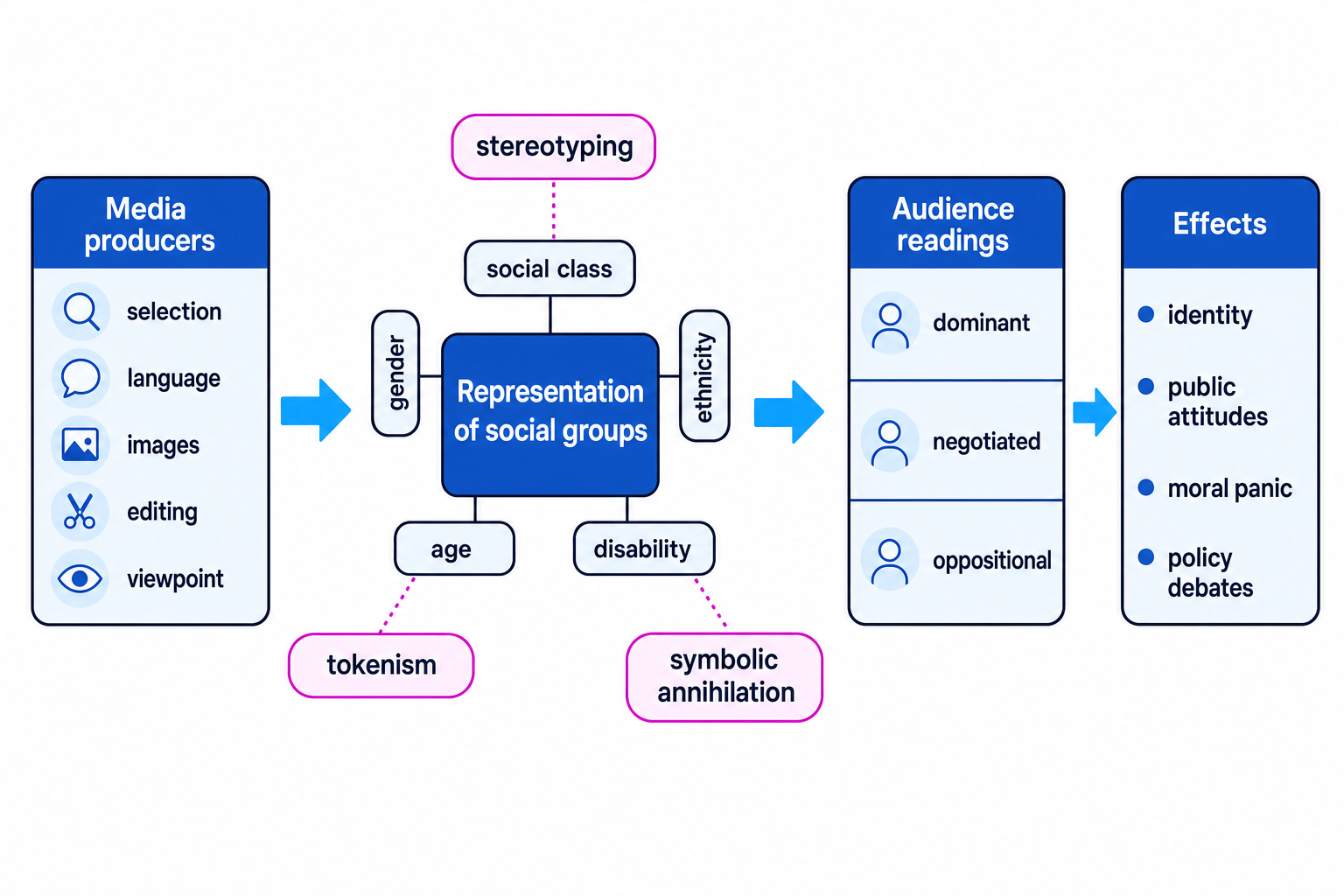
The basic process is: media producers select and frame content, audiences interpret it, and those meanings can shape identities, stereotypes and public debates.
Core concepts for analysing representation
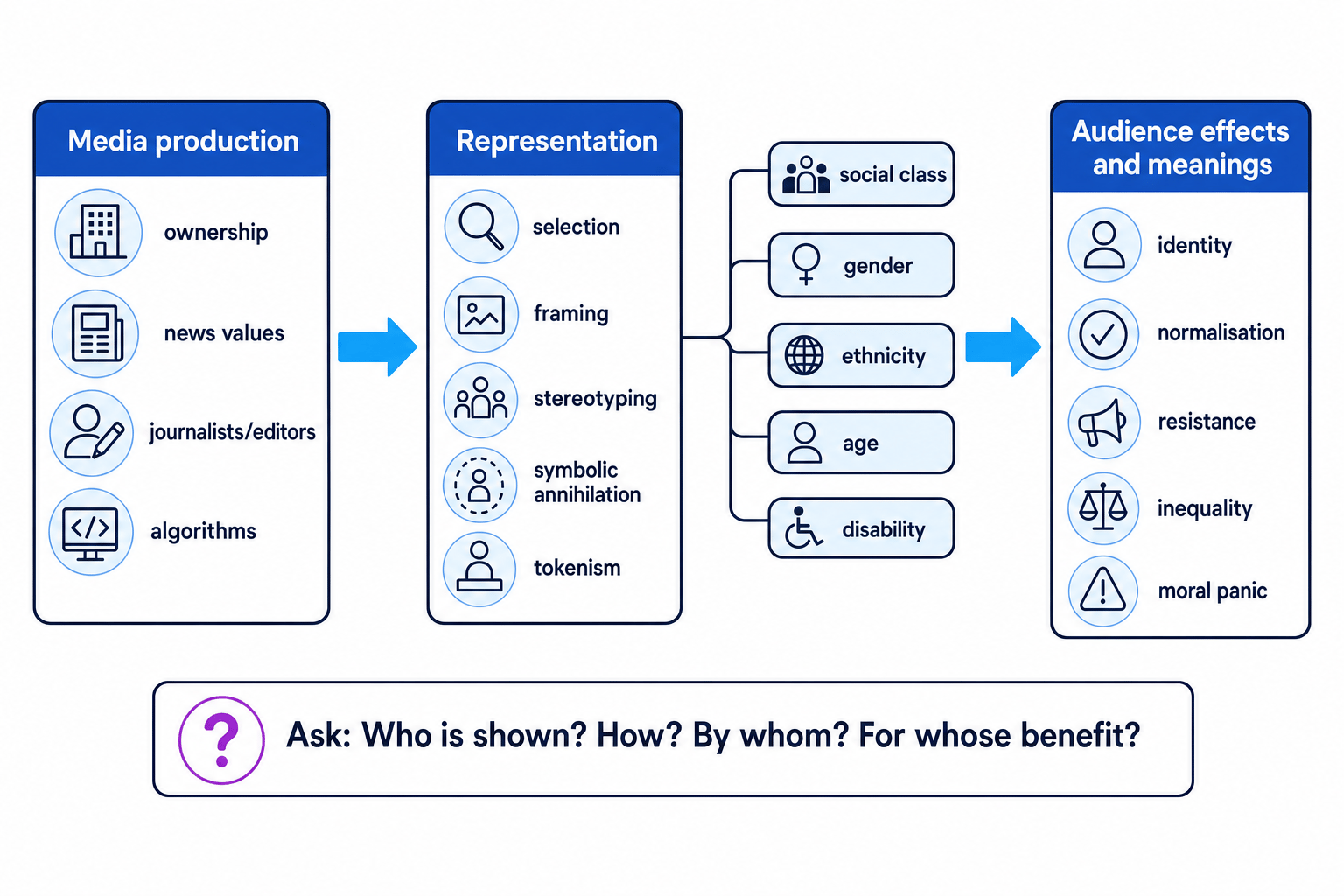
Stereotyping
A stereotype is an oversimplified image of a group, often presenting all members as sharing the same traits. Stereotypes are powerful because they make inequality look natural: for example, working-class people may be shown as irresponsible, or older people as dependent.
Framing
Framing means the angle or interpretation placed around an issue. A news story about poverty could be framed as “individual failure” or as “structural inequality caused by low wages and housing costs”. The facts selected may be similar, but the meaning changes.
Symbolic annihilation
Symbolic annihilation, associated with Tuchman, means a group is ignored, trivialised or condemned in media representations. If a group rarely appears, or appears only in narrow roles, audiences may see that group as less socially important.
Tokenism
Tokenism occurs when a minority group is included in a limited or superficial way to create the appearance of diversity without challenging underlying stereotypes or power structures.
The key question
For any representation, ask: Who is shown, how are they shown, who created the image, and whose interests might it serve?
Reading a representation in a news item
Imagine a newspaper article about a young working-class man involved in crime.
- Identify the social group being represented: here, the article may be constructing an image of young working-class men.
- Analyse the framing: if the article focuses on clothing, slang, housing estate imagery and “feral youth” language, it frames the issue as a cultural or moral problem rather than, for example, a problem of poverty, exclusion or policing.
- Link to theory: Cohen’s idea of moral panic could apply if the group is exaggerated as a threat to social order; Hall et al. could be used if crime reporting supports wider ideas about law, order and state power.
- Evaluate: audiences are not passive. Some readers may accept the dominant message, but others may reject it, especially if they have lived experience of the community being represented.
Representation of social class
Media representations of social class often treat middle-class lifestyles as normal and respectable, while working-class people are either invisible or shown through problems such as unemployment, crime, bad parenting or “benefit dependency”.
Newman argued that media often focus on the behaviour of poor people rather than the structural causes of poverty. Owen Jones, in Chavs (2011), argues that working-class people have been ridiculed and blamed through the “chav” stereotype. This links to a wider ideological message: inequality becomes the fault of individuals rather than the result of low pay, insecure work, housing costs or welfare policy.
AO2 examples include UK reality and documentary formats such as Benefits Street, which was criticised for presenting poverty as entertainment, sometimes called “poverty porn”. Tabloid coverage of “scroungers” can contrast sharply with sympathetic coverage of middle-class hardship during the cost-of-living crisis.
However, representation is not one-sided. Some dramas, documentaries and investigative journalism highlight food banks, insecure work and housing inequality. Pluralists would argue that the modern media landscape contains competing viewpoints, especially through social media, podcasts and independent journalism.
Blaming the whole media
Avoid writing “the media always show working-class people negatively”. Stronger answers say some media forms and genres tend to, then give examples and evaluate with counter-examples.
Representation of gender
Gender representation has changed significantly, but inequality remains. A gender role is the set of expectations attached to being male, female or another gender identity in a particular society.
Tuchman argued that women experience symbolic annihilation because they are underrepresented or shown mainly in domestic, sexualised or dependent roles. Mulvey’s concept of the male gaze suggests that women in film and visual media are often presented from a heterosexual male viewpoint, as objects to be looked at.
Feminists argue that these images support patriarchy, a social system in which men hold greater power. For example, women politicians may be judged on appearance, clothing or family life more than male politicians. Advertising and reality TV can present women’s bodies as projects requiring constant improvement.
There have also been changes. McRobbie identified more “girl power” and independent female images in popular culture, while Gill argues that postfeminist media often mix empowerment with self-surveillance: women are told they are free and confident, but also expected to constantly manage their bodies, sexuality and appearance.
Men are represented too. Connell’s idea of hegemonic masculinity refers to the culturally dominant form of masculinity: tough, heterosexual, competitive and emotionally controlled. Media sport, action films and some advertising often reproduce this ideal, although there are more diverse representations of fatherhood, mental health and male vulnerability than in the past.
AO2 examples include coverage of the Lionesses increasing the visibility of women’s sport, alongside continued inequalities in funding, pay and media attention. The Advertising Standards Authority introduced rules in 2019 against harmful gender stereotypes in adverts, showing how policy can respond to representation concerns.
Representation of ethnicity
Ethnicity refers to shared culture, ancestry, language, religion or national background. Media representations of ethnicity are closely linked to power because they can define who is seen as belonging to the nation and who is treated as an “outsider”.
Hall et al., in Policing the Crisis (1978), argued that media coverage of “mugging” helped create a moral panic around young Black men. This connected crime, race and social disorder in ways that supported stronger policing and law-and-order politics.
Van Dijk’s work on racism and discourse shows how news language can present minority ethnic groups as problems or threats, especially in stories about immigration, asylum or crime. Research by Poole and Richardson has examined how Muslims have often been associated with terrorism, extremism or lack of integration in British media.
There are also more positive and complex trends. UK television, film and streaming now include more Black, Asian and minority ethnic presenters, actors and storylines. Public debates after Black Lives Matter increased attention to representation, racism and newsroom diversity. Organisations such as Ofcom and the Creative Diversity Network monitor aspects of diversity, while the Equality Act 2010 provides a legal framework against discrimination.
AO3 evaluation is important: increased visibility does not automatically mean equality. A group may be visible but still stereotyped, tokenised or framed mainly through conflict.
Representation of age
Age groups are also represented unevenly. Young people are often shown as risky, deviant, irresponsible or vulnerable. Cohen’s study of the Mods and Rockers showed how media can create a moral panic, where a group is exaggerated as a threat to society and becomes a “folk devil”.
In contemporary UK media, young people may be linked to knife crime, gangs, social media addiction or anti-social behaviour. This can ignore youth poverty, education pressures, insecure work and cuts to youth services. It can also shape public attitudes toward policing, schooling and welfare.
Older people are often represented in contradictory ways. They may be shown as frail, lonely, dependent and a “burden” on the NHS or pensions system. Alternatively, they may be represented as affluent “boomers” who have benefited from housing wealth. Both frames can oversimplify age inequality and ignore differences of class, gender, ethnicity and health.
There are signs of change. Digital media allow young people to represent themselves through TikTok, YouTube and podcasts. Older presenters, campaigners and influencers also challenge ageist assumptions, though ageism in broadcasting and employment remains a relevant issue.
Representation of disability
Disability representation is often shaped by the difference between the medical model and the social model of disability. The medical model sees disability mainly as an individual impairment or problem. The social model argues that people are disabled by social barriers such as inaccessible buildings, discrimination and lack of support.
Barnes (1992) identified common media stereotypes of disabled people, including the disabled person as pitiable, tragic, dependent, sinister, a burden, or exceptionally heroic. The “supercrip” stereotype praises disabled people only when they “overcome” disability in extraordinary ways, which can still imply that ordinary disabled lives are less valuable.
AO2 examples include the Paralympics, which increased visibility but also used “superhuman” narratives that some disability activists criticised. TV has also seen more disabled performers and presenters, such as Rose Ayling-Ellis and Ellie Simmonds, challenging older stereotypes. Yet disabled people remain underrepresented behind the camera and in senior media roles.
The Equality Act 2010 requires reasonable adjustments and prohibits disability discrimination, but legal equality does not guarantee equal cultural representation. Sociologically, the issue is not simply whether disabled people appear, but whether they are shown as full social actors with varied identities, relationships and ambitions.
Use the social model
For disability essays, you can gain AO3 by asking whether the media presents disability as an individual tragedy or as a result of social barriers and unequal power.
Intersectionality: groups overlap
Intersectionality, associated with Crenshaw, means people’s experiences are shaped by overlapping social categories such as class, gender, ethnicity, age and disability. Media representations often combine these categories.
For example, a young Black working-class man may be represented through crime stereotypes, while a Muslim woman may be represented through gender, religion and ethnicity at the same time. An older disabled woman may face both ageist and ableist assumptions. Strong answers recognise that social groups are not separate boxes in real life.
How to evaluate evidence about representation
Sociologists study representation using different methods. Content analysis counts patterns, such as how often women appear as experts in news programmes. It can be reliable because categories can be repeated by another researcher, but it may miss deeper meanings.
Discourse analysis studies language, images and narratives in detail. It is useful for validity because it explores meaning, but it can be more subjective. Audience research, such as interviews or focus groups, helps test how people interpret media messages. Hall’s encoding/decoding model is useful here: audiences may take a dominant, negotiated or oppositional reading.
Choosing evidence for a claim about stereotypes
Suppose you want to investigate whether older people are represented negatively in TV news.
- Choose a sample that matches the claim: for example, a month of evening news bulletins across BBC, ITV and Channel 4, rather than one dramatic story.
- Use content analysis to count categories such as “older person as victim”, “older person as expert”, “older person as burden” and “older person as active citizen”.
- Add discourse analysis to examine the language and images used, such as whether stories rely on hospital beds, loneliness or pension costs.
- Evaluate audience interpretation: viewers may not all read the message in the same way, so interviews or focus groups would strengthen the evidence.
Big debate: are representations improving?
There is strong evidence of change. UK media now include more diverse casting, more women in public life, more minority ethnic voices and more discussion of mental health, disability and sexuality. Social media has also allowed groups to challenge stereotypes directly.
But inequalities persist. Ownership, senior editorial roles and algorithmic visibility remain uneven. Marxists and feminists argue that dominant representations still reflect unequal power. Pluralists and postmodernists stress diversity, choice and audience agency. The best exam answers usually take a balanced view: representations are more varied than in the past, but stereotypes and unequal framing continue.
In the exam
- Start by defining representation and naming the social group you are discussing.
- Give a clear pattern or trend, then support it with a theorist, study or concept.
- Apply it to a contemporary UK example, such as news, advertising, reality TV, sport, streaming or social media.
- Analyse the link to socialisation, identity, power and stratification.
- Evaluate with a counter-trend, an alternative perspective, or a methods point about how the evidence was gathered.
Check yourself
- How could the same news story be framed differently for different audiences?
- What is the difference between underrepresentation, stereotyping and tokenism?
- Which two contemporary UK examples could you use for gender, ethnicity or disability representation?