What you'll learn
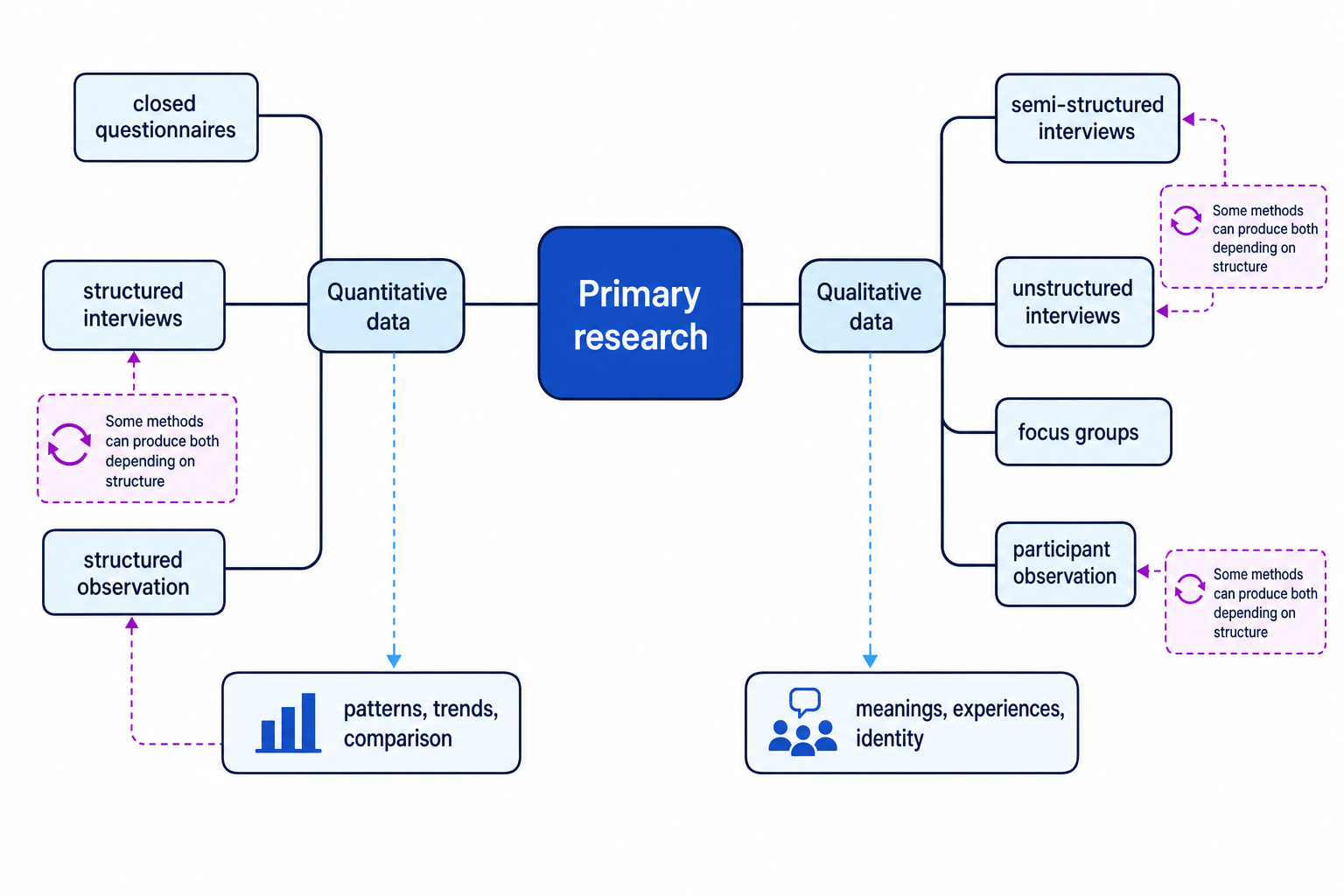
- What primary research is, and how it can produce quantitative or qualitative data.
- How sociologists use questionnaires, interviews, focus groups and observations.
- How to evaluate methods using practical, ethical and theoretical issues.
- How to apply methods to real sociological topics about culture, identity, power and stratification.
The basic map: primary, quantitative and qualitative
Sociologists collect evidence to study social life. In Component 2, you need to understand not just what a method is, but why a researcher might choose it.
Core terms
- Primary data is information collected first-hand by the sociologist for their own research aim.
- Quantitative data is numerical data, often used to identify patterns, trends and correlations.
- Qualitative data is detailed, non-numerical data, often used to understand meanings, identities and experiences.
- A method is the practical technique used to collect data, such as a questionnaire or observation.
This grid shows where the main methods fit. Remember: some methods can cross categories. For example, an interview can be highly structured and quantitative, or open-ended and qualitative.
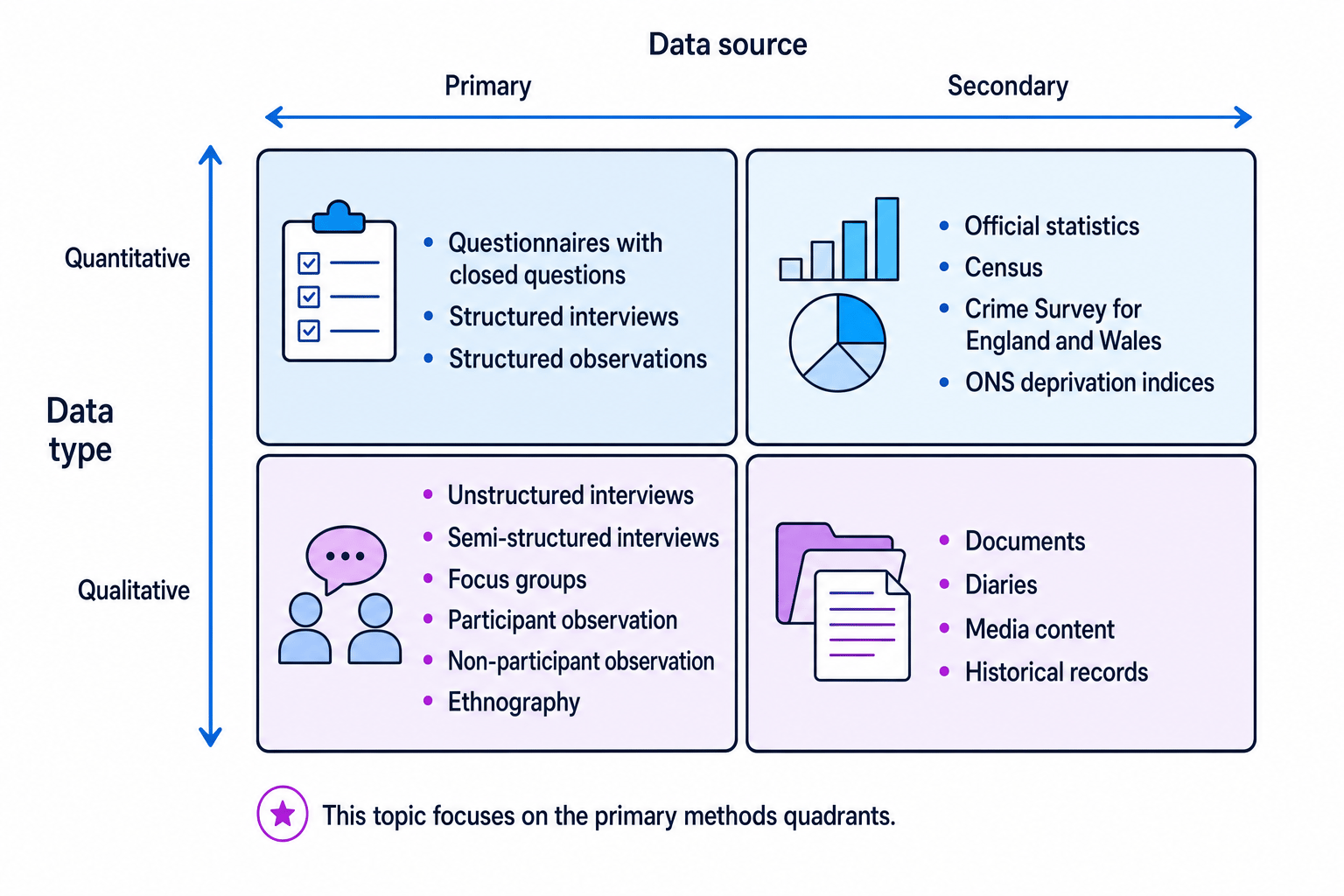
The big distinction
Primary research means the sociologist collects the data themselves. The key exam skill is explaining whether that method is likely to produce reliable, valid and representative evidence for the research aim.
The quality checklist sociologists use
Before looking at each method, you need four core evaluation terms.
Research quality terms
- Reliability means consistency: would the research produce similar results if repeated?
- Validity means accuracy and depth: does the research really measure or understand what it claims to?
- Representativeness means how far the sample reflects the wider target population.
- Response rate means how many selected participants actually take part; low response rates can create non-response bias, where those who respond differ from those who do not.
You should also evaluate methods using three types of issue:
- Practical issues: time, cost, access, researcher skill and availability of a sampling frame.
- Ethical issues: informed consent, confidentiality, anonymity, deception and avoiding harm.
- Theoretical issues: whether the method fits a sociological perspective, such as positivism or interpretivism.
Positivism and interpretivism
Positivism favours scientific, measurable research that can reveal social patterns; Durkheim’s work on suicide is often used as a classic example of this approach. Interpretivism focuses on meanings and lived experiences; Weber’s idea of verstehen means understanding social action from the actor’s point of view.
Questionnaires
A questionnaire is a set of written or online questions completed by respondents. It is usually a primary quantitative method, especially when it uses closed questions, where respondents choose from fixed answers.
Questionnaires can also include open questions, where respondents write their own answers, but they are usually less detailed than interviews.
Types of questionnaire questions
- Closed question: “Which age group are you in?”
- Likert scale: a scale such as “strongly agree” to “strongly disagree”.
- Open question: “Explain how social media affects your identity.”
Closed questions can measure different things:
- Nominal data: categories with no order, such as religion or housing type.
- Ordinal data: ordered categories, such as social class groups or agreement scales.
- Numerical data: numbers such as age, hours online, or number of siblings.
Strengths of questionnaires
Questionnaires are useful when sociologists want to study a large group. They can be cheap, quick and easy to repeat, so they often have high reliability. If the sample is carefully chosen, questionnaires can produce representative data.
For example, a sociologist studying educational aspirations in Wales might send a questionnaire to Year 12 students in several schools and compare responses by gender, class background or ethnicity.
Limitations of questionnaires
Questionnaires may have lower validity because respondents cannot easily explain their answers. People may misunderstand questions, give socially desirable answers, or skip the survey entirely. Online questionnaires may exclude people with limited digital access, which links to power and stratification.
Improving a questionnaire item
A researcher asks: “Don’t you agree that strict school rules improve behaviour and achievement?”
- The wording is leading because “Don’t you agree” pushes respondents towards agreement.
- The question is double-barrelled because behaviour and achievement are two different issues.
- A better version would separate the issues: “To what extent do you agree that strict school rules improve student behaviour?” with options from “strongly agree” to “strongly disagree”.
- The researcher could then add a second question about achievement, making the data easier to analyse and more valid.
Assuming numbers are automatically objective
Quantitative data can still be biased. A questionnaire with leading questions, a weak sample or a low response rate may produce unreliable or unrepresentative findings.
Interviews
An interview is a method where the researcher asks questions directly. Interviews vary in structure.
Types of interview
- Structured interviews use the same questions in the same order, often producing quantitative data.
- Semi-structured interviews use planned questions but allow follow-up questions.
- Unstructured interviews are more like guided conversations and usually produce qualitative data.
Structured interviews can be reliable because every participant is asked the same questions. They may also improve response rates because an interviewer can encourage completion.
Semi-structured and unstructured interviews are usually stronger for validity. They allow respondents to explain meanings, emotions and identities in their own words. This is useful for topics such as experiences of racism, gender identity, disability, poverty or family life.
Oakley (1981) criticised traditional interviews for creating unequal power relationships between researcher and participant. Feminist researchers often argue that more open, reciprocal interviews can reduce hierarchy and give participants more voice.
Evaluating interviews
Interviews can produce rich data, but they are time-consuming and expensive. The researcher’s age, gender, ethnicity, accent or class position may affect responses. This is called an interviewer effect.
Ethically, interviews require care when discussing sensitive topics. Researchers must protect confidentiality and avoid causing distress.
Choosing an interview type
A sociologist wants to research how Universal Credit claimants experience stigma.
- A structured interview would allow comparison between many claimants, but it may not capture the emotional meaning of stigma.
- A semi-structured interview is stronger because the researcher can ask comparable questions while also probing personal experiences.
- The researcher should consider power and ethics: participants may fear judgement or consequences, so confidentiality and informed consent are essential.
- For evaluation, the findings may be highly valid but not very representative if the sample is small or recruited through one advice centre.
Focus groups
A focus group is a guided group discussion led by a researcher. It usually produces qualitative data.
Focus groups are especially useful for studying shared meanings, peer influence and group norms. This connects closely to socialisation, culture and identity. For example, a researcher might use focus groups to explore how young people discuss masculinity, Welsh identity, social media beauty standards or attitudes to stop and search.
The strength of focus groups is that participants can respond to each other, challenge ideas and reveal how opinions are formed socially. This can show power in action: who speaks, who is interrupted, and which views become dominant.
However, focus groups have limitations. Some participants may stay silent, conform to the group, or avoid sensitive disclosures. Confidentiality is harder to guarantee because other participants hear what is said.
Focus groups are not just cheaper interviews
In a focus group, the interaction between participants is part of the data. You can evaluate not only what people say, but how group pressure and shared culture shape what becomes sayable.
Observational methods
Observation means watching social behaviour directly. It can be quantitative or qualitative, depending on how it is designed.
Types of observation
- Participant observation: the researcher joins the group being studied.
- Non-participant observation: the researcher watches without joining in.
- Overt observation: participants know they are being studied.
- Covert observation: participants do not know they are being studied.
- Structured observation: the researcher uses a checklist or coding frame.
- Unstructured observation: the researcher records detailed field notes more freely.
Structured observation can produce quantitative data. For example, a researcher might count how often teachers ask boys and girls questions in lessons. This can be reliable if the categories are clearly defined.
Participant observation is usually qualitative and interpretivist. It can produce high validity because the researcher sees behaviour in context. Classic examples include Willis’ Learning to Labour (1977), which used qualitative research to understand working-class boys’ school culture, and Goffman’s Asylums (1961), which explored institutional life.
Evaluating observation
Observation is useful because it studies what people do, not just what they say they do. This can reveal hidden norms, informal power and everyday socialisation.
But it can be difficult to gain access, especially to closed groups. Overt observation may create the Hawthorne effect, where people change behaviour because they know they are being watched. Covert observation may avoid this, but raises ethical concerns because participants have not given informed consent.
Choosing an observation strategy
A researcher wants to study whether teachers interact differently with pupils by gender.
- A structured non-participant observation would suit the aim because the researcher can record comparable categories, such as praise, discipline and question-answering.
- The researcher should define categories clearly before entering the classroom, otherwise reliability will be weak.
- Overt observation is ethically safer in a school, but pupils and teachers may alter behaviour because they know research is taking place.
- To improve validity, the researcher could combine observation with interviews asking pupils how they experience teacher attention.
Sampling: who gets included?
A sample is the smaller group selected from the wider target population. A sampling frame is a list of people from which a sample can be chosen, such as a school register or membership list.
Common sampling techniques include:
- Random sampling: everyone in the sampling frame has an equal chance of selection.
- Stratified sampling: the researcher divides the population into groups, such as gender or age, then samples from each group.
- Quota sampling: the researcher fills set categories, often without random selection.
- Opportunity sampling: the researcher uses whoever is easiest to access.
- Snowball sampling: existing participants help recruit others, useful for hidden or hard-to-reach groups.
Sampling links directly to power and stratification. Groups with less trust in institutions, unstable housing, language barriers or insecure migration status may be under-represented in research.
Putting methods together
Sociologists often use mixed methods, combining quantitative and qualitative approaches. Triangulation means using more than one method or source to improve the overall strength of the research.
For example, a researcher studying youth unemployment might use:
- questionnaires to identify broad patterns;
- interviews to explore identity, stigma and aspirations;
- observation in a job centre or training programme;
- secondary sources such as ONS data or deprivation indices for wider context.
No method is perfect
A strong methods answer does not say “qualitative is better” or “quantitative is better”. It explains which method fits the research aim, then evaluates the trade-off between reliability, validity, representativeness, practicality, ethics and theory.
Quick comparison
| Method | Usually produces | Best for | Main limitation |
|---|---|---|---|
| Questionnaires | Quantitative data | Large-scale patterns | Low validity if questions are misunderstood |
| Structured interviews | Quantitative data | Comparable responses with higher completion | Interviewer effects |
| Semi/unstructured interviews | Qualitative data | Meanings, identity and lived experience | Time-consuming and less reliable |
| Focus groups | Qualitative data | Group norms and shared culture | Dominant voices and confidentiality issues |
| Structured observation | Quantitative data | Counting visible behaviour | May miss meanings |
| Participant observation | Qualitative data | Understanding culture from within | Access, ethics and researcher bias |
In the exam
- Start with clear AO1: define the method and say whether it usually produces quantitative or qualitative data.
- Apply it to the item or topic: name the group, setting and issue being studied.
- Evaluate using practical, ethical and theoretical points rather than listing generic strengths.
- Use paired concepts: reliability versus validity, representativeness versus depth, access versus ethics.
- Link to sociological perspectives where relevant: positivists often prefer structured quantitative methods, while interpretivists often prefer qualitative methods.
Check yourself
- Why might a questionnaire be reliable but not very valid?
- Which method would you choose to study peer pressure in youth culture, and why?
- What ethical problems are most likely in covert observation?