What you'll learn
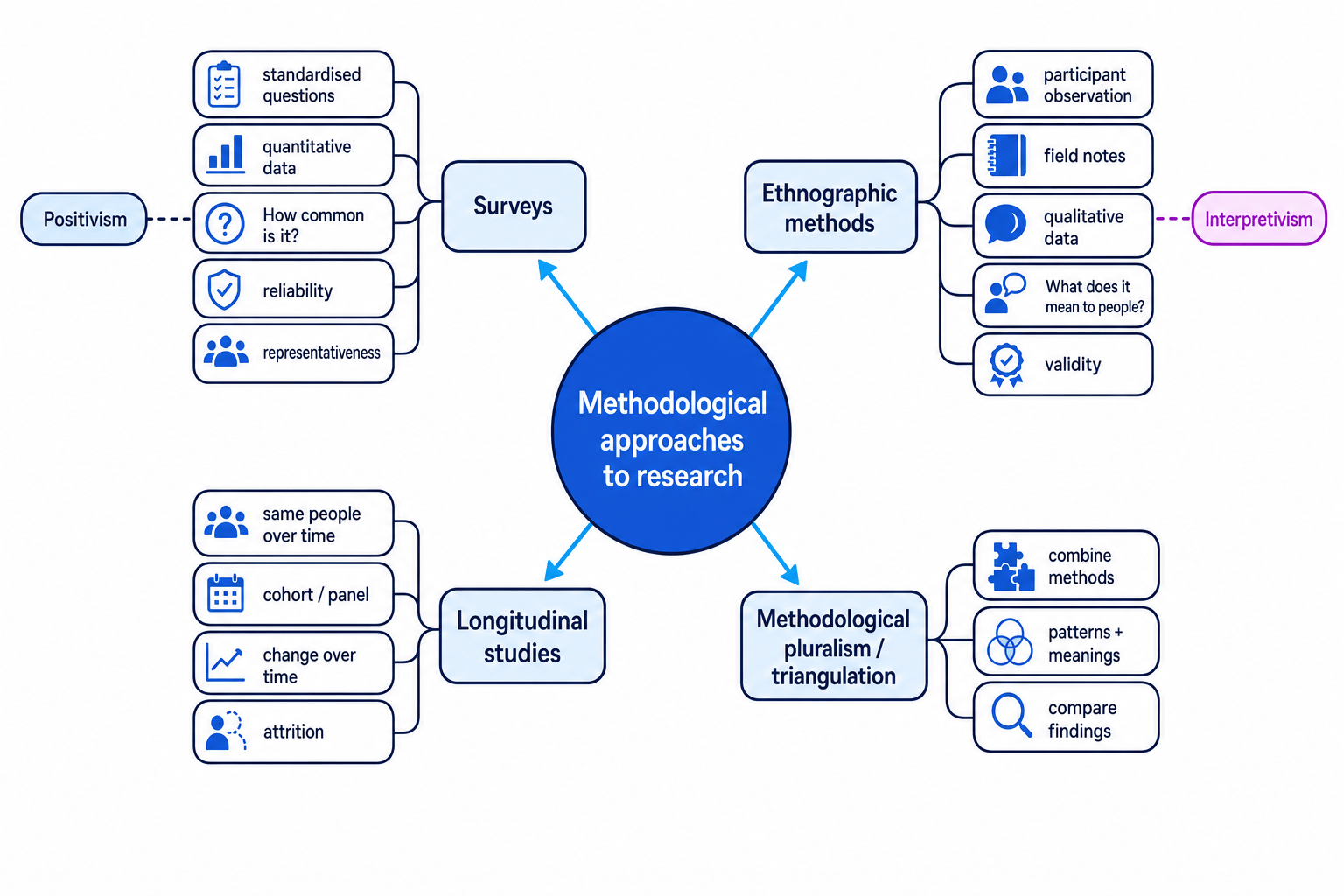
- How sociologists use surveys, ethnographic methods, longitudinal studies, and methodological pluralism/triangulation.
- How each approach links to positivist and interpretivist ideas about evidence.
- How to evaluate methods using practical, ethical and theoretical issues.
- How to apply methods to real UK examples, such as the Crime Survey for England and Wales, British Social Attitudes, and Understanding Society.
Starting point: what is a methodological approach?
A research method is a specific tool for collecting data, such as a questionnaire, interview or observation. A methodological approach is broader: it is the overall way a sociologist designs research to answer a question.
For example, a researcher might use a survey approach to measure how common an attitude is, or an ethnographic approach to understand how people create meanings in everyday life.
Methodological approach
A methodological approach is the overall research design used to investigate a sociological question, including the type of data collected, the relationship with participants, and the logic used to produce evidence.
Before choosing an approach, you need a few core terms. Quantitative data means numerical data, such as percentages or counts. Qualitative data means detailed non-numerical data, such as interview accounts or field notes. Reliability means a study could be repeated and produce similar results. Validity means the research accurately captures what it claims to measure. Representativeness means the sample reflects the wider population being studied.
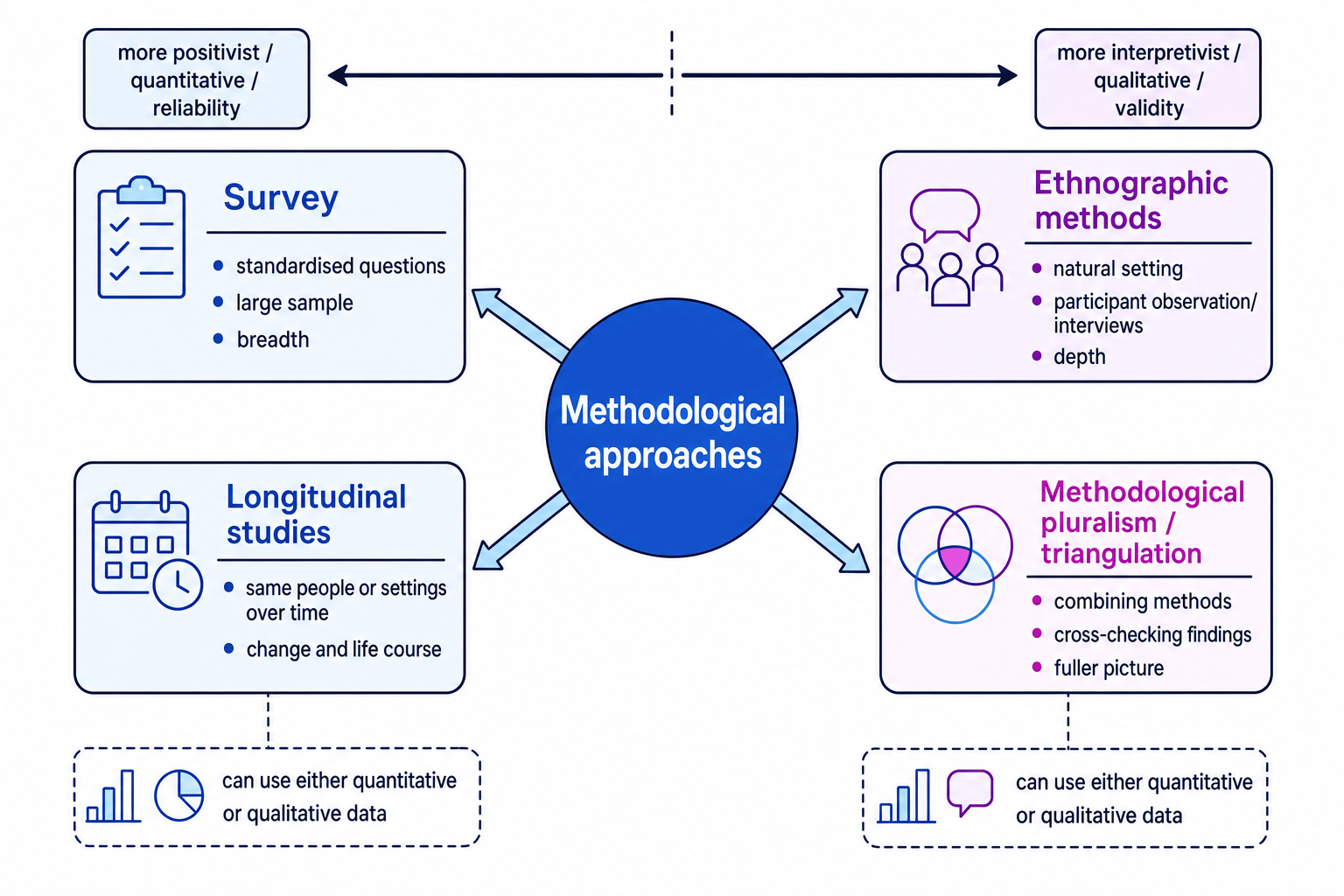
Most debates in this topic are about trade-offs: breadth versus depth, reliability versus validity, and snapshot evidence versus evidence over time.
Theoretical background: positivism and interpretivism
Positivism is the view that society can be studied using objective, systematic measurement, a bit like the natural sciences. Positivists often prefer quantitative methods because they can identify patterns, trends and correlations. Durkheim’s study of suicide (1897), using official statistics to study “social facts”, is a classic influence here.
Interpretivism is the view that sociologists should understand the meanings people attach to their actions. Interpretivists often prefer qualitative methods because social life depends on identity, interaction and interpretation. Weber’s idea of verstehen, meaning empathetic understanding, is important here.
Method follows the question
Do not treat methods as “good” or “bad” in isolation. A method is strong when it fits the research question, the group being studied, and the kind of evidence needed.
Matching an approach to a research question
-
If the question asks “How common is this?”, such as how many people report fear of crime, a survey is suitable because it collects comparable answers from many people.
-
If the question asks “What does this mean to people?”, such as how young people experience school exclusion, ethnographic methods are stronger because they capture interaction, identity and context.
-
If the question asks “How does this change over time?”, such as whether childhood poverty affects adult health, a longitudinal study is useful because it follows change rather than giving one snapshot.
-
If the question needs both patterns and meanings, such as why domestic abuse is under-reported, methodological pluralism or triangulation may be best because it combines different forms of evidence.
Surveys
A survey is a research approach that collects information from a population or sample using standardised questions. A sample is the smaller group selected from the wider target population, which is the group the researcher wants to make claims about.
Surveys usually use questionnaires, where participants complete written or online questions, or structured interviews, where an interviewer asks the same questions in the same order. Closed questions give fixed response options, while open questions allow participants to answer in their own words. A Likert scale is a common survey format using options such as “strongly agree” to “strongly disagree”.
Surveys often fit a positivist approach because they can produce reliable, comparable and sometimes representative data. In the UK, the Crime Survey for England and Wales asks people about their experiences of crime, including crimes not reported to the police. British Social Attitudes, run by NatCen, tracks changing attitudes to issues such as welfare, gender roles and religion. The Census, run by the Office for National Statistics, is not a sample survey because it aims to count the whole population, but it shows how large-scale standardised data can inform policy and funding.
Strengths of surveys
Surveys are useful when sociologists want broad patterns. They can compare social groups by age, gender, ethnicity, social class, region or disability. This makes them important for studying power and stratification, because they can reveal inequalities in income, victimisation, education or health.
They are also relatively easy to replicate if the questions and sampling method are clear. This supports reliability and allows comparison over time, especially when the same questions are repeated in later surveys.
Limitations of surveys
Surveys may lack validity if responses are superficial or if participants interpret questions differently. Social desirability bias occurs when people give answers they think are socially acceptable rather than honest. Non-response occurs when selected participants do not take part, which can damage representativeness.
Surveys can also impose official categories onto people’s identities. For example, fixed ethnic categories may not fully capture mixed, changing or contested identities. This links methods to the wider themes of culture, identity and power.
Calling all quantitative research a survey
Not every piece of numerical research is a survey. A survey uses standardised questions asked of a population or sample. Official statistics, experiments and content analysis may also produce numbers, but they are not automatically surveys.
Designing a survey on trust in policing
-
The researcher wants to compare trust in the police across age, ethnicity and region, so a survey is suitable because it can collect standardised answers from a large sample.
-
They use a Likert scale for statements such as “I have confidence in my local police”, because this creates comparable responses across different social groups.
-
They make the survey anonymous to reduce social desirability bias, especially because policing can be sensitive for groups with negative experiences of authority.
-
For AO3 evaluation, the survey may be reliable and representative if the sample and response rate are strong, but it may have weaker validity because it cannot fully explain why people trust or distrust the police.
Ethnographic methods
Ethnography is a detailed study of a group, community or culture in its natural setting. The natural setting means the everyday context where social life normally happens, such as a school, workplace, street, family home or online community.
Ethnographic methods often include participant observation, where the researcher watches or joins in with a group’s activities. They may also use unstructured interviews, which are flexible conversations, and field notes, which are detailed written records of observations and reflections.
Ethnography is closely linked to interpretivism because it aims to understand meanings from the participant’s point of view. Willis’s Learning to Labour (1977) is a key example: he used ethnographic methods to study working-class boys, known as “the lads”, and how their anti-school culture helped reproduce class inequality. Goffman’s Asylums (1961) and Whyte’s Street Corner Society (1943) are also influential observational studies.
Strengths of ethnography
Ethnography can produce high validity because it gets close to everyday interaction. It is especially useful for studying socialisation, youth cultures, school subcultures, deviance, identity, stigma and informal power relationships.
It can also reveal hidden behaviour that surveys miss. For example, a survey might show that pupils say they value education, while ethnographic observation might reveal peer pressure against “acting clever” in certain groups.
Limitations of ethnography
Ethnography is often time-consuming and expensive. Access may depend on gatekeepers, people who control entry to a setting, such as headteachers, employers or community leaders.
There are serious ethical issues. Overt research means participants know they are being studied. Covert research means the researcher hides their role, which can reduce the researcher effect, where people change behaviour because they are being observed, but it creates problems of informed consent. Researchers can also risk “going native”, meaning they become so involved with the group that they lose analytical distance.
Evaluating a school ethnography
-
The research question asks how peer-group status is created in lessons and playground interactions, so ethnography fits because these meanings develop in everyday settings.
-
The researcher chooses overt participant observation through school permission, which improves ethical protection but may increase the researcher effect.
-
Field notes are combined with informal interviews, allowing the researcher to compare what pupils do with what they say their actions mean.
-
For AO3 evaluation, the study may have strong validity but weaker reliability and representativeness, because one school or peer group cannot easily stand for all pupils.
Longitudinal studies
A longitudinal study follows the same people, households, organisations or settings over time. This contrasts with a cross-sectional study, which collects data at one point in time.
A cohort study follows people who share a starting point, such as being born in the same year. A panel study repeatedly collects data from the same individuals or households. UK examples include the National Child Development Study following people born in 1958, the British Cohort Study 1970, the Millennium Cohort Study, and Understanding Society, the UK Household Longitudinal Study.
Strengths of longitudinal studies
Longitudinal studies are excellent for studying change. They can show how early social class, family background, education, ethnicity, gender or disability relate to later outcomes. This makes them very useful for studying social mobility, health inequalities, family change and the long-term effects of policy.
They also help establish temporal order, meaning which event came first. For example, if poverty is recorded before later health problems, researchers can make a stronger argument about possible influence than they could from a one-off snapshot.
Limitations of longitudinal studies
Longitudinal studies are expensive and take a long time. A major problem is attrition, where participants drop out over time. If disadvantaged participants are more likely to drop out, the study may underestimate inequality.
There may also be panel conditioning, where people change their answers or behaviour because they have taken part repeatedly. Longitudinal evidence can show patterns over time, but it still may not fully explain people’s meanings, motivations or identities unless qualitative data are included.
Using longitudinal evidence to study social mobility
-
The researcher starts with childhood data on parental occupation, housing, school attainment and neighbourhood, because these measure early class position.
-
They follow participants into adulthood and compare later education, income and occupation, allowing them to trace movement between class positions over the life course.
-
They check attrition carefully, because if poorer households are more likely to leave the study, the findings may make social mobility look easier than it is.
-
For AO3 evaluation, the approach is strong for showing change over time, but it may need interviews or ethnography to explain how people experience class identity and opportunity.
Methodological pluralism and triangulation
Methodological pluralism means using more than one method or type of evidence within a study or research programme. Mixed methods is a form of this where quantitative and qualitative methods are combined.
Triangulation means comparing evidence from different methods, sources, researchers or theories to check, challenge or deepen findings. Denzin (1970) identified different forms of triangulation, including methodological triangulation, where researchers use more than one method.
The key difference is this: pluralism is about using multiple methods; triangulation is about making those methods speak to each other.
Why sociologists use pluralism
Pluralism can combine the strengths of positivist and interpretivist approaches. A survey may show the scale of a problem, while interviews explain how people experience it. Official statistics may show patterns of inequality, while ethnography reveals how those inequalities are reproduced in daily interaction.
For example, research into domestic abuse might use police records, the Crime Survey for England and Wales, interviews with survivors, and observations of support services. This can reveal both the scale of abuse and the power relations that shape reporting, safety and access to help.
Evaluation of pluralism and triangulation
Pluralism can improve validity by giving a fuller picture, and it can improve confidence when different methods point in the same direction. It is also useful for policy because governments and charities often need both numbers and lived experiences.
However, it is not a magic solution. It costs more, takes longer and requires more research skills. Different methods may also produce contradictory findings. That is not always a failure: contradictions can reveal something sociologically important, such as the gap between official categories and lived identities.
Mixing methods is not automatically triangulation
A study only uses triangulation if the different sources are compared or used to check and develop each other. Simply adding an interview after a survey is methodological pluralism, but it becomes triangulation when the findings are actively connected.
Triangulating domestic-abuse research
-
Police records are useful but may understate domestic abuse because many victims do not report incidents due to fear, shame, financial dependence or distrust of authorities.
-
A confidential survey can estimate wider prevalence, including cases not known to the police, so it provides a broader quantitative picture.
-
In-depth interviews can explore meanings and barriers, such as coercive control, immigration status, housing insecurity or concern for children.
-
If the sources disagree, the researcher analyses why. The contradiction may reveal hidden power relations rather than simply proving one source is “wrong”.
Quick comparison
| Approach | Best for asking… | Typical evidence | Main evaluation issue |
|---|---|---|---|
| Survey | “How common is it?” or “Which groups differ?” | Standardised questionnaire or structured interview data | May be reliable and representative, but weaker on meaning and validity |
| Ethnography | “How do people experience and create meanings?” | Field notes, observations, informal interviews | High validity, but issues with access, ethics, reliability and representativeness |
| Longitudinal study | “How does this change over time?” | Repeated data from the same people, households or cohorts | Excellent for change, but affected by time, cost and attrition |
| Pluralism/triangulation | “How can we combine pattern and meaning?” | Multiple methods or sources | Fuller picture, but complex, costly and sometimes contradictory |
Essay shortcut
A strong methods paragraph usually does three things: defines the approach accurately for AO1, applies it to a concrete topic or source for AO2, and evaluates it using practical, ethical and theoretical issues for AO3.
In the exam
-
Start by naming and defining the approach precisely: survey, ethnography, longitudinal study, methodological pluralism or triangulation.
-
Apply it to the issue in the question or item, using a real example where possible, such as the CSEW, British Social Attitudes, Willis, or Understanding Society.
-
Evaluate with a balanced judgement: cover at least one practical issue, one ethical issue and one theoretical issue such as reliability, validity or representativeness.
Check yourself
- Why might a survey be reliable but not very valid?
- How does ethnography help sociologists understand culture and identity?
- What is the difference between methodological pluralism and triangulation?