What you'll learn
- What education social policy means and why governments keep reforming schools.
- How key UK policies changed from selection to comprehensive schooling, then to marketisation and accountability.
- How to apply functionalist, New Right, Marxist, feminist and interactionist views.
- How to evaluate policies using evidence about class, gender, ethnicity, identity and power.
What is social policy?
The state means the institutions that govern society, such as Parliament, government departments, local authorities, regulators and publicly funded services. In education, the state decides things like funding, school types, curriculum, exams, inspection and admissions.
Social policy
Social policy is government action designed to deal with social issues, shape people’s lives and influence how society works. Education policy is social policy focused on schooling, colleges, universities, training and lifelong learning.
Education policy matters because schools do more than teach subjects. They are major agencies of socialisation, meaning the process through which people learn norms, values, roles and identities. They also affect stratification, meaning structured inequalities between groups, such as social classes, genders and ethnic groups.
A good sociology answer does not just list policies. It asks: Who benefits? Who loses? What values are being promoted? Does the policy reduce inequality, or reproduce it?
Policy is never neutral
Education policy shapes what counts as “success”, what kind of pupil is valued, and which groups get access to powerful qualifications and opportunities.
The big picture: major policy shifts
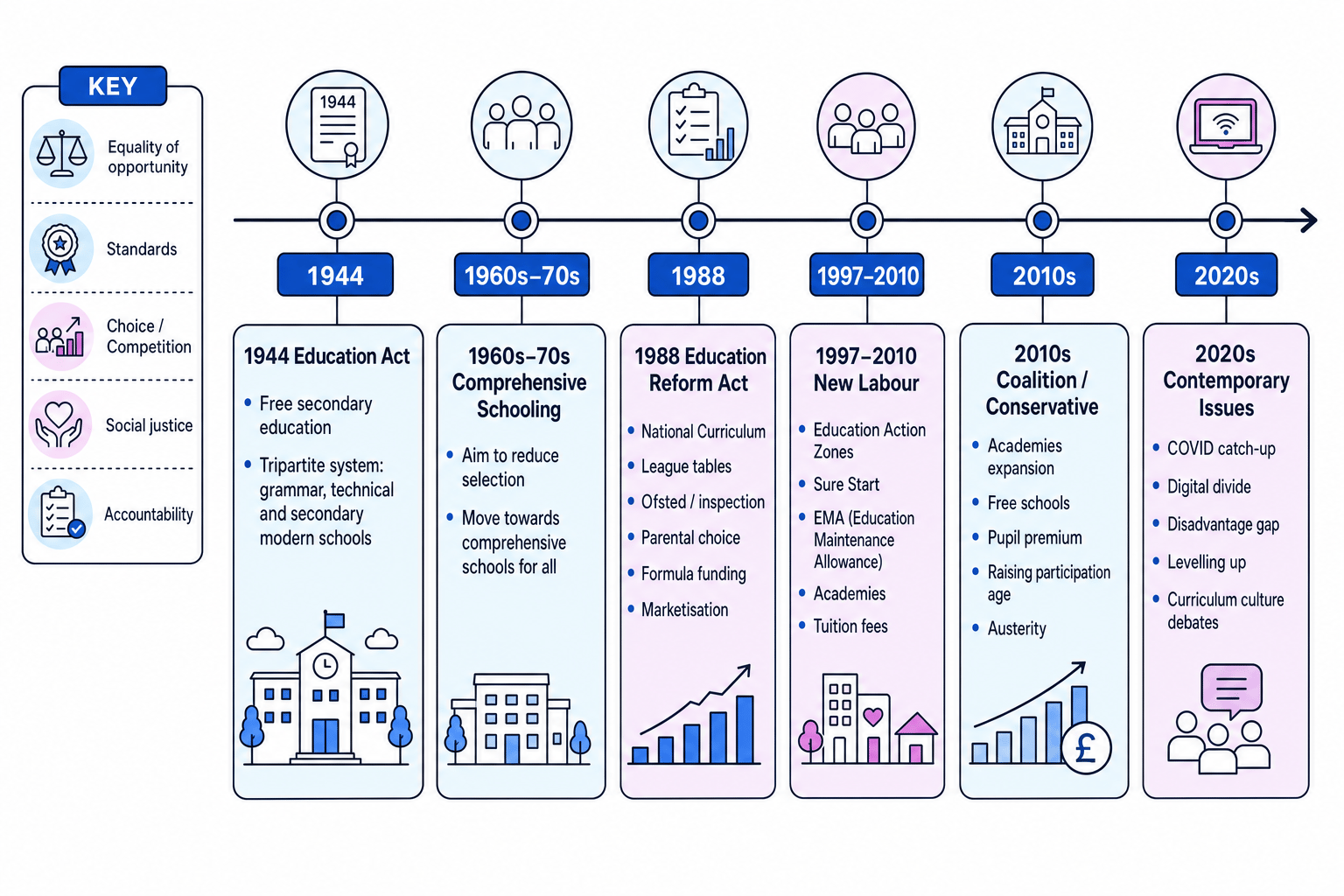
UK education policy has moved through several broad phases: post-war equality of opportunity, comprehensive reform, marketisation, New Labour inclusion, academy/free school expansion, and contemporary debates about poverty, COVID catch-up and curriculum.
From selection to comprehensive schooling
The 1944 Education Act introduced free secondary education for all. It created the tripartite system, which separated pupils into grammar schools, technical schools and secondary modern schools, usually through the 11-plus examination.
This was presented as meritocratic. A meritocracy is a system where people are rewarded according to ability and effort rather than background. In theory, bright working-class children could win a place at grammar school and become upwardly mobile.
However, sociologists argue that selection often reproduced class inequality. Middle-class children were more likely to have the cultural support, parental confidence and resources needed to succeed in the 11-plus. The technical school sector was also underdeveloped, so many pupils were channelled into secondary modern schools with fewer opportunities.
From the 1960s and 1970s, many areas moved towards comprehensive schools, which are non-selective schools intended to educate pupils of all abilities together.
AO3 evaluation is important here. Comprehensive schooling reduced obvious selection between schools, but inequalities continued through setting and streaming, where pupils are grouped by perceived ability within schools. Catchment areas also meant that housing wealth could influence access to “good” schools.
Marketisation: choice, competition and standards
A major turning point was the Education Reform Act 1988. This introduced the National Curriculum, more parental choice, formula funding linked to pupil numbers, and later a stronger culture of testing, league tables and inspection.
Marketisation
Marketisation means introducing market-like features into public education, such as parental choice, competition between schools, published performance data and funding linked to attracting pupils.
The New Right and neoliberal thinkers support this direction. Neoliberalism is the view that competition, consumer choice and limited state control improve efficiency. New Right writers such as Chubb and Moe argued that state schooling can become inefficient because schools do not have enough incentive to respond to parents.
In practice, marketisation means parents can compare schools using exam results, inspection reports and reputation. Schools compete to attract pupils because pupil numbers affect funding and status.
Applying marketisation to league tables
-
Identify the policy mechanism: league tables publish school performance data, so schools can be compared publicly.
-
Apply it to behaviour: parents may try to choose schools with better results, while schools try to protect or improve their position in the table.
-
Analyse inequality: middle-class parents often have more knowledge, time, transport and confidence to use choice effectively, so marketisation may increase class advantage rather than create equal opportunity.
Stephen Ball criticised the idea of parentocracy, where parents supposedly have real power as educational consumers. He argued that choice is unequal because some parents are better placed to play the system. Gewirtz, Ball and Bowe identified “privileged-skilled choosers”, who use cultural and economic capital to secure school places, compared with less advantaged parents who may have fewer options.
Marxist and critical sociologists also use the ideas of cream-skimming and silt-shifting. Cream-skimming means schools select or attract easier-to-teach, high-achieving pupils. Silt-shifting means avoiding pupils seen as costly or risky, such as those with behavioural difficulties or lower prior attainment.
Marketisation is not the same as privatisation
Marketisation means making schools compete like businesses. Privatisation means private companies, charities or external organisations take over parts of education provision. The two often overlap, but they are not identical.
New Labour: social inclusion plus competition
From 1997 to 2010, New Labour followed a Third Way approach associated with Anthony Giddens: combining market efficiency with social justice. This meant keeping many market reforms while also trying to reduce disadvantage.
Key policies included:
- Sure Start, which supported young children and families in disadvantaged areas.
- Education Action Zones and Excellence in Cities, which targeted support at deprived communities.
- Education Maintenance Allowance, or EMA, which paid some 16–19-year-olds from low-income households to remain in education.
- Expansion of academies, originally aimed at replacing underperforming schools in disadvantaged areas.
- Literacy and numeracy strategies to raise standards.
These are examples of compensatory education: policies that provide extra support to compensate for social and economic disadvantages outside school.
AO3 evaluation is mixed. New Labour took poverty and exclusion seriously, and some policies helped participation. However, critics argue that it still accepted marketisation and testing. Tuition fees also expanded in higher education, raising questions about whether university access was becoming more unequal.
Coalition, Conservative and contemporary policy
From 2010 onwards, education policy in England strongly emphasised school autonomy, competition and accountability. Academies are state-funded schools outside direct local authority control, often run by academy trusts. Free schools are new state-funded schools set up by groups such as parents, charities or academy trusts.
Other important policies include:
- The Pupil Premium, extra funding for schools in England to support disadvantaged pupils.
- Raising the participation age so young people stay in education or training until 18.
- GCSE and curriculum reforms, including the English Baccalaureate, or EBacc.
- Expansion of student loans and higher tuition fees in higher education.
- COVID-19 catch-up funding and tutoring programmes.
In Wales, policy has taken a somewhat different route. Wales has retained a stronger local authority role, kept EMA, uses Estyn rather than Ofsted for inspection, introduced the Curriculum for Wales from 2022, and uses the Pupil Development Grant to support learners affected by poverty. Universal free school meals for primary pupils have also become an important contemporary policy direction in Wales.
Analysing the Pupil Premium or Pupil Development Grant
-
Start with the aim: these policies try to reduce the attainment gap linked to poverty by giving schools extra resources for disadvantaged learners.
-
Explain the mechanism: schools might spend the money on tutoring, breakfast clubs, literacy support, counselling, attendance work or parental engagement.
-
Apply stratification: the policy targets class inequality, but class often intersects with ethnicity, gender, disability and local deprivation.
-
Evaluate the limit: extra school funding can help, but it may not fully overcome low household income, insecure housing, digital exclusion, cuts to wider services or differences in parental cultural capital.
The COVID-19 pandemic made the digital divide very visible. The digital divide means unequal access to devices, internet connections, quiet study space and digital skills. This showed how education policy is linked to wider social policy on poverty, housing, welfare and health.
Theoretical perspectives on education policy
Functionalism
Functionalists such as Durkheim and Parsons see education as helping social solidarity, shared values and role allocation. From this view, policies such as a National Curriculum, inspections and participation to age 18 can help integrate young people and prepare them for work.
AO3: functionalism can be criticised for assuming society is fair and consensual. Marxists argue that “shared values” may really be ruling-class values.
New Right
The New Right supports parental choice, competition, discipline, traditional standards and reduced local authority control. Academies, free schools and league tables fit this perspective.
AO3: critics argue that education is not a normal market. Parents do not all have equal choice, and schools may prioritise image and results over inclusion.
Marxism
Marxists argue that education policy often reproduces capitalism. Althusser described education as an ideological state apparatus, meaning it spreads ideas that make inequality seem natural. Bowles and Gintis argued that schooling mirrors the workplace through hierarchy, punctuality and obedience. Bourdieu argued that schools value middle-class cultural capital, such as language, confidence and tastes.
From this view, marketisation, tuition fees and competition may increase class inequality while appearing meritocratic.
AO3: Marxism can be too deterministic. Some pupils resist school expectations, as Willis showed, and some policies genuinely improve opportunities for disadvantaged groups.
Feminism
Feminists examine how policy affects gender equality and patriarchy. Equal opportunities legislation, anti-sexist curriculum work, girls’ achievement initiatives and encouragement into STEM subjects can challenge gender inequality.
However, feminists also note continuing issues: gendered subject choices, sexual harassment, school uniform debates, and the hidden curriculum of gender expectations. Walby’s concept of patriarchy is useful for analysing how gender inequality can persist even when formal barriers are removed.
Interactionism
Interactionists focus on everyday meanings, labels and relationships. Becker’s work on teacher labelling and Rosenthal and Jacobson’s study of teacher expectations suggest that policy cannot be judged only by funding or structures. Accountability pressures may encourage schools to label pupils as likely successes or failures, affecting self-concept and identity.
Evidence: how do we know if policy works?
Sociologists use official statistics, meaning quantitative data collected by government or public bodies, such as exam results, exclusions, attendance, destinations and inspection outcomes.
You can evaluate this evidence using methods language:
- Reliability: official statistics are often collected regularly and consistently, making comparisons possible.
- Validity: exam results may not fully measure wellbeing, creativity, confidence or quality of learning.
- Representativeness: national datasets cover many pupils, but categories such as free school meals may not capture every form of poverty.
- Practical issues: large datasets are quick to access, but it can be hard to isolate the effect of one policy.
- Ethical issues: data about pupils must protect confidentiality and avoid stigmatising schools or communities.
A strong policy paragraph
Use this chain: name the policy → explain how it works → apply it to a social group → connect a theory → evaluate with evidence or a limitation.
In the exam
-
Name specific policies rather than writing vaguely about “the government” — for example, marketisation, academies, Pupil Premium, EMA or Curriculum for Wales.
-
Link each policy to inequality: class, gender, ethnicity, disability, region or the digital divide.
-
Balance AO1, AO2 and AO3: outline the policy, apply it to contemporary UK or Welsh society, then evaluate its effects and assumptions.
-
Compare perspectives directly: New Right writers may praise choice, while Marxists and Ball-style critics see unequal power behind that choice.
Check yourself
- How did the 1988 Education Reform Act create a market in education?
- Why might extra funding for disadvantaged pupils help, but not fully remove class inequality?
- Which sociological perspective is most likely to criticise education policy for reproducing capitalist inequality?
