What you'll learn
- How to define family, household, family form and family diversity accurately.
- The main types of family and household found in contemporary UK society.
- How sociologists such as Parsons, Rapoport and Rapoport, Chester, Oakley, Beck, Giddens and Weeks explain diversity.
- How to evaluate family diversity using evidence, policy examples and research-methods awareness.
Starting point: family and household are not the same thing
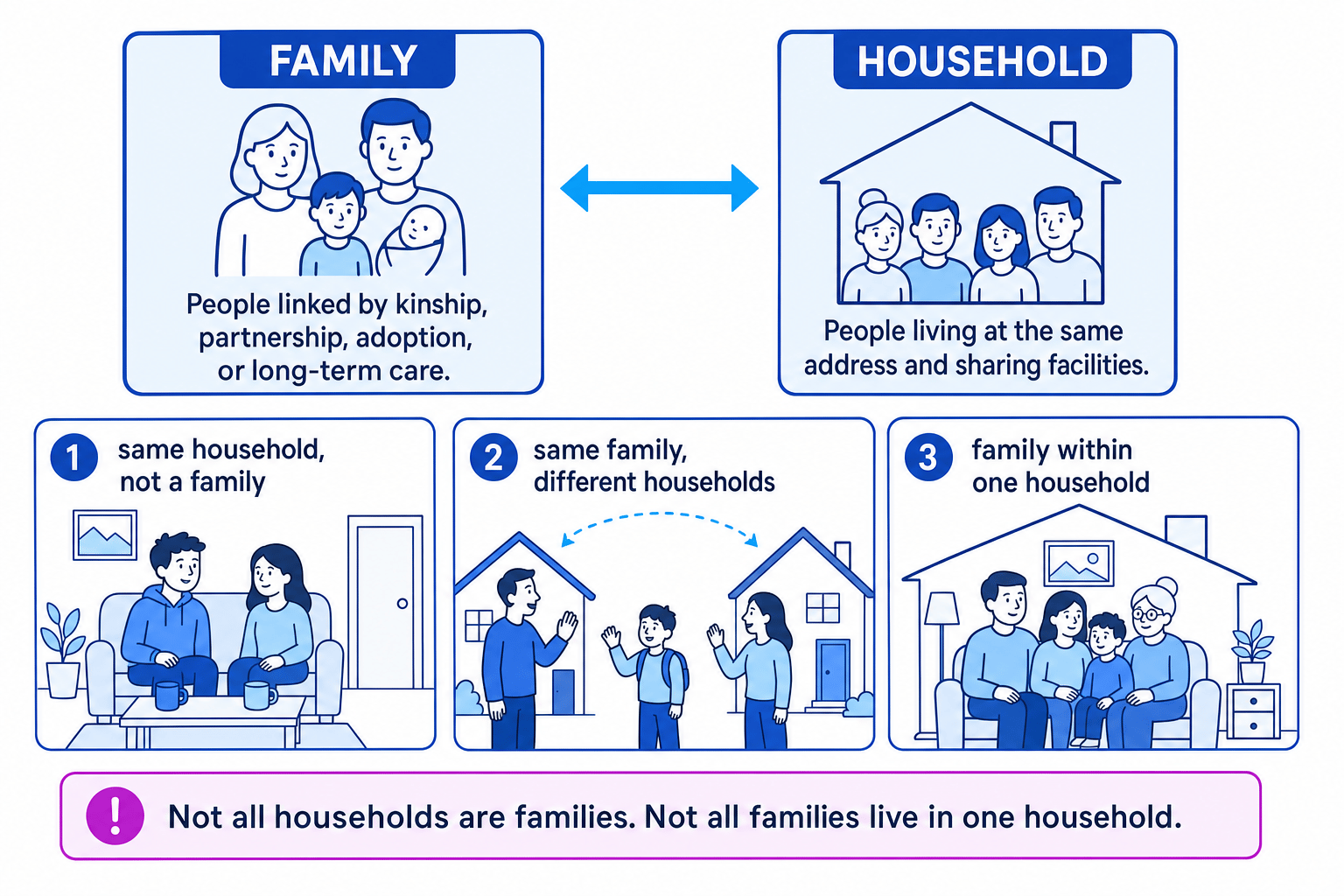
A family is usually understood as a group of people connected by kinship, marriage, civil partnership, cohabitation, adoption or long-term care relationships. Sociologists debate this definition because families can be biological, legal, emotional, chosen or practical.
A household is a person or group of people living at the same address and sharing facilities such as a kitchen or living space. A household might contain a family, but it does not have to.
Family form
A family form is the structure or arrangement of a family, such as a nuclear family, lone-parent family, extended family or same-sex parent family.
Family and household
Not all households are families, and not all families live in one household. This matters because official statistics often measure households more easily than they measure emotional family ties.
Distinguishing family from household
-
Consider two students sharing a rented flat. They live in the same household because they share an address, but they are not necessarily a family because their relationship is not based on kinship, partnership or long-term care.
-
Consider a divorced parent whose child stays with them at weekends. They may not always live in the same household, but they remain part of a family relationship.
-
Therefore, when analysing evidence, separate where people live from how they are socially connected.
Main family forms in contemporary society
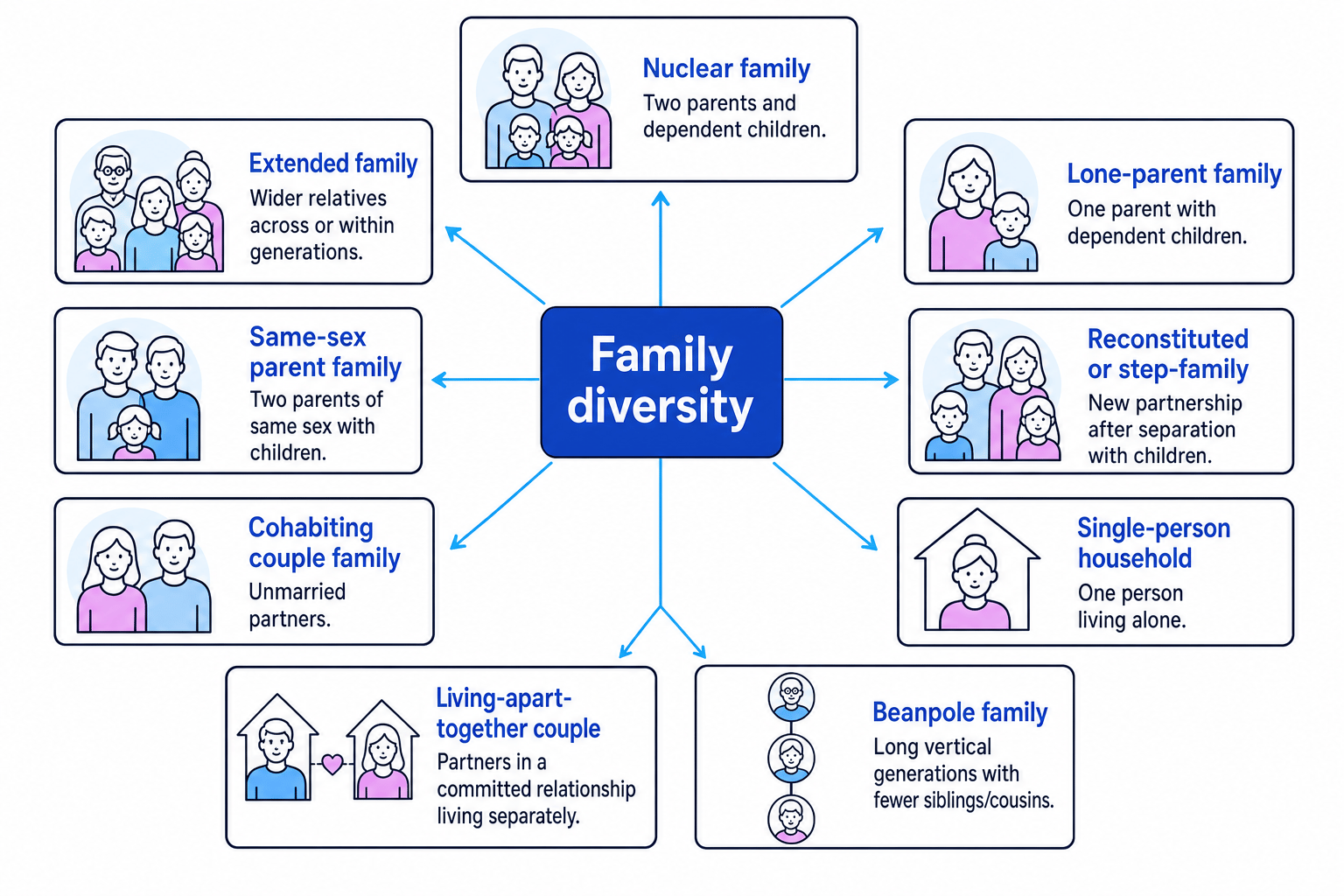
The nuclear family is a two-generation family made up of two parents and their dependent children. Functionalists such as Parsons saw this as especially suited to modern industrial society because it is geographically mobile and focused on child socialisation.
The extended family includes wider relatives beyond parents and dependent children, such as grandparents, aunts, uncles and cousins. This can be vertical across generations or horizontal across siblings and cousins.
The lone-parent family contains one parent and dependent children. In the UK, most lone-parent families are headed by women, which links family diversity to gender, poverty and care work.
The reconstituted family, also called a step-family, is formed when adults create a new family after separation, divorce or widowhood, often including children from previous relationships.
The cohabiting couple family is based on partners living together without being married or in a civil partnership. Cohabitation has become more socially accepted and is often linked to secularisation, changing gender roles and changing attitudes to marriage.
The same-sex parent family includes parents of the same sex raising children. Legal changes such as the Civil Partnership Act 2004, Adoption and Children Act 2002, and Marriage (Same Sex Couples) Act 2013 have increased recognition of LGBTQ+ family life.
The living-apart-together relationship describes committed partners who maintain separate households. This may be chosen for independence, work, caring responsibilities or financial reasons.
A single-person household is one person living alone. This is a household form, not automatically a family form, but it is important for understanding ageing, individualisation and changing life courses.
A beanpole family is a long, thin family structure with several living generations but fewer siblings, cousins, aunts and uncles. It is linked to longer life expectancy and smaller family size.
Assuming one family form is the norm
Avoid writing as if the nuclear family is automatically “normal” and all other family forms are “deviant”. In sociology, the point is to explain patterns, meanings and inequalities, not to moralise.
What is family diversity?
Family diversity
Family diversity means the increased variety of family and household forms, relationships, roles and life-course patterns found within society.
Family diversity is not just about different structures. It also includes different ways of organising money, housework, childcare, sexuality, emotional support and authority.
For example, two families may both be nuclear in structure, but one may have a traditional male breadwinner and female homemaker arrangement, while another may have two full-time earners sharing domestic labour more equally.
Rapoport and Rapoport: five types of diversity
Rapoport and Rapoport argued that Britain had moved away from one dominant family model towards a range of family patterns. Their work is very useful for essays because it gives you a clear framework.
Organisational diversity
Organisational diversity means differences in how families organise roles, paid work and domestic labour. For example, some families have a male breadwinner, some have dual earners, and some rely on wider kin for childcare.
Cultural diversity
Cultural diversity means family patterns vary according to ethnicity, religion and cultural tradition. For example, some South Asian families may place strong emphasis on extended kinship, although you must avoid stereotyping because there is variation within every ethnic group.
Class diversity
Class diversity means social class shapes family life. Middle-class families may have more resources for childcare, housing and education, while working-class families may face greater economic pressure.
Life-course diversity
Life-course diversity means people experience different family forms at different stages of life. Someone might live in a nuclear family as a child, cohabit as a young adult, become a lone parent after separation, and live alone in old age.
Cohort diversity
Cohort diversity means people born in different historical periods have different family experiences. For instance, older cohorts may have experienced stronger social pressure to marry, while younger cohorts may see cohabitation and same-sex relationships as more ordinary.
Applying the Rapoports' five types
-
Imagine a family where grandparents provide daily childcare while both parents work full-time. This shows organisational diversity because the family has arranged care and paid work in a particular way.
-
If the family’s expectations about respect for elders are influenced by religion or ethnicity, this adds cultural diversity.
-
If the parents rely on grandparents because private childcare is too expensive, this shows class diversity, because economic resources shape family choices.
-
If the same person later lives alone after retirement, that illustrates life-course diversity, because family form changes over time.
-
If their grandparents married young while the younger generation cohabits before marriage, that shows cohort diversity, because generations experience different social norms.
Why has family diversity increased?
Several social changes have made family life more varied.
Divorce and separation have become more common and less stigmatised. The Divorce Reform Act 1969 made divorce easier by allowing “irretrievable breakdown” as grounds for divorce, and later no-fault divorce reforms further reduced the need to blame one partner.
Changing gender roles matter too. Women’s increased participation in paid work, access to contraception and feminist challenges to the traditional housewife role have changed expectations of marriage, motherhood and independence.
Secularisation, meaning the declining influence of religion in many areas of social life, has reduced pressure to follow one family pathway. Cohabitation, childlessness and divorce are less likely to be treated as shameful than in the past.
Social policy has also changed. Civil partnerships, same-sex marriage, adoption rights and equality legislation have widened legal recognition. However, policy can still encourage particular family forms, for example through tax, welfare and housing rules.
Diversity is patterned
Family diversity does not mean everyone has unlimited choice. Gender, class, ethnicity, sexuality, age, disability, housing costs and welfare policy all shape what choices are realistically available.
Sociological views of family diversity
Functionalism: diversity as a challenge to social stability
Functionalists see the family as performing important functions for society, especially primary socialisation, where children learn basic norms and values, and the stabilisation of adult personalities.
Parsons argued that the nuclear family fitted industrial society because it was small, mobile and specialised. From this view, too much diversity might weaken shared norms.
AO3 evaluation: functionalism can be criticised for idealising the nuclear family and ignoring conflict, domestic abuse, gender inequality and the positive support found in other family forms.
New Right: diversity as family decline
The New Right argue that the traditional married nuclear family is best for raising children and maintaining social order. Murray linked lone-parent families to welfare dependency and an “underclass”.
AO3 evaluation: this view is often criticised for blaming lone parents, especially women, for problems caused by poverty, insecure work or lack of affordable childcare. It also assumes children need one mother and one father, which is challenged by research on same-sex parenting and by the success of many non-nuclear families.
Feminism: diversity as both opportunity and inequality
Feminists argue that the traditional family can be patriarchal, meaning structured around male power. Oakley criticised the idea that women are naturally suited to housework and childcare. Delphy and Leonard argued that men benefit from women’s unpaid domestic labour.
Family diversity may offer women more freedom through divorce, paid work, contraception and alternative relationships. However, feminists also point out that women still often carry the main burden of childcare, emotional labour and domestic work.
Marxism: diversity within capitalism
Marxists link the family to capitalism. Engels argued that the monogamous family helped transmit private property through inheritance. Later Marxists argue that families reproduce class inequality by socialising children into obedience and encouraging consumption.
AO3 evaluation: Marxism is useful for linking family life to class and economic power, but it can underplay love, care, agency and the emotional meanings people attach to family.
Postmodernism and individualisation: diversity as choice
Postmodernists argue that there is no longer one dominant family type. People construct identities through choice, negotiation and lifestyle.
Giddens described the pure relationship, based on emotional satisfaction rather than duty. Beck and Beck-Gernsheim argued that relationships have become more negotiated as tradition weakens. Weeks, Heaphy and Donovan found that many LGBTQ+ people create “families of choice” based on friendship, care and commitment.
AO3 evaluation: these views capture real changes in identity and intimacy, but they may exaggerate freedom. A wealthy person has more ability to “choose” family arrangements than someone constrained by poverty, housing shortages or immigration rules.
Chester: the neo-conventional family
Chester argued that family diversity may be overstated. He claimed the neo-conventional family — a dual-earner nuclear family — remains a common ideal and experience, even if people pass through different family forms over the life course.
This is a useful counter-argument: diversity has increased, but the nuclear family has not disappeared. ONS data still show married and civil-partner couple families as a major family type, while cohabiting couples, one-person households and lone-parent families have also become significant.
Evaluating a claim about family decline
-
Start with the claim: the New Right argue that rising divorce, lone parenthood and cohabitation show decline from the stable nuclear family.
-
Apply evidence: contemporary UK society does show more cohabitation, reconstituted families and legal recognition of same-sex relationships, so family forms are more diverse.
-
Challenge the assumption: greater diversity does not automatically mean weaker care or socialisation; extended kin, same-sex parents and lone parents can provide strong emotional and practical support.
-
Add power analysis: problems linked to some family forms may be caused by poverty, gender inequality or housing insecurity rather than the family form itself.
-
Reach a balanced judgement: it is stronger to argue that family life has changed and diversified, rather than simply declined.
Research methods: how do we know families are changing?
Official statistics from the ONS and Census are useful because they cover large populations and allow comparisons over time. They are generally reliable because categories are applied consistently.
However, they may have validity problems. A Census can record who lives in a household, but it may not fully capture emotional support, chosen families, step-relationships, shared care after divorce or living-apart-together relationships.
Qualitative methods, such as interviews, can explore meanings and experiences in more depth. For example, interviews with same-sex couples or lone parents may reveal how people “do family” in everyday life. The drawback is that smaller samples may be less representative.
Methods link
If an essay asks about family diversity, add a short methods evaluation: official statistics are strong for trends, but weaker for hidden meanings and relationships across households.
Bringing it together for essays
For Eduqas Families and households, strong answers do three things.
First, show AO1 by defining key terms and using named sociologists accurately. Rapoport and Rapoport are especially useful because their five types of diversity give your essay structure.
Second, show AO2 by applying ideas to contemporary UK examples: cohabitation, divorce reform, same-sex marriage, lone parenthood, ageing, beanpole families, migration, childcare costs and ONS household data.
Third, show AO3 by debating interpretation. Is diversity evidence of freedom, decline, inequality, or simply life-course change? The best answers avoid one-sided claims.
In the exam
-
Define family diversity early, then use at least two specific family forms rather than writing vaguely about “different families”.
-
Build paragraphs around perspectives: for example, New Right decline, feminist patriarchy, postmodern choice, and Chester’s neo-conventional family.
-
Evaluate throughout by asking: who benefits, who is constrained, and does the evidence show diversity, inequality or continuity?
Check yourself
- What is the difference between a family and a household?
- How do Rapoport and Rapoport’s five types of diversity help organise an essay?
- Why might postmodernists and feminists interpret the same family changes differently?