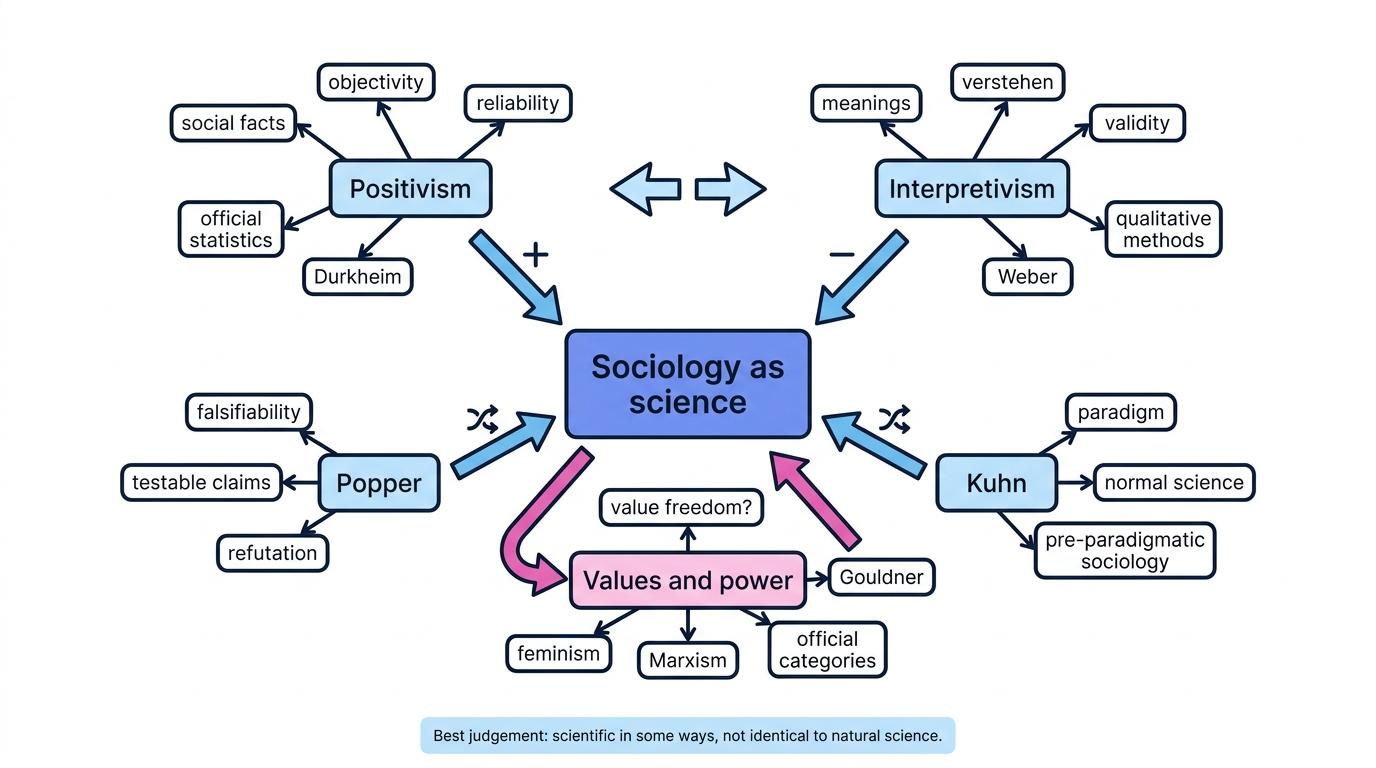
What you'll learn
- What “science” means in sociology: evidence, objectivity, reliability and validity.
- Why positivists argue sociology can discover social patterns scientifically.
- Why interpretivists, Popper and Kuhn challenge the idea of sociology as a science.
- How to evaluate the debate using UK examples, methods issues and power inequalities.
Starting point: what is science?
In sociology, science does not just mean test tubes and laboratories. It means a systematic way of producing knowledge using evidence, clear methods and critical testing.
Science
Science is a systematic approach to knowledge based on empirical evidence — evidence gathered through observation, measurement or experience — and the testing of explanations against that evidence.
A few terms matter straight away:
- Theory: an explanation of how or why something happens.
- Hypothesis: a specific, testable claim based on a theory.
- Objectivity: trying to minimise personal bias so conclusions are based on evidence rather than opinion.
- Reliability: whether a method produces consistent results if repeated.
- Validity: whether research gives a true or accurate picture of what it claims to study.
- Replication: repeating a study to check whether the same findings appear again.
The key debate is not “Is sociology exactly like physics?” It is whether sociology can use scientific principles when studying human society.
The central debate
Sociology is more scientific when it uses systematic evidence, clear concepts and testable claims, but less like natural science when it deals with meanings, values, identities and power relations that cannot easily be measured or controlled.
Why this debate matters in A-Level Sociology
This topic links directly to methods and theory.
If sociology is scientific, then sociologists should aim for reliable, objective and measurable data. This supports methods such as official statistics, questionnaires, social surveys and experiments.
If sociology is not like natural science, then sociologists should focus on meanings, interpretation and lived experience. This supports methods such as unstructured interviews, participant observation and ethnography.
It also connects to the two core themes:
- Socialisation, culture and identity: people act according to meanings, norms and identities, which may be hard to measure scientifically.
- Social differentiation, power and stratification: class, gender, ethnicity, age and disability create patterned inequalities, which can often be studied using quantitative evidence.
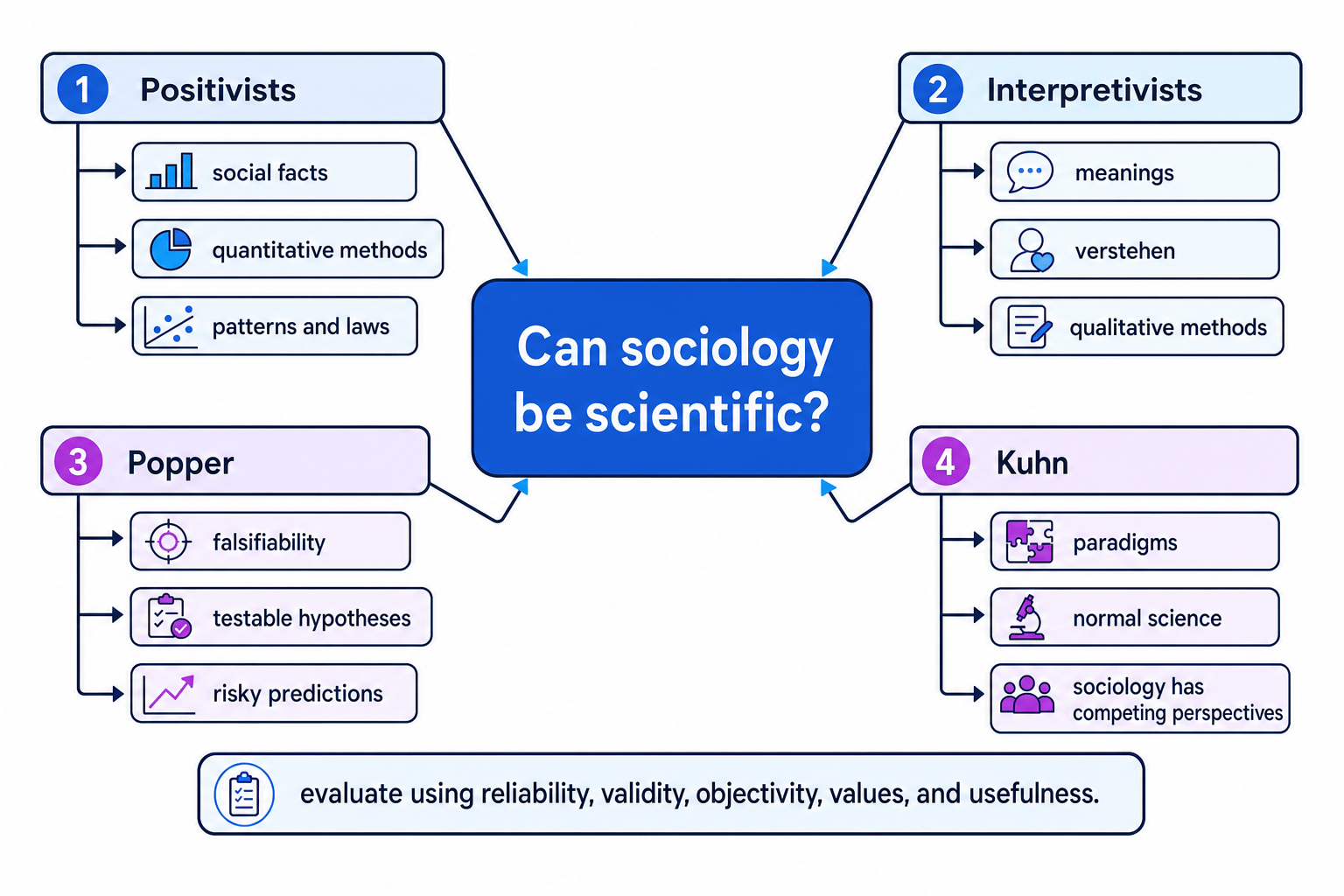
Here is a map of the main positions you need to compare in essays.
Positivism: sociology can be scientific
Positivism
Positivism is the view that sociology should use the methods of the natural sciences to discover objective social facts, patterns and cause-and-effect relationships.
Positivists argue that society has structures that shape people’s behaviour. These can be studied scientifically.
Auguste Comte argued that sociology should become a “positive science” of society. He believed sociologists should move away from speculation and base knowledge on observable evidence.
Émile Durkheim developed this further. He argued that sociologists should study social facts: external social forces that shape individuals, such as norms, laws, institutions, religion, education and rates of suicide.
Social facts
Social facts are social forces outside individuals that influence or constrain behaviour, such as family structures, education systems, laws, moral beliefs and social class patterns.
Durkheim’s study of suicide is the classic example. Suicide appears to be a deeply personal act, but Durkheim used official statistics to show that suicide rates varied between groups. He argued that these patterns were linked to levels of social integration and regulation.
For positivists, this shows that even personal behaviour can have social causes.
Applying positivism to UK society
A positivist sociologist might use:
- Census data to examine household structure, ethnicity, religion and migration.
- Office for National Statistics data to study income, employment, health and inequality.
- Crime Survey for England and Wales data to examine victimisation.
- Education statistics to compare achievement by class, gender and ethnicity.
For example, if official data show persistent differences in educational achievement between pupils eligible for free school meals and those not eligible, positivists may investigate how material deprivation, school resources or parental education affect outcomes.
Using positivist reasoning to study educational inequality
-
Identify the social pattern: pupils from lower-income households tend, on average, to achieve lower educational outcomes than pupils from higher-income households.
-
Treat the pattern as a possible social fact by looking beyond individual effort and considering structural factors such as housing, parental income, school funding and access to private tutoring.
-
Use quantitative data from large-scale sources, such as school performance tables or longitudinal surveys, to compare groups across regions and over time.
-
Evaluate the explanation by asking whether the data show a consistent relationship, while also recognising that statistics may not reveal pupils’ identities, teacher labelling or peer-group meanings.
Strengths of positivism
Positivist sociology can be powerful because it identifies large-scale patterns. This is especially useful for studying social differentiation and stratification, such as class inequality, gender pay gaps, ethnic inequalities in stop and search, or regional differences in health.
It can also influence policy. Governments often rely on quantitative data to make decisions about schools, policing, welfare and healthcare.
Limitations of positivism
The main criticism is that humans are not like atoms or chemicals. People have consciousness, meanings and choices. They may change their behaviour if they know they are being studied.
Official statistics may also be socially constructed. For example, crime statistics depend on what victims report, what police record and how laws define crime. Suicide statistics depend partly on coroners’ decisions. This means statistics may be reliable in appearance but not fully valid.
Science does not mean “definitely true”
Do not argue that sociology is unscientific simply because sociologists disagree. Scientific knowledge can be provisional, contested and revised. The stronger argument is about whether sociological claims are testable, evidence-based and open to criticism.
Interpretivism: sociology studies meanings
Interpretivism
Interpretivism is the view that sociology should focus on meanings, motives and interpretations rather than trying to copy the natural sciences.
Interpretivists argue that humans act based on how they understand the world. This means sociology needs to study social action: behaviour shaped by meanings.
Max Weber argued that sociologists should use verstehen, meaning empathetic understanding. Instead of only measuring what people do, sociologists should understand why people think their actions make sense.
This approach links strongly to culture and identity. For example, a young person’s attitude to school may be shaped by class identity, gender expectations, ethnic identity, peer-group status and experiences of labelling.
Interpretivists prefer qualitative methods, which collect detailed non-numerical data. These include unstructured interviews, participant observation, diaries and personal documents.
Choosing a method to study school identity
-
Start with the research problem: why do some pupils reject school values even when education may improve their future opportunities?
-
A positivist approach could measure attendance, exclusions and exam results, giving useful patterns but limited insight into meanings.
-
An interpretivist approach could use interviews or observation to explore peer-group status, masculinity, teacher labelling and pupils’ sense of identity.
-
The evaluation is balanced: qualitative research may have higher validity because it captures meanings, but it may be less reliable and less representative because it often uses smaller samples.
A good example is Willis’s study of working-class “lads”, which showed how peer culture shaped resistance to school. This kind of research is difficult to reduce to variables, but it gives insight into socialisation, identity and class reproduction.
Popper: science must be falsifiable
Falsifiability
Falsifiability means that a claim is scientific only if it could, in principle, be proven false by evidence.
Karl Popper argued that science does not prove theories true forever. Instead, science progresses by making bold claims and trying to refute them. If a theory survives serious testing, it is strengthened — but still not finally proven.
This matters for sociology because some sociological claims are testable. For example:
- “Children from higher-income families are more likely to attend university.”
- “Victims are more likely to report some types of crime than others.”
- “People with higher levels of educational qualifications are more likely to be employed.”
These claims can be compared with evidence.
However, Popper criticised theories that explain everything after the event and cannot be disproved. Some versions of Marxism, functionalism or psychoanalysis may become unfalsifiable if every possible outcome is treated as supporting the theory.
Testing a sociological claim with falsification
-
Turn a broad theory into a testable claim, such as: “Material deprivation reduces educational achievement.”
-
Decide what evidence would challenge the claim, such as a case where pupils experiencing material deprivation consistently achieve the same outcomes as wealthier pupils, after other factors are considered.
-
Compare the claim with data on income, free school meal eligibility, school resources and exam results.
-
Judge the result carefully: if the pattern is weak, the theory may need revising, but this does not automatically mean poverty has no effect because other variables may be involved.
Popper helps you evaluate the extent to which sociology is scientific. Sociology is more scientific when it makes clear, testable claims. It is less scientific when theories become too vague to challenge.
Kuhn: science depends on paradigms
Paradigm
A paradigm is a shared framework of ideas, assumptions, concepts and methods used by a scientific community.
Thomas Kuhn argued that science does not simply progress through neutral facts. Instead, scientists usually work within a dominant paradigm. This is called normal science, where researchers solve problems using accepted assumptions.
Sometimes evidence builds up that the old paradigm cannot explain. This may lead to a scientific revolution, where one paradigm is replaced by another.
Kuhn’s argument creates a challenge for sociology. Natural sciences often have a dominant paradigm, but sociology has competing perspectives: functionalism, Marxism, feminism, interactionism, postmodernism and others.
This may suggest sociology is pre-paradigmatic, meaning it has not settled around one shared scientific framework.
However, you can evaluate this. Sociology may need multiple paradigms because society is complex and power is contested. A Marxist, feminist and interactionist may ask different questions because class, gender, ethnicity and identity shape social life in different ways.
Values, objectivity and power
A major issue is whether sociology can be value-free. Value freedom means keeping personal, political or moral beliefs out of the research process.
Weber argued that values may influence the choice of topic, but sociologists should still aim to be objective when collecting and analysing evidence. For example, a sociologist may care about poverty, but they should not distort evidence to fit their political view.
Other sociologists disagree. Gouldner argued that value-free sociology is impossible because researchers are part of society. Feminists and Marxists add that claims of neutrality can hide power. What counts as “normal”, “deviant”, “successful” or “criminal” may reflect dominant groups’ interests.
This is important for UK examples. Official categories around ethnicity, gender, disability, unemployment and crime are not just technical labels. They shape how inequality is seen and how policy responds.
A strong essay stance
The best answer is usually not “yes” or “no”. Argue that sociology can be scientific in some ways and less scientific in others, depending on the theory, method, topic and type of evidence.
Merton: scientific norms
Robert Merton argued that science is guided by norms sometimes summarised as CUDOS:
- Communalism: scientific knowledge should be shared.
- Universalism: claims should be judged by evidence, not by the researcher’s status.
- Disinterestedness: researchers should not be driven by personal gain.
- Organised scepticism: findings should be critically examined.
Sociology can follow these norms through peer review, transparent methods, published datasets and critical debate.
But there are limits. Research funding, political pressure, media attention and institutional power can shape what gets studied. For example, government-funded research may prioritise employability, crime control or welfare costs rather than questions asked by marginalised communities.
So, can sociology be regarded as scientific?
The most balanced conclusion is: to some extent.
Sociology can be scientific when it:
- uses systematic evidence;
- makes clear and testable claims;
- uses reliable methods;
- compares findings with data;
- is open to criticism and revision.
But sociology is not fully like natural science because:
- people interpret situations and act on meanings;
- society is an open system with many interacting causes;
- research categories may be shaped by power;
- values can influence topic choice, method and interpretation;
- controlled experiments are often impractical or unethical.
This means sociology is best seen as a disciplined social science: not identical to physics or chemistry, but still capable of rigorous, evidence-based knowledge about society.
In the exam
-
Start with clear AO1: define science, positivism, interpretivism, falsifiability and paradigms before evaluating.
-
Use AO2 examples from UK society, such as Census data, education statistics, crime statistics, social class inequalities, gender pay gaps or ethnic inequalities in policing.
-
Build AO3 throughout: compare positivist strengths with interpretivist criticisms, then add Popper, Kuhn and values to reach a balanced “to some extent” judgement.
Check yourself
- Why did Durkheim think suicide could be studied scientifically?
- How does Popper’s idea of falsifiability challenge some sociological theories?
- Why might interpretivists argue that validity matters more than reliability?