What you'll learn
- What sociologists mean by modernity, post-modernity and late modernity.
- How classical theorists such as Marx, Durkheim and Weber are linked to modern society.
- How post-modernists such as Lyotard, Baudrillard and Bauman challenge “big” sociological theories.
- How to apply and evaluate these ideas using contemporary UK examples.
Why this topic matters
Sociological theory means an organised explanation of how society works, why it changes, and how power and inequality are structured. The debate about modernity and post-modernity is really a debate about what kind of society we now live in — and therefore what kind of sociology we need.
A simple starting point:
- Modernist sociology often looks for large-scale patterns, structures and causes.
- Post-modern sociology questions whether society still has one clear structure or one “truthful” explanation.
This links directly to the two big AQA themes: socialisation, culture and identity and social differentiation, power and stratification.
Modernity: the starting point
Modernity
Modernity refers to the type of society that developed with industrialisation, capitalism, scientific thinking, bureaucracy and the modern nation-state. It is associated with the belief that human reason and social science can explain and improve society.
Modernity developed especially from the Enlightenment and the Industrial Revolution. The Enlightenment was an intellectual movement that valued reason, science and progress over tradition and religious authority. Industrialisation means the shift from small-scale agricultural production to factory-based production using machines.
Key features of modernity include:
- Capitalism: an economic system based on private ownership, wage labour and profit.
- Bureaucracy: organisation through formal rules, records and hierarchies.
- Rationalisation: Weber’s term for the increasing use of calculation, efficiency and rules.
- Secularisation: the declining social influence of religion.
- Class stratification: inequality organised mainly around economic position.
- Nation-state: a centralised political unit with laws, borders and citizenship.
In modern societies, socialisation often happens through powerful institutions such as the family, school, workplace and state. These institutions help produce shared culture and identity — for example, through the National Curriculum, citizenship education and official categories such as “employed”, “unemployed” or “British”.
At the same time, modernity creates new forms of power and inequality. Class divisions, bureaucratic authority, gender roles, racism and colonial power are all part of the modern world.
Applying modernity to education
-
A state school can be seen as a modern institution because it is organised through timetables, rules, exams, age groups and official records.
-
Durkheim would argue that schools help create social solidarity by teaching shared values and preparing young people for specialised roles in an industrial society.
-
Marxists would apply a conflict view: schools may reproduce class inequality by preparing working-class pupils for obedience and middle-class pupils for leadership.
-
A strong answer would evaluate both: schools do socialise pupils into shared culture, but outcomes are still shaped by class, gender and ethnicity.
Modernist sociological theory
Classical sociology developed as an attempt to understand modernity.
Marx saw modern society as capitalist. For Marx, the central conflict was between the bourgeoisie, who own the means of production, and the proletariat, who sell their labour. His theory is a conflict theory because it sees society as shaped by power struggles.
Durkheim focused on social order. He argued that modern societies rely on organic solidarity, where people depend on each other because they perform specialised roles. He also warned about anomie, a state of normlessness when social rules become unclear.
Weber agreed that modern society was increasingly rational, but he did not reduce everything to class. He analysed class, status and party, and warned that bureaucracy could trap people in an “iron cage” of rules.
A metanarrative is a large, overarching explanation of history or society. Marxism, functionalism and some forms of feminism can be treated as metanarratives because they claim to explain society as a whole.
Modernist sociology
Modernist theories usually assume that society has real structures that can be studied systematically, such as class, institutions, value consensus, patriarchy or bureaucracy.
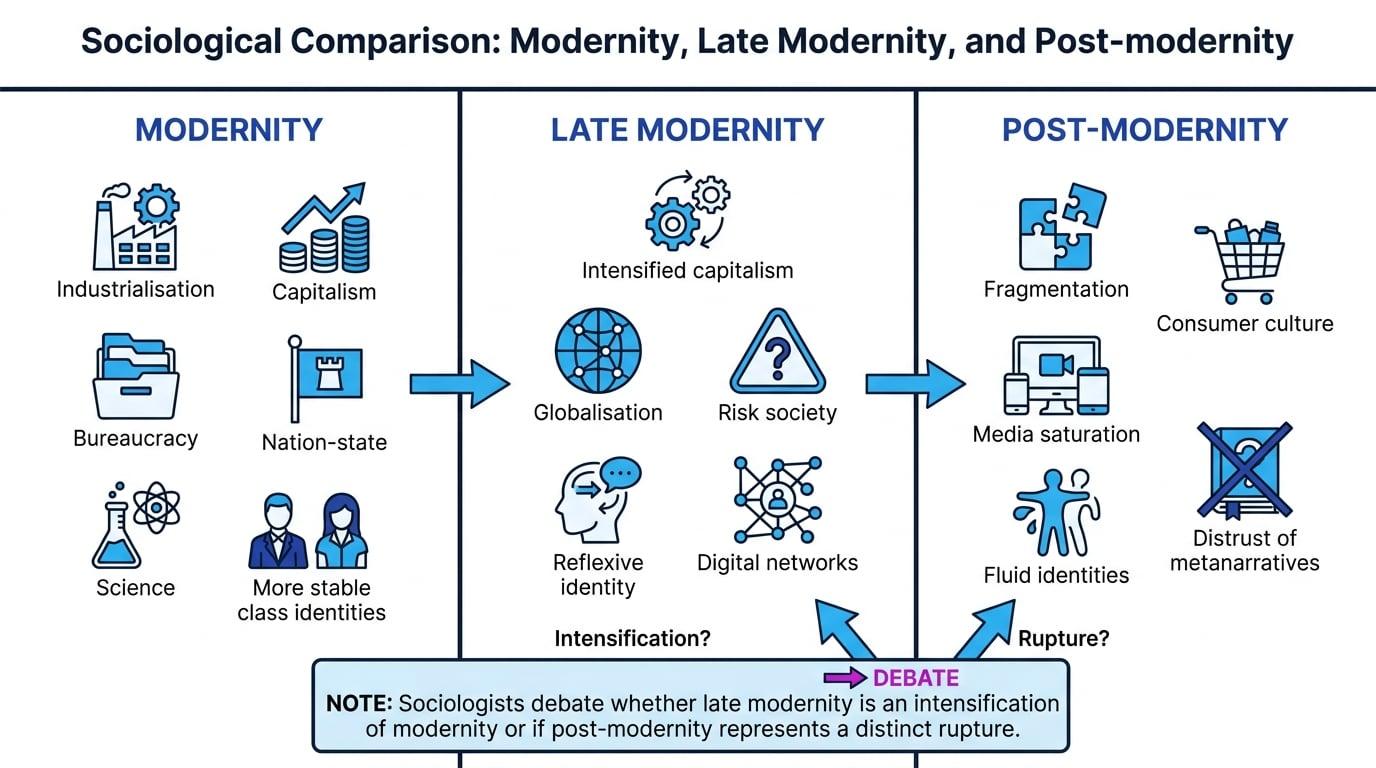
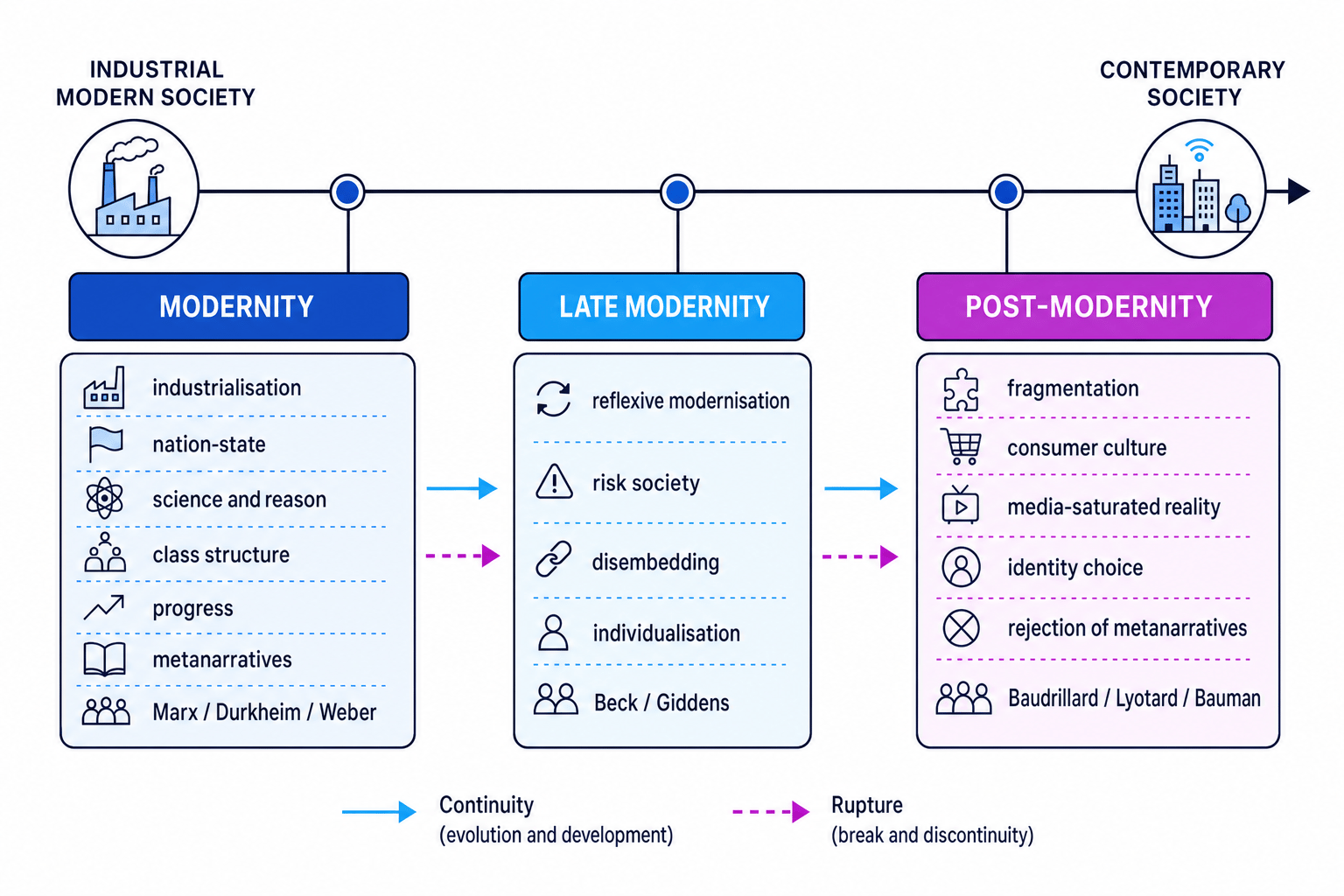
The diagram summarises the relationship between modernity, late modernity and post-modernity.
Post-modernity: a claimed break from modern society
Post-modernity
Post-modernity refers to the idea that modern society has been replaced, or at least deeply transformed, by a more fragmented, media-saturated, consumer-driven society where identities are fluid and “truth” is contested.
Post-modernists argue that society is no longer organised mainly by stable class identities, shared values or clear institutions. Instead, culture is more diverse and identities are more flexible.
Important features include:
- Fragmentation: society is split into many lifestyles, identities and communities.
- Pluralism: many different values and cultures exist side by side.
- Consumer culture: people express identity through what they buy, wear, watch and share.
- Media saturation: media images and digital platforms shape how people experience reality.
- Identity choice: people are seen as constructing identities rather than simply inheriting them.
Lyotard argued that post-modern society is marked by “incredulity towards metanarratives”. This means people are less likely to trust one big story, such as religion, Marxism or scientific progress, as the final truth.
Baudrillard argued that media and signs can become more important than reality itself. A simulacrum is a copy or image with no clear original. Hyperreality is a situation where representations feel more real or meaningful than the thing they supposedly represent — for example, influencer lifestyles, advertising images or heavily edited online identities.
Bauman described contemporary life as liquid modernity, where relationships, work and identities are less fixed. He is often used as a bridge between late modern and post-modern ideas.
Interpreting social media identity
-
A post-modernist would treat an Instagram or TikTok profile as identity work: users select images, sounds, brands and captions to present a version of the self.
-
Baudrillard can be applied because the online image may become more socially important than the offline person; the sign or performance takes on its own reality.
-
This links to stratification because not everyone has equal access to digital skills, time, money, beauty standards or algorithmic visibility.
-
Evaluation is needed: post-modernism explains fluid identity well, but Marxists and feminists would argue that class, gender and racial inequalities still shape who benefits.
Post-modernity does not mean ‘nothing is real’
A better phrasing is: post-modernists argue that our access to reality is increasingly mediated through language, images, consumer signs and digital platforms.
Late modernity: change without a complete break
Some sociologists argue that we have not moved beyond modernity. Instead, modernity has intensified.
Late modernity means a society where modern features — capitalism, science, bureaucracy, individualism and globalisation — continue, but become faster, more uncertain and more reflexive.
Giddens argues that modern social life is increasingly reflexive: people constantly monitor and revise their choices, identities and relationships. He also uses the term disembedding, meaning social relations are lifted out of local contexts — for example, online banking, global supply chains or long-distance relationships.
Beck describes a risk society, where modern progress creates new manufactured risks such as climate change, nuclear power, pandemics, data surveillance and pollution. These risks are not simply natural; they are produced by human activity.
Explaining the gig economy
-
A post-modern interpretation would focus on flexibility, lifestyle choice and app-based identities: workers may present themselves as independent, mobile and entrepreneurial.
-
A late-modern interpretation would argue that this is still modern capitalism, but intensified through digital platforms, uncertainty and individual responsibility for risk.
-
A Marxist evaluation would add that gig workers often lack control over pay, hours and algorithms, so class power has not disappeared.
Rupture or intensification?
Use post-modernity when arguing that society has broken away from modern structures. Use late modernity when arguing that modern structures still exist but have become faster, riskier and more unstable.
Methods and theory
This topic matters for Theory and Methods because different views of society imply different views of knowledge.
A positivist approach argues that sociology should be scientific, objective and often quantitative. Modernist sociology often fits this approach because it looks for measurable patterns, such as class differences in educational achievement or official crime rates.
An interpretivist approach focuses on meanings, motives and lived experience. Post-modernists often go further by questioning whether any research can fully represent “the truth”, because knowledge is shaped by language, power and perspective.
This creates methodological debates:
- Practical issues: large-scale surveys and official statistics can show broad patterns, but they are costly and depend on categories chosen by institutions.
- Ethical issues: digital research raises questions about consent, privacy and harm when analysing online communities.
- Theoretical issues: positivists value reliability and representativeness, while interpretivists and post-modernists often prioritise validity, meaning and discourse.
A UK example is the Census. It provides highly useful data on religion, ethnicity, household structure and identity. However, post-modernists would remind you that categories such as religion, ethnicity and national identity are not neutral; they are socially constructed and may not capture fluid identities.
Comparing the positions
| Issue | Modernity / modernist theory | Post-modernity | Late-modern evaluation |
|---|---|---|---|
| Social order | Institutions create order through rules, roles and shared values | Society is fragmented into diverse lifestyles | Institutions still matter, but trust in them is more uncertain |
| Identity | More stable identities linked to class, gender, work, nation and family | Fluid identities shaped by consumption and media | People reflexively construct identities, but within constraints |
| Power | Power is structured through class, state, patriarchy and bureaucracy | Power is dispersed through discourse, media and knowledge | Old inequalities remain but operate through new risks and systems |
| Knowledge | Sociology can discover social facts and causal patterns | All knowledge claims are partial and contested | Research is still possible, but must be reflexive |
Evaluation: how far is society post-modern?
Post-modernism is useful because it captures real changes: social media, consumer culture, global media, diverse family forms, changing gender and sexual identities, and declining religious authority. For example, the 2021 Census for England and Wales showed Christianity below half the population for the first time, while “No religion” rose to 37.2%.
However, critics argue that post-modernism can exaggerate choice. Identities may be more fluid, but people do not choose them freely from an equal starting point. Class affects housing, health and education. Gender shapes safety, care work and pay. Ethnicity affects experiences of racism, policing and labour markets.
Marxists argue that capitalism remains central. Feminists such as Walby would argue that patriarchy has changed form rather than disappeared. Weberians would point out that bureaucracy and state power are still highly significant, especially in welfare, education, policing and immigration control.
A strong AO3 point is that post-modernism is excellent at describing cultural change, but weaker at explaining material inequality. Late modernity may be a better middle position because it recognises both change and continuity.
In the exam
-
Define modernity and post-modernity early, then attach each to named theorists such as Marx, Durkheim, Weber, Lyotard, Baudrillard, Giddens and Beck.
-
Apply ideas to contemporary UK examples: social media identity, the Census, secularisation, the gig economy, education, the NHS or climate-risk politics.
-
Evaluate by comparing perspectives: post-modernists stress fragmentation and media; Marxists, feminists and Weberians stress continuing structures of power.
-
Link back to both themes: how identities are socialised and chosen, and how power and stratification still shape those choices.
Check yourself
- Why are Marx, Durkheim and Weber usually seen as theorists of modernity?
- How does Baudrillard’s idea of hyperreality apply to contemporary media culture?
- Is the UK better described as modern, late modern or post-modern — and what evidence would you use?