What you'll learn
- What positivism and interpretivism mean in sociology.
- How each perspective links to different research methods.
- What Durkheim meant by social facts.
- How to evaluate these ideas in A-Level essays using AO1, AO2 and AO3.
Why this topic matters
This topic sits inside Theory and Methods, but it links to almost every area of sociology. When you study education, crime, families, beliefs or stratification, you are also asking: what counts as good evidence?
Some sociologists want to discover broad social patterns using methods like surveys and official statistics. Others want to understand people’s meanings, identities and everyday interactions through interviews and observation. The debate between positivism and interpretivism is really a debate about what society is like and how we should study it.
Starting point: theory, methods and evidence
A theory is a set of ideas that explains how society works. A method is a way of collecting evidence, such as questionnaires, interviews, observation or using official statistics.
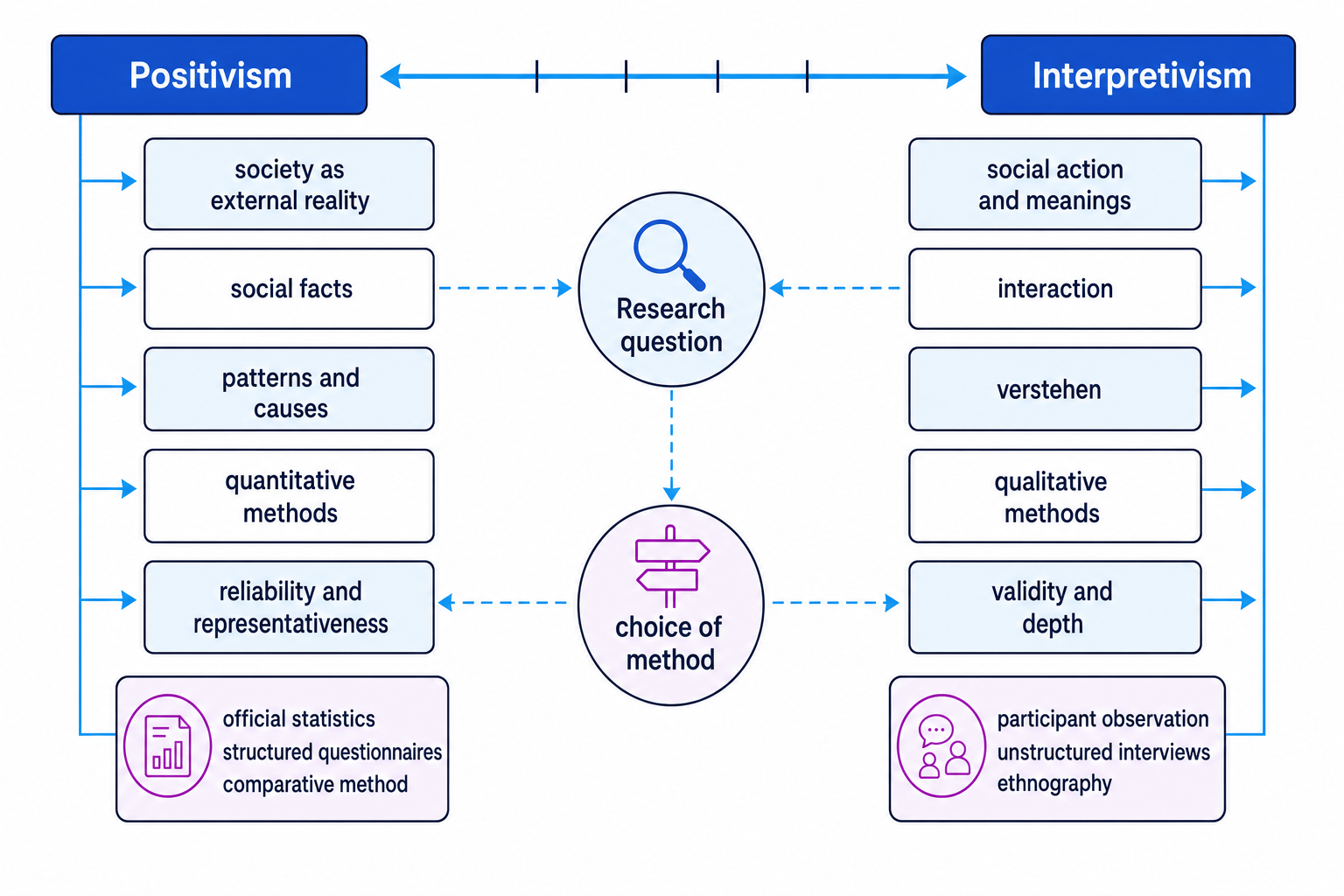
A key issue in sociology is that your theory often shapes your method. If you think society is made up of measurable external forces, you are likely to favour large-scale quantitative data. If you think society is built through meanings and interactions, you are more likely to favour qualitative data.
Methodology
Methodology means the reasoning behind research methods: why a sociologist chooses a method, what kind of evidence they think is valid, and what they believe society is like.
Positivism
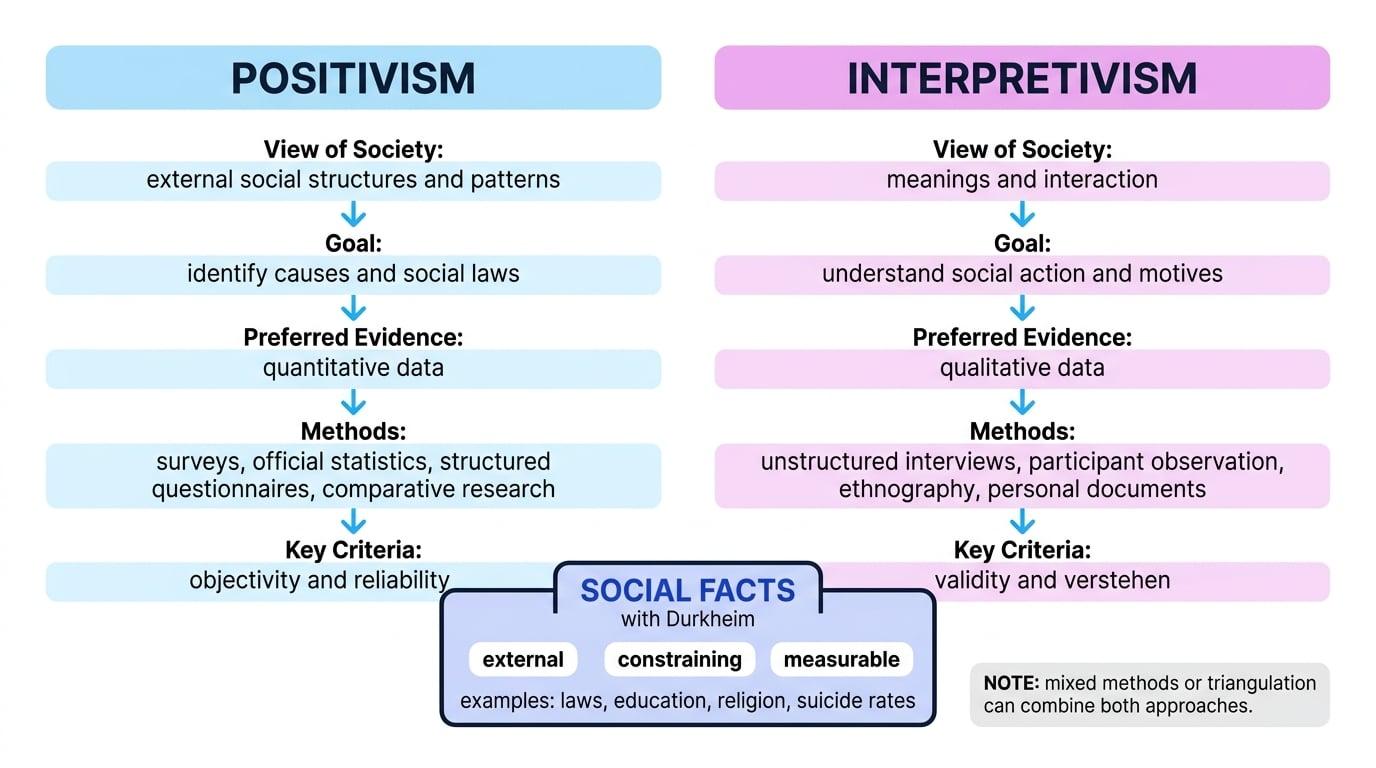
Positivism is the view that sociology should study society scientifically, in a similar way to the natural sciences. Positivists argue that society has patterns, causes and regularities that can be discovered through objective research.
The term is associated with Auguste Comte, who argued that sociology should search for social laws. It is also strongly linked to Émile Durkheim, who believed that social life could be studied as an external reality.
Positivism
Positivism is the view that sociology should use systematic, objective and often quantitative methods to discover patterns, causes and social laws.
What positivists assume
Positivists usually assume that:
- Society exists outside individuals and shapes their behaviour.
- Social behaviour can be measured using variables such as class, gender, ethnicity, income, religion or educational achievement.
- Sociologists should aim for objectivity, meaning research should not be distorted by personal bias.
- Good research should be reliable, meaning it can be repeated and produce similar results.
- Large-scale data can reveal patterns that individuals may not notice themselves.
In A-Level terms, positivists are often linked to quantitative methods: methods that produce numerical data. These include structured questionnaires, official statistics, content analysis and comparative research.
Positivist logic
For positivists, the aim is not mainly to understand one person’s story in depth. It is to identify wider social patterns and explain what causes them.
Using a positivist approach to study educational achievement
-
Choose a research question that can be measured, such as whether pupils eligible for free school meals are less likely to achieve high GCSE grades than pupils not eligible for free school meals.
-
Turn the concepts into measurable variables. For example, “social class background” might be measured using free school meal eligibility, and “achievement” might be measured using GCSE results.
-
Use large-scale data, such as Department for Education statistics, to compare groups and identify patterns across thousands of pupils.
-
Analyse whether the pattern suggests a relationship between material disadvantage and educational outcomes, while recognising that the data may not reveal pupils’ experiences, meanings or identities.
Interpretivism
Interpretivism is the view that sociology should focus on meanings, motives and the way people interpret the social world. Interpretivists argue that humans are not like objects in the natural sciences because people think, reflect, negotiate and attach meaning to what they do.
This approach is linked to Max Weber, who argued that sociology should understand social action: behaviour to which individuals attach meaning. Weber used the term verstehen, meaning empathetic understanding.
Interpretivism
Interpretivism is the view that sociology should study people’s meanings, interpretations and everyday interactions, usually through qualitative methods.
What interpretivists assume
Interpretivists usually argue that:
- Society is created and recreated through interaction.
- People act according to meanings, not simply external forces.
- Sociologists need to understand the world from the participant’s point of view.
- Good research should have validity, meaning it gives a truthful, authentic picture of social life.
- Small-scale, in-depth methods may reveal things that surveys miss.
Interpretivists are often linked to qualitative methods: methods that produce detailed, non-numerical data. These include unstructured interviews, participant observation, ethnography and personal documents.
Using an interpretivist approach to study school identity
-
Choose a research question about meaning, such as how working-class pupils experience being placed in lower sets at school.
-
Use methods that allow pupils to explain their views in their own words, such as unstructured interviews or participant observation in classrooms and playgrounds.
-
Analyse how labels, peer groups and teacher expectations shape pupils’ identities, for example whether pupils begin to see themselves as “not academic”.
-
Evaluate the evidence by noting that it may be high in validity, but harder to generalise because it is based on a smaller sample.
Do not reduce the debate to method labels
A common mistake is to write “positivists use questionnaires and interpretivists use interviews” as if that is the whole answer. The deeper issue is theoretical: positivists and interpretivists disagree about what society is like and what counts as valid knowledge.
Social facts
The idea of social facts comes mainly from Durkheim. In The Rules of Sociological Method (1895), Durkheim argued that social facts should be treated as “things”. He meant that sociologists should study social forces as real, external and measurable.
Social facts
Social facts are social forces, norms, values, institutions or patterns that exist outside individuals and constrain their behaviour.
For Durkheim, social facts include things like:
- Laws and legal systems.
- Religious beliefs and rituals.
- Education systems.
- Family structures.
- Moral rules and norms.
- Suicide rates, birth rates and crime rates.
Social facts are external because they exist before any one individual is born. They are constraining because they shape what people feel able or expected to do. For example, you did not personally invent the education system, exam rules or gender norms, but they influence your choices and identity.
Material and non-material social facts
Durkheim distinguished between different kinds of social facts.
Material social facts are visible institutions and structures, such as schools, courts, churches and the state.
Non-material social facts are less visible but still powerful, such as shared values, moral beliefs, collective conscience and social norms.
Social facts and socialisation
Social facts connect strongly to the core theme of socialisation, culture and identity because they show how society teaches people what is normal, expected and acceptable.
Durkheim’s study of suicide
Durkheim’s Suicide (1897) is the classic example of positivist sociology. Suicide may look like a deeply individual act, but Durkheim argued that suicide rates vary between societies and groups because of social forces.
He used official statistics to compare suicide rates by religion, marital status and social context. He argued that patterns in suicide could be explained by levels of social integration and social regulation.
Social integration and social regulation
Social integration means the strength of a person’s attachment to social groups. Social regulation means the extent to which society’s norms and rules guide people’s behaviour.
Durkheim identified types of suicide, including:
- Egoistic suicide, linked to too little integration.
- Altruistic suicide, linked to too much integration.
- Anomic suicide, linked to too little regulation, often during rapid social change.
- Fatalistic suicide, linked to too much regulation.
Explaining suicide rates as social facts
-
Start with the pattern rather than individual motives. If one group has a higher suicide rate than another, Durkheim would treat that rate as something sociologically significant.
-
Look for social causes. For example, Durkheim argued that lower integration may leave people more isolated and therefore more vulnerable.
-
Apply this to a contemporary UK example carefully. ONS data often show higher suicide rates among men than women, so a sociologist might examine masculinity, help-seeking norms, unemployment, relationship breakdown and social isolation.
-
Evaluate the explanation. The pattern may reveal social pressures, but official statistics cannot fully capture meanings, hidden cases or the personal circumstances behind each death.
How positivism shapes methods
Positivists usually favour methods that are:
- Reliable: easy to repeat.
- Representative: based on large or carefully selected samples.
- Objective: less dependent on the researcher’s personal judgement.
- Quantitative: producing numerical data.
- Comparative: allowing differences between groups or societies to be studied.
Examples include the Census, the Crime Survey for England and Wales, ONS statistics, structured questionnaires and large-scale social surveys.
These methods are useful for studying social differentiation, power and stratification. For example, statistics can show inequalities in income, educational achievement, health, imprisonment or housing by class, gender, ethnicity, age and region.
Positivist strengths
Positivist methods can reveal patterns that are not obvious from individual experience. For example, official statistics may show that some ethnic groups are disproportionately stopped and searched, or that pupils from poorer households are less likely to enter high-tariff universities.
This is useful for policy because governments often need large-scale evidence before designing interventions.
Positivist limitations
Interpretivists criticise positivists for treating people as if they are passive objects. They argue that statistics may measure official categories rather than social reality.
For example, crime statistics do not simply measure “crime”; they also reflect policing priorities, reporting rates, recording practices and public trust in authorities. A rise in recorded domestic abuse may reflect more offending, but it may also reflect improved reporting and recording.
Official statistics are not neutral mirrors
Official statistics are useful, but they are produced by organisations with definitions, procedures and priorities. Always ask how the category was created and what might be missing.
How interpretivism shapes methods
Interpretivists usually favour methods that are:
- Valid: capturing meanings accurately.
- Flexible: allowing new themes to emerge.
- Qualitative: producing detailed descriptions.
- Small-scale: focusing on depth rather than breadth.
- Participant-centred: allowing people to explain their own lives.
These methods are especially useful when studying identity, labelling, deviance, family relationships, religious belief, classroom interaction or media audiences.
For example, an interpretivist studying youth subcultures would not only count how many young people join a group. They would ask what the group means to its members: belonging, resistance, style, status, safety or identity.
Interpretivist strengths
Interpretivist research can show how power is experienced in everyday life. For instance, interviews with working-class students may reveal feelings of not “fitting in” at university, linking to Bourdieu’s ideas about cultural capital and symbolic power.
It can also uncover meanings that official data misses. A survey may record that a person is unemployed, while an interview may reveal shame, resilience, informal work, caring responsibilities or distrust of institutions.
Interpretivist limitations
Positivists argue that interpretivist methods can lack reliability and representativeness. If a study is based on a small group, it may be difficult to know whether the findings apply more widely.
There are also practical and ethical issues. Participant observation can take a long time, access may be difficult, and there may be concerns about informed consent, confidentiality and researcher influence.
Link methods to theory
In essays, use this chain: view of society → preferred evidence → method → strength → limitation. That helps you move from AO1 into AO3 rather than just listing methods.
Positivism versus interpretivism: not a simple either/or
Although the contrast is important, real sociological research is often more flexible. Some researchers use mixed methods, combining quantitative and qualitative evidence.
For example, a study of educational inequality might use national statistics to identify class patterns, then interviews to explore how pupils experience setting, teacher labelling or parental expectations. This combination is sometimes called triangulation.
Triangulation
Triangulation means using more than one method or source of data to study the same issue, often to improve the overall strength of the research.
Triangulation can improve validity and reliability, but it can also be costly and time-consuming. It may also create tensions if different data sources point in different directions.
Evaluating social facts
Durkheim’s idea of social facts is powerful because it reminds us that society is bigger than individual choice. Social structures can shape behaviour even when people believe they are acting freely.
This is especially important for studying inequality. For example, patterns in poverty, housing, school exclusions, health outcomes and imprisonment suggest that class, gender, ethnicity and region are not just personal characteristics. They are linked to wider structures of power and stratification.
However, interpretivists argue that Durkheim underplays meaning. A social fact such as “religion” or “family” may not mean the same thing to everyone. For example, marriage, cohabitation, lone parenthood and reconstituted families may carry different meanings depending on culture, generation, religion and personal experience.
A strong evaluation is therefore balanced: social facts help sociologists identify structural patterns, but they may miss the meanings through which people understand and respond to those structures.
Bringing it together for essays
For AO1, you need accurate knowledge: define positivism, interpretivism and social facts; name Comte, Durkheim and Weber; link each view to methods.
For AO2, apply the ideas to examples: Census data, crime statistics, educational achievement, suicide rates, class inequality, gender norms or ethnicity and policing.
For AO3, evaluate: compare perspectives, discuss reliability and validity, question official statistics, and consider whether mixed methods give a better account.
In the exam
-
Start by defining the key concept in the question, such as positivism, interpretivism or social facts.
-
Link theory to method explicitly: explain why a positivist might prefer official statistics or why an interpretivist might prefer unstructured interviews.
-
Evaluate throughout by using paired contrasts, such as reliability versus validity, structure versus meaning, and representativeness versus depth.
Check yourself
- Why did Durkheim argue that suicide rates could be studied as social facts?
- How would a positivist and an interpretivist study the same issue differently?
- What are the strengths and weaknesses of using official statistics to study social inequality?