When sociologists set out to study society, they cannot simply pick a topic and a method at random. Every research project is shaped, limited, and directed by a complex web of real-world pressures.
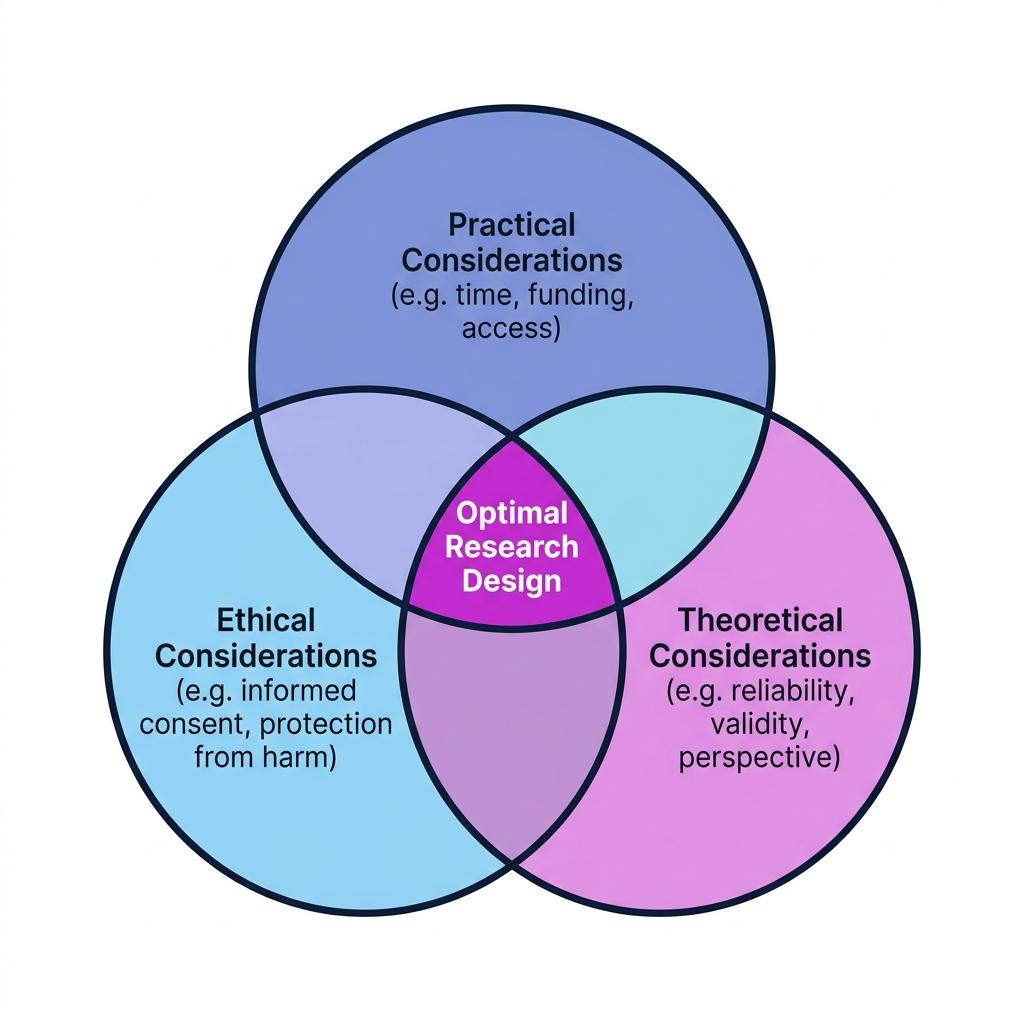
In your A-Level exam, you will need to evaluate how these pressures affect a sociologist's decisions. We group these pressures into three core categories, easily remembered by the acronym PET: Practical, Ethical, and Theoretical considerations.
What you'll learn
- How to identify and distinguish between the Practical, Ethical, and Theoretical (PET) factors influencing research.
- Why different sociological perspectives (like Positivism and Interpretivism) prefer different methods.
- How to weigh up the competing demands of PET when planning or evaluating a piece of sociological research.
The "PET" Framework
Before a sociologist can collect their first piece of data, they have to make two fundamental decisions:
- What are they going to study? (The choice of topic)
- How are they going to study it? (The choice of method)
Both decisions are governed by Practical, Ethical, and Theoretical factors.
Practical Considerations
The logistical, physical, and financial realities of carrying out a piece of research. This includes resources such as time, funding, and the personal characteristics of the researcher.
Ethical Considerations
The moral issues and guidelines designed to protect research participants, researchers themselves, and the wider sociological community from harm or exploitation.
Theoretical Considerations
The underlying philosophical beliefs about what society is, how we should study it (epistemology), and what constitutes "good" data (e.g., reliability, validity, and representativeness).
Let's break each of these down in detail.
Practical Considerations (P)
You can have the most brilliant, revolutionary research idea in the world, but if you do not have the practical means to pull it off, the research will never happen. Key practical factors include:
1. Time and Money
Different methods require vastly different amounts of resources.
- Large-scale social surveys (like the UK Census) require massive teams of researchers, software, and millions of pounds in funding.
- Participant observation (where a researcher embeds themselves in a group, like James Patrick's classic study A Glasgow Gang Observed in 1973) may not require expensive equipment, but it takes months or years of the researcher's life.
2. Funding Bodies
Most research is funded by external organizations, such as government departments (like the Department for Education), charities, or the Economic and Social Research Council (ESRC). These bodies have their own agendas. If a government department wants to measure the quantitative impact of a new school policy, they will only fund structured, statistical research. They are unlikely to fund a Marxist researcher who wants to spend a year doing unstructured interviews to critisise capitalism.
3. Access and Gatekeepers
To study certain groups, you need permission. A gatekeeper is someone with the authority to control access to a research site or group of participants (for example, a headteacher of a school, a prison governor, or a gang leader). If a gatekeeper refuses access, a researcher may have to change their entire methodology—perhaps opting for a covert (secret) study instead of an overt one.
The Gatekeeper as a Nightclub Bouncer
Think of a gatekeeper like a bouncer at a nightclub. If the bouncer doesn't like your outfit (your research topic) or doesn't trust your intentions (your research methods), you aren't getting past the door. Sociologists must negotiate with these bouncers to reach the "dancefloor" (their participants).
4. Personal Skills and Characteristics
Not every researcher is suited to every method. A covert participant observation of a football hooligan firm requires a researcher who can blend in seamlessly (matching their age, gender, or cultural background). Similarly, unstructured interviews require deep empathy and interpersonal skills, whereas large-scale quantitative surveys require advanced statistical and computing skills.
Ethical Considerations (E)
In the UK, the British Sociological Association (BSA) sets out ethical guidelines that all sociological research should follow. The main ethical hurdles include:
1. Informed Consent
Participants should know exactly what the research is about, how their data will be used, and that they have the right to withdraw at any time.
- The challenge: In covert research, where the researcher hides their identity, informed consent is impossible. This makes covert research highly controversial, even if it is the only way to get truthful data.
2. Protection from Harm
Research should not physically or psychologically harm participants or the researcher.
- This is highly relevant when researching sensitive topics, such as domestic violence (e.g., Dobash and Dobash's research) or mental health. Asking vulnerable people to relive traumatic experiences can cause severe distress.
3. Privacy, Confidentiality, and Anonymity
Researchers must protect their participants' identities. This means changing names, deleting identifying details, and storing data securely.
- The challenge: If you are studying criminal behavior or deviance, you face a major dilemma. If a participant tells you they are planning a serious crime, do you maintain confidentiality, or do you report them to the police?
Confidentiality vs. Anonymity
These are not the same thing. Anonymity means even the researcher does not know who the participant is (e.g., an unsigned postal questionnaire). Confidentiality means the researcher does know who they are, but promises never to reveal their identity to anyone else. Make sure you use the correct term in your essays!
Theoretical Considerations (T)
Your theoretical approach shapes how you view society, which directly dictates how you think we should study it. The grand debate here is between Positivism and Interpretivism.
       Positivism                          Interpretivism
   [Quantitative Data]                  [Qualitative Data]
           │                                    │
    ┌──────┴──────┐                      ┌──────┴──────┐
    ▼             ▼                      ▼             ▼
Reliability   Macro-Scale             Validity      Micro-Scale
Positivists: The "Scientific" Approach
Positivists (like Émile Durkheim) view society as a set of objective social facts that exist independently of individuals. They want sociology to be a science, so they prefer:
- Quantitative data (numbers, percentages, statistics).
- Reliability: The ability to repeat a study and get the exact same results.
- Representativeness: Ensuring the research sample is a perfect mini-version of the wider population, allowing for generalizations.
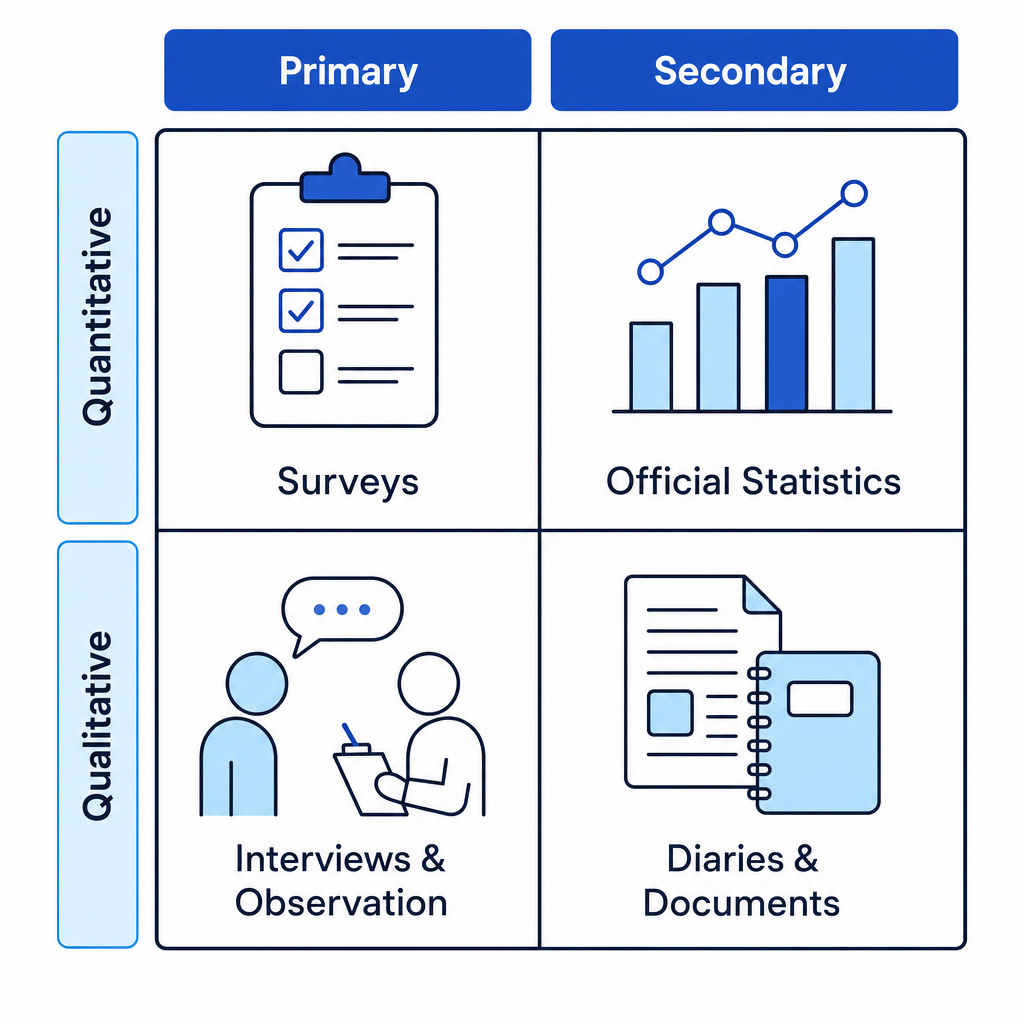
- Preferred Methods: Closed-ended questionnaires, structured interviews, and official statistics.
Interpretivists: The "Understanding" Approach
Interpretivists (influenced by Max Weber's concept of Verstehen—empathetic understanding) believe society is constructed by individuals attaching meanings to their actions. They argue we cannot study humans the way scientists study chemicals. They prefer:
- Qualitative data (words, feelings, descriptions).
- Validity: Getting a true, deep, authentic picture of social reality.
- Preferred Methods: Unstructured interviews, participant observations, and personal documents (like diaries).
To visualize how these methods map across different theoretical and structural dimensions, consider the four quadrants of methodological choices below:
Theoretical Perspectives and Choice of Topic
It is not just about Positivism vs. Interpretivism. Different structural perspectives choose different topics:
- Feminists (like Ann Oakley) choose topics that highlight gender inequality, patriarchy, and women's lived experiences, often using qualitative methods to give women a "voice."
- Marxists focus on class inequalities, state oppression, and exploitation, often using historical documents and secondary statistics to critique capitalism.
The PET Tension
Sociological research is always a game of trade-offs. If you want high validity (Theoretical), you might have to use participant observation, which is highly expensive and time-consuming (Practical) and risks deceptive/covert practices (Ethical). If you prioritize absolute safety and informed consent (Ethical), you might limit your ability to study hidden criminal groups, thereby reducing the validity of your data.
Selecting a Research Design
Let's look at how a sociologist must process these competing PET factors when designing a real-world research project.
Selecting a research design for studying excluded students
Imagine you are a researcher who wants to study the experiences of students who have been permanently excluded from mainstream UK schools and are now attending a Pupil Referral Unit (PRU). Walk through how you would navigate PET factors to select the best research method.
- Evaluate the Theoretical Aims: Since you want to understand the "experiences" and meanings behind school exclusion, your goal is to achieve deep validity and Verstehen. This points you toward qualitative methods (Interpretivism) rather than quantitative surveys. You want to hear the students' stories in their own words.
- Assess the Ethical Constraints: Excluded pupils are under 18, meaning they are legally classed as children (vulnerable participants). You must secure informed consent from both the pupils and their parents/guardians. Furthermore, discussing exclusion might trigger feelings of anger or low self-esteem, meaning you must design your questions to minimize psychological harm and guarantee absolute confidentiality.
- Analyze the Practical Barriers: Access is a major issue here. You cannot just walk into a PRU. You must negotiate with a gatekeeper (the headteacher of the PRU). A headteacher will be protective of their students and their institution's reputation. They may reject highly invasive methods like participant observation. However, they may agree to let you conduct semi-structured interviews during school hours if you can prove your ethical clearance.
Conclusion: By balancing these factors, you rule out questionnaires (too superficial, low validity) and participant observation (unlikely to get gatekeeper access or parental consent). You select semi-structured interviews as they offer the best compromise: high validity, manageable safety/ethical controls, and a method that gatekeepers are more likely to approve.
In the exam
- Never evaluate a method in a vacuum: If an exam question asks you to evaluate a specific method (e.g., unstructured interviews), structure your essay using PET. Spend one or two paragraphs on Practical strengths/weaknesses, one on Ethical issues, and one on Theoretical issues.
- Link theory to methods: Always explain why a Positivist or Interpretivist would like or dislike the method in question. Don't just say "unstructured interviews are valid." Say: "Interpretivists favor unstructured interviews because they allow the researcher to build rapport, meaning the participant is more likely to reveal their true feelings, thus increasing the validity of the data."
- Remember the "Methods in Context" connection: If you are an A-Level student sitting Paper 1 (Education with Methods in Context), you must apply these PET factors specifically to school environments (students, parents, teachers, classrooms, governors).
Check yourself
- Why might a researcher choose a less valid research method over a more valid one? Give a practical and an ethical reason.
- What is a "gatekeeper," and how can they influence a researcher’s choice of method?
- Contrast the theoretical priorities of a Positivist researcher with those of an Interpretivist researcher.