What you'll learn
- How to tell the difference between consensus, conflict, structural and social action theories.
- Where major perspectives like functionalism, Marxism, feminism, Weberian theory and interactionism fit.
- How to apply these theories to UK society using AO2 examples.
- How to evaluate theories through comparison, evidence and methods.
Before the theories: the basic building blocks
Sociological theories are different ways of explaining how society works. For this topic, you need to keep asking: what shapes human behaviour? Is it mainly large-scale social forces, or the meanings people create in everyday interaction?
Core vocabulary
- Social structure means patterned social arrangements, such as class, gender, ethnicity, families, education, religion, work and the state, that shape people’s opportunities.
- Agency means people’s capacity to make choices, interpret situations and act.
- Socialisation is the process through which people learn norms, values and expected behaviour.
- Culture means shared meanings, values, practices and ways of life.
- Identity means a person’s sense of who they are, including class, gender, ethnicity, religion, nationality and sexuality.
- Power means the ability to influence others or shape outcomes, even when there is resistance.
- Stratification means structured inequality, where groups are ranked above or below others in terms of resources, status and power.
The two core AQA themes run through this whole topic. Socialisation, culture and identity helps you discuss how people learn and negotiate meanings. Social differentiation, power and stratification helps you discuss inequality between groups.
The two axes: consensus/conflict and structure/action
Consensus theories argue that society is held together by shared values and agreement about basic norms. They often focus on social order, integration and stability.
Conflict theories argue that society is shaped by inequality, competition and domination. They focus on who benefits from social arrangements and who is disadvantaged.
Structural theories explain behaviour mainly through large-scale social forces outside individuals. These are usually macro theories, meaning they look at society as a whole.
Social action theories explain behaviour by focusing on meanings, interpretations and interactions. These are usually micro theories, meaning they look at small-scale everyday life.
Use this grid as a mental map. It is a simplification, because some theorists cross categories, but it helps you avoid mixing up separate debates.
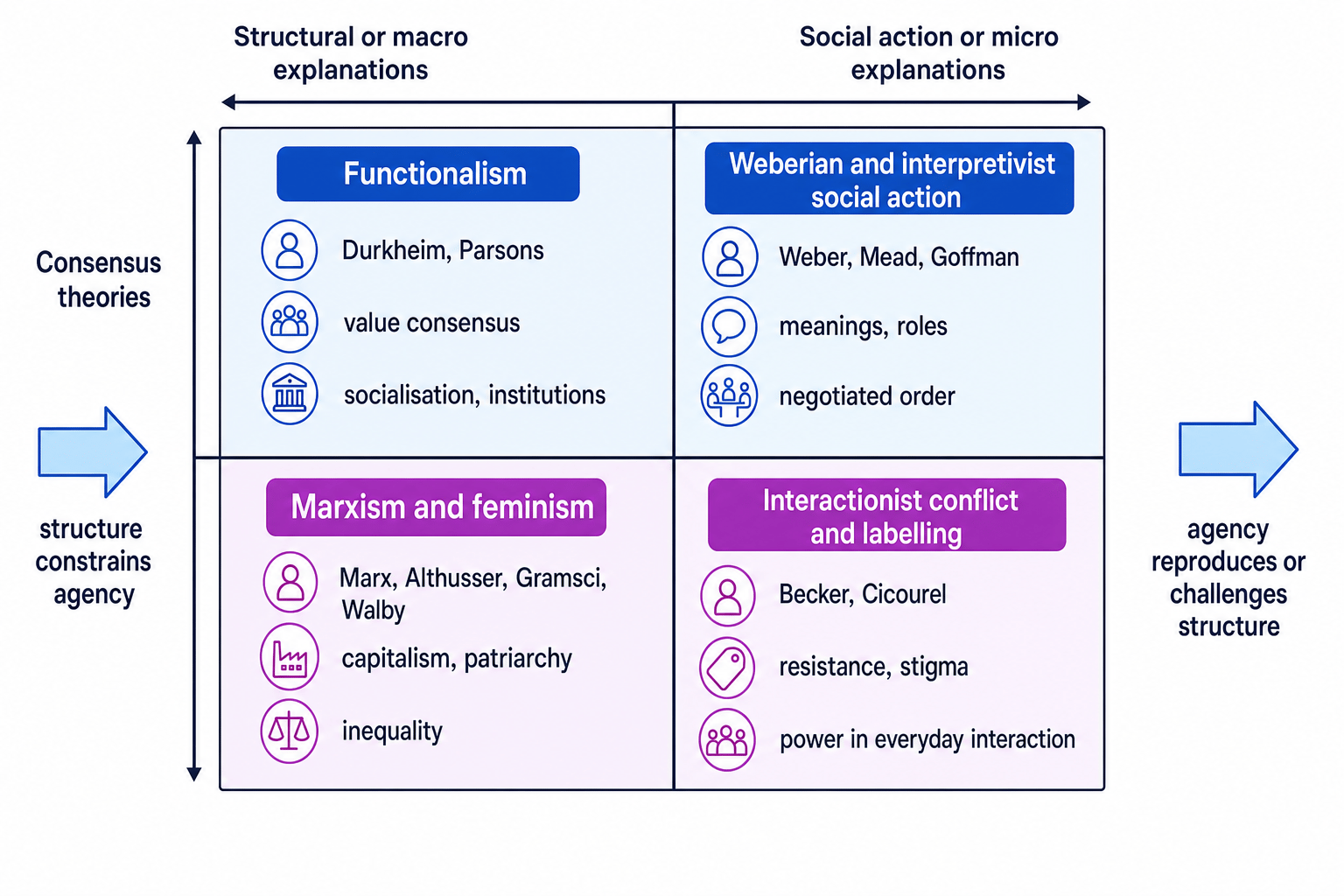
Two separate questions
Do not treat “consensus vs conflict” and “structure vs action” as the same thing. A theory can be structural and consensus-based, like functionalism, or structural and conflict-based, like Marxism and many forms of feminism.
Classifying a theory from an item
An item says: “Schools teach shared values and prepare young people for adult roles in society.”
- The explanation begins with schools as an institution shaping individuals, so it is mainly structural.
- It presents society as held together by shared values, not by domination or exploitation, so it is a consensus view.
- Structural plus consensus points to functionalism. You could apply it to education by discussing socialisation into punctuality, achievement and respect for authority.
Consensus and structural theory: functionalism
Functionalism is a structural consensus theory. It sees society as a system of interconnected parts, such as the family, education, religion, the economy and the legal system. Each part performs functions that help maintain social order.
Durkheim argued that society has social facts: external forces, such as laws and moral rules, that shape individuals. He was interested in social solidarity, meaning the sense of belonging that holds people together. Parsons developed the idea of value consensus, where people broadly agree on society’s core values. Merton added that institutions can have manifest functions intended outcomes, latent functions unintended outcomes, and dysfunctions harmful consequences.
For AO2, you could apply functionalism to UK schools teaching “British values”, the NHS creating collective responsibility for health, or national rituals such as Remembrance Sunday producing shared identity.
For AO3, functionalism can be criticised for being too optimistic. It often underplays conflict, coercion and inequality. Marxists ask: whose values are being presented as “shared”? Feminists ask: does social order benefit men more than women? Interactionists argue that functionalism ignores the meanings people attach to everyday situations.
Conflict and structural theories: Marxism and feminism
Marxism is a structural conflict theory focused on capitalism. Marx argued that capitalist society is divided between the bourgeoisie, who own the means of production, and the proletariat, who sell their labour. The economic base shapes the superstructure, including education, law, religion and media. These institutions can spread ideology, meaning ideas that justify inequality.
Althusser argued that education and media act as ideological state apparatuses, passing on ruling-class ideas. Gramsci developed the idea of hegemony, where the ruling class maintains power partly through consent, not just force.
Feminism is also a conflict approach, but it focuses on patriarchy, meaning male domination. Walby argued that patriarchy operates in several sites, including paid work, the household, culture, sexuality, violence and the state. Connell’s work on masculinities shows how gender power can be reproduced through cultural expectations about “real men”.
For AO2, Marxists might discuss private schools, inherited wealth, insecure work or media ownership. Feminists might discuss the gender pay gap, unpaid domestic labour, violence against women and girls, or gendered expectations in subject choice.
For AO3, conflict theories are strong on power and stratification, but can become over-deterministic if they imply people are simply controlled by capitalism or patriarchy. Contemporary UK society also includes legal rights, social mobility and diverse identities, so you should consider how class, gender, ethnicity, age and sexuality intersect.
Conflict does not just mean arguments
In sociology, conflict theory is not mainly about people disagreeing in everyday life. It is about structured inequalities between social groups, such as classes, genders or ethnic groups.
Social action theories: Weber, interactionism and labelling
Social action theory focuses on the meanings individuals attach to their actions. Weber argued that sociologists should use Verstehen, meaning empathetic understanding, to grasp people’s motives. He identified different types of action, including rational action, value-driven action, traditional action and emotional action.
Weber is useful because he bridges structure and action. He recognised class inequality, but also argued that status and party, meaning organised political power, shape life chances.
Symbolic interactionism studies how meanings are created through interaction. Mead argued that the self develops through taking the role of others. Goffman used dramaturgy, comparing social life to a performance where people manage impressions. Becker’s labelling theory argues that deviance is not simply an act itself, but the result of social reactions. Cicourel showed how police and youth justice officials use assumptions and typifications when deciding who seems suspicious.
For AO2, you might apply interactionism to teacher labelling, stop and search, social media identity, mental health stigma, or how people present themselves differently at school, work and online.
For AO3, social action theories are strong on validity, because they explore meanings in depth. However, they can underplay wider structures such as class, patriarchy and racism. A good answer often links labelling to power: not everyone has the same ability to label others.
Explaining school exclusion through labelling
A student is repeatedly described by teachers as “trouble”.
- Labelling theory focuses on the interaction between teachers and the student, rather than assuming the student’s behaviour has one fixed meaning.
- The label may affect teacher expectations, leading to more surveillance, harsher punishment and fewer chances to repair relationships.
- The student may internalise the label, developing a deviant identity or joining peers who share that reputation.
- To evaluate, add a structural point: labels are not applied randomly, because class, gender and ethnicity can affect which pupils are seen as “disruptive”.
Bridging structure and agency
Many sociologists reject a simple either/or choice between structure and action. Giddens’ structuration theory argues that structures shape action, but actions also reproduce or change structures. For example, school rules shape pupils’ behaviour, but pupils and teachers also recreate the school culture every day.
Bourdieu also bridges the gap. Habitus means deeply learned dispositions shaped by upbringing. Capital means resources, such as economic capital, cultural capital and social capital. Field means a social arena, such as education or work, where people compete for advantage. This helps explain why choices can feel personal while still reflecting classed, gendered and ethnic inequalities.
Theory and methods link
Theories affect what sociologists count as good evidence.
Structural theories often fit with positivism, the view that sociology should study society using objective, systematic methods. They may use official statistics, surveys or large-scale comparisons to examine patterns in class, gender, ethnicity, crime, education or health. These methods can be reliable and representative, but may miss meanings and lived experience.
Social action theories often fit with interpretivism, the view that sociology should understand people’s meanings. They may use unstructured interviews, participant observation or ethnography. These can produce rich validity, but they are often time-consuming, harder to replicate and less representative.
Practical issues include cost, time, access and sampling. Ethical issues include informed consent, confidentiality and avoiding harm, especially when researching deviance, stigma or vulnerable groups. Theoretical issues include the trade-off between reliability, validity and representativeness.
Method matches theory
If a question asks about theory and methods together, link macro structural theories to patterns and statistics, and micro social action theories to meanings and qualitative data — then evaluate the limitations of each.
In the exam
- Define the two axes separately: consensus/conflict is about social order, while structure/action is about what shapes behaviour.
- Use named theorists for AO1, then apply them to a concrete UK example for AO2, such as education, policing, gender inequality or social media identity.
- For AO3, compare perspectives directly: “Functionalists would argue…, whereas Marxists/Feminists/Interactionists would argue…”
- Keep returning to the core themes: socialisation, culture and identity; social differentiation, power and stratification.
Check yourself
- Where would functionalism, Marxism, feminism and labelling theory fit on the two-axis grid?
- How does Weber’s approach differ from Durkheim’s?
- Why might an interactionist prefer interviews or observation over official statistics?
