What you'll learn
- What sociologists mean by theory and methods.
- Why positivists often prefer quantitative methods, while interpretivists often prefer qualitative methods.
- How theories about power, identity and inequality shape research choices.
- How to evaluate the idea that theory determines method.
The big idea: theory and methods are connected
Sociologists do not choose methods randomly. Their choice is usually linked to what they think society is like, what they think counts as good evidence, and what they are trying to explain.
Theory and methods
A theory is a set of linked ideas used to explain society, such as functionalism, Marxism, feminism or interactionism. A method is a systematic way of collecting or analysing evidence, such as questionnaires, interviews, observations or official statistics.
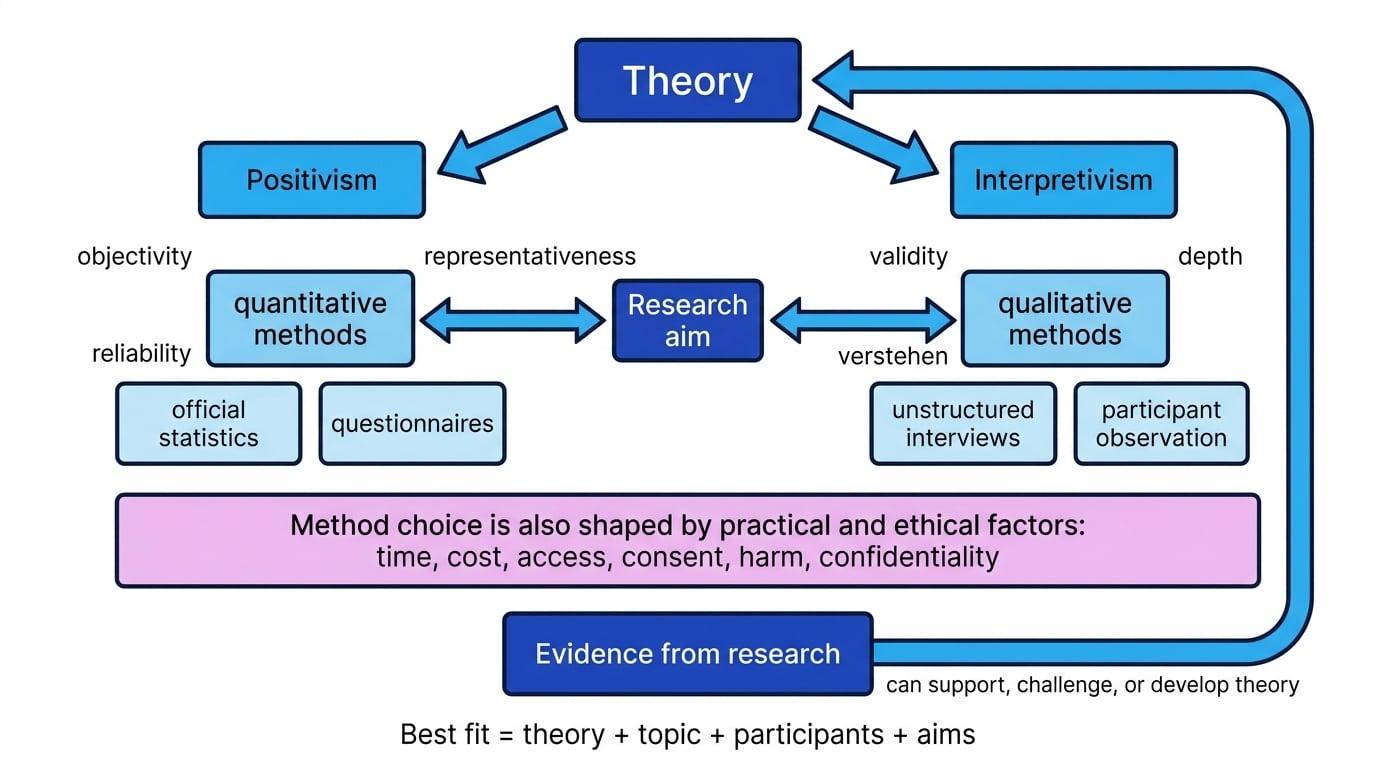
The relationship is two-way. Theory influences which methods sociologists choose, but evidence collected through methods can also support, challenge or develop theory.
A simple way to visualise the link is to compare the two classic positions: positivism and interpretivism. The diagram also shows an important exam point: method choice is never only theoretical; it is also shaped by practical and ethical issues.
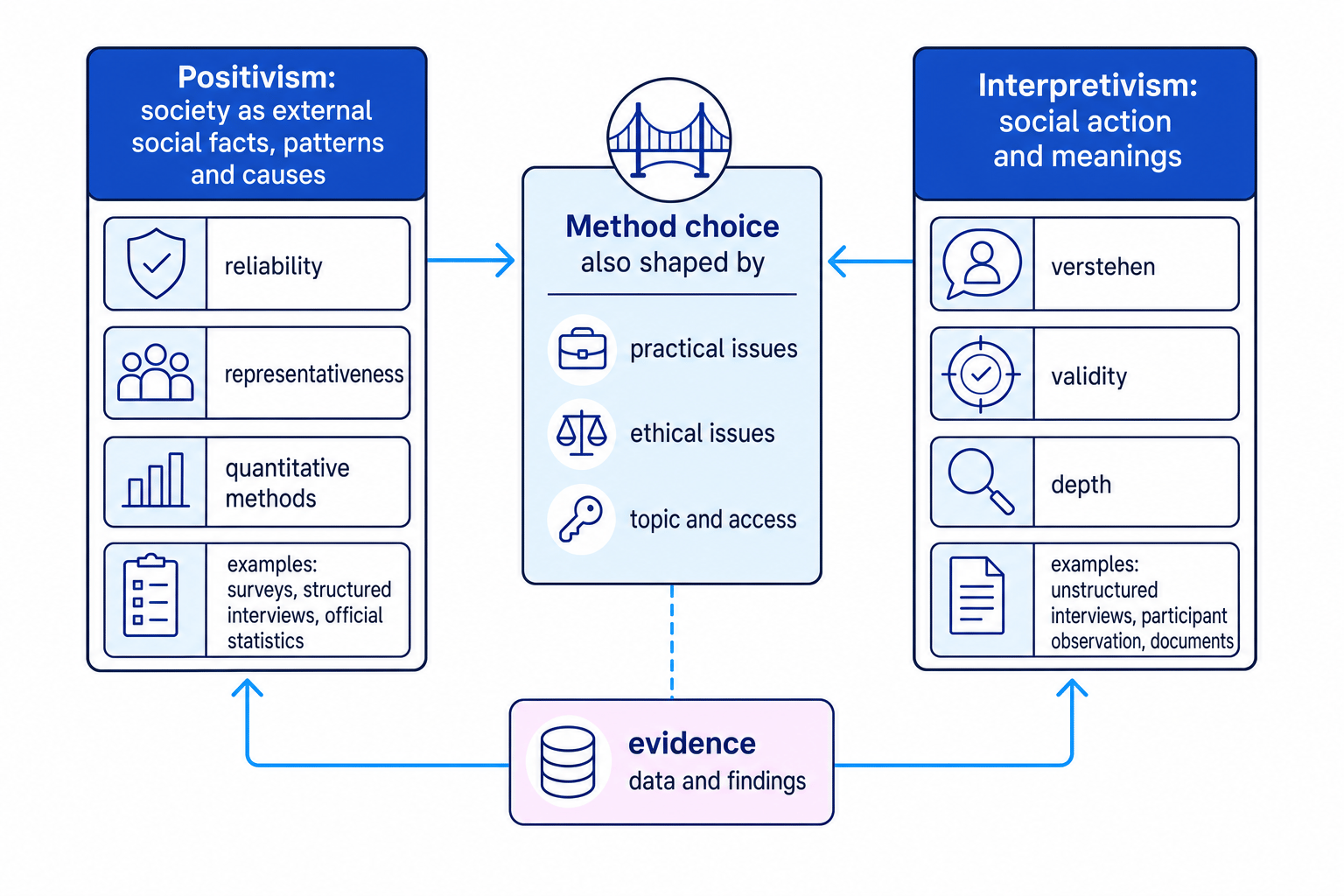
Core takeaway
In A-Level Sociology, the key debate is not “which method is best?” but “which method fits the theory, topic, participants and research aim?”
Starting point: what assumptions does the sociologist make?
Two useful words are ontology and epistemology. You do not need to overuse them, but they help you think clearly.
Ontology and epistemology
Ontology means assumptions about what social reality is like. Epistemology means assumptions about how we can know about that reality.
For example, if a sociologist believes society is made up of measurable patterns, they are more likely to use statistics. If they believe society is built through meanings and interactions, they are more likely to use interviews or observation.
Positivism: society as measurable social facts
Positivism
Positivism is the view that sociology should study society scientifically, looking for observable patterns, causes and correlations. Positivists often prefer quantitative methods.
Quantitative data is numerical data, such as percentages, rates or scores. Positivists like this because it can be used to compare groups and identify patterns across society.
Durkheim is the classic example. In Suicide (1897), he used official statistics — data collected by organisations such as the state — to compare suicide rates between groups. He argued that suicide, although it looks like a private act, is shaped by social facts: forces outside the individual, such as levels of integration and regulation.
Positivists often value:
- Reliability: the method could be repeated and produce similar findings.
- Representativeness: the sample reflects the wider population.
- Generalisation: findings from a sample can be applied to a larger group.
- Objectivity: the researcher tries to keep personal values out of the research.
This links closely to the theme of social differentiation, power and stratification. For example, quantitative data can show patterns in class, gender and ethnicity, such as differences in educational achievement, income, health or stop-and-search rates.
Choosing a positivist method
Suppose a sociologist wants to study whether social class affects GCSE achievement.
- The theoretical focus is on a large-scale social pattern: whether class position is linked to educational outcomes.
- A positivist would likely choose quantitative secondary data, such as Department for Education statistics on attainment by free school meal eligibility.
- This allows comparison between groups, for example pupils eligible and not eligible for free school meals, making the research more representative.
- The method fits the aim because it identifies a pattern across many pupils, but it may not explain the meanings behind pupils’ school experiences.
Assuming statistics are automatically objective
Official statistics are useful, but they are still socially produced. For example, Atkinson argued that suicide statistics depend on coroners’ decisions, so they may reflect labelling processes as well as actual suicide rates.
Interpretivism: society as meaning and interaction
Interpretivism
Interpretivism is the view that sociology should understand the meanings people give to their actions. Interpretivists often prefer qualitative methods.
Qualitative data is non-numerical data, such as words, observations, images or documents. Interpretivists argue that this gives deeper insight into people’s experiences.
Weber used the term verstehen, meaning empathetic understanding. The researcher tries to see the world from the participant’s point of view.
Interpretivists often value:
- Validity: the research captures what it claims to capture.
- Depth: rich detail about social meanings and experiences.
- Rapport: a trusting relationship between researcher and participant.
- Flexibility: the method can adapt as new ideas emerge.
This links strongly to socialisation, culture and identity. For example, interviews and participant observation can explore how pupils form identities, how religious believers experience belonging, or how young people negotiate gender and ethnicity in everyday life.
Studies such as Becker’s work on labelling and Willis’s Learning to Labour (1977) show how qualitative approaches can reveal processes that statistics alone might miss.
Choosing an interpretivist method
Suppose a sociologist wants to study how working-class boys develop anti-school identities.
- The theoretical focus is on meaning-making: how pupils interpret teachers, rules, masculinity and peer-group status.
- An interpretivist would likely choose participant observation or unstructured interviews, because these allow pupils’ own language and categories to emerge.
- This could reveal processes such as labelling, resistance and peer approval, rather than just measuring final exam results.
- The method has high validity, but the small sample may make it difficult to generalise to all working-class boys.
It is not just positivism versus interpretivism
The relationship between theory and methods is broader than one simple divide.
Functionalism
Functionalism
Functionalism is a consensus theory which sees society as a system of institutions working together to maintain social order.
Functionalists often favour large-scale evidence because they are interested in how institutions such as education, family and religion contribute to stability. For example, Parsons argued that education helps socialise children into shared values.
A functionalist studying education might use statistics on attendance, achievement and employment outcomes to examine whether schools help allocate people to roles.
Marxism
Marxism
Marxism is a conflict theory which argues that society is shaped by class inequality and the power of the capitalist ruling class.
Marxists may use quantitative data to show class inequality, such as wealth distribution or educational outcomes by social class. However, they may also use qualitative methods to explore ideology, false consciousness or workplace control.
For example, a Marxist could use official statistics to show inequality in university access, then interviews to explore how working-class students experience debt, habitus and cultural exclusion.
Feminism
Feminism
Feminism is a group of theories focusing on patriarchy, gender inequality and women’s experiences.
Feminist researchers have often criticised traditional research for ignoring women’s voices. Oakley argued that more open, less hierarchical interviews can produce better understanding of women’s lives.
However, feminists also use quantitative data. For example, statistics on the gender pay gap, domestic abuse or childcare responsibilities can reveal the scale of gender inequality in the UK.
Postmodernism
Postmodernism
Postmodernism argues that society is fragmented, diverse and shaped by media, signs and competing identities, rather than one single truth or grand theory.
Postmodernists may favour discourse analysis, media analysis or methods that explore identity and representation. For example, a postmodernist might study how social media platforms shape gender, celebrity or political identity.
Matching one theory to one method too rigidly
Do not write as if “Marxists always use statistics” or “feminists always use interviews”. The relationship is a tendency, not a fixed rule.
Methods can also shape theory
Sociology is not only about applying theory to data. Sometimes research findings change the theory.
Deductive and inductive approaches
A deductive approach starts with a theory and tests it using evidence. An inductive approach starts with evidence and builds theory from the findings.
Positivist research is often deductive. For example, a researcher may begin with the hypothesis that deprivation affects educational achievement, then test it using statistics.
Interpretivist research is often inductive. For example, a researcher may observe classroom interactions and gradually develop a theory about labelling, identity or resistance.
Using evidence to challenge a theory
Suppose a sociologist is evaluating the functionalist claim that education is meritocratic.
- The functionalist theory suggests that achievement should mainly reflect ability, effort and fair competition.
- Official statistics may show that class, gender and ethnicity are strongly linked to attainment and university entry.
- Qualitative studies may show processes such as teacher labelling, setting, racism or cultural capital shaping pupils’ experiences.
- This evidence challenges pure meritocracy and supports Marxist, feminist or interactionist explanations, although each method has its own limits.
Practical and ethical factors also matter
Theory is important, but it does not decide everything.
Practical issues include time, cost, access and whether a sampling frame exists. A sampling frame is a list of the population from which a sample can be selected, such as a school roll or electoral register.
Ethical issues include informed consent, confidentiality, deception and possible harm. These are especially important when researching children, crime, domestic abuse, racism, sexuality or religious identity.
For example, an interpretivist might want to observe a youth gang to understand meanings and status, but access and safety may make this impossible. A researcher may instead use interviews with youth workers, court reports or existing studies.
AQA evaluation shortcut
When evaluating any method choice, use three angles: theoretical issues, such as validity or reliability; practical issues, such as access and cost; and ethical issues, such as harm or consent.
Triangulation and mixed methods
Triangulation
Triangulation means using more than one method or source of data to study the same topic.
A researcher might combine official statistics with interviews. This can balance strengths and weaknesses. For example, statistics may show that Black Caribbean pupils are disproportionately excluded from school, while interviews may explore experiences of labelling, racism and school discipline.
Methodological pluralism
Methodological pluralism is the view that sociologists should use a range of methods depending on the research question, rather than being tied to one theoretical tradition.
This is often a strong evaluative point. It shows you understand that real sociological research is more flexible than textbook categories.
Bringing in the two core themes
The relationship between theory and methods connects directly to the two AQA core themes.
Socialisation, culture and identity
If the topic is about how people learn norms, develop identities or interpret culture, qualitative methods may be especially useful. For example, interviews can explore how young people construct gender identity on TikTok, or how religious identity is negotiated in a secular society.
Social differentiation, power and stratification
If the topic is about inequalities between groups, quantitative methods can reveal patterns of power. For example, ONS data can show differences in income, health, housing or employment by class, gender, ethnicity, age or region. But qualitative methods can show how inequality is lived and experienced.
Best answers connect methods to substance
Do not discuss methods in the abstract only. Link the method to the sociological issue: class inequality, gender identity, ethnicity, education, crime, religion, family or media.
How to write this in an essay
A strong paragraph should usually do three things:
- AO1: identify the theory-method link accurately.
- AO2: apply it to a real topic or study.
- AO3: evaluate the link by comparing perspectives or discussing practical, ethical and theoretical limits.
For example, you might write that Durkheim’s positivism led him to use official statistics because he wanted to identify social facts and patterns in suicide rates. You could then evaluate this using Atkinson, who argued that suicide statistics are constructed through coroners’ interpretations. That gives you theory, method, study and evaluation in one chain.
In the exam
- Start by naming the theoretical perspective, then explain what it assumes about society and knowledge.
- Link the theory to a method using concepts such as validity, reliability, representativeness, verstehen or objectivity.
- Evaluate by showing that method choice is also shaped by topic, access, ethics and practical constraints.
Check yourself
- Why might a positivist prefer official statistics when studying crime or education?
- How would an interpretivist defend the use of unstructured interviews?
- Why is it too simplistic to say that theory completely determines method?