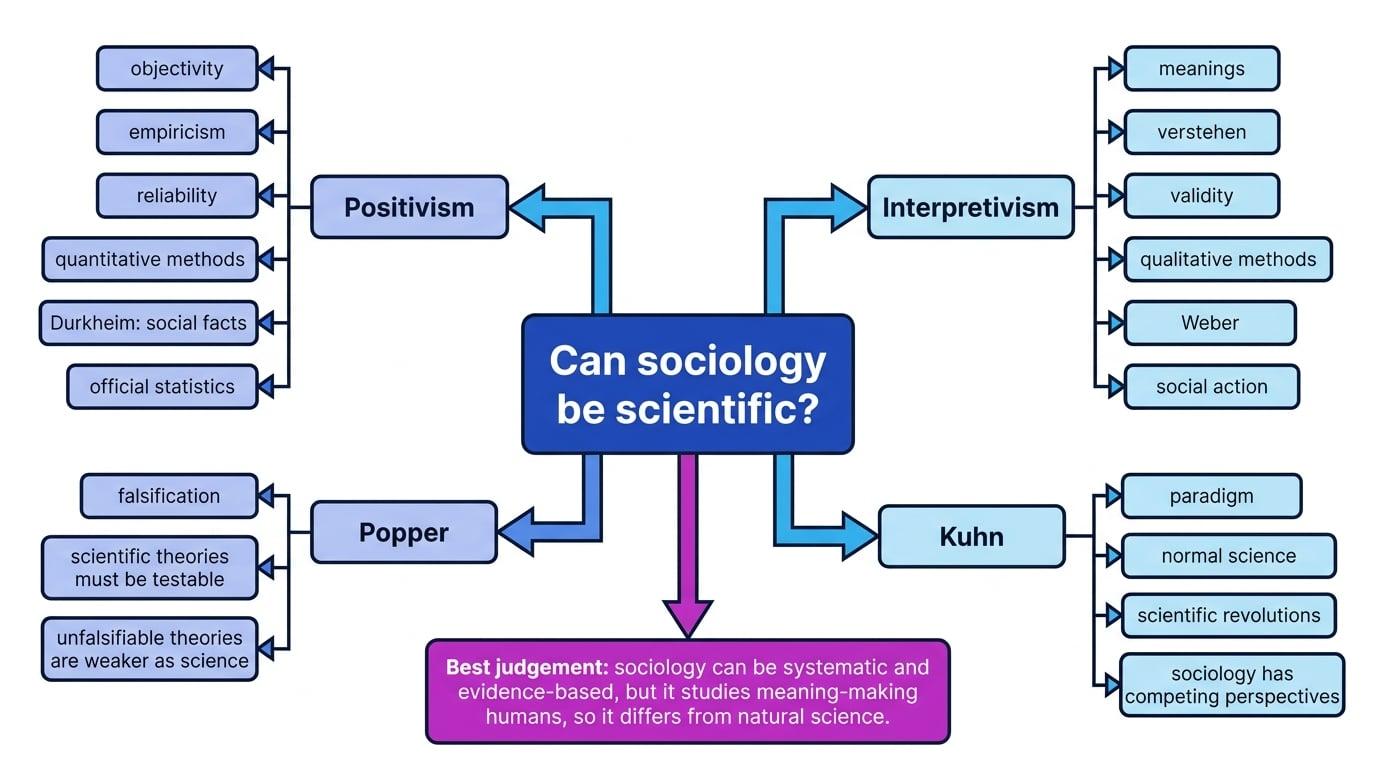
What you'll learn
- What sociologists mean by science, including objectivity, evidence, hypotheses and falsification.
- Why positivists argue sociology can be scientific.
- Why interpretivists argue society cannot be studied in the same way as the natural world.
- How to evaluate the debate using Popper, Kuhn, Durkheim, Weber and contemporary UK examples.
Why this topic matters
This topic sits in Theory and Methods and often appears in essay questions about whether sociology is a “real” science. The key is not to give a simple yes/no answer. You need to show that it depends on what we mean by science, what methods sociologists use, and whether human beings can be studied like atoms, plants or planets.
It links to the core themes too: sociologists study how people are shaped by socialisation, culture and identity, and how society is structured by social differentiation, power and stratification. The question is whether these things can be measured objectively, or whether they must be interpreted through meanings and values.
What is science?
Science
Science is a way of producing knowledge through systematic observation, evidence, theory-testing and critical scrutiny. It usually aims to be empirical, objective, reliable, generalisable and open to being proved wrong.
The natural sciences include subjects such as physics, chemistry and biology. They often study the natural world using controlled experiments, measurement and repeated testing.
Sociology is a social science because it studies human society. But humans have meanings, emotions, identities and values, so the debate is whether sociology can use the same model as natural science.
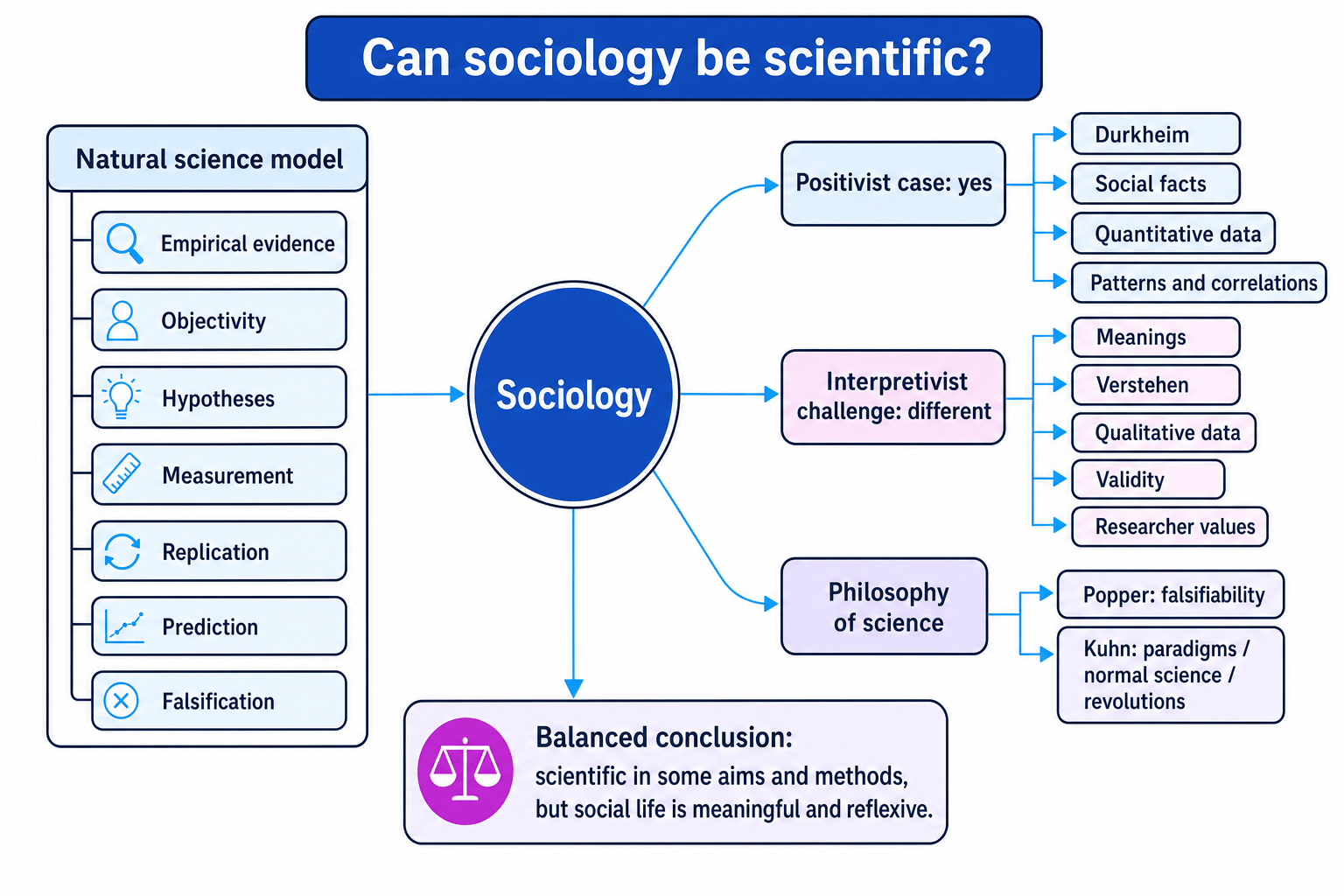
Here is the big debate in one map:
Features of scientific knowledge
Empiricism
Empiricism
Empiricism means basing knowledge on evidence from observation or experience, rather than on tradition, opinion or faith.
In sociology, empirical evidence might include Census data, the Crime Survey for England and Wales, interview transcripts, classroom observations or official statistics on poverty, education and health.
Objectivity
Objectivity
Objectivity means trying to keep personal values, beliefs and opinions separate from the research process.
For example, a researcher studying class inequality should not simply select evidence that confirms their political view. They should collect and analyse evidence systematically.
However, sociologists disagree about whether full objectivity is possible. Research topics, funding, concepts and interpretations may all be shaped by values.
Reliability and replication
Reliability
Reliability means that research can be repeated and produce similar results.
A standardised questionnaire is often more reliable than an unstructured interview because every respondent is asked the same questions in the same order. This appeals to positivists because it looks more like the methods of natural science.
Validity
Validity
Validity means that research measures or captures what it claims to measure.
A study may be reliable but not valid. For example, a questionnaire on racism might produce consistent answers, but respondents may hide prejudiced views because they want to appear socially acceptable.
Reliability versus validity
Scientific-looking methods are not automatically better. Questionnaires and official statistics may be reliable, but interpretivists argue they can miss the deeper meanings behind social action.
Positivism: sociology can be scientific
Positivism
Positivism is the view that sociology should study society using methods similar to the natural sciences, looking for patterns, causes and social laws.
The term is strongly associated with Comte, who believed sociology could discover the laws of society and improve social progress. Positivists see society as an external reality that shapes individuals.
Durkheim and social facts
Social facts
Social facts are external social forces, such as norms, values, institutions and rates of behaviour, that exist outside individuals and shape their actions.
Durkheim argued that sociology should study social facts “as things”. This means sociologists should treat social forces as real, observable and capable of being studied scientifically.
His classic study, Suicide (1897), is often used as evidence for the positivist approach. Suicide seems like a deeply personal act, but Durkheim used official statistics to show that suicide rates varied between social groups. He argued that these patterns were linked to levels of social integration and social regulation.
Using Durkheim’s study of suicide
-
Start with the apparently individual act: suicide might seem to be caused only by personal psychology, grief or mental illness.
-
Compare suicide rates between social groups: Durkheim found patterns by religion, marital status and levels of social integration.
-
Explain the pattern sociologically: if one group has a higher suicide rate, Durkheim argued this suggests a social cause, such as weaker integration into community life.
-
Evaluate the evidence: official suicide statistics may be affected by coroners’ decisions, family pressure and religious stigma, so the data may not be perfectly objective.
Why positivists favour quantitative methods
Quantitative data
Quantitative data is numerical data, such as percentages, rates, scores or counts.
Positivists often prefer surveys, structured interviews, experiments and official statistics because these methods can identify patterns and correlations.
For example, sociologists might use ONS data to examine links between social class and life expectancy, or Department for Education data to analyse gender differences in GCSE and A-level achievement.
This connects to social differentiation, power and stratification because quantitative data can reveal inequalities between classes, genders, ethnic groups and regions.
Positivist answer shortcut
If a question asks whether sociology can be scientific, positivists are your “yes” side: they stress measurement, patterns, causality, reliability and objectivity.
Interpretivism: sociology is different from natural science
Interpretivism
Interpretivism is the view that sociology should focus on meanings, motives and interpretations rather than simply measuring external social facts.
Interpretivists argue that humans are not like chemicals in a test tube. People have consciousness. They interpret situations, respond to labels, negotiate identities and change their behaviour when they know they are being studied.
Weber and verstehen
Verstehen
Verstehen means empathetic understanding: trying to understand the meanings and motives behind people’s actions from their point of view.
Weber did not reject evidence or rigour, but he argued that sociology must understand social action. For example, two pupils may both be absent from school, but their meanings may differ: one may be caring for a sibling, another may be avoiding bullying, and another may be rejecting school authority.
Interpreting truancy as meaningful action
-
A positivist approach might count absences and look for correlations with class, gender, ethnicity or school type.
-
An interpretivist approach asks what absence means to the pupil: resistance, fear, caring responsibility, boredom or exclusion.
-
This changes the explanation: the same behaviour can have different causes depending on the actor’s identity, relationships and school experience.
-
The evaluation is balanced: counting absences is useful for spotting patterns, but interviews or observations may give greater validity by uncovering meaning.
Why interpretivists favour qualitative methods
Qualitative data
Qualitative data is non-numerical data, such as words, meanings, descriptions, observations and personal accounts.
Interpretivists often use unstructured interviews, participant observation, diaries and case studies. These methods are usually less reliable than standardised surveys, but they may be more valid because they get closer to lived experience.
This matters for culture and identity. If you are studying religion, youth subcultures, gender identity or racism, simply measuring behaviour may miss how people understand themselves and others.
Treating interpretivists as anti-evidence
Interpretivists are not saying “anything goes”. They still collect evidence, but they argue that valid sociological evidence must include meanings, motives and context.
Popper: science must be falsifiable
Falsification
Falsification means that a theory is scientific only if it can, in principle, be tested and shown to be false.
Karl Popper argued that science does not prove theories true forever. Instead, scientists make bold claims and try to disprove them. A theory that survives serious attempts at falsification is strengthened, but never finally proven.
For Popper, a problem occurs when theories explain every possible outcome. If no evidence could ever count against a theory, it is not scientific.
Applying falsifiability to a sociological claim
-
Take a claim such as: “Material deprivation increases the likelihood of educational underachievement.”
-
Make it testable by specifying what evidence would challenge it, such as cases where deprivation is high but achievement remains consistently high across comparable groups.
-
Collect evidence using school performance data, interviews and contextual information about family, school funding and neighbourhood conditions.
-
Decide whether the theory needs refining: if evidence contradicts the claim, a scientific approach should modify the explanation rather than ignore the problem.
Popper criticised some versions of Marxism because he believed they became unfalsifiable when supporters explained away failed predictions. For example, if a revolution did not happen, Marxists might argue that workers had been temporarily misled by ideology rather than questioning the theory.
However, this is not a complete dismissal of all Marxist sociology. Many Marxist studies make testable claims about class inequality, ownership, education and ideology.
Kuhn: science depends on paradigms
Paradigm
A paradigm is a shared framework of assumptions, concepts, methods and questions used by a scientific community.
Thomas Kuhn argued that science is not simply a steady accumulation of objective facts. Instead, scientists usually work within a dominant paradigm. This is called normal science. When too many problems build up, there may be a scientific revolution, where one paradigm is replaced by another.
This creates an interesting issue for sociology. Natural sciences often have a dominant paradigm, but sociology has several competing perspectives: functionalism, Marxism, feminism, interactionism, postmodernism and others.
Some argue this means sociology is pre-paradigmatic and therefore not fully scientific. Others argue that multiple perspectives are a strength because society is complex and contested.
Kuhn’s challenge
Kuhn weakens the idea that natural science is perfectly objective. If even natural scientists work within paradigms, then sociology may not be uniquely “biased” or “unscientific”.
Merton: science as a social institution
Robert K. Merton argued that science is guided by social norms. These are often summarised as CUDOS:
- Communalism: scientific knowledge should be shared.
- Universalism: claims should be judged by evidence, not by who makes them.
- Disinterestedness: scientists should not distort findings for personal gain.
- Organised scepticism: findings should be critically tested.
This is useful because it shows science itself can be studied sociologically. Scientists work in universities, companies and governments. Their research may be shaped by funding, status, competition and power.
AO3 point: if natural science is also socially organised, then the difference between science and sociology may be less clear-cut than positivists suggest.
Realism and postmodernism: two extra evaluation angles
Realism
Realism
Realism is the view that sociology can be scientific by investigating underlying social structures and causal mechanisms, even if these cannot always be directly observed.
Realists argue that society is an open system. Unlike a laboratory, social life contains many interacting causes at once. For example, educational achievement may be shaped by class, ethnicity, gender, school funding, teacher expectations, parental support and peer culture.
So sociology may be scientific, but it will not always produce precise predictions like some natural sciences.
Postmodernism
Postmodernists are more sceptical. They argue that “science” can become a powerful metanarrative, meaning a big story claiming universal truth. Thinkers influenced by Foucault argue that knowledge is linked to power: experts classify people, define normality and influence policy.
For example, official categories of crime, mental illness, poverty or family structure can shape how the state sees and manages people.
Do not overstate postmodernism
Postmodernists challenge claims to objective truth, but in an exam you still need evidence and sociological reasoning. Do not turn the answer into “truth does not exist”, because that becomes hard to support.
So, can sociology be regarded as scientific?
The best answer is balanced: sociology can be scientific in some ways, but not in exactly the same way as the natural sciences.
Arguments that sociology can be scientific
- It uses systematic methods, such as surveys, experiments, official statistics and comparative research.
- It can identify patterns, such as links between class and health, gender and subject choice, or ethnicity and stop-and-search rates.
- It can test theories using evidence.
- Positivists such as Comte and Durkheim show that social facts can be studied empirically.
Arguments that sociology cannot be fully scientific
- Humans have meanings, identities and motives.
- Researchers’ values may affect topic choice, method and interpretation.
- Society changes over time, so predictions are difficult.
- Social categories are often socially constructed.
- Ethical rules limit experimentation: sociologists cannot manipulate poverty, racism or family breakdown in a laboratory.
Methodological evaluation
In research-methods terms, the debate turns on:
- Practical issues: large-scale surveys may be costly and time-consuming, while qualitative studies may have smaller samples.
- Ethical issues: informed consent, confidentiality and avoiding harm are especially important when studying vulnerable groups.
- Theoretical issues: positivists prioritise reliability and generalisation; interpretivists prioritise validity and meaning.
Writing a one-sided answer
A strong answer should not simply say “sociology is scientific” or “sociology is not scientific”. The highest-level response compares different definitions of science and evaluates how far each applies to sociology.
Building essay-style answers
For AO1, define the key concepts clearly: science, positivism, interpretivism, objectivity, reliability, validity, falsification and paradigm.
For AO2, apply them to real examples. You could use Durkheim’s suicide study, official statistics on crime or education, Census data, the Crime Survey for England and Wales, or qualitative research into identity and labelling.
For AO3, evaluate throughout. Compare positivism with interpretivism. Use Popper to question whether sociological theories can be falsified. Use Kuhn to challenge the idea that natural science is purely objective. Consider whether modern sociology can be scientific without copying physics or chemistry.
In the exam
-
Start by defining science and explaining that the debate depends on the model of science being used.
-
Build a clear contrast: use positivism and Durkheim for the argument that sociology can be scientific, then interpretivism and Weber for the challenge.
-
Evaluate with Popper and Kuhn, then reach a balanced judgement: sociology can be systematic and evidence-based, but human meaning, values and reflexivity make it different from the natural sciences.
Check yourself
- Why did Durkheim think suicide could be studied scientifically?
- How does Weber’s idea of verstehen challenge positivism?
- What is the difference between Popper’s falsification argument and Kuhn’s paradigm argument?