What you'll learn
- What sociologists mean by modernity, late modernity and post-modernity.
- How key theorists such as Marx, Durkheim, Weber, Lyotard, Baudrillard, Giddens, Beck and Bauman fit into the debate.
- How to apply these ideas to contemporary UK society, including identity, media, class, risk and inequality.
- How to evaluate postmodern claims using AO3: comparison, evidence and methodological critique.
Why this topic matters
This topic sits in Theory and Methods because it asks a big question: what kind of society are sociologists trying to explain? If society is still modern, then large-scale structures like class, the state, capitalism and bureaucracy remain central. If society is post-modern, then identity, culture, media and uncertainty may matter more than fixed social structures.
The debate also links directly to AQA’s core themes:
- Socialisation, culture and identity: are identities shaped by class, gender and family, or chosen through lifestyle and consumption?
- Social differentiation, power and stratification: are inequalities still structured by capitalism, patriarchy and racism, or are power relations more fragmented and fluid?
Starting point: pre-modern society
Before we define modernity, it helps to know what it is being contrasted with.
Pre-modern society
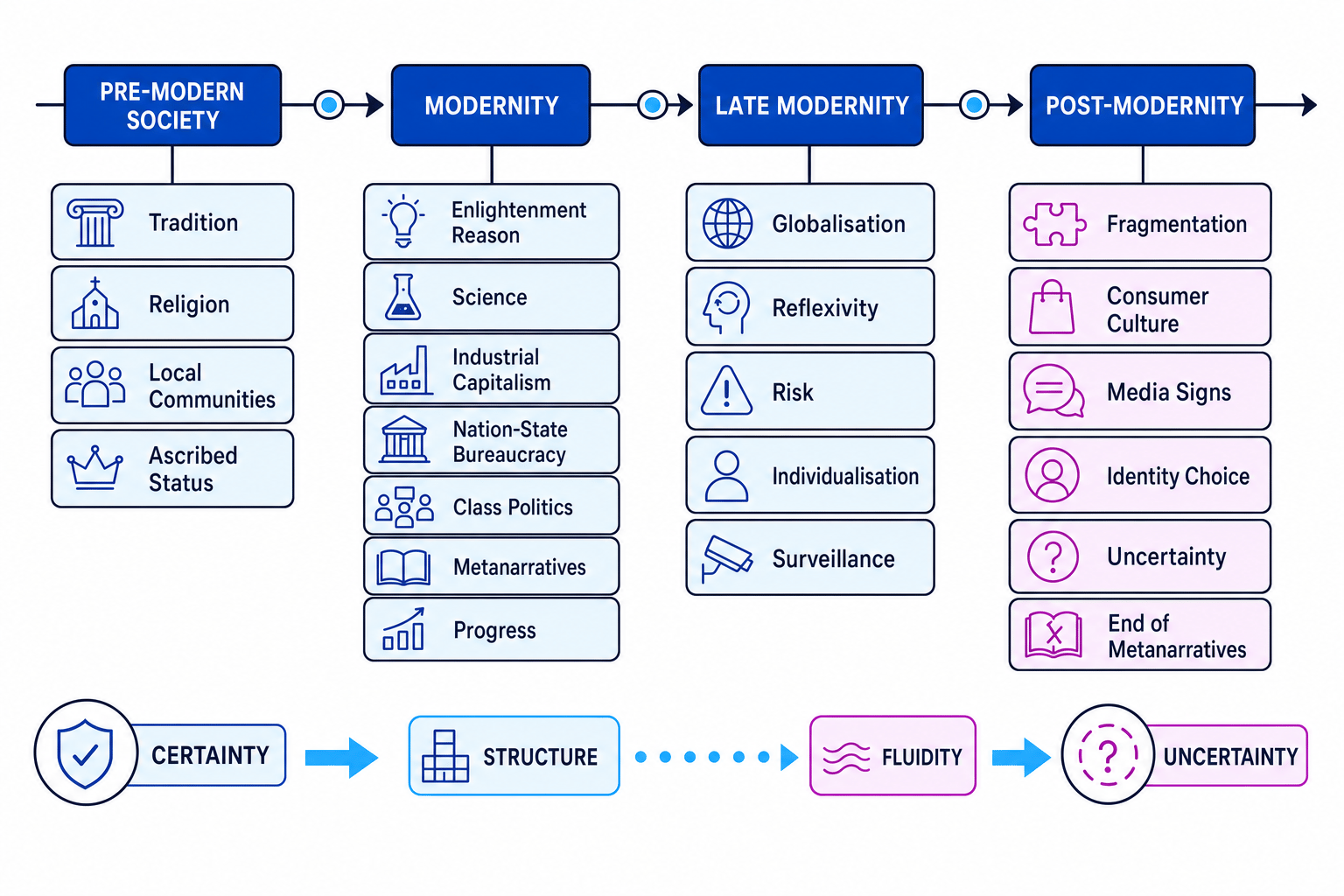
A pre-modern society is a society where social life is mainly organised around tradition, religion, local community, agriculture and ascribed status — the position you are born into.
In pre-modern societies, people’s identities were often relatively fixed. Your family, village, religion, gender and inherited status strongly shaped your life chances. Social change was slower, and knowledge was often justified through religious authority or custom.
This does not mean pre-modern societies were simple or peaceful. It means sociologists use the term as a contrast with the dramatic changes produced by industrialisation, capitalism, science and the modern state.
Modernity: society built around progress and reason
Modernity
Modernity refers to the type of society that emerged in Europe from roughly the Enlightenment and Industrial Revolution onwards, characterised by science, reason, industrial capitalism, urbanisation, bureaucracy, secularisation and belief in progress.
The Enlightenment was an intellectual movement that argued human beings could use reason, evidence and science to understand and improve the world. This matters because sociology itself is a modern project: it tries to study society systematically rather than relying only on tradition or religion.
Modernity is associated with several major social changes.
Industrialisation and capitalism
Industrialisation means the shift from agricultural production to factory-based machine production. Capitalism is an economic system based on private ownership, wage labour and production for profit.
For Marx, modern society is shaped by capitalism and class conflict. The key division is between the bourgeoisie, who own the means of production, and the proletariat, who sell their labour. Marx is a modernist theorist because he offers a large-scale explanation of society and believes capitalism has an underlying structure.
Bureaucracy and rationalisation
Weber argued that modernity involves rationalisation: social life becomes increasingly organised around calculation, efficiency, rules and technical expertise.
Bureaucracy
A bureaucracy is an organisation run through formal rules, hierarchy, written records and specialised roles, such as a government department, school, hospital or large company.
Weber saw bureaucracy as efficient but also potentially dehumanising. He famously warned of an iron cage, where people become trapped in systems of rules and targets.
AO2 example: in the UK, schools, the NHS, the tax system and the benefits system all depend on bureaucratic record-keeping. These systems can protect rights and distribute resources, but they can also feel impersonal.
Social solidarity and anomie
Durkheim argued that modern societies move from mechanical solidarity, based on similarity and shared tradition, to organic solidarity, based on interdependence between specialised roles.
He also warned that rapid social change could create anomie, a state of normlessness where people feel unclear about society’s rules and expectations.
Modernity in one sentence
Modernity means society becomes more industrial, rational, scientific and bureaucratic — but sociologists disagree over whether this creates freedom, exploitation, order or alienation.
Modernist sociology: big theories and social structures
Modernist theories often use metanarratives.
Metanarrative
A metanarrative is a large, overarching theory or story that claims to explain the direction of history or society as a whole.
Marxism is a metanarrative because it explains history through class struggle. Functionalism is also modernist because it sees society as a system with institutions performing functions. Parsons, for example, argued that social institutions such as the family, education and religion help maintain social order.
Modernist sociology often assumes that society has discoverable patterns. This links to positivism, the view that sociology should use scientific methods to find social facts, patterns and causes.
Positivism
Positivism is a theoretical approach that favours objective, scientific methods, often using quantitative data to identify patterns and causal relationships in society.
AO2 link: official statistics, such as Census data or ONS data on income, health and education, fit a modernist approach because they classify society into measurable categories.
The move towards late modernity
Some theorists argue that society has changed dramatically, but not enough to say modernity has ended. This is the idea of late modernity.
Late modernity
Late modernity is the view that modern society has become more globalised, reflexive, individualised and risky, but still remains shaped by modern institutions such as capitalism, science and the state.
Giddens: reflexivity and disembedding
Giddens argues that modernity has become more intense. People are increasingly reflexive, meaning they constantly reflect on and revise their choices using expert knowledge.
For example, people may use online information, medical advice, fitness apps or therapy language to make decisions about diet, relationships, education and identity.
Giddens also discusses disembedding, where social relationships are lifted out of local contexts. Online banking, remote work and global supply chains allow interactions without face-to-face local ties.
Beck: risk society
Beck argues that late modern societies are increasingly organised around managing manufactured risks — risks created by human activity and technology.
Examples include climate change, nuclear accidents, pandemics, data breaches and AI-driven surveillance. These are not simply natural dangers; they are produced by modern systems.
Bauman: liquid modernity
Bauman describes contemporary society as liquid modernity, where social life feels flexible, insecure and unstable. Jobs, relationships and identities may feel less fixed than in earlier modern societies.
AO2 example: the gig economy, short-term renting, dating apps and portfolio careers can all be used to illustrate Bauman’s idea of fluidity.
Applying late modernity to the gig economy
-
Identify the social change: gig economy workers may work through platforms such as Uber, Deliveroo or freelance websites rather than long-term employers.
-
Apply Giddens: workers may have to be reflexive, constantly reviewing ratings, income, availability and future plans rather than following a stable career path.
-
Apply Beck: the risks of insecure income, illness, pensions and employment rights are shifted onto individuals rather than fully carried by employers or the welfare state.
-
Evaluate with power and stratification: the freedom to choose flexible work is unequal. Middle-class professionals may experience flexibility as lifestyle choice, while lower-paid workers may experience it as insecurity.
Post-modernity: fragmentation, media and uncertainty
Post-modernity
Post-modernity is the idea that modern society has been replaced by a new type of society marked by uncertainty, fragmentation, consumer culture, media saturation and the decline of metanarratives.
Postmodernists argue that old certainties have weakened. Class, religion, nation, gender roles and traditional family structures may no longer provide stable identities in the way they once did.
Instead, people increasingly construct identities through consumption, media, lifestyle and personal choice.
Lyotard: the end of metanarratives
Lyotard argued that postmodern society is marked by incredulity towards metanarratives. In simpler terms, people are less likely to believe one big theory can explain everything.
This challenges Marxism, functionalism and even the Enlightenment belief in scientific progress. Postmodernists argue that truth claims are often partial, local and shaped by power.
Baudrillard: simulacra and hyperreality
Baudrillard argued that media signs and images can become more influential than reality itself.
Hyperreality
Hyperreality is a condition where media images, signs or simulations feel more real or meaningful than the reality they supposedly represent.
For example, celebrity branding, influencer culture, reality TV and political image-management can blur the boundary between reality and performance.
AO2 example: during election campaigns, voters may respond not only to policies but to image, slogans, memes, staged clips and media narratives.
Foucault: discourse and power
Foucault is often linked to postmodern and post-structuralist sociology. He argued that power is not only held by the state or ruling class. Power operates through discourse.
Discourse
A discourse is a system of language, knowledge and assumptions that shapes how people understand a topic, such as crime, mental health, sexuality or childhood.
For Foucault, expert knowledge can classify people as normal or deviant. This links theory to methods because sociologists may study documents, policies, professional language and media representations to see how categories are constructed.
Modernity vs post-modernity: the core contrast
| Issue | Modernity | Post-modernity |
|---|---|---|
| Knowledge | Science, reason, progress | Uncertainty, relativism, competing truths |
| Identity | Shaped by class, gender, nation, work, family | More fluid, chosen, fragmented and media-influenced |
| Power | Located in capitalism, state, patriarchy or institutions | Diffuse, operating through discourse, culture and representation |
| Culture | Distinction between high and popular culture | Boundaries blur; style, image and consumption dominate |
| Sociology | Big theories and structural explanations | Suspicion of metanarratives; focus on difference and diversity |
A quick way to remember the difference
Modernity asks, “What structures organise society?” Post-modernity asks, “What happens when those structures no longer feel stable, and identity is shaped through signs, media and choice?”
Research methods link
This topic matters for methods because different theories imply different ways of researching society.
Modernist and positivist approaches are more likely to value:
- official statistics
- surveys
- patterns and correlations
- reliability and representativeness
Postmodern and interpretivist approaches are more likely to value:
- qualitative interviews
- ethnography
- discourse analysis
- meanings, identities and representations
But be careful: this is not a simple split. A sociologist can use statistics while still criticising official categories, and a postmodernist can still make serious claims about power.
Treating postmodernism as just ‘anything goes’
Postmodernists do not simply say “nothing is real”. A stronger answer says they question universal truth claims and examine how reality is mediated through language, culture, images and power.
Evaluation: is society really post-modern?
Strengths of postmodernism
Postmodernism is useful for analysing contemporary culture. It helps explain why media, branding, lifestyle, online identity and consumption are so central to everyday life.
It also challenges sociology to avoid assuming that one theory explains everyone’s experience. This is important for studying diverse identities around gender, sexuality, ethnicity, religion and disability.
Limits of postmodernism
However, critics argue that postmodernism can exaggerate choice and ignore material inequality.
For example, class still strongly affects educational achievement, health, housing, life expectancy and access to digital resources in the UK. Gender and ethnicity also continue to shape experiences of work, policing, family life and representation.
Marxists argue that consumer choice can hide capitalist power. Buying different brands does not necessarily mean escaping exploitation, low wages or global inequality.
Feminists argue that gender identities may be more flexible than in the past, but patriarchy still affects pay, unpaid care, sexual violence and political representation.
Late modernity as a middle position
Giddens, Beck and Bauman are useful because they avoid a simple either/or answer. They accept that society is more uncertain and individualised, but they do not necessarily claim that modernity has ended.
Best evaluative judgement
A strong A-Level answer often argues that contemporary society has postmodern features, especially in culture and identity, but modern structures such as capitalism, the state, class, patriarchy and racism remain powerful.
Applying the debate to social media identity
-
Identify the postmodern features: social media allows people to curate identities through images, captions, filters, trends, brands and online communities.
-
Apply Baudrillard: the online image can become hyperreal, because the edited representation may become more socially important than the person’s offline reality.
-
Apply late modernity: users are reflexive because they monitor likes, comments, privacy, employability and risks to reputation when presenting themselves online.
-
Evaluate with stratification: identity is not purely free choice. Class affects devices, time and cultural capital; gender shapes beauty pressures and harassment; ethnicity can shape visibility, stereotyping and racism online.
How to use this in essays
For AO1, define the concepts clearly and attach theorists accurately.
For AO2, apply the debate to real features of UK society: social media, the gig economy, consumer culture, ONS inequality data, changing family forms, secularisation, education markets, surveillance and climate risk.
For AO3, avoid simply saying “postmodernism is good” or “modernity is outdated”. Compare perspectives and make a judgement about which parts of society each theory explains best.
In the exam
-
Start with clear definitions of modernity and post-modernity, then anchor each one to named theorists such as Marx, Weber, Durkheim, Lyotard, Baudrillard, Giddens, Beck or Bauman.
-
Apply the debate to concrete examples from contemporary society, especially identity, media, consumption, inequality, risk and the role of the state.
-
Evaluate by asking whether postmodern change affects all groups equally, or whether class, gender, ethnicity and institutional power still structure people’s life chances.
Check yourself
- What are three features of modernity, and which classical sociologist could you link to each?
- How does Baudrillard’s idea of hyperreality help explain media or influencer culture?
- Why might late modernity be a stronger argument than saying society is fully post-modern?
