What you'll learn
- How quantitative and qualitative methods differ, and why sociologists use both.
- How research design turns a broad sociological interest into a workable study.
- How to evaluate methods using practical, ethical and theoretical issues.
- How these choices affect evidence about identity, culture, power and social inequality.
Starting point: what is sociological research?
Sociological research is the organised collection and analysis of data about social life. Sociologists use research to investigate patterns, meanings, institutions and inequalities — for example, class differences in education, youth identities online, or experiences of policing.
Data
Data means evidence collected or used by researchers. Data can be numerical, written, spoken, visual, official, personal, newly collected, or already existing.
A method is the technique used to collect or analyse data, such as a questionnaire, interview, observation or official statistics.
A research design is the overall plan for a study: what the researcher wants to find out, who they will study, how they will collect evidence, and how they will judge the quality of that evidence.
Methods are choices, not magic
No method is automatically “best”. Strong answers explain why a method suits a particular research aim, and then evaluate what it gains and what it loses.
Quantitative and qualitative data
Quantitative and qualitative data
Quantitative data is numerical data, often used to identify patterns, trends and correlations. Qualitative data is non-numerical data, often used to understand meanings, motives, identities and experiences.
Quantitative methods are often linked with positivism, the view that sociology should try to study society scientifically by finding patterns and causes. Durkheim’s study of suicide used official statistics to compare suicide rates between social groups.
Qualitative methods are often linked with interpretivism, the view that sociology should understand the meanings people attach to their actions. Willis’s study of working-class “lads” used qualitative methods to explore how school culture shaped class identity.
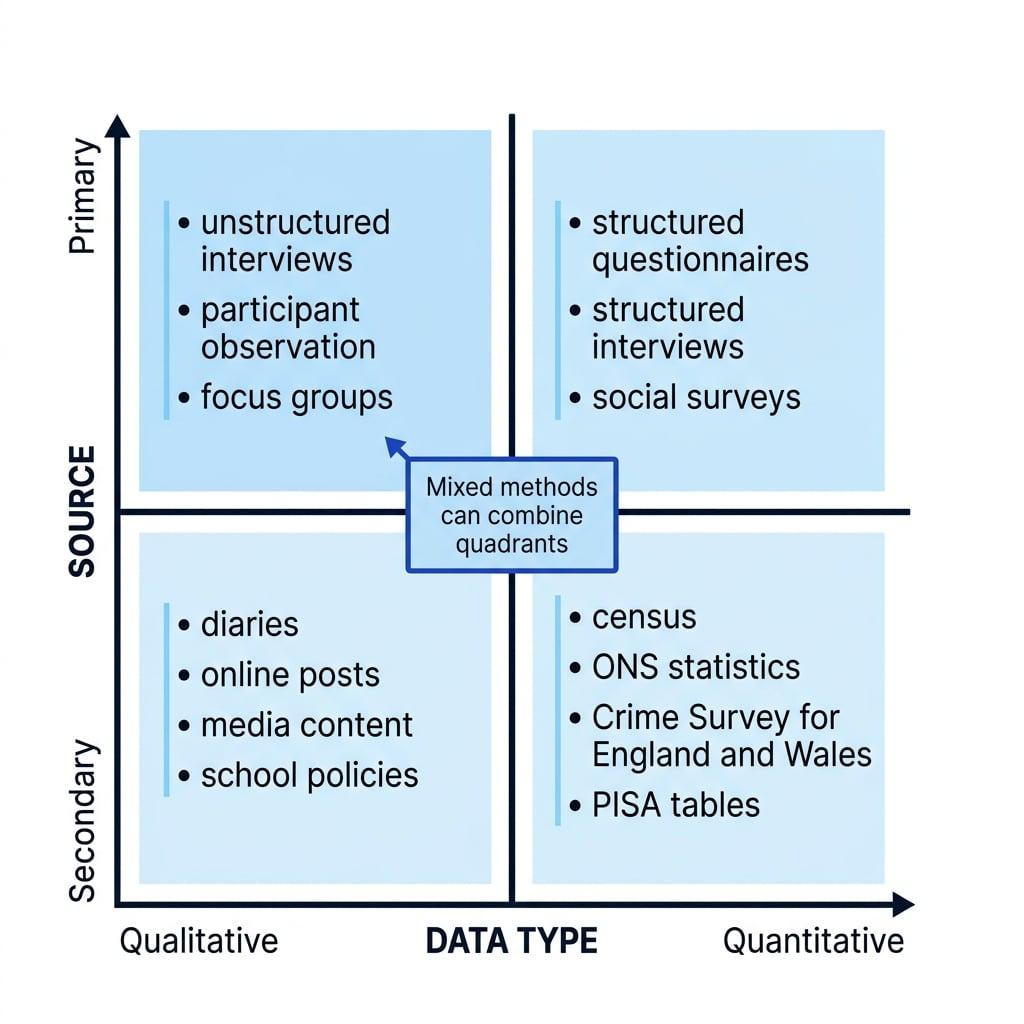
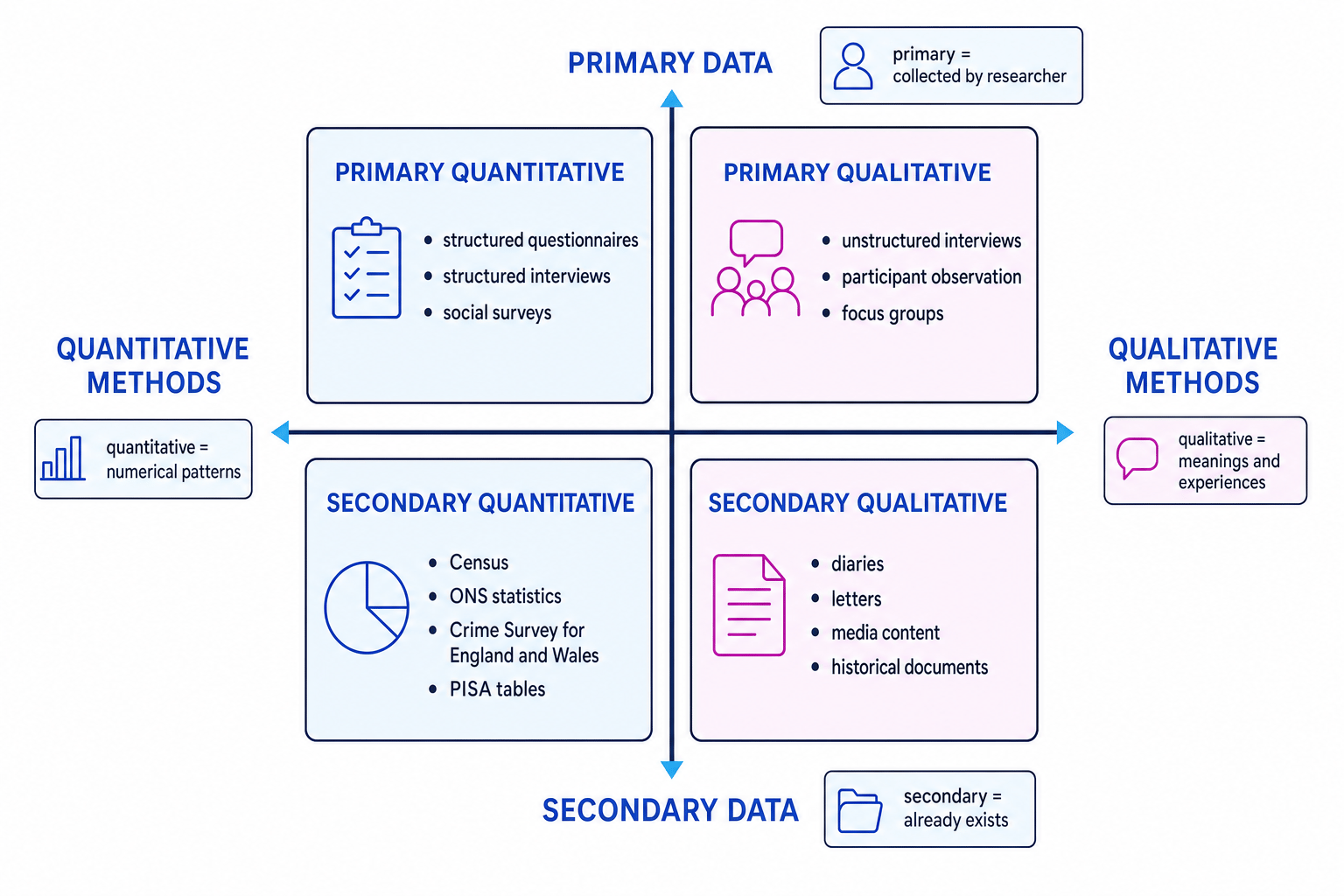
A useful way to organise methods is to ask two questions: is the data numerical or meaning-based, and is it collected by the researcher or already available?
Quantitative methods
Common quantitative methods include:
- Structured questionnaires with closed questions.
- Structured interviews where every respondent is asked the same questions.
- Social surveys using large samples.
- Official statistics, such as the Census, ONS deprivation indices, Crime Survey for England and Wales, or PISA league tables.
Quantitative methods are useful when researchers want to compare groups. For example, they might compare educational achievement by gender, ethnicity, region or social class. This links directly to social differentiation, power and stratification, because numbers can reveal unequal outcomes between groups.
However, quantitative research can miss meanings. A survey may show that some pupils have lower attendance, but not explain how peer culture, racism, teacher labelling or family responsibilities shape that attendance.
Qualitative methods
Common qualitative methods include:
- Unstructured interviews, where questions are flexible and conversational.
- Participant observation, where the researcher joins or watches a group.
- Focus groups, where people discuss a topic together.
- Documents and media content, such as diaries, online posts or school policies.
Qualitative methods are useful for exploring socialisation, culture and identity. For example, interviews might reveal how young people understand masculinity, religion, class identity or online status.
Qualitative methods often produce high validity, because they can get closer to people’s lived experiences. But they are usually based on smaller samples, so they may be less representative.
Key research quality terms
Reliability, validity and representativeness
Reliability means research could be repeated and produce similar results. Validity means research measures or captures what it claims to measure. Representativeness means the sample reflects the wider population being studied.
These terms are central to AO3 evaluation.
Quantitative research often scores well on reliability because standardised questions can be repeated. But it may be less valid if respondents tick boxes that do not reflect their real experiences.
Qualitative research often scores well on validity because it explores meanings in depth. But it may be less reliable because another researcher might ask different questions or interpret the data differently.
Confusing reliability with truth
Do not write that reliable research is automatically “true”. A questionnaire can reliably produce the same misleading answer if its questions are badly worded.
Levels of measurement
When sociologists design quantitative research, they must decide what kind of data a variable will produce.
Variable
A variable is something that can vary between people, groups or situations, such as age, income, religion, gender identity, social class, exam results or attitudes to the police.
| Level | Meaning | Sociology example |
|---|---|---|
| Nominal | Categories with no order | Religion, ethnic group, family type |
| Ordinal | Categories with an order | Strongly agree to strongly disagree; social class groups |
| Interval | Ordered scale with equal gaps but no true zero | Some attitude or index scores |
| Ratio | Ordered scale with equal gaps and a true zero | Age, income, number of children |
Choosing a measurement level
A researcher wants to study trust in the police.
- If they ask “Do you trust the police? Yes or no”, they create nominal data. This is simple to compare, but very blunt.
- If they ask “Do you strongly agree, agree, disagree or strongly disagree that the police treat people fairly?”, they create ordinal data. This captures strength of feeling, but the distance between categories is not exact.
- If they build a trust index from several questions, they may treat it more like interval data. This can show patterns between groups, but it may hide the personal meanings behind trust and mistrust.
Research design: the full plan
Research design is the process of turning a topic into a study that can actually be carried out.
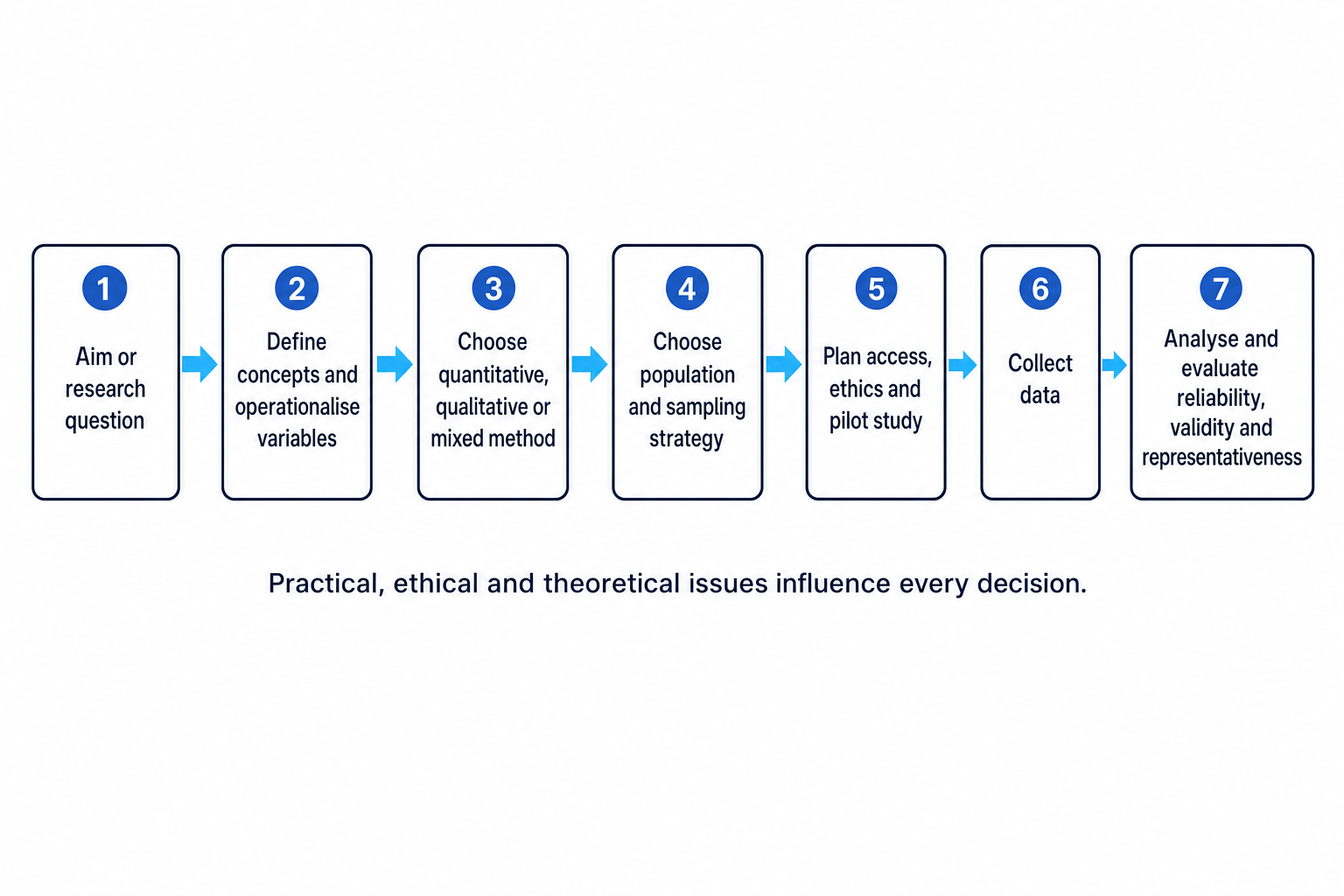
1. Start with an aim or research question
A research aim is the broad purpose of the study. A research question is a focused question the study tries to answer.
For example:
- Aim: to investigate social class and educational achievement.
- Research question: how do working-class pupils describe their relationships with teachers?
A quantitative study may also use a hypothesis.
Hypothesis
A hypothesis is a testable prediction about the relationship between variables, such as “pupils eligible for free school meals are more likely to have lower attendance”.
2. Operationalise key concepts
Operationalisation means turning an abstract concept into something measurable or observable.
For example, “poverty” could be operationalised using household income, free school meal eligibility, housing conditions or a deprivation index. Each choice matters. Income may be measurable, but it might not capture stigma, insecurity or social exclusion.
Operationalising social class and achievement
A researcher wants to study whether social class affects educational achievement.
- They decide how to measure social class. Parental occupation, eligibility for free school meals, household income or postcode deprivation could all be used, but each captures a slightly different aspect of inequality.
- They decide how to measure achievement. GCSE grades, attendance, predicted grades or teacher assessments could all be used, but some may reflect teacher labelling as well as pupil performance.
- They evaluate the design. The study may produce reliable numerical comparisons, but it may miss cultural factors such as parental expectations, peer-group identity or Bourdieu’s idea of cultural capital.
3. Choose a method
The method should match the research question.
If the researcher wants broad patterns, quantitative methods may fit. If they want meanings, qualitative methods may fit. Many sociologists use mixed methods, combining both.
Triangulation
Triangulation means using more than one method or source of data to study the same issue, so the strengths of one method can offset the weaknesses of another.
For example, a study of youth unemployment might use ONS statistics to identify patterns, then interviews to explore how unemployment affects identity, confidence and relationships.
4. Choose a sample
Population and sample
The population is the whole group the researcher is interested in. The sample is the smaller group actually studied.
Sampling matters because sociologists rarely study everyone. Key sampling techniques include:
- Random sampling: everyone in the sampling frame has an equal chance of selection.
- Stratified sampling: the researcher divides the population into important groups, such as gender or ethnicity, then samples from each.
- Quota sampling: the researcher fills set categories, but not randomly.
- Snowball sampling: participants help recruit others, useful for hidden or sensitive groups.
- Opportunity sampling: the researcher uses whoever is easiest to access.
A sampling frame is the list from which a sample is drawn, such as a school register. If the list is incomplete, the sample may be biased.
Sampling shortcut
For representativeness, think: “Who is missing?” If a study excludes people without internet access, non-English speakers, school refusers, prisoners or homeless people, its findings may under-represent already marginalised groups.
5. Plan access, ethics and a pilot study
Practical issues include time, cost, researcher skill, funding, access and response rates. For example, schools may be difficult to access because headteachers act as gatekeepers.
Ethical issues include informed consent, confidentiality, anonymity, avoiding harm, and being especially careful with vulnerable participants such as children or victims of crime.
A pilot study is a small trial run of the research design. It can reveal confusing questions, access problems or ethical risks before the main study begins.
Official statistics are not neutral facts
Official statistics are useful, but they are socially produced. Atkinson argued that suicide statistics depend partly on coroners’ interpretations, while crime statistics depend on reporting, recording and policing practices.
Evaluating quantitative and qualitative methods
Quantitative strengths and limits
Quantitative research can be large-scale, reliable and representative. It is useful for showing trends over time, such as Census changes in religion, family structure or ethnicity.
But quantitative research can impose the researcher’s categories onto participants. Feminists and interpretivists often argue that closed questions can silence people’s voices, especially when researching sensitive topics such as domestic abuse, gender identity or racism.
Qualitative strengths and limits
Qualitative research can produce rich, valid data about meanings and identities. For example, Goffman’s work on stigma helps sociologists understand how labels affect self-concept and interaction.
But qualitative research can be time-consuming, harder to repeat, and affected by the researcher’s presence. Participant observation can also raise ethical problems if people do not know they are being studied.
Theoretical perspective matters
Positivists often prefer quantitative methods because they value objectivity, reliability and causal explanation.
Interpretivists often prefer qualitative methods because they value meaning, empathy and verstehen — understanding action from the actor’s point of view.
Conflict perspectives, including Marxism, feminism and some postmodern approaches, ask an extra question: whose knowledge counts? Research can reveal power inequalities, but it can also reproduce them if researchers define people only through official categories.
Designing a mixed-methods study
A researcher wants to study how social media shapes Year 12 students’ gender identities.
- They use a questionnaire first to identify broad patterns, such as which platforms students use and whether usage differs by gender or social class.
- They then conduct semi-structured interviews to explore meanings, such as pressure to perform femininity, masculinity, popularity or authenticity online.
- They use stratified sampling across different schools to include students from varied class, ethnic and gender backgrounds.
- They evaluate the design: the survey improves representativeness, while interviews improve validity. However, self-report data may be affected by social desirability, and ethical care is needed because students may discuss sensitive online experiences.
Bringing it together
For A-Level essays, avoid treating methods as a checklist. Link the method to the research problem.
If the topic is social differentiation, ask whether the sample includes relevant groups and whether the method reveals inequality. If the topic is culture and identity, ask whether the method lets people explain meanings in their own words.
The strongest answers balance AO1 knowledge, AO2 application and AO3 evaluation.
In the exam
- Define the method clearly, then link it to a specific research aim or topic.
- Evaluate using practical, ethical and theoretical issues rather than generic “good” and “bad” points.
- Use paired concepts: reliability versus validity, representativeness versus depth, positivism versus interpretivism.
- Apply examples from UK society, such as the Census, ONS statistics, CSEW, schools, social media or class and ethnic inequalities.
Check yourself
- Why might a questionnaire be reliable but not very valid?
- When would snowball sampling be more useful than random sampling?
- How could a mixed-methods design improve a study of youth identity or social inequality?