What you'll learn
- What Methods in Context means in AQA Sociology.
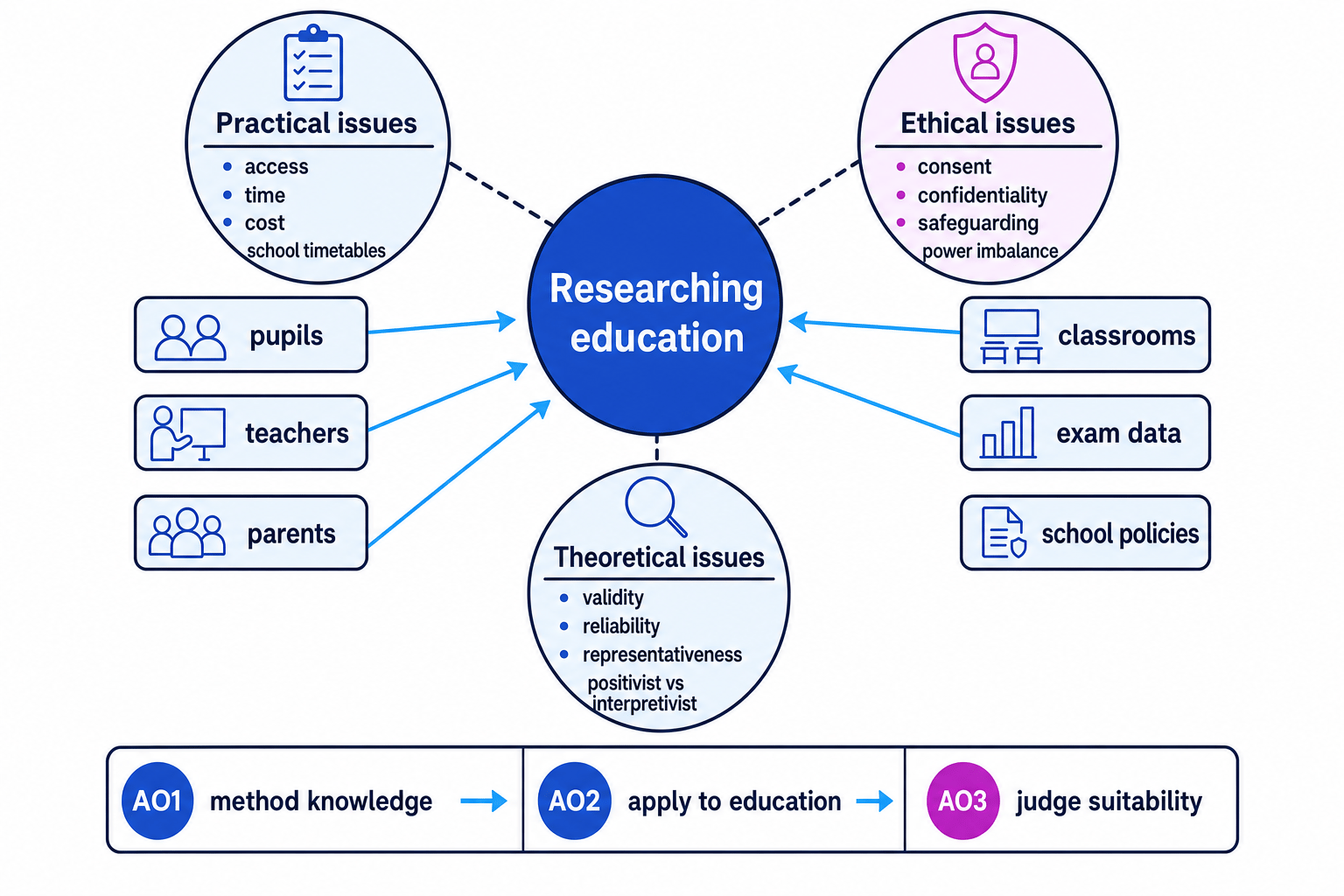
- How to apply research methods to schools, pupils, teachers, parents and education data.
- How to evaluate methods using practical, ethical and theoretical issues.
- How to build strong AO1, AO2 and AO3 points for Methods in Context questions.
What is Methods in Context?
Methods in Context is where you take your knowledge of sociological research methods and apply it to a specific education topic.
So instead of asking, “Are questionnaires good or bad?”, you ask:
“How useful are questionnaires for studying pupils’ experiences of setting and streaming?”
That extra education context changes everything. Schools are not neutral research spaces. They have rules, timetables, safeguarding policies, hierarchies, reputations and power relationships.
Methods in Context
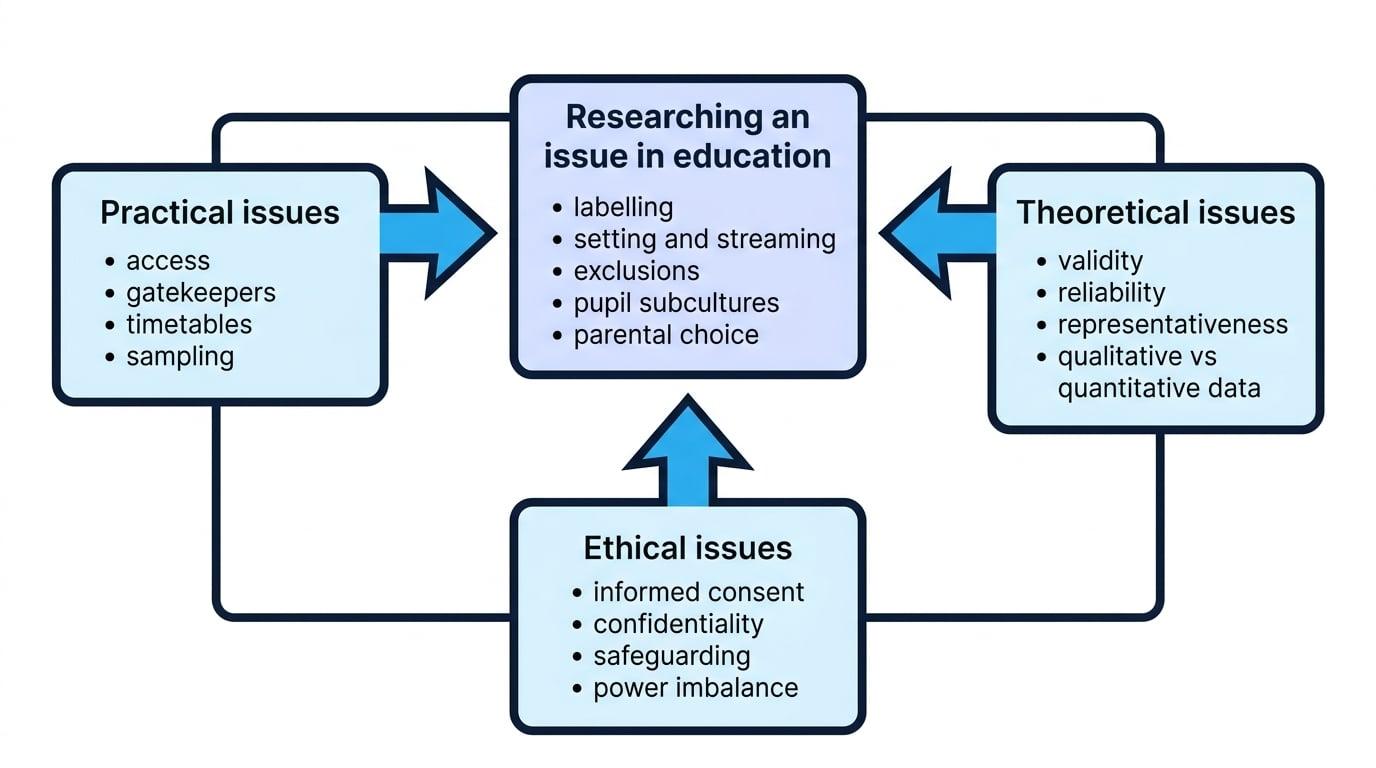
Methods in Context means evaluating how suitable a research method is for investigating a particular issue in education, such as labelling, pupil subcultures, achievement differences, exclusions, setting, streaming or parental choice.
The whole topic can be pictured as a three-way judgement: practical issues, ethical issues and theoretical issues all affect whether a method works well in a real educational setting.
The basic research-methods knowledge you need
Before you can apply methods to education, you need the core vocabulary.
Primary and secondary data
Primary and secondary data
Primary data is collected first-hand by the researcher, such as through interviews or observations. Secondary data already exists, such as official statistics, school policies, Ofsted reports or exam results.
Primary data gives the researcher more control over what is collected. For example, Willis (1977) used interviews and observation to study working-class “lads” and their anti-school subculture.
Secondary data can be quicker and cheaper. For example, Department for Education statistics can show patterns in achievement by gender, ethnicity, free school meals or region.
Quantitative and qualitative data
Quantitative and qualitative data
Quantitative data is numerical data, often used to measure patterns. Qualitative data is detailed, non-numerical data, often used to understand meanings, motives and experiences.
A questionnaire asking pupils how often they complete homework produces quantitative data. An interview asking pupils how they feel about homework produces qualitative data.
This matters because education is about both measurable outcomes and social meanings. Exam results, exclusions and attendance can be counted, but identity, teacher expectations, racism, sexism or pupil resistance often need deeper interpretation.
The education context: why schools are special research sites
Schools are organisations with clear authority structures. Headteachers, senior leaders and teachers act as gatekeepers, meaning they can allow or block access to pupils, classrooms and records.
Gatekeeper
A gatekeeper is someone who controls access to a research setting or group, such as a headteacher deciding whether a sociologist can interview pupils.
Schools are also places of socialisation, where pupils learn norms, values, identities and expectations. They are linked to culture and identity through peer groups, teacher labelling, hidden curriculum, uniforms, language and subject choices.
They are also places of social differentiation, power and stratification. Education research often investigates class, gender, ethnicity, disability, region and school type. For example, research into exclusions may reveal how power operates through behaviour policies and teacher judgements.
Context changes the method
A method that sounds strong in theory may become weak in a school if access is blocked, pupils feel pressured, teachers change their behaviour, or official statistics hide important meanings.
Practical issues in education research
Access
Access is a major issue. Researchers may need permission from headteachers, academy trusts, local authorities, parents and pupils.
Schools may refuse access because they fear bad publicity. A school may not want a researcher investigating racism, bullying, exclusions or low achievement because this could damage its reputation with parents, Ofsted or league tables.
Time and timing
School life runs on timetables, terms and exam seasons. Researchers may struggle to arrange interviews during lessons. Observations may be disrupted by assemblies, tests, staff absence or school trips.
Teachers are busy, so long interviews may be impractical. Pupils may only be available at break, lunch or after school, which can affect sample size and data quality.
Sampling
Sample
A sample is the smaller group selected from the wider population being studied, such as choosing 60 Year 10 pupils from a school population of 1,200.
Educational samples can be difficult. If teachers choose which pupils take part, they may select polite, high-achieving pupils, which reduces representativeness. Some groups, such as excluded pupils, persistent absentees or home-educated children, may be especially hard to reach.
Forgetting access bias
Do not just say “schools are easy to access because pupils are all in one place”. Schools may look convenient, but gatekeepers can filter who the researcher actually meets.
Ethical issues in education research
Ethics are especially important because many pupils are children or young people.
Informed consent
Informed consent means participants agree to take part after being told what the research involves, including their right to withdraw.
Researchers may need consent from pupils and parents or carers. They must also consider whether pupils feel genuinely free to say no, especially if a teacher is present.
Confidentiality and anonymity
Confidentiality
Confidentiality means protecting participants’ private information so it is not shared in ways that identify or harm them.
This can be difficult in schools because small groups are recognisable. For example, “the only Black girl in top-set physics” or “the Year 11 pupil excluded last term” may be identifiable even without a name.
Harm and safeguarding
Research can raise sensitive topics: bullying, racism, sexual harassment, mental health, family poverty or teacher mistreatment. Researchers must avoid causing harm, but they also cannot promise total secrecy if a safeguarding issue emerges.
Confidentiality has limits
If a pupil discloses serious harm or risk, the researcher may have a duty to report it through safeguarding procedures. This should be made clear during consent.
Theoretical issues: what kind of data does the method produce?
Theoretical issues are about the quality and type of knowledge produced.
Reliability
Reliability
Reliability means a method is consistent and could be repeated by another researcher to get similar results.
Structured questionnaires are usually more reliable because every participant answers the same questions. This suits positivist researchers, who often prefer measurable, comparable data.
Validity
Validity
Validity means the research measures or understands what it claims to measure or understand.
Unstructured interviews may produce more valid data because pupils can explain their meanings in their own words. This suits interpretivist researchers, who focus on subjective meanings and lived experiences.
Representativeness
Representativeness
Representativeness means the sample reflects the wider population being studied, so findings are more likely to be generalisable.
A large national survey may be more representative than a small case study of one school. However, a small study may still be valuable if it gives rich insight into processes such as labelling or pupil subcultures.
Applying methods to education topics
Questionnaires
Questionnaires are useful for collecting data from many pupils, parents or teachers. They can measure patterns in homework, aspirations, subject choice, bullying, attitudes to school or parental involvement.
They are relatively cheap, quick and reliable. Schools may distribute them during tutor time, increasing response rates.
However, questionnaires can lack validity. Pupils may misunderstand questions, rush answers, copy friends or give socially desirable responses. Sensitive topics such as racism, poverty or bullying may be underreported.
Interviews
Interviews are useful for exploring meanings, identities and experiences. They can help researchers understand how pupils feel about labelling, setting, gender expectations, racism or school discipline.
Group interviews may make pupils feel more comfortable, but peer pressure can reduce honesty. One-to-one interviews may produce deeper answers, but the adult-child power imbalance may shape what pupils are willing to say.
Link interviews to identity
Interviews are often strong for topics involving culture and identity because they allow pupils, teachers or parents to explain how they see themselves and how they interpret school life.
Observations
Observation is useful for studying what actually happens in classrooms, corridors or playgrounds. Researchers can examine teacher-pupil interaction, gendered behaviour, racism, labelling, discipline or pupil subcultures.
Ball’s study of Beachside Comprehensive used observation to explore setting and teacher expectations. Willis used observation and interviews to understand the “lads” and their resistance to school.
Observation can produce high validity because it captures behaviour in context. But if participants know they are being watched, they may change their behaviour. This is called the Hawthorne effect.
Hawthorne effect
The Hawthorne effect occurs when people change their behaviour because they know they are being observed.
Applying PET to classroom observation
A researcher wants to investigate whether teachers label working-class pupils differently during lessons.
-
Connect the method to the topic. Observation is suitable because labelling often happens through everyday interaction: tone of voice, praise, discipline, eye contact and who gets asked questions.
-
Apply practical issues. The researcher needs permission from school leaders and teachers. Teachers may resist because the topic could make them feel judged, and lesson timetables limit when observation can happen.
-
Apply ethical issues. Pupils are likely to be minors, so consent and confidentiality matter. The researcher must avoid naming pupils or teachers in ways that could damage relationships or reputations.
-
Apply theoretical issues. Observation may produce valid data because it captures real classroom interaction. However, reliability may be lower because another researcher might interpret the same behaviour differently.
-
Reach a judgement. Observation is strong for seeing labelling in action, but its usefulness depends on access, trust and whether teachers behave naturally while being observed.
Experiments
Experiments are less common in education because they can be unethical or artificial. For example, deliberately labelling pupils as “less able” would risk harm.
Rosenthal and Jacobson’s study of the self-fulfilling prophecy involved misleading teachers about pupils’ potential. It is useful for understanding teacher expectations, but it raises ethical concerns about deception and possible effects on pupils.
Natural experiments can be more acceptable. For example, researchers might study the impact of a policy change, such as a new behaviour system, without creating the change themselves.
Official statistics
Official statistics are produced by organisations such as the Department for Education, Ofsted, the Office for National Statistics or local authorities.
They are useful for studying patterns in achievement, exclusions, attendance, school type, free school meal eligibility, special educational needs and ethnicity.
They are often large-scale, cheap to access and useful for identifying social differentiation. For example, statistics can show whether boys are more likely than girls to be excluded, or whether pupils eligible for free school meals have lower average attainment.
However, official statistics may lack validity. Categories are created by the state, not by pupils themselves. “Free school meals” is often used as a measure of poverty, but not all eligible families claim it, and poverty is more complex than one indicator.
Documents
Documents include school policies, prospectuses, websites, textbooks, Ofsted reports, behaviour codes, letters to parents and league tables.
They are useful for studying school culture and the hidden curriculum. For example, a behaviour policy may reveal assumptions about discipline, authority and “ideal” pupils.
However, documents may show what schools want to project rather than what actually happens. A school website may celebrate diversity while pupils still experience racism or sexism in everyday interactions.
How to build a strong Methods in Context paragraph
A strong paragraph does not just list generic strengths and weaknesses. It links the method directly to the educational issue.
Use this pattern:
- Name a feature of the method. For example, questionnaires are standardised.
- Apply it to the education topic. For example, this helps compare many pupils’ experiences of homework pressure.
- Explain the consequence. For example, it improves reliability and makes patterns by gender or class easier to identify.
- Evaluate. For example, it may still lack validity because pupils may hide stress or give socially acceptable answers.
The best answers are contextual
Every point should make the examiner feel you are discussing this method for this education issue, not just repeating a general research-methods essay.
Bringing in AO1, AO2 and AO3
AO1: knowledge
AO1 is your accurate knowledge of methods and education. This includes terms such as validity, reliability, representativeness, informed consent, sampling and gatekeepers.
You can also use studies such as Willis, Ball, Becker, Gillborn and Youdell, or Rosenthal and Jacobson where relevant.
AO2: application
AO2 means applying your knowledge to the specific educational context in the question or item.
If the question is about researching truancy, mention absentees being hard to access. If it is about teacher labelling, mention classroom interaction and teacher power. If it is about parental choice, mention social class, cultural capital and differences in parents’ confidence dealing with schools.
AO3: analysis and evaluation
AO3 means judging strengths and limitations. You should compare perspectives, weigh up issues and reach a reasoned conclusion.
For example, a positivist may prefer official statistics on exclusions because they allow comparisons between schools. An interpretivist may criticise them for failing to reveal how pupils experience exclusion or how teachers make disciplinary decisions.
In the exam
-
Use the item early. Pick out the specific education issue, such as pupils, teachers, parents, classrooms, achievement data or school policies.
-
Apply PET throughout. Make practical, ethical and theoretical points, but always connect them to the method and the education topic.
-
Keep judging suitability. End paragraphs with a mini-judgement about whether the method is more or less useful in that context.
Check yourself
- Why might headteachers act as gatekeepers in education research?
- How could pupil age and teacher authority affect informed consent?
- Why might official statistics be reliable but still lack validity?