What you'll learn:
- How to distinguish between primary and secondary sources of data.
- The differences between quantitative and qualitative data forms.
- How to evaluate each data type using Practical, Ethical, and Theoretical (PET) criteria.
- How Positivist and Interpretivist perspectives align with different methodological choices.
Introduction to Methodological Classifications
Sociologists study society to uncover patterns, understand human behaviour, and reveal social structures. However, before choosing a specific method (like questionnaires or unstructured interviews), a researcher must decide what form of data they need and how they will obtain it.
These decisions are mapped onto two key axes:
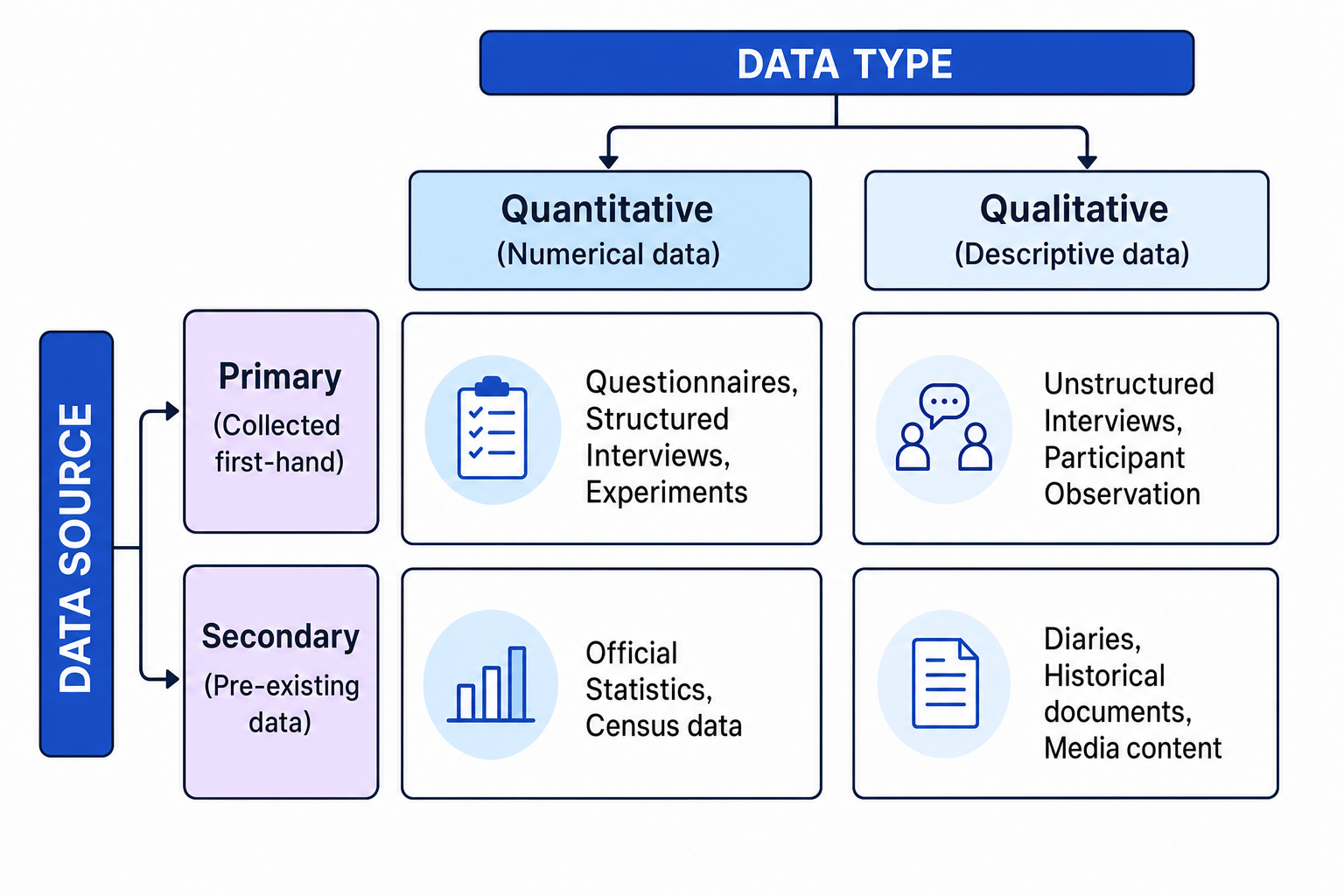
- The Source of the Data: Is it Primary (collected first-hand) or Secondary (using pre-existing data)?
- The Nature of the Data: Is it Quantitative (numerical/statistical) or Qualitative (words, meanings, and descriptions)?
Primary vs. Secondary Data
Let's begin by defining the source of the data.
Primary Data
Primary data is information collected directly by the sociologist themselves for their own specific research purposes. The researcher is the original creator of the data.
Primary data collection allows the researcher to design a study that targets their exact research question. For example, if a sociologist wants to study the subcultural behaviours of contemporary UK drill music fans, they might conduct their own participant observations or interviews.
Evaluation of Primary Data
- Strengths (AO3):
- High Validity and Relevance: The researcher can tailor the questions or observation schedules to get exactly the information they need to answer their hypothesis.
- Up-to-Date: The data is current, reflecting contemporary social trends.
- Limitations (AO3):
- Practical Issues: It is highly time-consuming, expensive, and requires significant effort to recruit samples and design instruments from scratch.
- Access and Safety: It can be difficult to gain entry to certain social groups (e.g., criminal gangs or corporate elites) and may pose personal safety risks.
Secondary Data
Secondary data is information that already exists, having been collected or created by someone else for another purpose, which the sociologist then uses for their own analysis.
Secondary sources are vast. They can range from official government data like the Census or the Crime Survey for England and Wales (CSEW) to personal diaries, historical records, and media broadcasts.
Evaluation of Secondary Data
- Strengths (AO3):
- Highly Practical: It is incredibly cheap, fast, and easily accessible. Large-scale datasets (like the UK Census) would be virtually impossible for an individual researcher to fund or collect alone.
- Historical Comparison: It allows sociologists to study trends over time (diachronic analysis) by comparing historical documents with contemporary ones (e.g., studying changes in family representations over fifty years of media advertisements).
- Limitations (AO3):
- Lack of Fit: Since the data was collected by someone else for a different purpose, it may not perfectly match the sociologist's research question.
- Operationalisation Issues: The original collectors may have defined key concepts differently (e.g., how the government defined "unemployment" has changed over 30 times since 1979).
The Primary vs. Secondary Core Difference
The essential distinction is authorship and control. With primary data, the sociologist is in the driver's seat, deciding exactly how data is gathered. With secondary data, the sociologist is a passenger, relying on what others have already produced.
Quantitative vs. Qualitative Data
Now let's examine the nature and form of the data collected.
Quantitative Data
Quantitative data is information presented in numerical or statistical form. It measures "how much", "how many", or "how often", looking for patterns, correlations, and trends.
Quantitative data includes figures like the percentage of students achieving top grades at GCSE, the rate of recidivism (reoffending) among former prisoners, or closed-ended survey responses showing that 72%72\%72% of respondents agree with a statement.
Evaluation of Quantitative Data
- Strengths (AO3):
- High Reliability: Standardised methods (like closed-ended questionnaires) can be easily repeated by other researchers to check if they yield the exact same results.
- Representativeness and Generalisability: Because quantitative methods are easier to distribute on a massive scale, researchers can use large, representative samples to generalise findings to the wider population.
- Objectivity: Minimises the researcher’s personal bias, as data is collected in a structured, detached manner.
- Limitations (AO3):
- Low Validity: It provides a superficial "snapshot" of social life. It does not explain why people act the way they do, nor does it explore subjective meanings.
- Inflexible: Once a structured survey is designed and distributed, the researcher cannot adapt it if unexpected insights emerge.
Qualitative Data
Qualitative data is descriptive, non-numerical information, usually expressed in words, images, or actions. It seeks to capture the meanings, feelings, interpretations, and lived experiences of research participants.
Examples include transcriptions of unstructured interviews (e.g., Paul Willis’s (1977) Learning to Labour study of working-class "lads"), diary entries, or field notes from participant observation.
Evaluation of Qualitative Data
- Strengths (AO3):
- High Validity: It provides rich, deep, and detailed insights (what Clifford Geertz calls "thick description"). It allows researchers to capture the authentic voice of the participant.
- Flexibility: The researcher can follow up on unexpected answers, change the direction of the interview, and let the participant guide the focus.
- Verstehen (Empathy): It allows the researcher to put themselves in the shoes of the participant to understand their subjective reality (Max Weber’s concept of Verstehen).
- Limitations (AO3):
- Low Reliability: Because qualitative methods are highly interactive and unstructured, they are virtually impossible to replicate exactly.
- Low Representativeness: They are time-consuming to conduct, meaning sample sizes are usually very small (e.g., 10 to 20 individuals), making it impossible to generalise findings to the wider population.
- Subjectivity: The researcher's own values, interpretations, and relationship with the participant can easily bias the analysis.
Theoretical Perspectives: Positivism vs. Interpretivism
A student cannot fully master research methods without understanding how these data types align with sociological theory. Your choice of data is deeply tied to your epistemological position (how you believe knowledge should be constructed).
Positivists: The Search for Social Facts
Positivists (such as Auguste Comte and Émile Durkheim) believe that sociology should model itself on the natural sciences. They argue that society is an objective reality made up of "social facts" that exert influence over individuals.
- Data Preference: Quantitative data.
- Reasoning: They want to identify patterns, establish cause-and-effect relationships, and find correlations (for example, Durkheim's study of suicide rates across different European countries). They value reliability, objectivity, and representativeness.
Interpretivists: The Search for Meaning
Interpretivists (influenced by Max Weber) reject the idea that human beings can be studied like inanimate particles. They argue that individuals possess free will and construct their own social realities based on the meanings they attach to actions.
- Data Preference: Qualitative data.
- Reasoning: They argue that statistical patterns are social constructs, not objective facts. To understand human behaviour, we must uncover the subjective meanings behind it. They value validity, depth, and Verstehen.
The Camera Analogy
Think of quantitative data as a wide-angle drone photograph of a crowded football stadium. It shows you the overall layout, the size of the crowd, and general movements, but it cannot tell you how any individual fan is feeling. Qualitative data is like a zoom-lens video interview with a single fan in the stands. It captures their passion, their disappointment, and their voice, but it cannot tell you if their experience represents the entire stadium.
Methodological Decision-Making in Action
When designing a sociological study, researchers do not operate in a vacuum. They must weigh up Practical, Ethical, and Theoretical (PET) considerations to decide which combination of data sources and types is appropriate.
Let's walk through an example of how a sociologist systematically works through these choices.
Selecting a Methodological Strategy for Researching Domestic Abuse
Suppose a sociologist wants to investigate the prevalence and subjective experience of domestic abuse in the UK. They must choose between a quantitative-secondary approach (e.g., police statistics) and a qualitative-primary approach (e.g., semi-structured interviews in a women's refuge).
Here is how the sociologist evaluates the decision-making process:
- Evaluate the validity of secondary quantitative data: The researcher examines official police statistics on domestic violence. They quickly identify a massive "dark figure of crime" (unreported and unrecorded crime). Many victims do not report abuse due to fear, shame, or distrust of police. Thus, while quantitative and easy to access, these statistics lack validity and do not represent the true scale of the issue.
- Assess the ethical risks of primary qualitative data collection: The researcher considers conducting primary qualitative interviews. Because domestic abuse is a highly sensitive topic, the researcher must secure informed consent, guarantee absolute anonymity, and prepare for the risk of psychological distress (harm) to both the participant and themselves.
- Align the method with the theoretical objective: If the researcher’s goal is to understand the subjective meanings and coping mechanisms of survivors (an Interpretivist goal), they decide that a primary qualitative approach is theoretically necessary. The deep, empathetic insights (Verstehen) gained from face-to-face interviews outweigh the limitations of police statistics, despite the higher ethical and practical hurdles.
Confusing Primary/Secondary with Quantitative/Qualitative
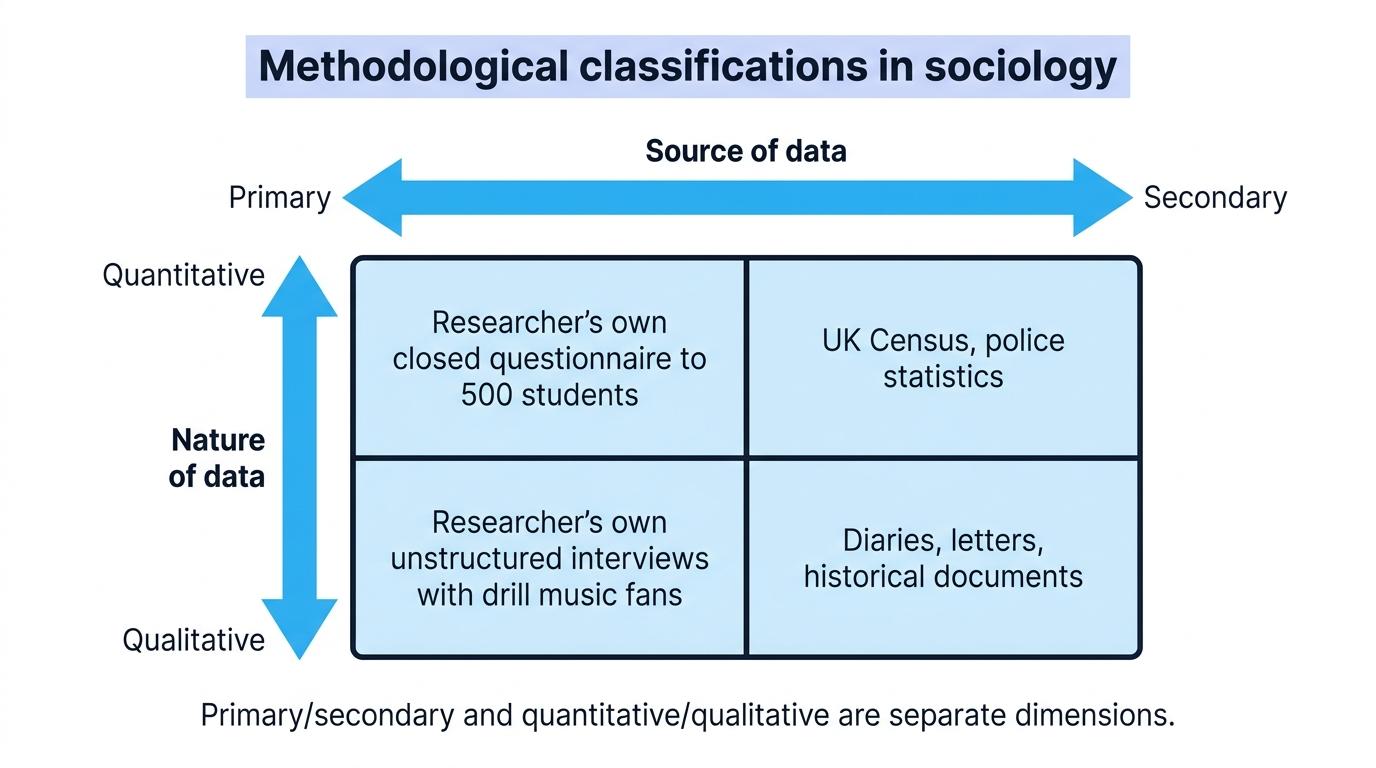
Do not treat "primary" as synonymous with "qualitative", or "secondary" as synonymous with "quantitative". This is a very common error. You can easily have primary quantitative data (e.g., a sociologist distributing their own closed-ended survey to 500 people) and secondary qualitative data (e.g., a sociologist reading Anne Frank's diary or analyzing historical letters). Use the 2x2 grid to keep these distinctions clear!
Triangulation and Mixed Methods
Many modern sociologists do not choose just one quadrant. Instead, they use triangulation—combining different methods and data types (e.g., using official statistics to find a general trend, then conducting qualitative interviews to understand the 'why' behind it). This helps validate findings and overcomes the weaknesses of using a single method.
In the exam
- Always use the PET framework: When evaluating any data type (e.g., primary qualitative data), structure your points around Practical, Ethical, and Theoretical issues. This ensures a comprehensive, balanced evaluation