What you'll learn
- How positivism and interpretivism see society differently.
- Why these perspectives tend to prefer different research methods.
- What Durkheim meant by social facts, and why they matter.
- How to evaluate these ideas in essays using AO1, AO2 and AO3.
Starting point: what is this debate really about?
In Theory and Methods, sociologists are not just asking “Which method should we use?” They are also asking deeper questions:
- What is society made of?
- Can social life be studied scientifically?
- Are people mainly shaped by social forces, or by the meanings they create?
- What counts as good evidence?
These questions link directly to the two core AQA themes:
- Socialisation, culture and identity: are our identities shaped by external social forces, or built through interaction?
- Social differentiation, power and stratification: can we measure inequality as an objective pattern, or must we understand how people experience it?
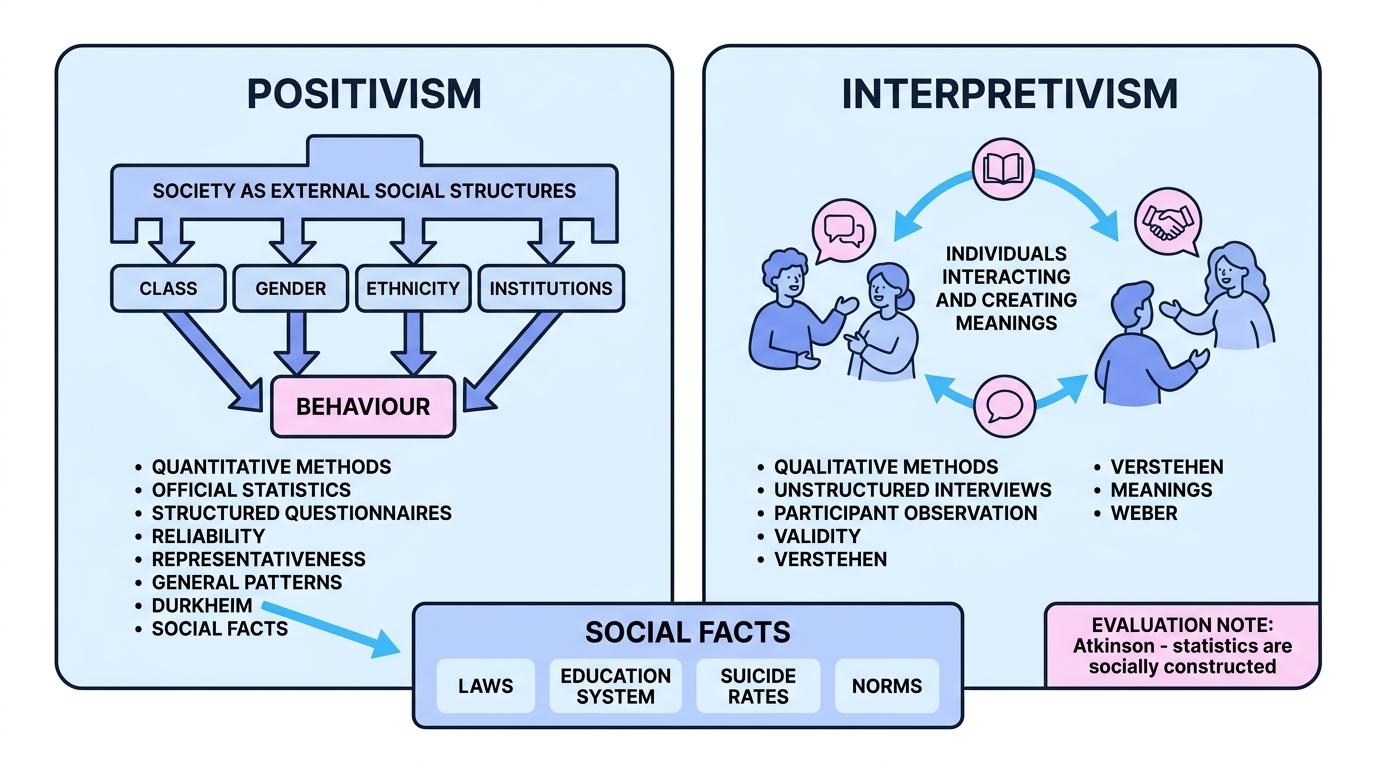
The diagram below gives you the big picture: positivists usually look for measurable patterns, while interpretivists usually look for meanings and lived experience.
Positivism
Positivism
Positivism is the view that sociology should study society using methods similar to the natural sciences, looking for observable facts, patterns, causes and general laws.
Positivists argue that society exists outside individuals and shapes their behaviour. For example, your chances of educational success, employment, health or offending may be patterned by class, gender, ethnicity and age.
This approach is linked with Auguste Comte, who argued that sociology should become a scientific study of society, and Émile Durkheim, who tried to show that even something as personal as suicide could be explained by social causes.
Positivist methods
Positivists tend to prefer quantitative methods, which produce numerical data. These include:
- Official statistics, such as Census data, ONS statistics, school results or crime rates.
- Structured questionnaires, where everyone answers the same questions.
- Structured interviews, where questions are standardised.
- Experiments, where variables are controlled to test cause and effect.
Reliability
Reliability means that a method can be repeated and is likely to produce similar results again.
Representativeness
Representativeness means that the people studied reflect the wider population, allowing cautious generalisations.
For positivists, strong research often has high reliability and representativeness. For example, a large-scale survey of thousands of UK households can reveal patterns in income, health or family structure.
Positivist view of society
Positivists usually see social behaviour as patterned, measurable and shaped by forces beyond individual choice.
Choosing a positivist method
A researcher wants to study whether social class affects university entry in the UK.
- The researcher identifies a measurable relationship: social class background may affect university entry rates.
- They choose quantitative data, such as UCAS admissions statistics, school attainment data or a structured survey of applicants, because these allow comparison across large groups.
- They look for patterns, such as whether pupils from professional middle-class backgrounds are more likely to enter higher-tariff universities than working-class pupils.
- They explain the pattern using social causes, such as differences in income, cultural capital, school resources or parental expectations.
Interpretivism
Interpretivism
Interpretivism is the view that sociology should understand the meanings, motives and interpretations that individuals give to their actions.
Interpretivists argue that society is not simply an external force acting on people. Instead, it is created and recreated through everyday interaction. People interpret situations, attach meanings to others’ actions, and act on the basis of those meanings.
This approach is linked with Max Weber, who argued that sociologists need verstehen.
Verstehen
Verstehen means empathetic understanding: trying to see the social world from the point of view of the people being studied.
Interpretivist methods
Interpretivists tend to prefer qualitative methods, which produce detailed, non-numerical data. These include:
- Participant observation, where the researcher joins or observes a group.
- Unstructured interviews, where participants can explain their views in depth.
- Semi-structured interviews, where there are guiding questions but flexibility.
- Personal documents, such as diaries, letters, blogs or social media posts.
Validity
Validity means that research gives a true, accurate or authentic picture of what it claims to study.
Interpretivists often argue that official statistics and questionnaires may measure surface behaviour but miss meanings. For example, school exclusion statistics may show which pupils are excluded, but interviews might reveal how pupils experience labelling, racism, poverty or conflict with teachers.
Interpretivist view of society
Interpretivists usually see social behaviour as meaningful, negotiated and best understood from the actor’s perspective.
Choosing an interpretivist method
A researcher wants to study why some pupils stop engaging with school.
- The researcher decides that disengagement cannot be understood only by counting absences, because pupils may have different motives and experiences.
- They choose unstructured interviews or participant observation to explore pupils’ meanings, such as feeling labelled, bored, unsupported or excluded from school culture.
- They analyse how interaction shapes identity, for example how repeated teacher criticism may lead a pupil to see themselves as “not academic”.
- They produce a deeper explanation of the process, rather than only a statistical pattern.
The relationship between theory and methods
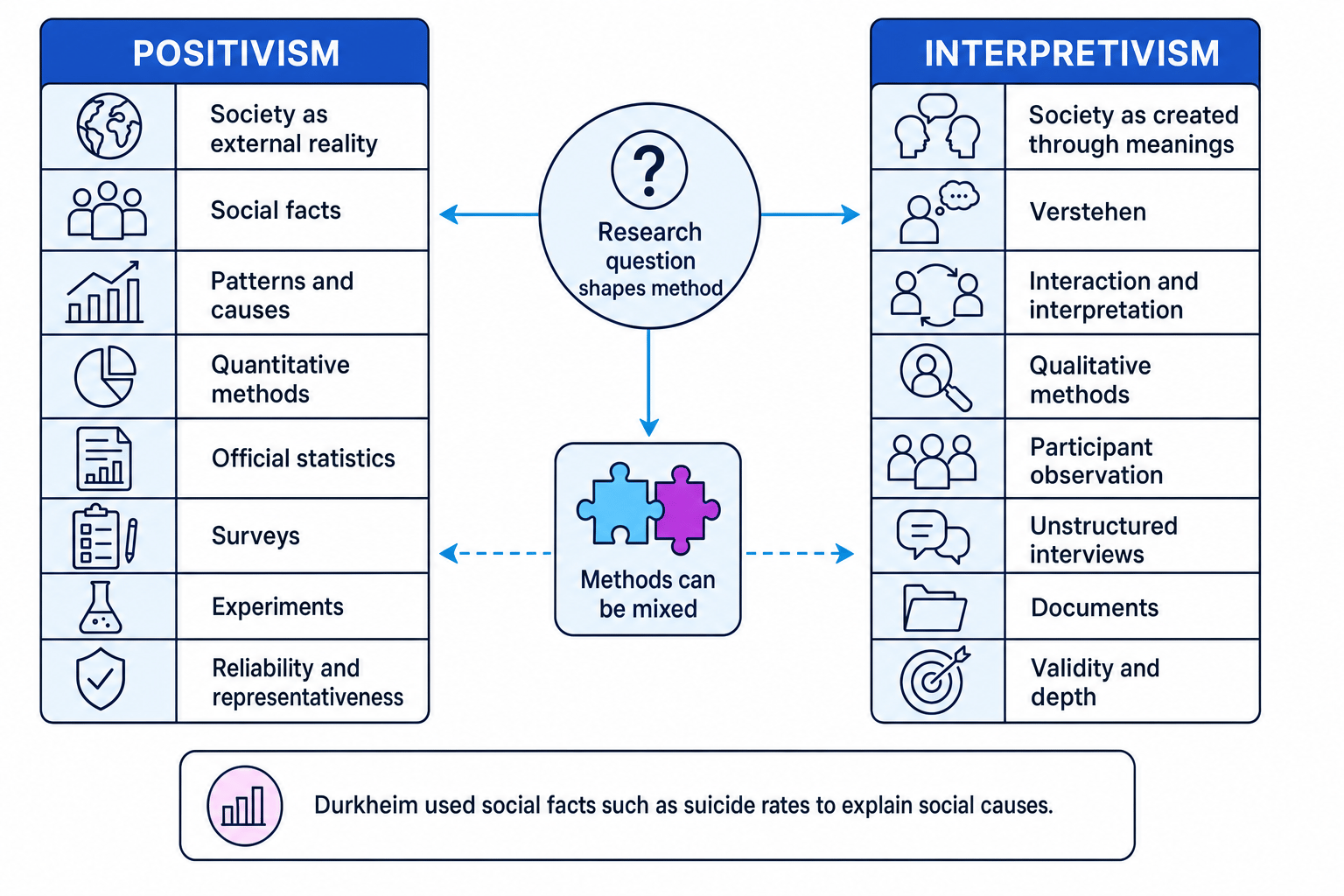
A sociologist’s theoretical perspective often influences their method choice, but it does not mechanically determine it.
Typical links
- Positivism links to quantitative methods, reliability, objectivity and generalisation.
- Interpretivism links to qualitative methods, validity, meanings and depth.
However, many sociologists use methodological pluralism.
Methodological pluralism
Methodological pluralism means using more than one method or type of data to study a topic.
For example, a study of domestic abuse could use police statistics to identify patterns, then interviews to understand survivors’ experiences and barriers to reporting. This can also be called triangulation, where researchers compare different sources of evidence to build a stronger picture.
Link theory to method carefully
Do not write “positivists only use questionnaires” or “interpretivists only use interviews”. Say they tend to prefer those methods because of their assumptions about society and evidence.
Social facts
Social facts
Social facts are social forces, patterns or institutions that exist outside individuals and constrain their behaviour.
Durkheim argued that sociology should study social facts as “things”. By this, he did not mean that society is literally a physical object. He meant that social facts should be treated as real, external and observable.
Examples of social facts include:
- Laws and rules.
- Education systems.
- Religious beliefs.
- Rates of marriage, divorce, birth or suicide.
- Norms about gender, family life or work.
- Class inequalities in health, income or education.
Social facts are important because they show how society shapes individuals. You may feel that your choices are personal, but Durkheim would ask how far those choices are structured by social forces.
Durkheim and suicide
Durkheim’s classic study Suicide (1897) is the key example. Suicide seems like a deeply individual act, but Durkheim examined suicide rates across societies and groups. He argued that variations in suicide rates could be explained by levels of social integration and social regulation.
Social integration and social regulation
Social integration means the strength of people’s bonds to groups and communities. Social regulation means the degree to which people’s behaviour is guided by norms, rules and expectations.
Durkheim identified different types of suicide, including:
- Egoistic suicide: linked to low integration, where people feel detached from society.
- Altruistic suicide: linked to excessive integration, where group demands override the individual.
- Anomic suicide: linked to low regulation, often during rapid social change or crisis.
- Fatalistic suicide: linked to excessive regulation, where people feel trapped by oppressive rules.
Applying social facts to suicide rates
Imagine official statistics show that one social group has a higher suicide rate than another.
- A positivist begins by treating the suicide rate as a social pattern, not just a collection of private decisions.
- They compare the groups’ levels of integration and regulation, such as family ties, religious community, employment stability or experiences of social disruption.
- They explain the difference using social causes: for instance, unemployment may reduce routine, status and belonging, increasing risk of anomic or egoistic suicide.
- They use the pattern to support the claim that social facts can constrain individual behaviour.
Evaluating positivism and social facts
Positivism has clear strengths. It can identify large-scale patterns that would be invisible from individual stories alone. For example, official statistics can show class inequalities in life expectancy, gender differences in pay, or ethnic disparities in stop and search. This is useful for policy because governments often need measurable evidence before allocating resources.
But there are important criticisms.
Interpretivist criticism
Interpretivists argue that positivists may ignore meanings. A suicide statistic may not simply “speak for itself”. Atkinson argued that suicide statistics are socially constructed because coroners interpret deaths before classifying them as suicide. This means official statistics may reflect social processes of labelling and decision-making, not just objective facts.
Treating statistics as automatically true
Official statistics can be useful, but they are not neutral mirrors of reality. Always ask how they were collected, defined and classified.
Practical and ethical issues
Quantitative methods can cover large samples, but they may be expensive, time-consuming and dependent on access to reliable sampling frames. Qualitative methods may give richer data, but smaller samples make generalisation harder.
Ethically, both approaches have challenges. Surveys must protect confidentiality, especially on sensitive topics like crime, poverty or mental health. Participant observation may raise issues of informed consent, deception and harm.
Power and inequality
Critical sociologists, including Marxists and feminists, may use positivist evidence to show structured inequality. For example, statistics on wealth inequality or violence against women can reveal patterns of power and stratification.
However, they may also argue that positivism can hide power if it treats social categories as natural. For instance, measuring “family type” without exploring gendered unpaid labour may miss how patriarchy operates inside households.
Evaluating interpretivism
Interpretivism is strong on validity because it explores lived experience. It is especially useful for studying identity, labelling, deviance, classroom interaction, religious belief or media audiences.
For example, Becker showed how deviance can be shaped by labelling, while Cicourel argued that official crime statistics are affected by police and probation officers’ interpretations.
However, interpretivist research may be criticised for being less reliable because it is harder to repeat exactly. Small samples may also make it difficult to know whether findings apply more widely.
Best evaluation point
The strongest answers do not simply say “positivism is better” or “interpretivism is better”. They explain that each approach is useful for different research aims.
Bringing it together
For A-Level essays, think of positivism and interpretivism as two different answers to the same big question: how should sociology produce knowledge about society?
- Positivists prioritise patterns, causes, reliability and generalisation.
- Interpretivists prioritise meanings, interaction, validity and depth.
- Durkheim’s social facts show the positivist belief that society can be studied as an external reality.
- Interpretivist critiques remind us that data, categories and actions are often shaped by interpretation.
In the exam
- Define key terms early: positivism, interpretivism, social facts, reliability and validity.
- Link theory to methods explicitly: explain why positivists favour quantitative methods and why interpretivists favour qualitative methods.
- Evaluate both sides using named thinkers, such as Durkheim, Weber, Atkinson, Becker or Cicourel, and apply them to contemporary UK examples.
Check yourself
- Why did Durkheim see suicide rates as evidence of social facts?
- How would a positivist and an interpretivist study educational inequality differently?
- Why might official statistics be useful but also socially constructed?