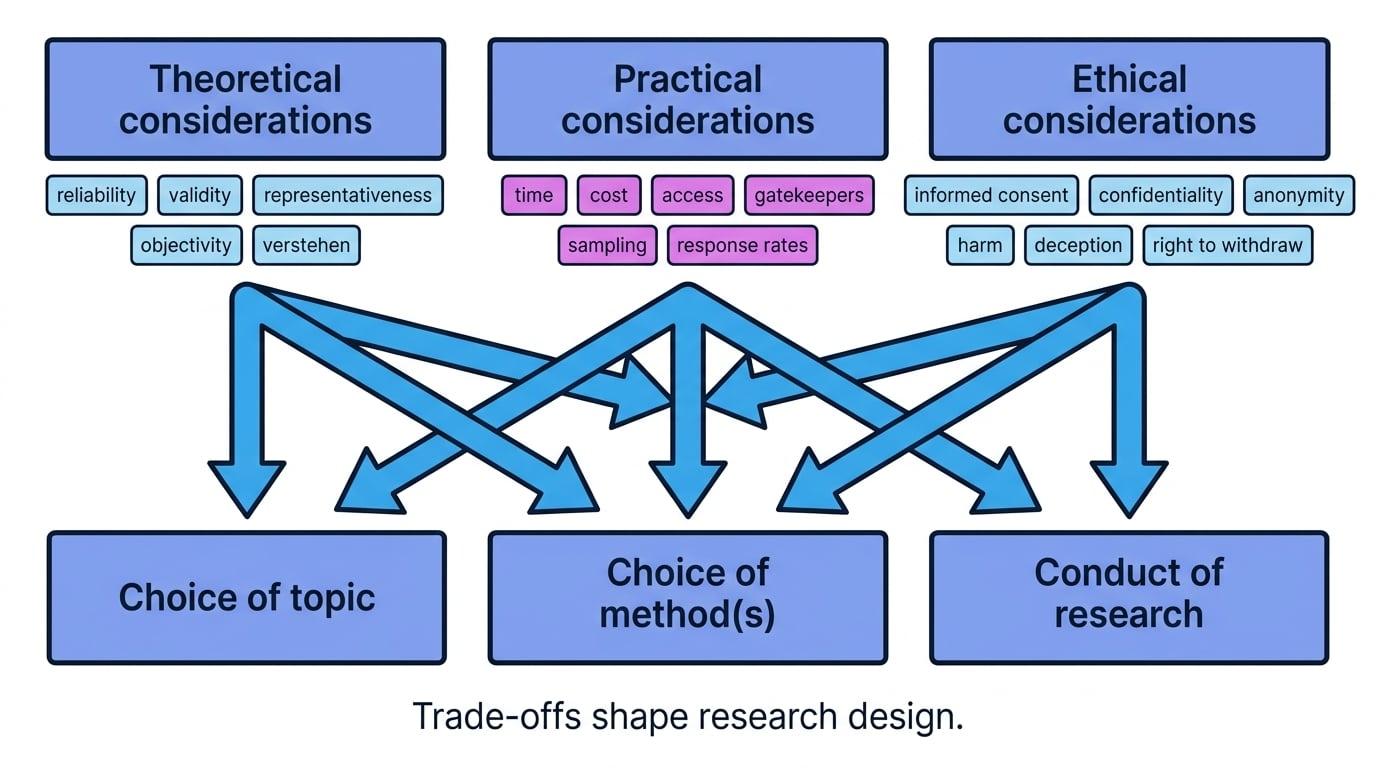
What you'll learn
- How theoretical, practical and ethical considerations shape sociological research.
- How these considerations affect the choice of topic, choice of method(s) and conduct of research.
- How to apply this to AQA essays using AO1 knowledge, AO2 examples and AO3 evaluation.
Start point: research is never just “pick a method”
Sociologists make choices at every stage: what to study, how to study it, who to include, how to behave in the field, and how to present findings. A useful framework is PET: Practical, Ethical and Theoretical considerations.
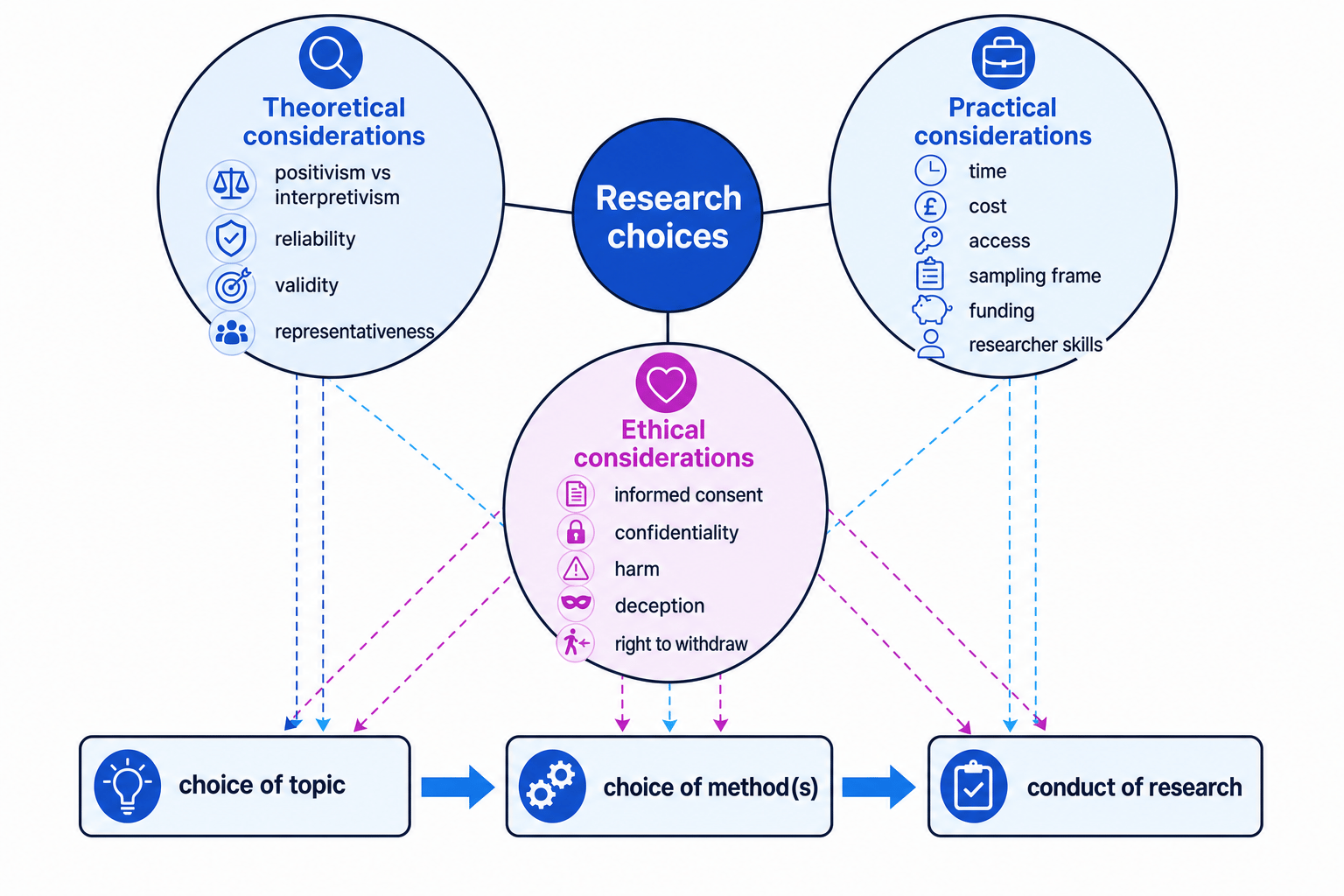
The PET framework
For any research design, ask: Is it theoretically suitable? Is it practically possible? Is it ethically acceptable? Strong answers explain the trade-off, not just a list of advantages and disadvantages.
The three main stages
Choice of topic
The choice of topic means deciding what social issue to investigate. This may be influenced by the researcher’s values, the theoretical perspective they follow, funding opportunities, current social problems, and whether the topic is ethically sensitive.
For example, a feminist sociologist might choose to study domestic abuse, workplace harassment or gendered unpaid labour because these reveal patriarchy — male power over women. A Marxist might focus on class inequality, poverty or exploitation because these show the power of capitalism.
Choice of method(s)
The choice of method means deciding how data will be collected. Methods include questionnaires, interviews, observations, experiments, official statistics and documents. Some research uses mixed methods, meaning more than one method, such as a survey followed by interviews.
Conduct of research
The conduct of research means how the research is carried out in practice: gaining consent, protecting participants, building rapport, recording data accurately, avoiding harm and reflecting on the researcher’s influence.
Reflexivity
Reflexivity means the researcher thinks critically about how their own identity, values and behaviour may affect the research process and findings.
Theoretical considerations: what counts as good sociology?
Theoretical considerations
Theoretical considerations are questions about what kind of data is sociologically valuable, how society should be studied, and what makes research reliable, valid or representative.
Positivism
Positivism is an approach that sees society as something that can be studied scientifically. Positivists often prefer quantitative data — numerical data — because it can reveal patterns, correlations and trends.
Durkheim’s study of suicide used official statistics to identify social patterns. A modern example would be using Census data, ONS deprivation indices or Crime Survey for England and Wales data to study social class, ethnicity or victimisation.
Positivists usually value:
- Reliability — whether the research can be repeated with similar results.
- Representativeness — whether the sample reflects the wider target population.
- Objectivity — whether the researcher avoids personal bias.
Interpretivism
Interpretivism is an approach that focuses on meanings, motives and interactions. Interpretivists often prefer qualitative data — detailed, non-numerical data — because it can capture how people understand their own lives.
For example, Willis’ study of working-class “lads” used qualitative methods to understand school culture, masculinity and resistance to authority. This links strongly to the core theme of socialisation, culture and identity.
Interpretivists usually value:
- Validity — whether the research captures what it claims to capture.
- Depth — whether the data reveals meanings and experiences.
- Verstehen — Weber’s term for empathetic understanding of social action.
Reliability, validity and representativeness
Reliability means consistency. Validity means truthfulness or accuracy in capturing the real meaning of what is being studied. Representativeness means the people studied are similar to the wider group the researcher wants to understand.
Matching a method to a theoretical aim
A sociologist wants to study how pupils experience teacher labelling and racism in a secondary school.
- If the aim is to understand pupils’ meanings and identities, the research needs valid, detailed data rather than just broad numerical patterns.
- A closed questionnaire could reach many pupils and be more reliable, but it may not capture subtle experiences such as feeling stereotyped or watched more closely.
- Semi-structured interviews would allow pupils to explain experiences in their own words, while classroom observation could show how interactions happen in practice.
- The best theoretical choice might be interviews plus observation, but the researcher should evaluate the trade-off: the findings may be less representative than a large survey.
Method equals theory
Do not write as if positivists only ever use questionnaires or interpretivists only ever use interviews. These are tendencies, not absolute rules. Good sociologists often combine methods.
Values and the choice of topic
Research topics are not chosen in a vacuum. Weber argued that values influence what researchers see as important, even if they should try to be objective when analysing evidence. Becker’s question “Whose side are we on?” highlights that sociology often investigates inequality and power.
This matters for social differentiation, power and stratification. Research on class, gender, ethnicity, disability or sexuality may challenge powerful groups by exposing inequality. For example, research on stop and search, exclusions or housing discrimination can make visible the experiences of marginalised communities.
AO3 angle
A strong evaluation point is that “objectivity” itself is debated. Positivists may see values as a threat to scientific research, while feminists and interactionists may argue that openly recognising values can make research more honest and valid.
Practical considerations: what can actually be done?
Practical considerations
Practical considerations are real-world limits on research, such as time, cost, access, funding, researcher skills, sample availability and response rates.
Time and cost
Large-scale surveys can be expensive, but they may produce representative data. Longitudinal research, which follows people over time, can be very valuable but takes years. By contrast, secondary data such as Census statistics may be cheaper and quicker, though it may not measure exactly what the sociologist wants.
Access and gatekeepers
Access means getting permission to study people or settings. Gatekeepers are people or organisations who control access, such as headteachers, prison governors, youth workers, parents or online moderators.
Schools, prisons, workplaces and gangs can be difficult to access because they involve authority, risk or reputational concerns. This affects what sociology can know: powerful institutions may be able to block uncomfortable research.
Sampling and response rates
A sampling frame is a list of people from which a sample can be selected. If no reliable list exists, random sampling becomes difficult. A low response rate can reduce representativeness because those who reply may differ from those who do not.
Assessing practical feasibility
A researcher wants to study the experiences of permanently excluded pupils.
- The target group is difficult to reach because excluded pupils are spread across pupil referral units, alternative provision, charities and home settings.
- A simple random sample is unlikely because there may be no accessible sampling frame and schools may be reluctant to share details.
- Interviews through youth charities or pupil referral units may be more practical, but gatekeepers could influence who is included.
- A mixed-method design could help: DfE exclusion statistics show wider patterns, while interviews explore pupils’ experiences. The researcher should still note limits to representativeness.
Listing without linking
Do not just write “time, money, access”. Link the practical issue to the research decision: because access to excluded pupils is difficult, the researcher may rely on gatekeepers, which affects sampling and validity.
Ethical considerations: what is acceptable?
Ethical considerations
Ethical considerations are moral and professional responsibilities to protect participants, avoid harm and conduct research honestly and safely.
Key ethical issues include:
- Informed consent — participants should understand the research and agree to take part.
- Confidentiality — personal information should not be shared in ways that identify participants.
- Anonymity — names and identifying details should be removed where possible.
- Harm — researchers should avoid physical, emotional, legal or social harm.
- Deception — misleading participants is usually problematic unless strongly justified.
- Right to withdraw — participants should be able to leave the research.
Ethics are especially important when studying children, victims of crime, domestic abuse survivors, mental health, illegal behaviour or online communities. In UK research, researchers also need to consider data protection and safeguarding responsibilities.
Covert research
Covert research means participants do not know they are being studied. It can improve validity because people may behave more naturally, but it raises serious ethical problems because participants cannot give informed consent.
Patrick’s study of a Glasgow gang is often used as an example of covert participant observation. It gave access to hidden behaviour, but it also involved deception and potential danger.
Deciding whether covert observation is justified
A sociologist wants to study misogynistic behaviour in an online forum.
- Overt research may change behaviour because users could hide extreme views once they know they are being studied.
- Covert observation might produce more valid data, but it creates ethical problems around consent, privacy and possible harm.
- The researcher could reduce risk by observing only public posts, anonymising usernames, avoiding interaction and not quoting searchable phrases directly.
- If the forum is private or includes vulnerable users, the ethical objections become stronger, so interviews, document analysis or approved digital methods may be more appropriate.
Ethics can override validity
A method may produce excellent data but still be unacceptable if it risks serious harm, breaches privacy or exploits vulnerable people.
Putting PET across the whole research process
| Stage | Theoretical considerations | Practical considerations | Ethical considerations |
|---|---|---|---|
| Choice of topic | Does the topic fit the researcher’s perspective, such as feminism, Marxism or interactionism? | Is there funding, access and available data? | Is the topic too sensitive or risky for participants? |
| Choice of method(s) | Is the method reliable, valid and representative? | Is it affordable, realistic and manageable? | Can consent, confidentiality and safety be protected? |
| Conduct of research | Is the researcher collecting data in a way that fits the aim? | Are recordings, sampling and fieldwork working in practice? | Is consent ongoing, data secure and harm minimised? |
Mixed methods and triangulation
Triangulation means using more than one method or data source to check findings and build a fuller picture. It is useful because PET considerations often conflict.
For example, a study of social class and educational achievement might use official statistics to show patterns in attainment, then interviews to explore pupils’ identities, teacher expectations and cultural capital. This combines breadth with depth.
No perfect method
Every method involves trade-offs. Official statistics may be reliable and representative but lack validity. Interviews may be valid and detailed but less representative. Evaluation means explaining these tensions.
In the exam
- Use PET as your organising structure: theoretical, practical and ethical.
- Always link the consideration to a research decision: topic, method or conduct.
- Apply your answer to the context, such as schools, crime, families, online media or inequality.
- Evaluate trade-offs: reliability versus validity, access versus representativeness, validity versus ethics.
- Use named ideas where relevant, such as Durkheim, Weber, Becker, Willis or Patrick.
Check yourself
- How might a positivist and an interpretivist choose different methods for the same topic?
- Why can gatekeepers affect both practical access and representativeness?
- When might covert observation produce valid data but still be ethically unacceptable?