What you'll learn
- How to distinguish consensus theories from conflict theories.
- How to distinguish structural theories from social action theories.
- How key theorists such as Durkheim, Parsons, Marx, Weber, Becker and Goffman fit into these debates.
- How to use these theories in essays for AO1 knowledge, AO2 application and AO3 evaluation.
Why this topic matters
In A-Level Sociology, theory is your toolkit. Different theories give different answers to big questions:
- Why does society hold together?
- Why is there inequality?
- Are people shaped by society, or do they actively create society through their choices?
- Can official statistics and surveys reveal social reality, or do we need to understand meanings and interactions?
These debates cut across the two core themes of AQA Sociology: socialisation, culture and identity, and social differentiation, power and stratification.
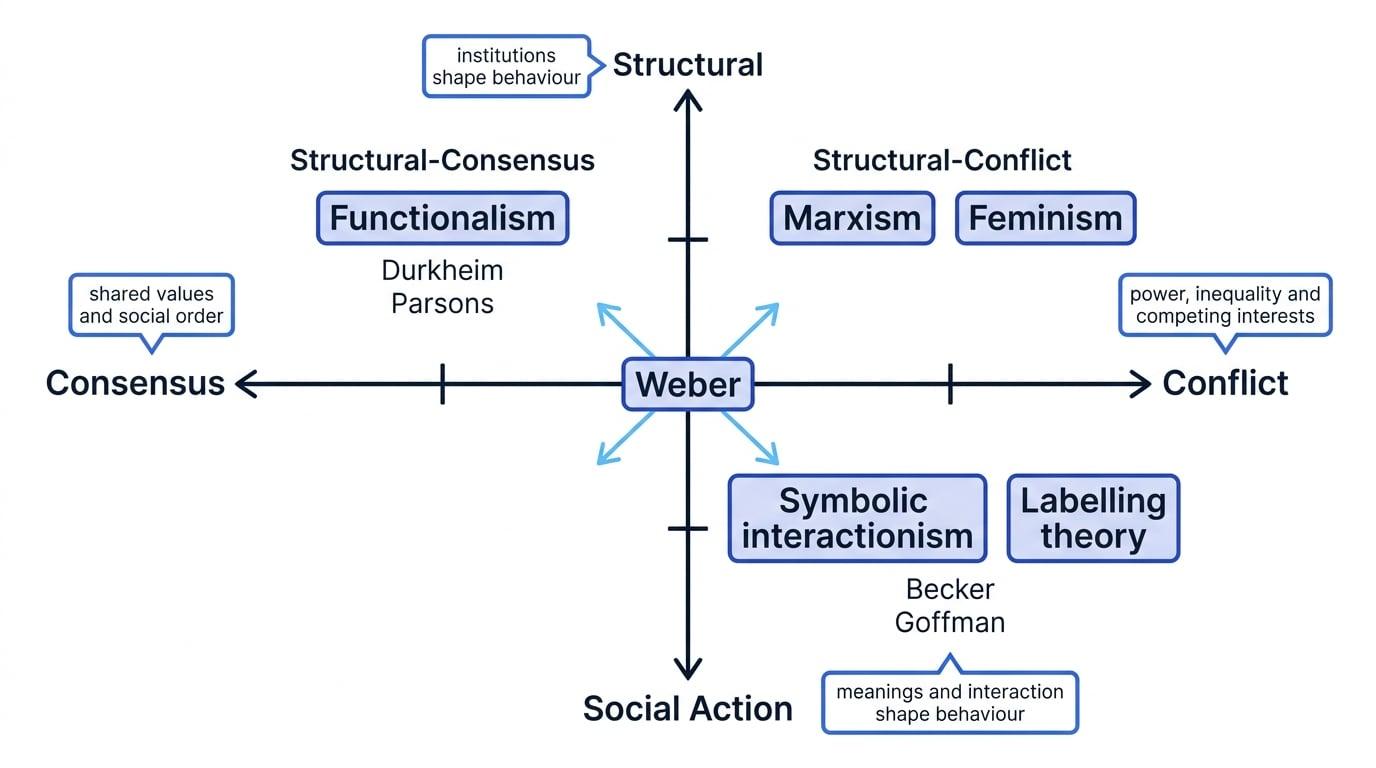
The two big axes: consensus/conflict and structure/action
Consensus versus conflict
Consensus theory
A consensus theory argues that society is held together by shared norms, values and beliefs. It tends to see social institutions as contributing to social order and stability.
Functionalism is the main consensus theory. It asks: How does this institution help society function?
Conflict theory
A conflict theory argues that society is shaped by inequality, power struggles and competing interests between groups such as classes, genders or ethnic groups.
Marxism and feminism are major conflict theories. They ask: Who benefits from this social arrangement, and who is disadvantaged?
Structural versus social action
Structural theory
A structural theory explains behaviour mainly through large-scale social structures, such as the economy, education system, family, religion, law and the media.
Structural theories are usually macro theories, meaning they focus on society as a whole.
Social action theory
A social action theory explains society by looking at how individuals create meanings, interpret situations and act in everyday interactions.
Social action theories are usually micro theories, meaning they focus on small-scale interactions.
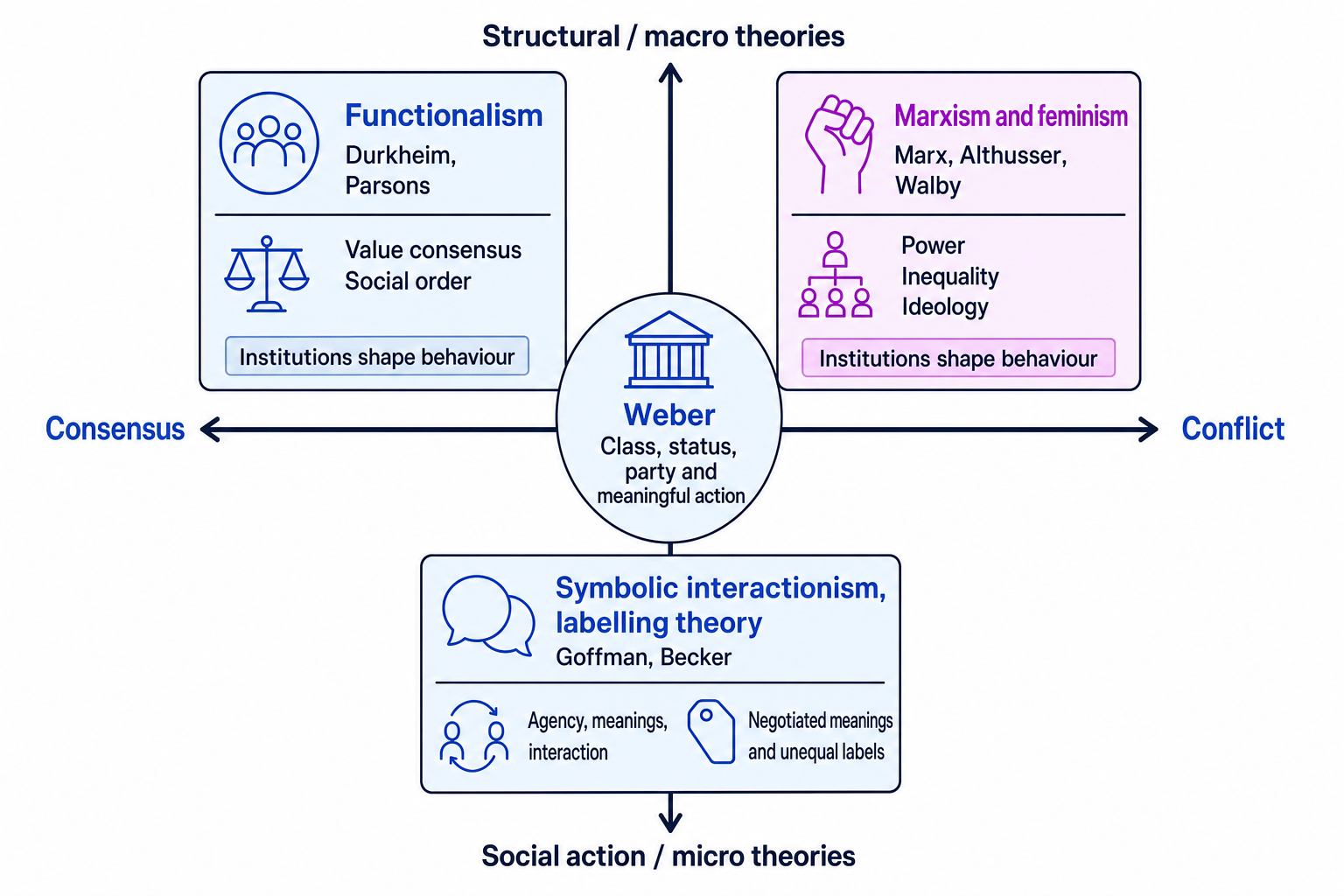
Here is the key map you should keep in your head:
The main contrast
Structural theories start with society shaping individuals. Social action theories start with individuals creating social meanings. Consensus theories stress shared values. Conflict theories stress power and inequality.
Classifying a sociological theory
Suppose you are given a theory that says schools teach shared values, encourage social solidarity and prepare young people for adult roles.
- The theory focuses on institutions, especially education, shaping individuals. That makes it mainly structural.
- It emphasises shared values and social order rather than exploitation or inequality. That makes it a consensus theory.
- Therefore, the theory is best classified as functionalism, especially the work of Durkheim and Parsons.
Functionalism: structural consensus theory
Functionalism sees society as like a system with interconnected parts. Institutions such as the family, education, religion and the law perform functions for society.
Durkheim argued that society needs social solidarity, meaning a sense of belonging and shared moral commitment. Parsons developed this by arguing that institutions socialise individuals into a value consensus, a shared agreement about right and wrong.
Key functionalist ideas
- Socialisation: the process of learning society’s norms and values.
- Value consensus: shared beliefs that bind society together.
- Social order: stability created when people broadly accept society’s rules.
- Meritocracy: the idea that rewards are based on talent and effort.
Applying functionalism
In the UK, functionalists might argue that schools promote social solidarity through assemblies, citizenship education, uniforms, rules and national curriculum content. The legal system may be seen as reinforcing shared norms by punishing behaviour defined as criminal.
For the theme of culture and identity, functionalism shows how people learn shared identities, such as being a pupil, worker, citizen or family member.
Evaluating functionalism
Functionalism is useful because it explains why social institutions often appear stable and why many people do follow social rules. However, it can be criticised for being too optimistic. It may ignore social differentiation, power and stratification, such as class inequality, patriarchy and racism.
Treating consensus as saying everyone agrees
Consensus theories do not claim every single person agrees with every rule. They argue that society depends on a broad level of shared values. In evaluation, you can argue that this broad agreement may be weaker than functionalists suggest.
Marxism: structural conflict theory
Marxism is a conflict theory based on the work of Karl Marx. It argues that capitalist society is divided between the bourgeoisie, who own the means of production, and the proletariat, who sell their labour.
Capitalism
Capitalism is an economic system where production is organised for profit and businesses are privately owned.
Marxists argue that institutions such as education, media, religion and the state help maintain class inequality. The base is the economic system, while the superstructure includes institutions and ideas that support it.
Althusser argued that schools and media act as ideological state apparatuses, meaning they spread ideas that make capitalism seem normal and fair.
Applying Marxism
A Marxist might analyse private schools, unpaid internships or elite university access as ways that middle- and upper-class advantage is reproduced. They may also argue that media coverage of poverty sometimes blames individuals rather than examining low wages, housing costs and insecure work.
Evaluating Marxism
Marxism is powerful for analysing wealth inequality and class power. For example, the UK has persistent gaps in income, housing, health and educational outcomes.
However, critics argue that traditional Marxism can be economically deterministic, meaning it explains too much through capitalism. Feminists argue it may underplay gender inequality, while Weberians argue class is not the only source of power.
Feminism: structural conflict theory
Feminism focuses on patriarchy, meaning male dominance in society. Feminists examine how institutions such as family, work, education, religion and media can reproduce gender inequality.
Walby identified different structures of patriarchy, including paid work, household production, culture, sexuality, violence and the state.
Applying feminism
In contemporary UK society, feminism can be applied to the gender pay gap, unequal domestic labour, sexual harassment, media representations of women and debates about violence against women and girls.
For culture and identity, feminism asks how gender identities are socially constructed through toys, school subject choices, peer pressure and media images. For power and stratification, it examines how gender shapes access to income, safety, authority and status.
Evaluating feminism
Feminism is strong because it highlights inequalities ignored by functionalism and some Marxism. However, there are internal debates. Liberal feminists focus on equal rights and legal reform, while radical feminists focus on patriarchy as a deep system of male power. Intersectional feminists argue gender must be studied alongside class, ethnicity, sexuality, age and disability.
Use intersectionality for stronger evaluation
When evaluating feminism, avoid writing as if all women have the same experience. An intersectional answer considers how gender combines with class, ethnicity and other inequalities.
Weber: a bridge between structure and action
Max Weber is often used as a bridge between structural and social action approaches.
Weber agreed that class matters, but he argued that inequality has several dimensions:
- Class: economic position.
- Status: social honour or prestige.
- Party: political power and organisation.
Weber also argued that sociologists must understand meaningful social action. People do not simply react mechanically to structures; they interpret the world and act according to meanings, beliefs and motives.
Applying Weber
A Weberian analysis of UK inequality might compare income with status. For example, a celebrity influencer may have high status and income, while a care worker may perform socially essential work but receive lower pay and status. Weber helps you see that stratification is not only about ownership of capital.
Symbolic interactionism and labelling theory: social action approaches
Symbolic interactionism focuses on everyday interaction. It argues that people act based on meanings, and those meanings are created and negotiated through social life.
Goffman studied how people manage impressions in everyday situations. He suggested that social life is like a performance, where individuals present themselves differently depending on the audience.
Becker developed labelling theory, arguing that deviance is not simply about the act itself but about how others react to it. A person becomes “deviant” when powerful groups successfully label them that way.
Labelling
Labelling is the process by which people or groups are defined in particular ways, such as “bright”, “troublemaker”, “criminal” or “respectable”, often affecting how they are treated and how they see themselves.
Applying social action theory
In education, a teacher may label a pupil as “able” or “disruptive”. This can affect the pupil’s self-concept, teacher expectations and future behaviour. In crime and deviance, police stop-and-search practices can be analysed through labelling theory if certain groups are more likely to be treated as suspicious.
Applying labelling theory to school behaviour
A pupil is repeatedly described by teachers as “not academic” and is often removed from lessons.
- Labelling theory would focus on the interaction between teachers and the pupil, rather than assuming the pupil’s behaviour has one fixed meaning.
- The label “not academic” may shape teacher expectations, leading to less encouragement, lower sets or more punishment.
- The pupil may internalise the label and develop a changed self-concept, possibly becoming less engaged with school.
- This may create a self-fulfilling prophecy, where the original label helps produce the behaviour it claimed to describe.
Evaluating social action theories
Social action theories are strong on validity, because they explore meanings and lived experiences. They fit well with qualitative methods such as interviews, observations and ethnography.
However, they can be criticised for underplaying wider structures. A pupil’s school experience is shaped not only by labels but also by class background, school funding, housing, racism, gender expectations and government policy.
Theory and methods link
Theories often connect to different research methods.
Structural theories, especially functionalism and some Marxism, often fit with positivism. Positivists favour scientific methods, patterns, causality, reliability and quantitative data such as official statistics.
Social action theories often fit with interpretivism. Interpretivists favour understanding meanings, motives and experiences, often through qualitative methods.
Conflict theories may also question official statistics. For example, Marxists and feminists may ask whether statistics reflect the interests and definitions of powerful groups.
Methodological evaluation
- Practical issues: large surveys can show broad patterns, but they can be expensive and may miss hidden experiences.
- Ethical issues: research on deviance, inequality or identity needs confidentiality and care to avoid harm.
- Theoretical issues: quantitative data may be reliable but lack validity; qualitative data may be valid but less representative.
Theory shapes method
A sociologist’s theory affects what they study, what counts as evidence, and how they interpret data. Methods are never completely separate from theory.
Comparing the theories in essays
A strong essay does not just list theories. It compares them.
For example, if asked about education:
- A functionalist may argue schools integrate pupils into shared values.
- A Marxist may argue schools reproduce class inequality.
- A feminist may argue schools reproduce or challenge gender identities.
- An interactionist may analyse teacher labelling and pupil identity.
For AO3, you can evaluate by asking:
- Does the theory overstate social order or conflict?
- Does it give enough attention to agency?
- Is it still relevant to contemporary UK society?
- What evidence supports or challenges it?
- What methods would best test or explore its claims?
In the exam
- Define your key terms early: for example, consensus, conflict, structure and agency.
- Use named theorists precisely, such as Durkheim for social solidarity, Parsons for value consensus, Marx for class conflict, Weber for multidimensional stratification, and Becker for labelling.
- Build AO3 by comparing perspectives directly: “Unlike functionalists, Marxists argue…” or “However, interactionists would criticise structural theories for…”
- Apply theories to concrete UK examples, such as education, policing, welfare, media, gender pay, social class or family life.
- Link theory to methods where possible: positivism, interpretivism, reliability, validity, representativeness and the use of official statistics.
Check yourself
- What is the difference between a consensus theory and a conflict theory?
- Why are functionalism and Marxism both structural theories, even though they disagree strongly?
- How would labelling theory explain a pupil becoming defined as “deviant” or “low ability”?