What you'll learn
- How social stratification creates unequal life chances: opportunities for education, work, health, housing and security.
- How class, gender, ethnicity and age shape both identity and access to power.
- Key sociological explanations, including Marxist, Weberian, feminist and interactionist ideas.
- How to apply evidence and evaluate patterns without treating groups as all the same.
The basic idea: difference is not automatically inequality
Sociologists study how societies sort people into categories. Some differences are fairly neutral: people may have different tastes in music, accents or hobbies. But some differences become tied to resources, status and power. That is when differentiation becomes stratification.
Differentiation and stratification
- Social differentiation means the process by which people are distinguished from one another through social categories such as class, gender, ethnicity and age.
- Social stratification means the ranking of individuals or groups into a hierarchy, where some have more wealth, status and power than others.
- Life chances, a term associated with Weber, means the opportunities people have to obtain valued things such as good health, education, income, safety and housing.
A key point for A-Level essays is that stratification is not just about money. It also affects how people are seen, labelled, respected, listened to and controlled.
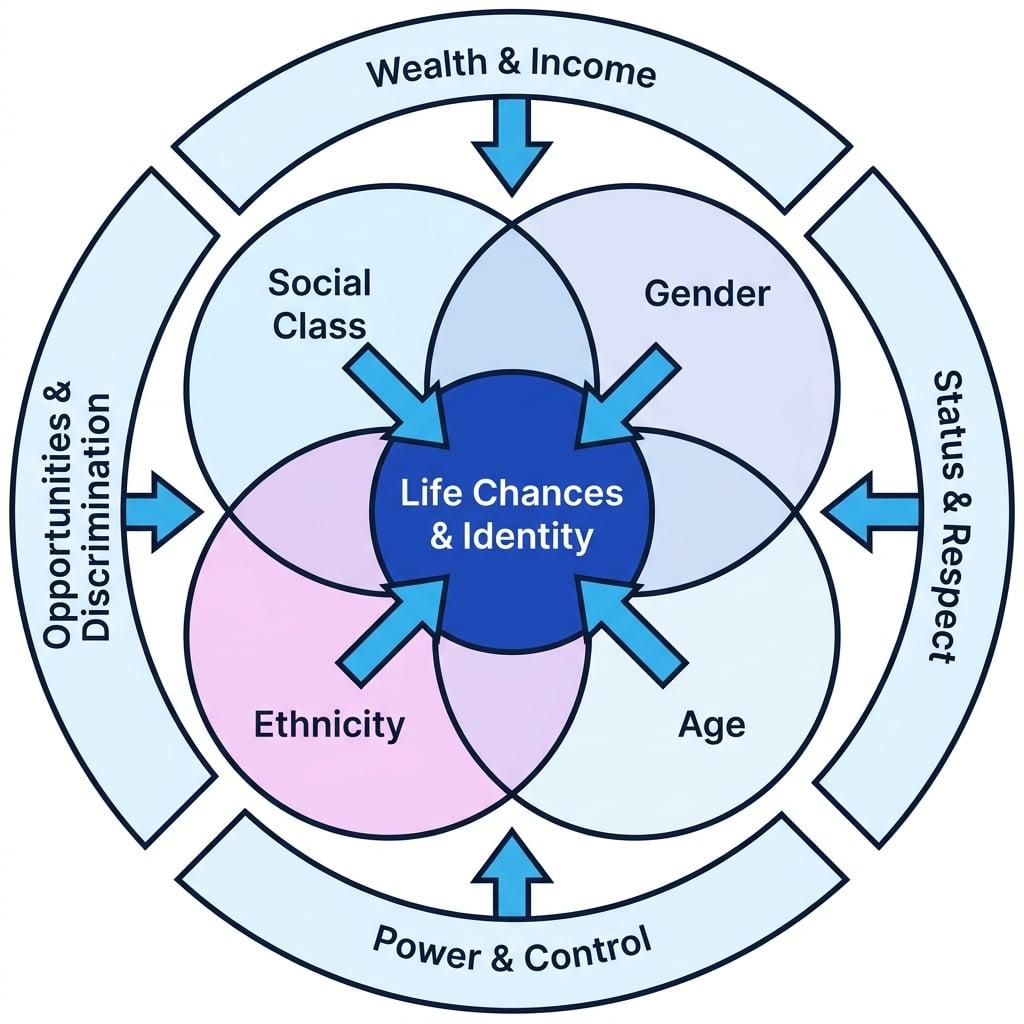
The diagram below shows how the four dimensions in this topic combine to shape life chances and identity.
Four dimensions, one system
Class, gender, ethnicity and age should be analysed separately and together. In real life, people experience them at the same time.
Social class: work, wealth and culture
Social class
Social class refers to a person’s position in the economic hierarchy, often linked to occupation, income, wealth, education and lifestyle.
Marx saw class as based on the relationship to the means of production: the factories, land, businesses and technology used to produce goods and services. For Marx, capitalist society is divided mainly between the bourgeoisie, who own the means of production, and the proletariat, who sell their labour. This creates exploitation because workers produce profit that owners control.
Weber agreed that economic position matters, but he argued that stratification has three dimensions: class or market situation, status or social honour, and party or political power. This is useful because someone may have high status but not huge wealth, or wealth but low social respect.
Functionalists such as Davis and Moore argue that inequality can be beneficial because it motivates people to train for important roles. In this view, stratification is linked to meritocracy, where rewards are based on talent and effort. However, Tumin criticises this because unequal starting points mean society may waste talent from poorer backgrounds.
Bourdieu adds that class is reproduced through different forms of capital. Economic capital means money and assets. Cultural capital means valued knowledge, tastes, language and qualifications. Social capital means useful networks and contacts. This helps explain why class advantage can continue even when education appears open to everyone.
Applying class to the UK
In contemporary Britain, class affects housing, health, education and work. For example, middle-class families are more likely to have savings, stable housing, private tutoring, professional networks and access to high-performing schools. The Marmot Review links social inequality to health inequalities, showing that people in more deprived areas tend to have worse health outcomes and shorter life expectancy.
Savage et al.’s Great British Class Survey suggested that traditional class labels such as “working class” and “middle class” may be too simple, because wealth, culture and social networks create more complex class divisions.
Reducing class to income only
Do not write as if class is just how much someone earns. In sociology, class can include wealth, job security, education, cultural capital, housing and social networks.
Gender: social expectations and patriarchy
Sex and gender
Sex usually refers to biological characteristics, while gender refers to socially constructed expectations about masculinity and femininity.
Gender stratification means that men and women, and people who do not fit conventional gender categories, often have unequal access to resources, status and power.
Feminists argue that society is shaped by patriarchy, meaning male dominance. Walby identifies several structures of patriarchy, including paid work, household labour, culture, sexuality, violence and the state. Oakley shows how gender roles are learned through gender socialisation, such as manipulation, canalisation, verbal appellations and different activities.
Liberal feminists focus on legal and policy reform, such as equal pay law, anti-discrimination law and educational opportunities. Radical feminists emphasise deep-rooted male power, especially in sexuality, violence and family life. Marxist feminists connect women’s oppression to capitalism, arguing that unpaid domestic labour supports the workforce at low cost.
Connell’s concept of hegemonic masculinity is useful because gender stratification does not only affect women. Some forms of masculinity are rewarded more than others, while men who do not fit dominant masculine ideals may be marginalised.
Applying gender to the UK
Gender inequality can be seen in the gender pay gap, the under-representation of women in some senior roles, unequal unpaid care work and the risks of domestic abuse. At the same time, girls often outperform boys in many areas of education, so gender patterns are not one-directional.
AO3 evaluation matters here: legal equality has improved significantly, but informal cultural expectations and workplace practices can still reproduce inequality. Also, gender intersects with class, ethnicity, disability and age, so “women” and “men” are not uniform groups.
Ethnicity: identity, racism and social closure
Ethnicity
Ethnicity refers to shared cultural identity, ancestry, language, religion, history or traditions. It is socially constructed, meaning its meanings are created and changed by society.
Ethnicity is not the same as biological “race”. Sociologists usually treat “race” as a social construct: a category society creates and attaches meaning to, often through racism.
Racism and social closure
Racism means prejudice, discrimination or unequal power based on racialised ideas. Social closure, associated with Weberian sociology, means groups protecting advantages by excluding others from opportunities.
Ethnic stratification can operate through labour markets, education, policing, housing, media representation and politics. For example, discrimination may affect job applications, while stereotypes may shape teacher expectations or policing practices.
Hall et al. argued that media and political responses to “mugging” in the 1970s helped construct Black youth as a threat, linking ethnicity to moral panic and social control. Modood’s work on ethnicity highlights that minority ethnic groups do not all experience the same outcomes; there are differences by class, religion, migration history, gender and generation.
Applying ethnicity to the UK
The 2021 Census shows Britain is ethnically diverse, especially in large urban areas. ONS data and other official statistics can reveal inequalities in employment, housing, health and criminal justice. However, patterns vary between groups. For example, it is not accurate to make one claim about “ethnic minorities” as if all groups have the same experiences.
Use precise language
In essays, avoid vague phrases like “ethnic people”. Everyone has an ethnicity. Use terms such as “minority ethnic groups”, “racialised groups”, or name the specific group if the evidence does.
Age: the life course and unequal power
Age stratification
Age stratification means inequality linked to age groups and stages of the life course, such as childhood, youth, adulthood and old age.
Age seems natural, but sociologists argue that age categories are partly socially constructed. Aries argued that childhood has changed historically; children were not always seen as needing the same protection, schooling and innocence associated with modern childhood.
Age shapes power. Children and young people are often controlled by adults through families, schools and the law. Older people may face ageism, meaning stereotyping or discrimination based on age. At the same time, older people may also have advantages, such as pensions, housing wealth or political influence, depending on class and generation.
Phillipson links old age to capitalism, arguing that retirement can push older people out of paid work and reduce their status. Hockey and James suggest that childhood and old age can both involve dependency and surveillance, although in different ways.
Applying age to the UK
Age stratification appears in debates about student debt, insecure youth employment, housing affordability, pensions, social care and NHS pressures. Younger adults may struggle to buy homes, while some older adults face loneliness, poverty or inadequate care. The key is to avoid stereotypes: “older people” and “young people” are internally divided by class, gender, ethnicity and health.
Intersectionality: putting the dimensions together
Intersectionality
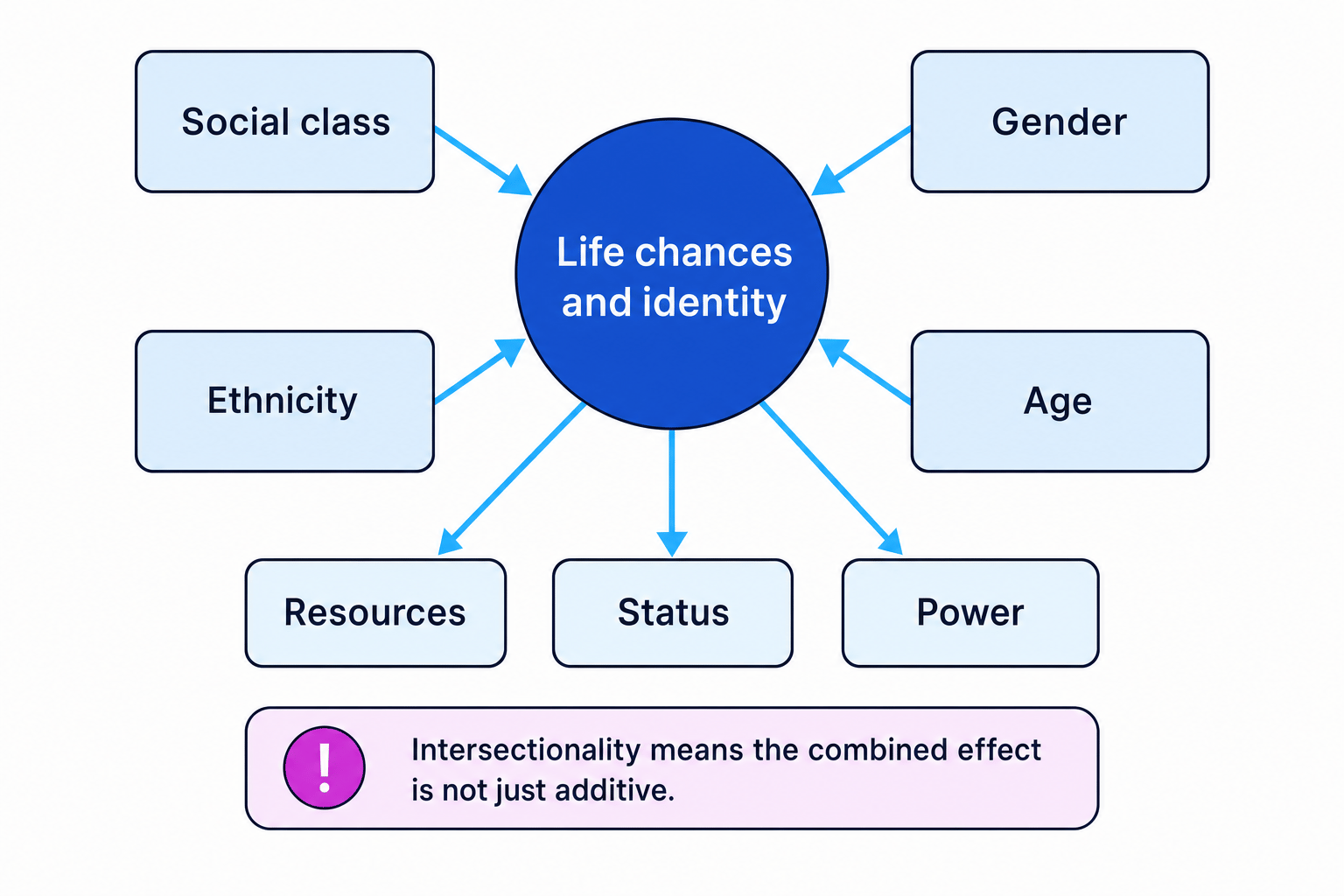
Intersectionality, associated with Crenshaw, means that different forms of inequality combine and interact, rather than simply adding together separately.
For example, a working-class woman from a minority ethnic background may experience class inequality, sexism and racism in ways that shape each other. Her experience is not just “class plus gender plus ethnicity”; the combination may create specific barriers and identities.
Applying intersectionality
A source describes a 55-year-old Black Caribbean woman working part-time in social care, renting privately and caring for grandchildren.
-
Identify the class dimension: part-time low-paid care work and private renting may reduce economic security, savings and housing stability.
-
Add the gender and age dimensions: caring for grandchildren may reflect gendered expectations around unpaid care, while being 55 may affect promotion chances, retraining opportunities or health.
-
Add the ethnicity dimension carefully: she may face racialised stereotypes or discrimination in employment and services, but you should not assume all Black Caribbean women have the same experience.
-
Build the analysis: her life chances are shaped by the interaction of labour market position, caring responsibilities, age and racism, not by one factor alone.
-
Evaluate: she may also have agency, family support, trade union protection or access to welfare policies, so stratification increases constraints but does not fully determine outcomes.
Using evidence carefully
Sociologists use official statistics, surveys, interviews, ethnographies and documents to study stratification. Official statistics, such as Census and ONS data, are often large-scale and useful for identifying patterns. This supports reliability and representativeness.
However, statistics may hide meanings and experiences. Interpretivists argue that qualitative methods can reveal how people understand identity, stigma, respect and exclusion. For example, interviews may show how class shame, racism or ageism feels in everyday life.
Methodological evaluation is important. Practical issues include access, cost and whether a good sampling frame exists. Ethical issues include confidentiality, informed consent and avoiding harm when researching discrimination or poverty. Theoretical issues include whether the research prioritises reliability, often linked to positivism, or validity, often linked to interpretivism.
Groups are not fixed boxes
Class, gender, ethnicity and age categories are socially meaningful, but they are not perfectly fixed or internally identical. Always allow for diversity within groups.
Bringing it together for essays
A strong essay does three things. First, it explains the pattern of inequality using sociological concepts. Second, it applies the pattern to real examples from contemporary UK society. Third, it evaluates by comparing perspectives, questioning evidence and recognising intersectionality.
In the exam
-
Define the key dimension clearly: class, gender, ethnicity or age, then link it to life chances, identity, power or status.
-
Use named theory: for example, Marx or Weber for class, Walby or Oakley for gender, Hall or Modood for ethnicity, Aries or Phillipson for age.
-
Apply to a concrete UK example, such as education, pay, housing, health, policing, pensions or social care.
-
Evaluate by adding complexity: legal change, social mobility, diversity within groups, intersectionality, or methodological limits of the evidence.
Check yourself
- What is the difference between social differentiation and social stratification?
- How would a Weberian explanation of class differ from a Marxist one?
- Why is intersectionality useful when analysing gender, ethnicity, class and age?