What you'll learn
- How media organisations select, construct and present content rather than simply reflecting reality.
- How different audience theories explain the relationship between media messages and audience responses.
- How class, gender, ethnicity, age and power shape the way media content is produced and interpreted.
- How to evaluate media-effects arguments using contemporary UK examples and named sociologists.
The basic relationship: media, content, presentation and audiences
The media are not just “things we watch”. In sociology, the media include organisations, technologies and platforms that produce and circulate messages: TV, newspapers, radio, film, advertising, social media, streaming services, podcasts and online news.
Media content and presentation
Media content means the actual messages, images, stories, sounds and information carried by the media. Presentation means how that content is organised and shown: headlines, camera angles, editing, tone, layout, algorithms, music, captions, image choice and ordering.
An audience is the group of people who receive, consume or interact with media content. However, audiences are not all the same. A teenager scrolling TikTok, a pensioner reading the Daily Mail, and a commuter listening to BBC Radio 4 may respond very differently to the same story.
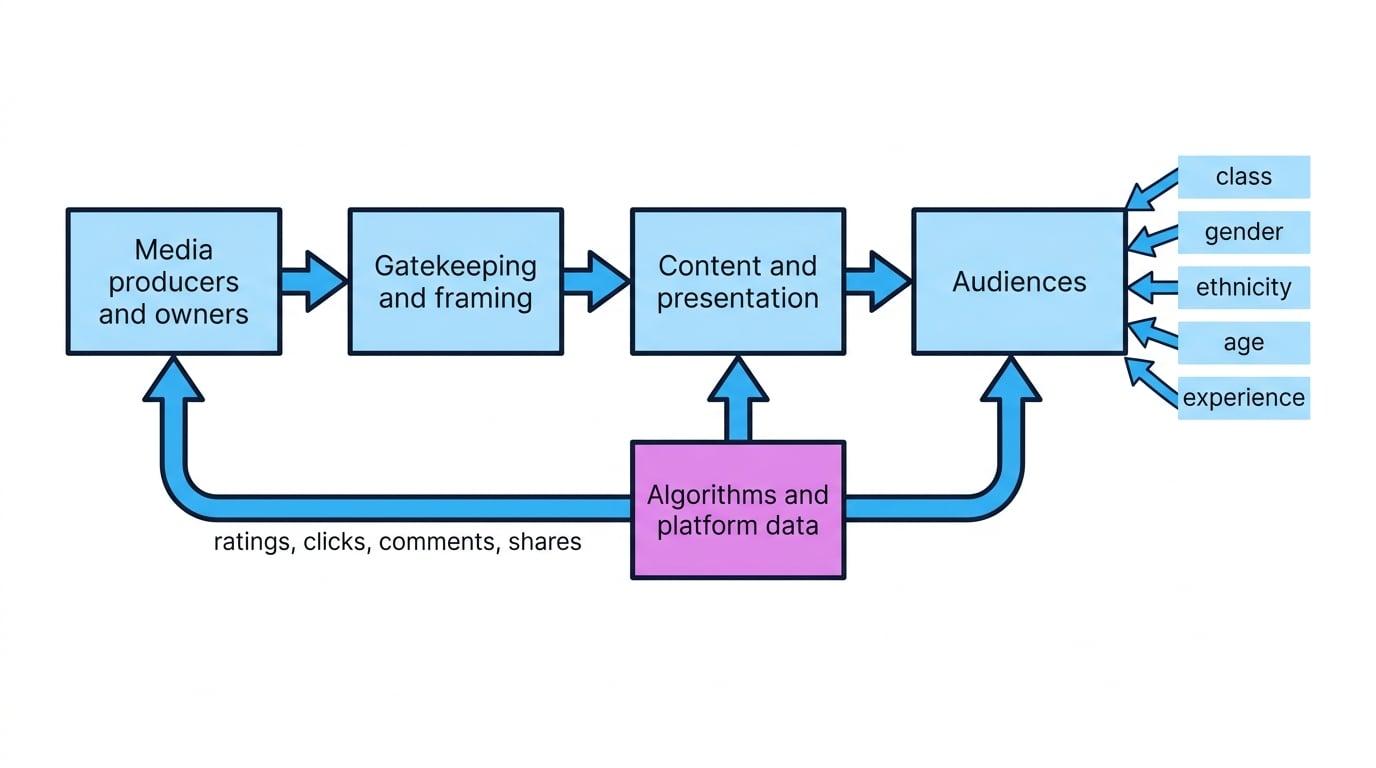
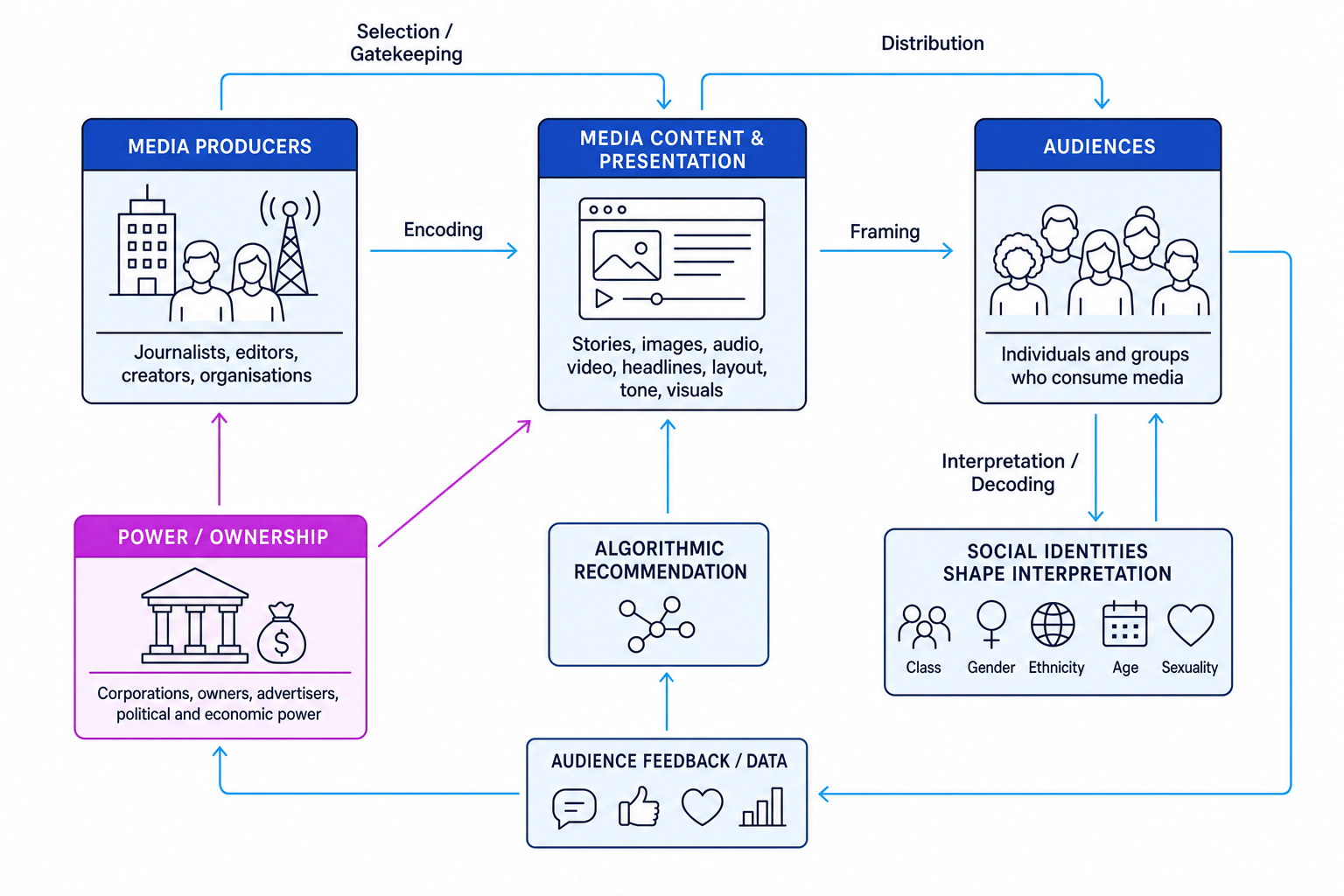
This relationship is best understood as a loop: producers create content, audiences interpret it, and audience reactions feed back into future content through ratings, clicks, comments, shares and data.
The media do not simply mirror reality
Media content is selected, framed and presented. Audiences then interpret it through their own social identities and experiences. This makes the relationship between media and audiences active, contested and shaped by power.
Selection, gatekeeping and framing
Media organisations cannot show everything. They must select what counts as news, entertainment or “interesting” content.
Gatekeeping
Gatekeeping is the process by which journalists, editors, producers, platform moderators or algorithms decide what content is included, excluded or prioritised.
For traditional news, this might involve editors choosing which stories appear on the front page. For social media, algorithms act as gatekeepers by deciding which posts appear in your feed.
The content is then framed.
Framing
Framing means presenting an issue in a particular way so that audiences are encouraged to interpret it through a specific angle, problem or moral judgement.
For example, a news report about people crossing the Channel might frame them as “desperate refugees”, “illegal migrants”, “victims of trafficking” or “a threat to border security”. The basic event may be similar, but the presentation encourages different meanings.
Applying framing to a news story
Imagine two headlines about the same public-sector strike:
- Compare the wording. “Nurses demand fair pay after years of pressure” frames workers as deserving and under strain. “Militant unions hold patients to ransom” frames workers as unreasonable and harmful.
- Identify what each frame highlights. The first highlights low pay, care work and pressure on the NHS. The second highlights disruption, conflict and possible danger to patients.
- Link to audience interpretation. Audiences may support or oppose the strike partly because the presentation encourages them to see the workers either as exploited employees or as selfish troublemakers.
- Add sociological analysis. A conflict perspective would ask who benefits from this framing: workers, government, employers, media owners or political parties.
Passive audience theories: media as powerful
Some theories see audiences as relatively passive. This means audiences are seen as likely to absorb media messages without much resistance.
Passive audience
A passive audience is an audience assumed to receive and accept media messages with little critical interpretation.
The hypodermic syringe model
The hypodermic syringe model suggests media messages are “injected” directly into audiences, producing immediate effects. It is often linked to early concerns about propaganda, advertising and media violence.
For example, some debates about violent video games assume that exposure to violent content directly causes violent behaviour.
However, this model is widely criticised because it treats audiences as too easily manipulated. It ignores social background, prior beliefs, family, education, peer groups and individual interpretation.
Do not overuse the hypodermic syringe model
It is useful as a starting point, but it is too simplistic for most A-level essays. Strong answers usually contrast it with active audience theories such as uses and gratifications, two-step flow or Hall’s encoding/decoding model.
Cultivation theory
Gerbner’s cultivation theory argues that repeated long-term exposure to media content can gradually shape people’s view of reality. The effect is not instant, but cumulative.
For example, if crime dramas and news reports constantly show urban areas as dangerous, audiences may develop a “mean world syndrome”, where they overestimate the risk of crime.
This links to socialisation, because the media can teach norms, values and expectations. It also links to power, because repeated representations may normalise stereotypes about class, ethnicity, gender or age.
Active audience theories: audiences interpret and choose
Active audience theories argue that people do not simply absorb media messages. They select, interpret, reject, share and remix content.
Active audience
An active audience is an audience that interprets media content, makes choices about what to consume, and may resist or reshape media meanings.
Uses and gratifications
Blumler and Katz argue that audiences use media to satisfy needs. Common gratifications include:
- Diversion: entertainment and escape.
- Personal relationships: feeling connected to characters, celebrities or online communities.
- Personal identity: finding models for who you are or want to be.
- Surveillance: gaining information about the world.
AO2 example: a student may use TikTok for diversion, BBC News for surveillance, Netflix dramas for identity, and group chats for relationships. The same person can use different media for different purposes.
AO3 evaluation: uses and gratifications is stronger than the hypodermic syringe model because it recognises choice. However, it may exaggerate freedom. Algorithms, advertising, subscription costs, digital literacy and unequal access still shape what audiences can choose.
Two-step flow
Katz and Lazarsfeld’s two-step flow model argues that media messages often reach audiences through opinion leaders.
Opinion leader
An opinion leader is someone whose views influence others’ interpretations of media content, such as a celebrity, journalist, influencer, teacher, parent, religious leader or politically engaged friend.
This is especially relevant today. A political speech might be watched by relatively few people directly, but clips and reactions from influencers, journalists and commentators spread widely on X, TikTok, Instagram and YouTube.
Using the two-step flow model
A government announces a new policy on immigration.
- Start with the original media message. The policy is reported through news articles, TV interviews and government social media posts.
- Identify opinion leaders. Political journalists, campaign groups, MPs, influencers and community leaders interpret the policy for their followers.
- Explain the audience effect. Many people may form their view less from the original announcement and more from trusted commentators who simplify, criticise or support it.
- Evaluate the model. Two-step flow fits digital media well, but it may now be more like a “multi-step flow” because messages move through many networks, not just one clear leader.
Hall: encoding and decoding
Stuart Hall’s encoding/decoding model is one of the most useful theories for this topic.
Encoding and decoding
Encoding is when media producers build preferred meanings into content. Decoding is when audiences interpret those meanings.
Hall argued that producers often create a preferred reading: the meaning they want audiences to take. However, audiences may decode the message in different ways:
- A dominant reading accepts the preferred meaning.
- A negotiated reading partly accepts it but adapts it to personal experience.
- An oppositional reading rejects the preferred meaning and interprets the content critically.
Applying Hall’s decoding model
A luxury car advert presents the car as a symbol of success, freedom and status.
- Identify the preferred reading. The advert encourages the audience to see buying the car as a sign of achievement and personal identity.
- Apply a dominant reading. A viewer may accept the message and think the car represents aspiration and success.
- Apply a negotiated reading. Another viewer may like the car but think it is unrealistic because of the cost of living.
- Apply an oppositional reading. A third viewer may reject the advert as consumerist, environmentally irresponsible or aimed at wealthy elites.
- Link to social differentiation. Class position, age, environmental values and income can all shape how the audience decodes the same content.
Hall is useful because he avoids both extremes: the media are not all-powerful, but audiences are not completely free either. Meanings are shaped by the power of producers and by the social position of audiences.
Morley and audience diversity
David Morley’s study of audiences watching the BBC programme Nationwide found that social class and occupation influenced interpretation, but not mechanically.
For example, managers were more likely to accept the programme’s dominant assumptions, while some trade union groups were more critical. However, people in the same class position did not always interpret content identically.
This is important for AO3: sociology should avoid assuming that “all working-class audiences think X” or “all women read media in the same way”. Social identities intersect.
Use intersectionality carefully
When analysing audiences, consider how class, gender, ethnicity, age, sexuality, religion and disability may combine. A young Muslim woman, an older white middle-class man and a working-class Black teenager may all decode the same news report differently.
Media content, identity and representation
Media content helps construct identity. It can offer role models, lifestyles and categories through which people understand themselves.
This links directly to the core theme of socialisation, culture and identity. Media can teach people what is seen as normal, desirable, deviant, masculine, feminine, British, successful or risky.
It also links to social differentiation, power and stratification. Groups with more power often have more ability to define how others are represented.
Examples include:
- Gendered advertising that links women to beauty and care work, and men to strength or technology.
- News reports that overrepresent young working-class men as threatening.
- Streaming platforms offering more diverse representations of sexuality and ethnicity than older broadcast media.
- Reality TV presenting poverty as individual failure rather than linking it to structural inequality.
Marxist approaches argue that media content often supports dominant ideology by making capitalism, consumerism and inequality appear normal. Feminist approaches focus on patriarchy, objectification and gender stereotypes. Postcolonial approaches, influenced by writers such as Said, examine how “Western” media may construct non-Western groups as backward, dangerous or exotic.
Pluralists disagree. They argue that media content is diverse because audiences are diverse. If audiences dislike content, they can switch platform, boycott, complain or create alternatives.
Digital media: from audiences to users and producers
In digital media, the boundary between producer and audience is blurred. People do not just consume content; they comment, share, livestream, review, remix and create.
Prosumer
A prosumer is someone who is both a producer and consumer of media content.
For example, a teenager who watches makeup tutorials and then posts their own reviews is a prosumer. A football fan who reacts to match clips on YouTube is also helping circulate and interpret content.
However, digital participation does not automatically mean equal power. Large platforms such as Meta, Google, TikTok and X control algorithms, moderation systems and advertising models. Audience activity creates valuable data, which can be sold to advertisers or used to target content.
Digital audiences are active but tracked
Online audiences have more opportunities to respond and create content, but their activity is also measured, monetised and shaped by algorithms.
Evaluating the relationship overall
A strong A-level answer should avoid choosing only one model. The best approach is to compare theories.
Passive models are useful for showing that media can influence beliefs, especially through repeated exposure, emotional imagery and unequal power. But they underestimate audience interpretation.
Active models are useful for showing choice, identity and resistance. But they can underestimate structural power: ownership, platform algorithms, advertising, state regulation and unequal access to cultural capital.
Hall’s model is often the most balanced because it shows both media power and audience agency. Producers encode preferred meanings, but audiences may negotiate or oppose them.
In the exam
- Define the relationship clearly: media content is selected and presented; audiences interpret it through social identities and experiences.
- Use contrasting theories: compare passive effects, uses and gratifications, two-step flow, and Hall’s encoding/decoding model.
- Apply to real examples: use UK news, social media algorithms, advertising, streaming, moral panics or representation of class, gender and ethnicity.
- Evaluate throughout: ask whether the theory overstates media power, overstates audience freedom, or ignores ownership, algorithms and inequality.
Check yourself
- How is “presentation” different from “content” in media sociology?
- Why does Hall’s encoding/decoding model offer a more balanced view than the hypodermic syringe model?
- How might class, gender or ethnicity affect the way an audience interprets the same news story?