What you'll learn
- How sociologists distinguish class, status and power as dimensions of inequality.
- What life-chances are, and why they vary by social class, gender, ethnicity, age and disability.
- How to apply UK examples such as education, employment, health, housing and official statistics.
- How to evaluate inequality arguments using theory, evidence and methods.
Starting point: inequality is structured
In everyday life, people differ in many ways: age, tastes, jobs, accents, family background, religion, health and identity. Sociology asks when these differences become social inequalities — patterned advantages and disadvantages between groups.
Social stratification
Social stratification means society is organised into layers or unequal positions, where some groups have more resources, status and power than others.
Social differentiation
Social differentiation means society separates people into categories, such as class, gender, ethnicity, age or disability. Differentiation is not automatically unequal, but it becomes inequality when some categories are rewarded, respected or protected more than others.
The two big AQA themes fit strongly here. Socialisation, culture and identity matter because people learn norms about “appropriate” gender roles, class tastes, ethnic identities, ageing and disability. Social differentiation, power and stratification matter because these identities are linked to unequal resources and opportunities.
Life-chances: the key idea
Life-chances
Life-chances are the probabilities people have of gaining valued things in society, such as good education, secure work, decent income, health, housing, safety and influence over decisions.
The concept is usually associated with Max Weber. Life-chances are not fixed destinies. They are probabilities. A working-class student can become a doctor; a middle-class student can become unemployed. But sociologists look at the pattern: some groups have better odds than others.
Life-chances are patterned, not guaranteed
A sociological answer should avoid saying “all women”, “all disabled people” or “all working-class people” experience the same outcomes. Instead, say that social divisions make some outcomes more or less likely.
Weber: class, status and power
Weber argued that inequality is multidimensional. It is not only about money. Three dimensions are especially useful.
Class
Class
Class refers to a person’s economic position, especially their relationship to work, wealth, income, property and the labour market.
For Marx, class is mainly about ownership: the bourgeoisie own the means of production, while the proletariat sell their labour. For Weber, class is broader: people’s market situation affects their life-chances, such as qualifications, skills, job security and income.
Status
Status
Status means social honour, prestige or respect. It is about how highly a person or group is regarded by others.
Status can overlap with class, but it is not identical. A celebrity may have high status without long-term economic security. Some low-paid caring roles may be socially praised but economically undervalued.
Power
Power
Power is the ability to achieve goals or influence others, even when there is resistance.
Weber also discussed party, meaning organised groups that try to influence decision-making, such as political parties, trade unions, pressure groups or professional associations.
A useful way to remember Weber is: class affects your resources, status affects your respect, and power affects your voice.
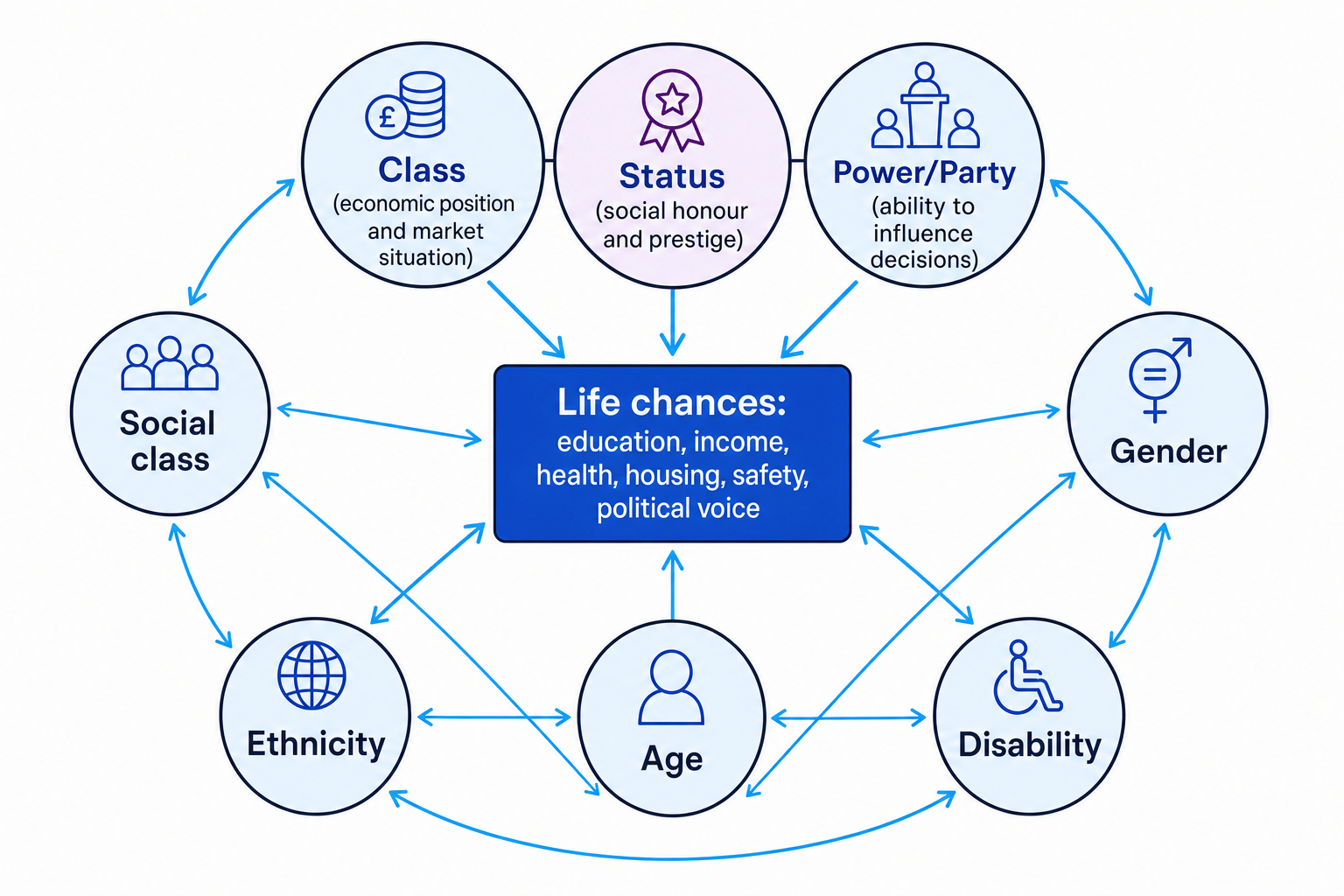
Applying class, status and power
Imagine two people: one is a low-paid care worker; the other is a well-paid investment banker.
- Compare class position: the banker has higher income, likely more savings and stronger labour-market rewards, so their class position gives stronger life-chances in housing, education choices and financial security.
- Compare status: the care worker may be morally valued as “essential”, especially after COVID-19, but this respect does not necessarily translate into pay or influence.
- Compare power: the banker may have more influence through professional networks, financial knowledge and access to decision-makers, while the care worker may rely more on trade unions or collective action.
- Reach a sociological judgement: Weber’s model shows why inequality is not just “who earns more”; it also involves prestige and the ability to shape decisions.
Reducing everything to income
Class matters, but do not treat inequality as only about wages. Exams reward answers that connect economic resources with status, power, identity and institutions.
Social class and life-chances
Social class affects life-chances through income, wealth, education, housing, health and social networks. In the UK, class is often measured using occupation, such as the National Statistics Socio-economic Classification used in official statistics.
Bourdieu adds that class advantage is reproduced through different forms of capital:
- Economic capital: money, property and assets.
- Cultural capital: valued knowledge, tastes, language, qualifications and confidence.
- Social capital: useful networks and contacts.
- Symbolic capital: prestige and recognition.
In education, middle-class parents may be better able to afford tutoring, laptops, quiet study space and access to high-performing schools. In health, the Marmot Review found a social gradient: people in more deprived areas tend to have worse health and shorter life expectancy.
AO3 evaluation: class remains powerful, but it does not work alone. Gender, ethnicity, age, disability and region can all reshape class experiences. Also, class categories based on occupation may miss wealth, debt, insecure work or unpaid caring.
Gender and life-chances
Gender
Gender refers to socially constructed expectations about masculinity and femininity. It is different from biological sex, although the two are often linked in everyday thinking.
Feminists argue that gender inequality is rooted in patriarchy, a system of male power and female subordination. Walby describes patriarchy as operating in several sites, including paid work, household labour, culture, sexuality, violence and the state.
Gender shapes life-chances through:
- Education: girls now often outperform boys in school attainment, but subject choices remain gendered.
- Work: women are more likely to do part-time work and unpaid caring, contributing to the gender pay gap.
- Family life: caring responsibilities still affect women’s career progression.
- Safety: women experience higher risks of domestic abuse and sexual harassment.
AO2 example: the Equality Act 2010 legally protects against sex discrimination, but legal equality does not automatically remove informal workplace cultures, childcare costs or gendered expectations.
AO3 evaluation: gender inequality has changed significantly. Women’s educational achievement and labour-market participation have increased. However, intersectional feminists argue that “women” are not one single group: class, ethnicity, age and disability shape women’s experiences differently.
Ethnicity and life-chances
Ethnicity
Ethnicity refers to shared cultural identity, often linked to ancestry, language, religion, nationality, traditions or collective history.
Ethnic inequalities may be caused by racism, discrimination, migration history, residential segregation, labour-market barriers and school processes such as labelling. Institutional racism means discriminatory outcomes are built into the routines or assumptions of organisations, even without openly racist individuals.
Life-chances vary between ethnic groups, so avoid overgeneralising. Some minority ethnic groups have high educational attainment, while others face higher poverty rates, unemployment or housing overcrowding. In criminal justice, stop-and-search data has repeatedly shown disproportionate policing of some minority ethnic groups.
AO3 evaluation: ethnicity is not a simple “variable”. Broad labels such as “Asian” or “Black” can hide major differences of class, religion, nationality, migration generation and gender. Official statistics are useful for patterns, but they can flatten complex identities.
Age and life-chances
Ageism
Ageism means stereotyping, prejudice or discrimination based on age.
Age affects life-chances across the life course, meaning the socially patterned stages people move through, such as childhood, youth, adulthood and old age.
Young people may face high housing costs, student debt, insecure work and difficulty entering well-paid careers. Older people may experience pensioner poverty, health problems, loneliness, age discrimination and barriers to digital services. At the same time, some older people have strong housing wealth and pension security, showing that age interacts with class.
Sociologists such as Phillipson link old-age inequality to capitalism, arguing that people may lose status when they leave paid work. Hockey and James discuss how older people can be treated as dependent or childlike, reducing their autonomy.
AO3 evaluation: be careful to separate age effects from cohort effects. An age effect is about being young or old now; a cohort effect is about belonging to a generation shaped by particular historical conditions, such as post-war housing expansion or the 2008 financial crisis.
Disability and life-chances
Social model of disability
The social model of disability, associated with writers such as Oliver, argues that people are disabled by social barriers, not simply by impairments. Barriers include inaccessible buildings, discrimination, inflexible workplaces and negative attitudes.
This contrasts with the medical model, which treats disability mainly as an individual physical or mental condition to be treated or managed.
Disability can affect life-chances through education access, employment discrimination, transport, income, housing design, healthcare and social participation. UK policies such as the Equality Act 2010 require reasonable adjustments, but disabled people may still face poverty, benefit assessments, inaccessible services and social stigma.
AO3 evaluation: the social model is powerful because it shifts attention from “fixing” individuals to changing society. However, some disabled writers also argue that pain, fatigue and impairment itself should not be ignored.
Intersectionality: inequalities overlap
Intersectionality
Intersectionality, associated with Crenshaw, means social divisions such as class, gender, ethnicity, age and disability overlap, producing experiences that cannot be understood by looking at one division alone.
For example, a middle-class disabled man, a working-class disabled woman and an older disabled migrant may all experience disability differently because their class position, gender, age and ethnicity shape access to resources and recognition.
Analysing overlapping inequalities
Consider a working-class Pakistani British woman with a disability applying for professional employment.
- Identify the relevant divisions: her life-chances may be shaped by class background, gender expectations, ethnicity, disability and possibly religion.
- Connect each division to a mechanism: class may affect networks and cultural capital; gender may affect caring expectations; ethnicity may affect employer discrimination; disability may require workplace adjustments.
- Avoid adding inequalities mechanically: do not simply say she is “four times disadvantaged”. Instead, explain how the divisions interact in a specific setting, such as recruitment.
- Make a balanced judgement: her outcome will also depend on qualifications, local labour markets, anti-discrimination law, employer practice and support networks.
A strong evaluation phrase
Use: “This division is important, but it is mediated by…” Then add class, gender, ethnicity, age, disability, region or policy.
Using evidence: official statistics and their limits
Inequality is often studied using official statistics, such as the Census, ONS labour-market data, health data, school attainment data and deprivation indices. These can show large-scale patterns and trends.
The Index of Multiple Deprivation is useful because it combines several dimensions, including income, employment, education, health, crime, housing barriers and living environment. This fits the idea that life-chances are multidimensional.
AO3 methodological evaluation:
- Strength: official statistics are large-scale and often representative, making patterns visible.
- Weakness: categories may be too broad, such as combining diverse ethnic groups.
- Weakness: statistics show correlation, not necessarily causation.
- Interpretivist critique: numbers may miss meanings, identity, stigma and lived experience.
- Positivist defence: reliable quantitative data helps compare groups and track change over time.
Confusing correlation with causation
If poorer health is associated with lower social class, that does not automatically prove class alone caused the health outcome. You need to consider housing, work conditions, diet, stress, environment, healthcare access and lifestyle.
Big theoretical debate
Functionalism
Functionalists such as Davis and Moore argue that inequality can motivate people to train for important roles. Higher rewards encourage effort and role allocation.
AO3: Tumin criticises this view because it ignores inherited advantage and discrimination. Some highly rewarded jobs may not be the most socially useful, while essential workers can be low paid.
Marxism
Marxists argue that class inequality is built into capitalism. The ruling class controls economic resources and uses ideology to make inequality appear natural or deserved.
AO3: Marxism strongly explains economic exploitation, but it can underplay gender, ethnicity, age and disability unless combined with other perspectives.
Weberian theory
Weberian theory is useful because it separates class, status and power. This helps explain why some groups may be economically successful but still face racism, sexism or low status.
AO3: Weber describes several dimensions well, but critics argue it may not fully explain how capitalist structures reproduce inequality.
Feminism and intersectional approaches
Feminists focus on patriarchy, gender socialisation, unpaid labour and violence against women. Intersectional approaches add that gender cannot be separated from class, ethnicity, age and disability.
AO3: this is strong for complexity, but exam answers must still stay focused. Do not list every possible inequality without explaining mechanisms.
In the exam
- Define the key dimension first: if the question says class, status, power or life-chances, give a clear definition before applying it.
- Use the AO1–AO2–AO3 rhythm: make a sociological point, apply it to a UK example, then evaluate it with another perspective or limitation.
- Avoid one-factor answers: show how class, gender, ethnicity, age and disability can interact, but keep returning to the exact wording of the question.
Check yourself
- How are class, status and power different in Weber’s theory?
- Why is it better to describe life-chances as probabilities rather than fixed outcomes?
- How might disability interact with class, gender or ethnicity to shape life-chances?
