Welcome to your study notes on Socialisation and the agencies of socialisation. This is a foundational topic in A-Level Sociology (Spec 4.2.1.2) under the Culture and Identity unit. Understanding this topic is crucial, as the concepts and theories you learn here will reappear across all your option modules, including Family, Education, Beliefs, and Crime and Deviance.
What you'll learn
- The difference between primary and secondary socialisation.
- How key agencies of socialisation (such as the family, education, and the media) transmit culture.
- How different sociological perspectives (Functionalism, Marxism, Feminism, and Interactionism) explain the socialisation process.
What is Socialisation?
To understand how we become members of society, we first need to distinguish between what is biological (nature) and what is learned (nurture).
Sociologists argue that humans are not born knowing how to behave, speak, or interact. We have to learn our culture—the shared values, beliefs, norms, and language of our society. This learning process is called socialisation.
Socialisation
Socialisation is the lifelong process through which individuals learn and internalise the culture, values, beliefs, and norms of their society, enabling them to function as members of that society.
If you want proof of the power of nurture over nature, look no further than feral children (children raised with little or no human contact, such as Genie or Oxana Malaya). Without human socialisation, these children do not learn human speech, walk on two legs, or understand social cues. They demonstrate that "being human" is a social process, not just a biological one.
Primary vs. Secondary Socialisation
Sociologists divide the socialisation process into two distinct stages: primary and secondary.
Primary Socialisation
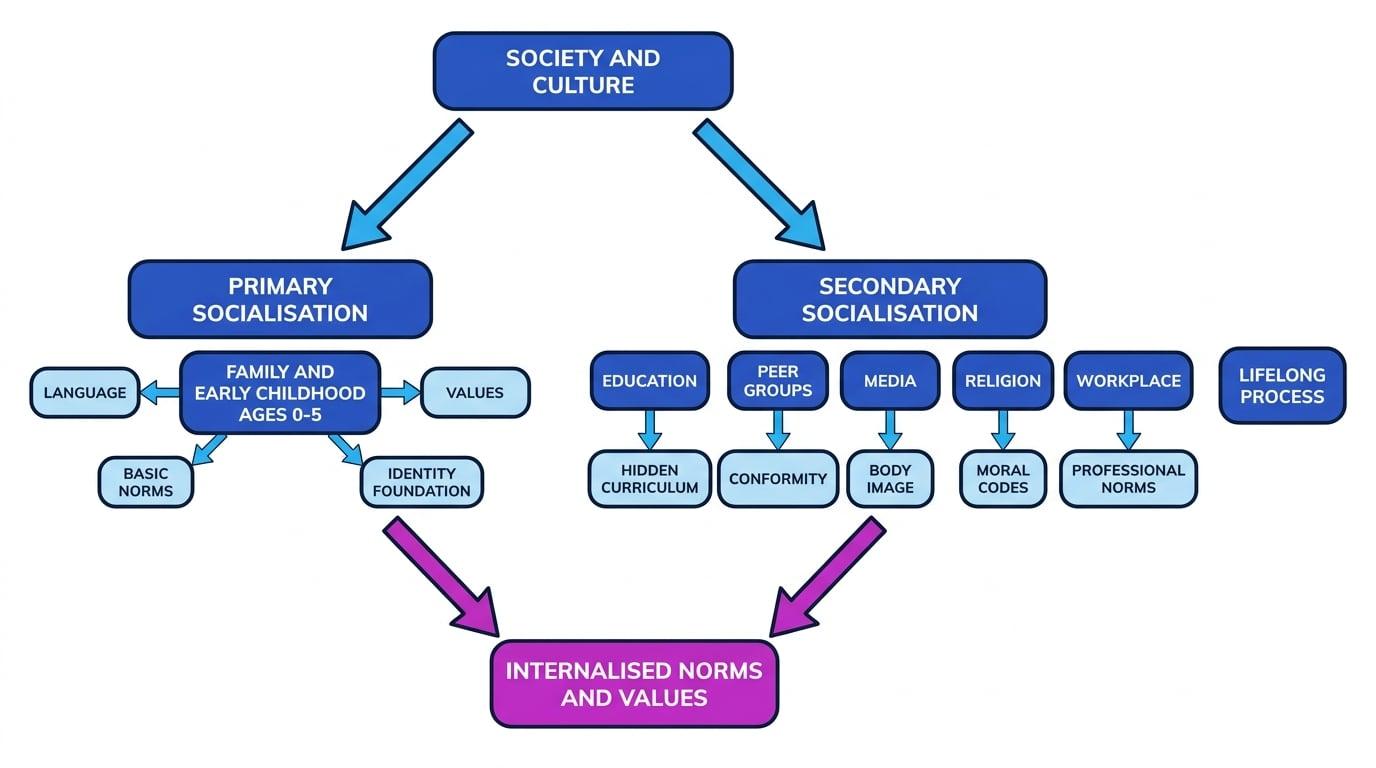
This occurs during early childhood (roughly ages 0 to 5) and takes place almost entirely within the family.
During this stage, children learn basic skills like language, basic hygiene, walking, and fundamental norms of behaviour (such as sharing or knowing right from wrong).
- The Family as an Agency: The family is the most critical agency of socialisation because it forms the foundation of our identity.
- Key Theorist (Functionalism): Talcott Parsons (1955) argued that the family is like a "factory" that produces human personalities. He believed the family’s primary role is to ensure children internalise the society's culture, leading to value consensus (shared agreement on values) and social stability.
The 'Software' Analogy
Think of primary socialisation as installing the "operating system" on a new computer. Without it, the computer cannot boot up or run programs. Secondary socialisation is like installing specific "apps" later on to navigate different areas of life, such as school, work, or hobbies.
Secondary Socialisation
This begins in later childhood and continues throughout your entire adult life. It takes place outside the home, in the wider social world.
Secondary socialisation helps us learn how to behave in formal public spaces and prepare for adult roles. The main agencies of secondary socialisation include:
- Education: Learning formal knowledge as well as the "hidden curriculum" (unwritten rules like punctuality, hierarchy, and competition).
- Peer Groups: Friends and social circles where individuals learn about conformity, subcultures, and status.
- The Media: TV, social media, and gaming, which transmit ideas about body image, gender roles, and consumerism.
- Religion: Providing moral codes, laws, and spiritual guidelines.
- The Workplace: Learning the professional norms, dress codes, and hierarchies of a career (often involving re-socialisation, where you must unlearn old habits and adapt to new ones).
The Agencies of Socialisation in Action
Let’s look more closely at how these agencies socialise us, using sociological evidence.
1. The Family: Gender Socialisation
Feminist sociologists argue that the family does not just neutralise or gently socialise children; it actively constructs gender roles.
Ann Oakley (1974) identified four mechanisms of gender socialisation within the family:
- Manipulation: Parents encourage gender-conforming behaviour and discourage deviant behaviour (e.g., praising a girl for being "pretty and quiet" or telling a boy "big boys don't cry").
- Canalisation: Parents channel children's interests into gender-specific toys and activities (e.g., giving girls dolls and tea sets to encourage domesticity, and boys action figures and construction sets to encourage spatial skills and aggression).
- Verbal Appellations: Using gendered language to address children (e.g., calling a girl "princess" or "angel" and a boy "trouble" or "soldier").
- Domestic Activities: Involving children in gender-stereotyped chores (e.g., girls helping with baking and cleaning, boys helping with DIY and gardening).
2. Education: The Hidden Curriculum
While schools teach you academic subjects (the formal curriculum), they also teach you how to accept authority and navigate hierarchy.
Hidden Curriculum
The hidden curriculum consists of the unwritten, unofficial, and often unintended lessons, values, and perspectives that students learn in school (e.g., obedience, punctuality, and conformity).
- Marxist Perspective: Bowles and Gintis (1976) argued that the hidden curriculum prepares working-class children for exploitation in the capitalist workplace. School teaches obedience to authority, acceptance of hierarchy, and repetitive tasks—mirroring the conditions of a factory or office.
3. Peer Groups: Status and Subcultures
As you grow older, your peer group becomes a major source of identity.
- Peer groups use sanctions to enforce conformity. If you do not wear the right clothes or listen to the right music, you may experience informal negative sanctions like teasing, exclusion, or bullying.
- Paul Willis (1977) studied a group of working-class boys ("the lads") who formed an anti-school subculture. Their peer group socialised them to reject school values, ironically preparing them for manual labour jobs where resisting authority was highly valued.
Sociological Perspectives on Socialisation
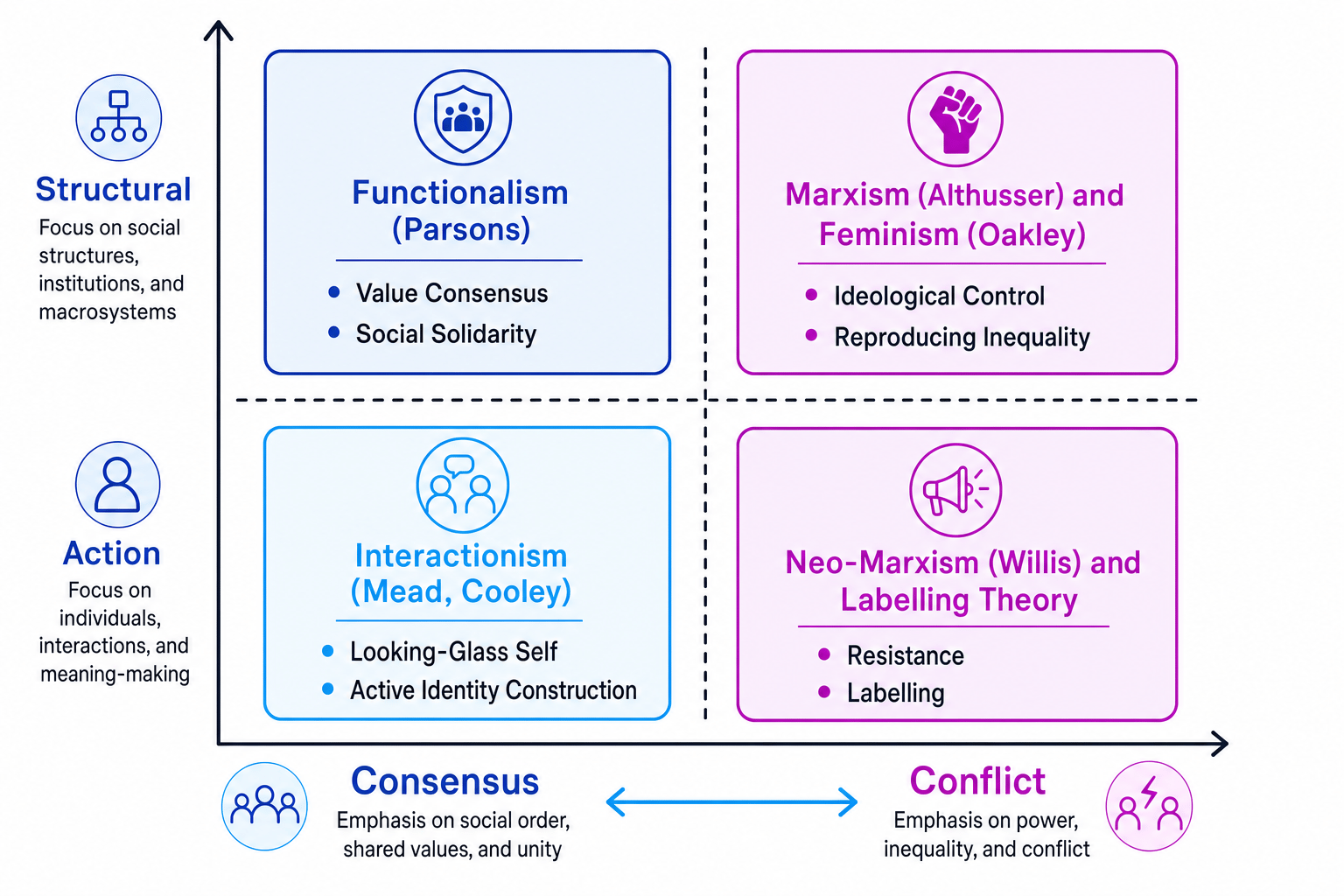
How you view socialisation depends heavily on your theoretical standpoint. Sociologists fall into different camps based on two main axes: Consensus vs. Conflict and Structure vs. Action.
Consensus (Functionalist) View
Functionalists like Talcott Parsons view socialisation as a positive, vital process.
- It creates social solidarity (a sense of belonging to a shared community) and value consensus.
- Without socialisation, society would collapse into chaos and normlessness (anomie).
Conflict (Marxist & Feminist) View
Conflict theorists see socialisation as a form of social control that reproduces inequality.
- Marxists like Louis Althusser (1971) view schools and the media as Ideological State Apparatuses (ISAs). They socialise the working class into accepting ruling-class ideology (false class consciousness), making exploitation seem natural and fair.
- Feminists argue that socialisation reproduces patriarchy. It trains women to accept subordinate, domestic roles, ensuring men maintain power in society.
The Functionalist vs. Conflict Divide
Functionalists believe socialisation benefits everyone by creating a stable, harmonious society. Conflict theorists (Marxists and Feminists) believe socialisation benefits only the powerful (the ruling class or men) by brainwashing the powerless into accepting inequality.
Social Action (Interactionist) View
Structural theories (like Functionalism and Marxism) treat individuals as passive "puppets" who are simply programmed by society. Interactionists reject this.
- They argue that socialisation is an active, two-way process.
- Charles Cooley (1902) proposed the Looking-Glass Self: our self-concept is built on how we imagine others perceive us, but we actively interpret and respond to these perceptions. We can accept, negotiate, or reject the labels given to us by agencies of socialisation.
Don't treat socialisation as a one-way street!
In your essays, always evaluate structural perspectives (which assume people are passive receivers of culture) using action perspectives (which argue we actively interpret and sometimes resist socialisation). Mentioning the concept of agency (the ability to act independently and make free choices) is an excellent way to gain AO3 evaluation marks.
Applying Socialisation Concepts
In A-Level Sociology, you must be able to apply abstract concepts to real-world scenarios. This is your AO2 (Application) skill.
Applying socialisation concepts to a contemporary scenario
Consider this scenario: Five-year-old Toby is bought a toy toolkit by his father. When Toby tries to play with his older sister's kitchen set, his father says, "No, Toby, that's for girls; help me fix this table instead." Later, at school, Toby's teacher praises him for sitting quietly and helping tidy up the classroom.
How do we analyse this scenario using sociological concepts of socialisation?
- Identify the primary agency and its mechanisms: Toby’s father is acting as an agent of primary socialisation. He is using canalisation by directing Toby toward gender-stereotypical toys (the toolkit) and away from female-stereotypical toys (the kitchen set). He also uses verbal appellations and direct instructions ("that's for girls") to establish gender boundaries.
- Identify the secondary agency and its mechanisms: The school and teacher act as agents of secondary socialisation. By praising Toby for sitting quietly and tidying, the teacher is using positive reinforcement to transmit the hidden curriculum—teaching Toby to respect authority, follow rules, and perform domestic/civic duties in public spaces.
- Contrast structural and interactionist interpretations: A structural sociologist (like a Feminist or Functionalist) would argue Toby is being successfully programmed into his socially designated gender and occupational role. However, an interactionist would suggest Toby is not a passive puppet. He may comply now to avoid a telling-off, but as he grows, he will actively negotiate his identity and might choose to reject these traditional masculine expectations later in life.
Confusing norms and values
Students often swap these terms, but they are different! Values are general principles or beliefs about what is good or desirable (e.g., privacy, respect for elders). Norms are the specific, concrete rules of behaviour that put those values into practice (e.g., knocking before entering a room, using polite titles like "Mr" or "Mrs"). Values are the abstract ideas; norms are the actions.
In the exam
If you are writing an essay or a short-answer question on socialisation, keep these strategies in mind:
- Explicitly name the agencies: Don't just write "people learn things." Clearly state which agency (e.g., "the education system" or "the mass media") and what mechanism (e.g., "the hidden curriculum" or "canalisation") is at work.
- Contrast consensus and conflict: For AO3 evaluation, immediately contrast Talcott Parsons’ optimistic view of socialisation (producing social order) with Louis Althusser's or Ann Oakley's critical view (producing submission to capitalism or patriarchy).
- Bring in contemporary examples: Show the examiner you understand 21st-century society. Mention modern media (algorithms, influencers, TikTok) as a powerful contemporary agent of secondary socialisation that bypasses traditional family control.
Check yourself
Review your understanding by trying to answer these questions:
- What are the four mechanisms of gender socialisation identified by Ann Oakley?
- How does the Marxist view of the "hidden curriculum" differ from the Functionalist view of school socialisation?
- Why do Social Action theorists criticise the structural view of socialisation?