What you'll learn
- What sociologists mean by the self, identity and difference.
- How identities are socially caused by structures such as class, gender, ethnicity, age, sexuality and disability.
- How identities are socially constructed through interaction, labels, meanings and institutions.
- How to use named theorists and contemporary UK examples for AO1, AO2 and AO3.
Why identity is sociological
At first, identity can feel completely personal: your name, style, accent, beliefs, friendships, music taste, religion, nationality or online profile. Sociology asks a bigger question: where did those “personal” features come from, and why do they matter socially?
This topic is about the link between your inner sense of yourself and the wider society around you. The key move is to see identity as both:
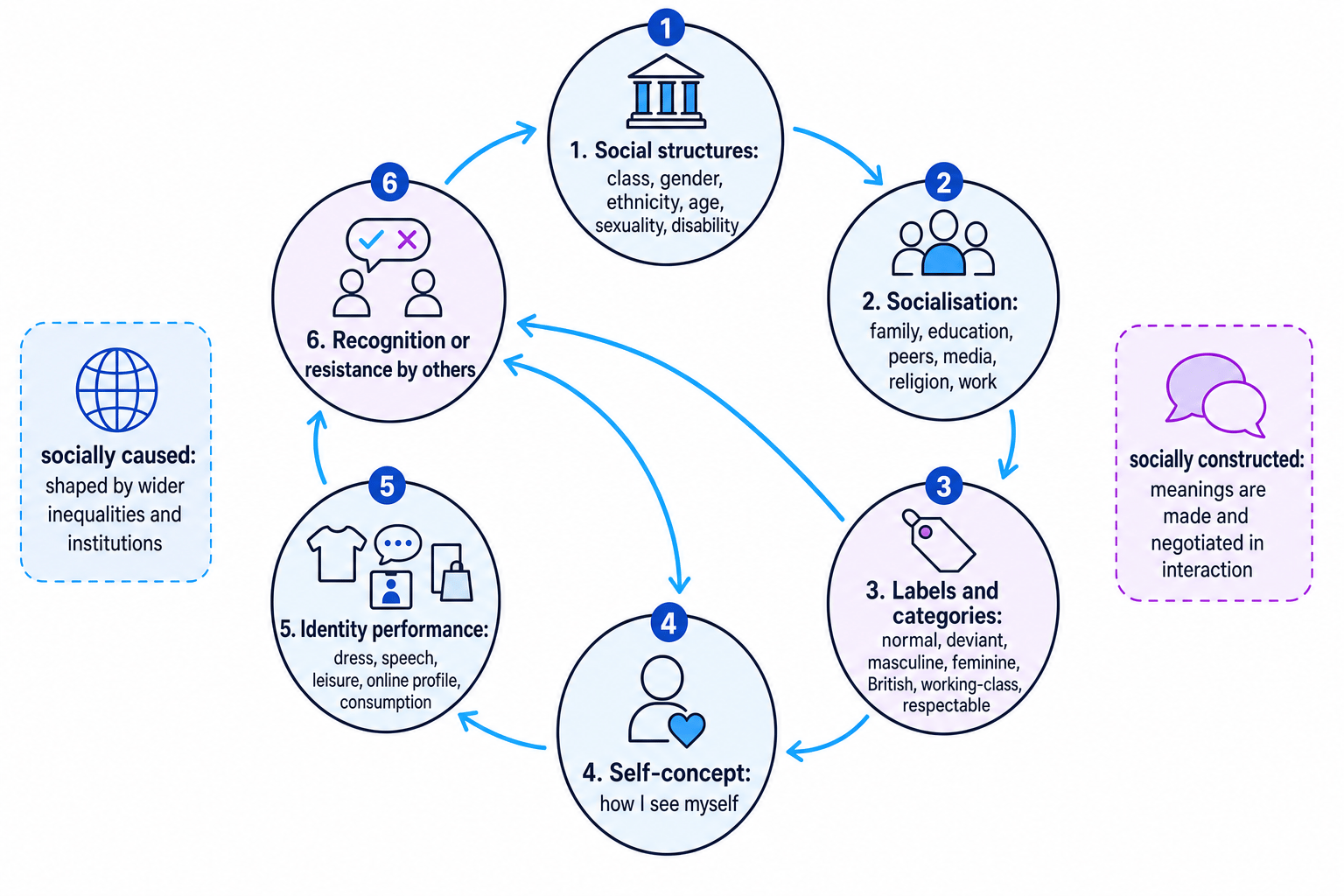
- socially caused — shaped by social structures and inequalities
- socially constructed — created and negotiated through meanings, labels and interaction
Core terms
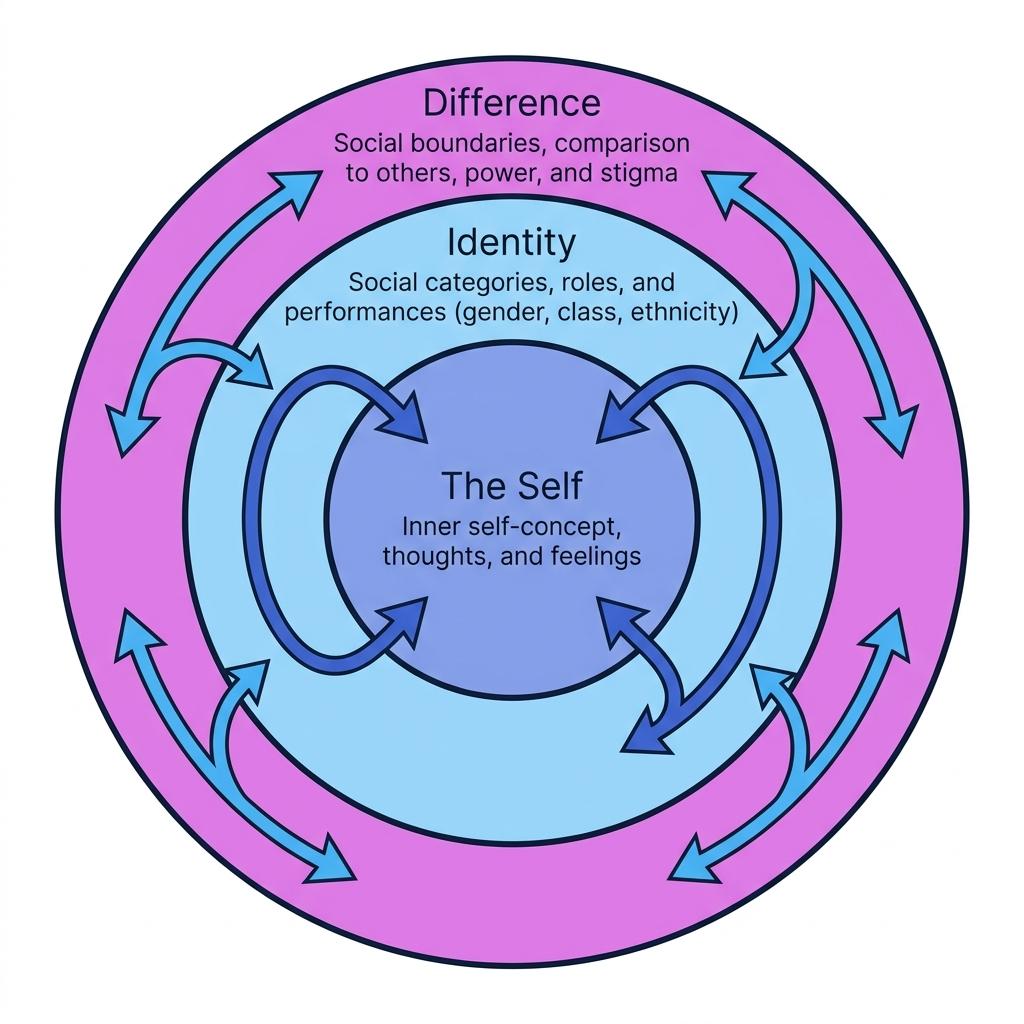
- The self means your sense of being a separate person with thoughts, feelings and a view of “who I am”.
- Identity means the meanings attached to who you are, including categories such as gender, class, ethnicity, age, nationality, sexuality, religion and disability.
- Difference means the way people and groups are marked as similar to or different from others. Difference can be neutral, but it can also become linked to power, stigma and inequality.
The diagram below shows the basic sociological idea: identity is not simply “inside” you. It develops through socialisation, labels, self-concept, performance and reactions from others.
Socialisation: how the self develops
Socialisation is the process through which people learn the norms, values, roles and expectations of their society.
- Primary socialisation happens early in life, usually through family and close carers.
- Secondary socialisation happens later through schools, peer groups, media, religion, work and other institutions.
Interactionist sociologists argue that the self develops through interaction with others. Cooley (1902) used the idea of the looking-glass self: we imagine how others see us, imagine their judgement, and develop feelings about ourselves as a result. Mead (1934) argued that children learn to “take the role of the other”, meaning they understand themselves by seeing themselves from other people’s viewpoints.
The self is learned
Sociologists do not treat the self as purely natural or fixed. Your self-concept develops through social interaction, especially through how others respond to you.
Developing a student identity
- A pupil receives repeated feedback from teachers: they are praised for written work but criticised for speaking out in class.
- The pupil begins to see themselves as “good at essays” but “not confident verbally”, because their self-concept is shaped by others’ responses.
- This identity affects behaviour: they volunteer for written tasks but avoid presentations.
- If later teachers or peers encourage speaking, the identity may change, showing that the self is socially shaped but not completely fixed.
Identity: belonging, positioning and performance
Identity is about how you understand yourself and how others place you. It includes personal identity — what makes you feel unique — and social identity — the groups and categories you are associated with.
A status is a social position, such as student, parent, teacher or employee. A role is the expected behaviour attached to that position. Some identities are ascribed, meaning they are given or assumed at birth, such as age or some aspects of ethnicity. Others are achieved, meaning they are gained through action, such as becoming a university student, activist or employee.
Goffman (1959) argued that social life involves impression management. People present themselves differently depending on the audience, like being “front stage” in public and “back stage” in private. This does not mean everyone is fake; it means identity is partly performed through dress, speech, body language, humour, online posts and consumer choices.
Identity is not just personality
Do not reduce identity to individual personality. In Sociology, identity is connected to social categories, power, culture, interaction and institutions.
Analysing an online identity
- A student chooses a profile picture, bio, pronouns, music clips and posts, selecting signs that communicate a version of themselves.
- Friends respond with likes, comments or silence, so the identity is recognised, questioned or ignored by others.
- The platform also shapes the performance by rewarding certain content through visibility and algorithms.
- This shows identity as constructed through interaction, but also socially caused by wider media structures and peer-group pressures.
Difference: boundaries, othering and inequality
Difference is not just about variety. Sociologists ask who defines difference, whose difference is treated as normal or abnormal, and what consequences follow.
A key idea is that identities are relational: people often understand who “we” are by contrasting themselves with “them”. For example, ideas of “Britishness”, “respectability”, “masculinity” or “youth culture” often depend on boundaries between insiders and outsiders.
Othering
Othering means defining a person or group as different from, and often inferior to, the assumed “normal” group.
Difference links directly to the core theme of social differentiation, power and stratification. Some differences become the basis for unequal treatment, such as racism, sexism, homophobia, ableism or class prejudice. Goffman (1963) used the term stigma to describe a discrediting label that damages a person’s social identity.
AO2 examples in contemporary UK society include accent discrimination, Islamophobic media stereotypes, debates over transgender identity, disability access, and the way working-class cultural styles are sometimes mocked through labels such as “chav”.
Turning difference into inequality
- A job applicant speaks with a strong regional or working-class accent during an interview.
- The interviewer interprets the accent through classed assumptions, such as “less professional” or “less educated”.
- The applicant’s difference becomes linked to unequal opportunity, even if their qualifications are strong.
- Sociologically, this is not just personal prejudice; it reflects wider classed ideas about respectability, speech and status.
Identity as socially caused
To say identity is socially caused means it is shaped by forces outside the individual: institutions, socialisation, economic resources, laws, media, religion, education and patterns of inequality.
Socially caused identity
An identity is socially caused when it is shaped by social structures, institutions and unequal life chances rather than simply chosen by the individual.
Different perspectives explain this in different ways:
- Functionalists, such as Parsons, see socialisation as helping people learn shared norms and perform roles needed for social order.
- Marxists argue that class identity is shaped by capitalism, work, consumption and ideology.
- Feminists argue that gender identity is shaped by patriarchy, gender-role socialisation and unequal power between men and women.
- Bourdieu (1984) argued that class shapes taste, lifestyle and confidence through habitus, meaning deeply learned dispositions, and cultural capital, meaning valued knowledge, language and cultural skills.
- Connell (1995) argued that masculinity is socially organised, with hegemonic masculinity being the dominant form associated with authority, toughness and heterosexuality.
Structure limits choice
People can make identity choices, but they do not choose from an equal starting point. Class, gender, ethnicity, age, sexuality and disability shape which identities are available, rewarded or punished.
Explaining classed identity choices
- A young person from a working-class background may avoid activities coded as “posh”, such as certain sports, accents or cultural events.
- This is socially caused because family income, local peer culture and school experiences shape what feels comfortable or “for people like us”.
- It is also constructed because the meaning of “posh” is created through labels, jokes, media images and everyday interaction.
- A strong answer would avoid determinism by noting that people can resist class expectations, but resistance is easier when they have resources and support.
Identity as socially constructed
To say identity is socially constructed means identities are made through shared meanings rather than being simply natural facts. This does not mean they are imaginary or unimportant. Social constructions can have very real consequences.
Social construction
Social construction means that categories, meanings and identities are created, maintained and changed through social interaction, language, culture and institutions.
Interactionists are especially important here. Becker (1963) argued that deviance is not simply an act itself, but the result of social reaction and labelling. If someone is repeatedly labelled “troublemaker”, “gifted”, “criminal” or “respectable”, that label can shape how they are treated and how they see themselves.
Postmodern and late-modern theorists also stress construction and change. Giddens (1991) described identity as a reflexive project, meaning people actively work on who they are through lifestyle choices, relationships and self-narratives. Bauman argued that modern identity is more fluid and uncertain. Hall (1992) similarly argued that identity is not fixed but fragmented, changing and shaped by representation.
AO2 examples include changing Census categories, debates over national identity after Brexit and devolution, and the growth of online identity communities. The UK Census does not just “measure” identity neutrally; by offering categories for ethnicity, religion, sex and gender, it can also shape how people think about belonging and difference.
Best phrase for essays
A strong sentence is: identity is socially constructed because meanings are made through interaction, but socially caused because those meanings are shaped by institutions and inequalities.
Holding both ideas together
The best A-Level answers do not treat “caused” and “constructed” as opposites. They work together.
| Focus | Socially caused | Socially constructed |
|---|---|---|
| Main question | What social forces shape identity? | How are meanings and labels created? |
| Level | Macro: structures and institutions | Micro: interaction and interpretation |
| Examples | Class, gender, ethnicity, education, media, law | Labels, symbols, discourse, performance |
| Risk if overused | Too deterministic | Too voluntaristic |
For example, gender identity can be socially caused by family socialisation, school rules, media representation and workplace inequality. But it is also socially constructed because ideas of “masculine” and “feminine” vary across time, cultures and settings. Butler (1990) argued that gender is performative: it is repeatedly produced through actions, language and norms.
AO3 evaluation matters here. Social constructionist approaches are useful because they show that identities can change. However, they may underplay material inequalities if they focus too much on language and choice. Structural approaches are useful because they show how power shapes identity, but they can overstate how passive people are. People negotiate, resist and reinterpret identities.
Methods: how sociologists study identity
Identity is often studied using qualitative methods, such as interviews, ethnography and participant observation. These can produce high validity because they explore people’s meanings in depth. For example, interviews can reveal how young people explain class, gender or ethnic identity in their own words.
However, there are methodological issues:
- Practical issues: identity research can take time, especially if trust and access are needed.
- Ethical issues: researchers must protect confidentiality when studying sensitive identities, such as sexuality, religion, disability or experiences of racism.
- Theoretical issues: interpretivists value depth and meaning, while positivists may criticise small samples for lacking representativeness and reliability.
Official statistics, such as the Census, are useful for spotting broad patterns in identity categories, but they may simplify complex, mixed or changing identities.
How to use this in essays
A good essay paragraph should usually do three things:
- AO1: define the concept and name a theorist, such as Mead, Goffman, Becker, Bourdieu, Butler or Giddens.
- AO2: apply it to a real example, such as social media, schooling, classed accents, gender roles, Census categories or media stereotypes.
- AO3: evaluate by comparing perspectives, considering power, or asking whether the theory overstates structure or choice.
In the exam
- Define self, identity or difference precisely before using them in analysis.
- Use the phrase “both socially caused and socially constructed” to avoid one-sided answers.
- Link identity to power: ask who benefits when some identities are treated as normal, respectable or superior.
Check yourself
- How would Cooley or Mead explain the development of the self?
- Why is difference sometimes linked to inequality rather than just diversity?
- Can you apply “socially caused” and “socially constructed” to one identity, such as gender, class or ethnicity?