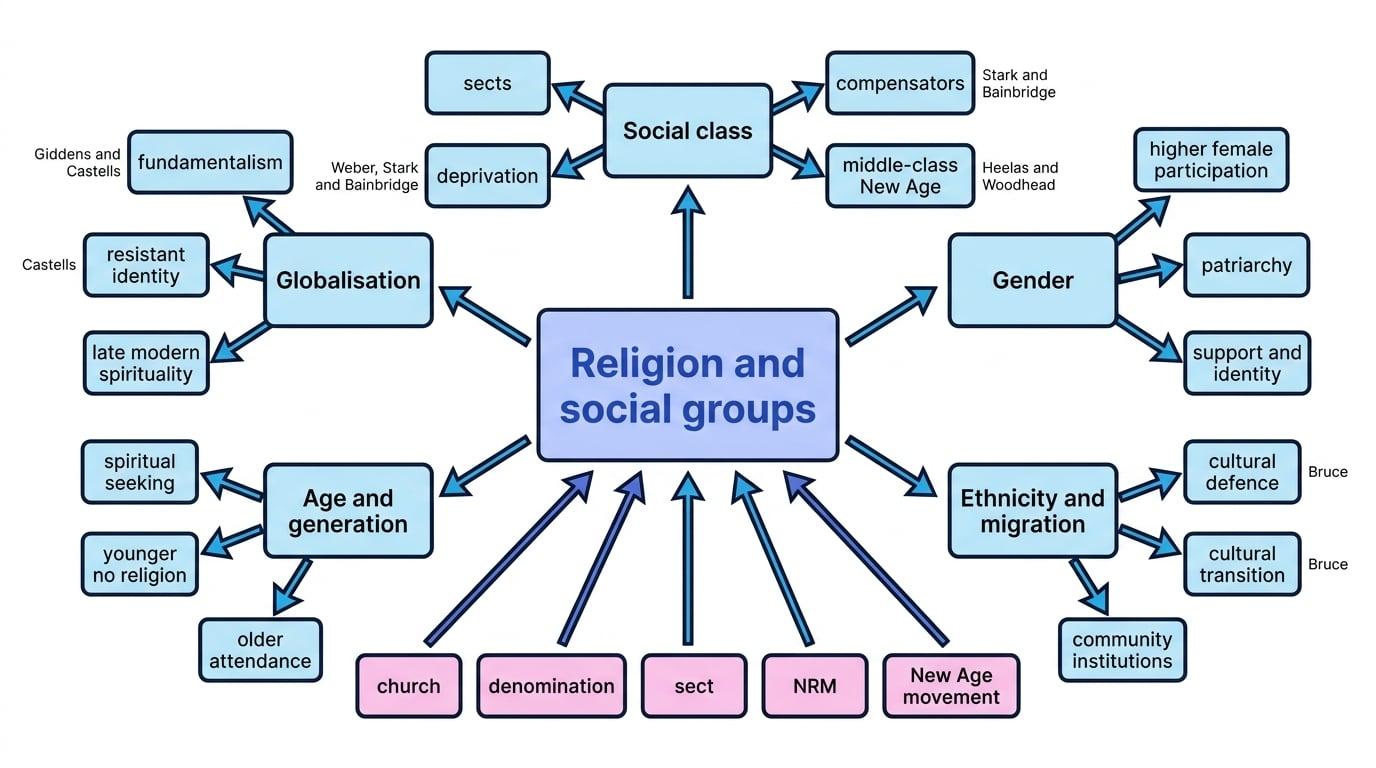
What you'll learn
- How different social groups relate to churches, sects, denominations, New Religious Movements and New Age spirituality.
- Why religion can be a source of identity, community, support, control or resistance.
- How to apply theorists such as Weber, Stark and Bainbridge, Bruce, Heelas, Woodhead, Giddens and Castells.
- How to evaluate patterns without stereotyping whole groups.
The starting point: religion is socially patterned
AQA wants you to understand the relationship between different social groups and religious or spiritual organisations, movements, beliefs and practices. In other words: religion is not randomly distributed across society. Patterns often vary by social class, gender, ethnicity, age, migration, deprivation and globalisation.
Social group
A social group is a category of people who share a social position or identity, such as class, gender, ethnicity, age, sexuality or nationality. Sociologists ask how these positions affect people’s experiences, opportunities and beliefs.
Religious and spiritual movements
A religious movement is an organised attempt to promote a set of religious beliefs and practices. A spiritual movement is usually looser and more individualised, often focused on personal growth, healing, wellbeing or “inner meaning” rather than formal doctrine.
This topic links directly to the two core AQA themes:
- Socialisation, culture and identity: religion can teach norms, create belonging, mark ethnic or gender identity, and shape life-course rituals.
- Social differentiation, power and stratification: religion may reflect inequality, compensate for disadvantage, justify power, or help marginalised groups resist oppression.
The big idea is that religious involvement is best understood as a set of tendencies, not fixed rules.
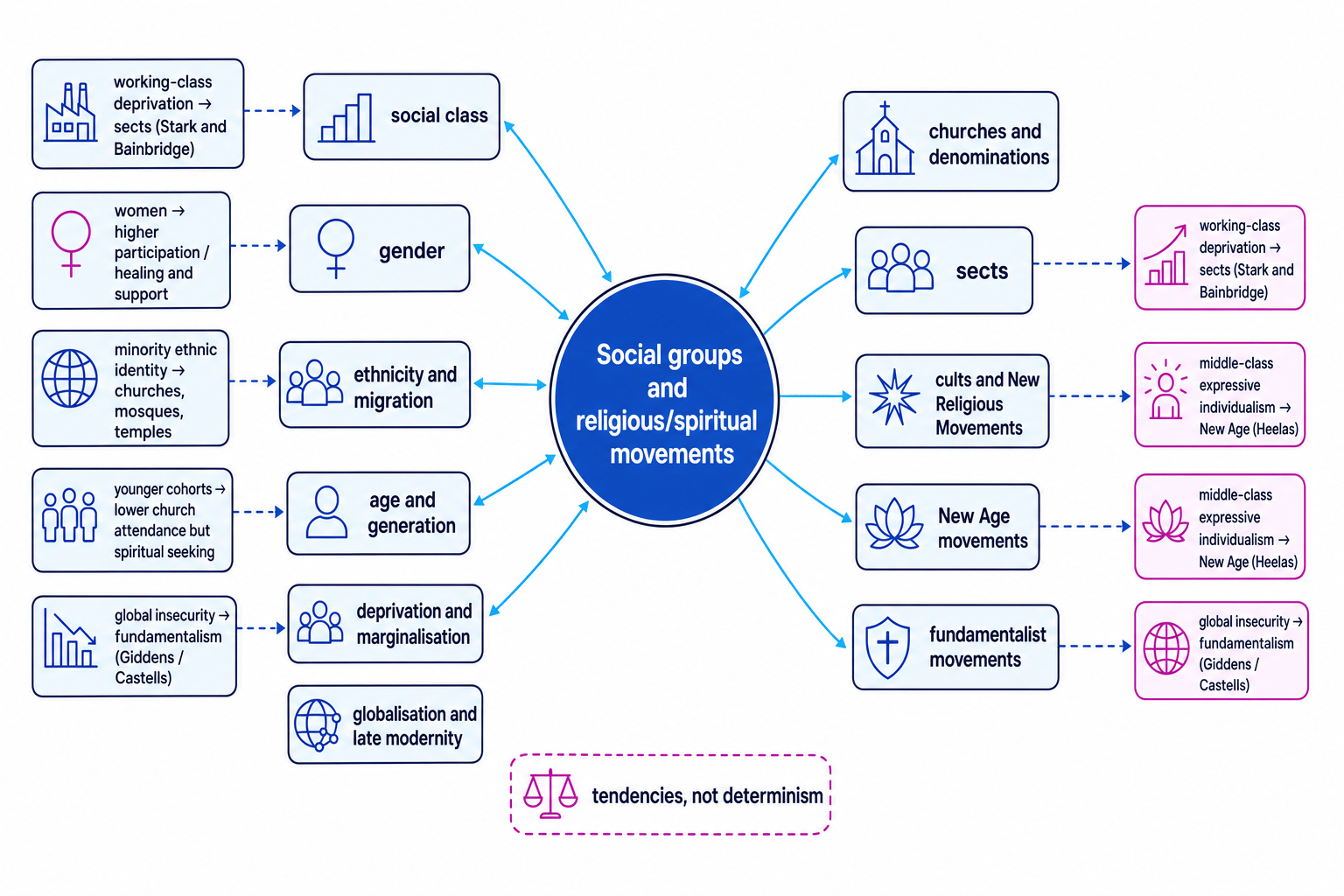
Tendencies, not destiny
Sociologists look for patterns: for example, women often show higher levels of religious participation than men, and ethnic minority groups in Britain are often more religious than the white British majority. But individuals are not determined by their group membership.
Quick organisation types you need to know
You do not need to reduce every answer to typologies, but they are useful for application.
Churches and denominations
A church is a large, established religious organisation, often linked to the state or national culture. The Church of England is the classic UK example because it has a formal role in national ceremonies and the monarchy.
A denomination is a respectable, mainstream religious organisation that usually accepts wider society and allows some religious choice. Methodists, Baptists and many mainstream Christian groups are examples.
Sects
A sect is a smaller, more exclusive religious group that often sees itself as separate from, or critical of, wider society. Troeltsch saw sects as more demanding and less compromising than churches.
Cults, New Religious Movements and New Age movements
A cult, in sociological use, means a loose movement based around new or unusual beliefs, not necessarily a dangerous group. Because “cult” is often used negatively in everyday language, many sociologists prefer New Religious Movement or NRM.
Wallis classified NRMs into:
- World-rejecting movements: critical of mainstream society and often demand major lifestyle change, such as some communal religious groups.
- World-accommodating movements: focus on renewing spiritual life while allowing members to remain in ordinary society.
- World-affirming movements: promise success, confidence or personal development within society.
New Age movements are usually individualistic and spiritual rather than strongly organised. Examples include astrology, tarot, crystals, Reiki, mindfulness, yoga spirituality and holistic healing.
Using 'cult' as an insult
In sociology, do not use “cult” simply to mean “weird” or “bad”. Define it analytically as a loose, often individualistic movement with unconventional beliefs, then evaluate whether the label is useful.
Social class: deprivation, compensation and choice
Class matters because religion can offer different things to different class groups.
Weber argued that religion may provide a theodicy of disprivilege: an explanation for suffering that gives meaning to the hardship of disadvantaged groups. For example, a group experiencing poverty or exclusion may be attracted to beliefs promising justice, salvation or a future reversal of status.
Stark and Bainbridge developed this through deprivation theory. They argued that sects are more likely to appeal to people experiencing deprivation because sects offer compensators: promised rewards when real-world rewards are unavailable. These rewards may be emotional, social or supernatural.
Compensator
A compensator is a promised reward that makes up for something a person lacks, such as status, wealth, certainty, community or hope.
There is also a class pattern in New Age spirituality. Heelas found that many New Age participants are relatively middle class, especially those with cultural capital, time and money to spend on retreats, books, therapy, wellness courses or alternative healing.
In the UK today, you might apply this to the popularity of mindfulness, yoga spirituality and wellness culture among professional middle-class groups, while some stricter sect-like groups may appeal to people seeking certainty, community or dignity in insecure circumstances.
Applying deprivation and compensation
- Identify the social position: a group experiencing economic insecurity, low status or social exclusion may feel blocked from mainstream rewards such as secure work, respect or influence.
- Connect this to the organisation type: a sect may offer tight community, moral certainty and the belief that members are spiritually chosen.
- Explain the mechanism: those beliefs act as compensators because they turn worldly disadvantage into religious meaning, such as “the faithful will be rewarded”.
- Add evaluation: this explains some patterns, but it can be too deterministic because not all deprived people join sects, and some sect members are middle class.
Gender: women’s higher participation and patriarchal power
A consistent finding in many societies is that women often show higher levels of religious participation than men, especially in prayer, attendance and involvement in caring or community roles.
Sociologists explain this in several ways:
- Gender socialisation: girls may be encouraged to be caring, expressive and morally responsible, which can fit religious roles.
- Structural location: women have historically been more involved in unpaid care, family life and community networks, linking them to churches, temples, mosques or religious support groups.
- Deprivation and compensation: women may use religion for support where they experience patriarchy, poverty, domestic pressures or exclusion from public power.
- Risk and security: Miller and Hoffman argue women may be more risk-averse, making religious commitment more attractive if it is seen as offering security or salvation.
Woodhead gives a useful balanced view: religion can be both a source of confirmation and compensation. It may confirm traditional femininity through motherhood, modesty or caring roles, but it may also compensate women by giving them status, friendship, leadership opportunities or emotional support.
Feminists are divided. Some argue religion reinforces patriarchy: for example, male leadership, restrictions on women’s bodies, or teachings about obedience. Others point out that religious spaces can empower women through activism, education, mutual aid and community leadership.
Explaining women’s religious participation
- Compare participation with power: women may be more active in religious practice, but men often hold more formal authority in many traditions.
- Apply socialisation: if women are encouraged into caring and community roles, churches or religious groups may become socially acceptable spaces for support and service.
- Add a feminist evaluation: higher participation does not automatically mean empowerment; it may reflect both agency and patriarchal constraint.
Gender essays
A strong answer avoids saying “religion oppresses women” as a blanket claim. Instead, contrast religion as patriarchal control with religion as support, identity and agency.
Ethnicity and migration: identity, defence and transition
In contemporary Britain, religion is closely connected to ethnicity and migration. The 2021 Census for England and Wales showed a decline in Christian identification and a rise in “no religion”, but religion remains especially significant for many minority ethnic communities. For example, Muslim, Hindu and Sikh identities are often linked to family, food, dress, festivals, language and community institutions.
Bruce identifies two important functions of religion for migrant and minority ethnic groups:
- Cultural defence: religion helps a community defend its identity against hostility, racism or pressure to assimilate.
- Cultural transition: religion helps migrants adjust to a new society by providing networks, advice, language support, childcare, marriage networks and practical help.
UK examples include Black majority Pentecostal churches, mosques, gurdwaras, Hindu temples and synagogues functioning not just as places of worship, but as community centres. They may support identity, socialisation of children, charity work and political voice.
Using cultural defence and cultural transition
- If a minority group faces racism or Islamophobia, apply cultural defence: religious institutions can protect identity and create solidarity.
- If a migrant group is adapting to life in Britain, apply cultural transition: religious networks may help with jobs, housing, language and social contacts.
- Evaluate with diversity: not all members of an ethnic group are religious, and younger generations may reinterpret religion more individually.
Avoid ethnic stereotypes
Do not write as if every member of an ethnic minority group has the same religion or level of commitment. Ethnicity and religion overlap, but they are not identical.
Age and generation: older participation, younger spiritual seeking
Age also shapes religion. Older people are generally more likely to attend religious services and identify with a religion, while younger cohorts are more likely to report no religion.
There are two main explanations:
Life-cycle effect
A life-cycle effect means people may become more religious as they age. Older people may think more about death, illness, bereavement and meaning, so religion may become more relevant.
Cohort effect
A cohort effect means generations differ because they were socialised in different historical periods. Voas and Crockett argue that religious decline in Britain is largely generational: older people were socialised into Christianity more strongly, while younger generations are less likely to inherit religious identity.
This matters for secularisation debates. If decline is mainly a cohort effect, religion may keep declining as older, more religious generations are replaced by less religious younger ones. However, young people may still engage in spirituality through meditation, online communities, astrology, festivals, identity politics or wellbeing practices.
New Age, late modernity and individual identity
New Age spirituality fits well with late modernity, a period where identity is more individualised, choice-based and uncertain. Giddens argues that people increasingly construct a reflexive project of the self: they work on their identity through lifestyle choices, therapy, relationships, health and beliefs.
New Age practices often appeal to people who want meaning without the authority of traditional churches. Heelas and Woodhead’s Kendal Project found evidence of a “holistic milieu” involving healing, self-spirituality and wellbeing, though critics argue this does not replace the scale of traditional religion’s decline.
This links to class and gender: New Age spirituality may appeal especially to middle-class women because it values emotion, healing, self-development and consumption.
Fundamentalism and global insecurity
Fundamentalism means a movement that insists on returning to what it sees as the basic, original or literal truths of a religion. It often claims certainty in a world experienced as morally confusing or threatening.
Giddens sees fundamentalism as a reaction to globalisation: as traditional communities are disrupted, some people seek certainty in absolute beliefs. Castells describes this as a resistant identity, where groups defend themselves against global capitalism, secular culture or perceived moral decline.
Fundamentalism can occur in many traditions, including Christianity, Islam, Judaism, Hinduism and others. In exam answers, be careful not to use it as a code word for one religion.
Religion can resist modernity
Some movements adapt to modern society through choice and spirituality; others resist modernity by demanding certainty, boundaries and strict moral codes.
Methods: how do sociologists know?
Evidence on religion often comes from the Census, social surveys, attendance counts, interviews and ethnography.
Each method has strengths and weaknesses:
- Official statistics are large-scale and useful for trends, but “religion” may measure identity rather than belief or practice.
- Surveys can compare groups, but people may interpret questions differently: “Christian” might mean churchgoing, family background or cultural identity.
- Interviews and ethnography give validity because they explore meaning and lived experience, but they are smaller-scale and less representative.
- Practical issues include access to closed religious groups, language barriers and the time needed to build trust.
- Ethical issues include confidentiality, informed consent and avoiding harm when researching sensitive beliefs or minority communities.
- Theoretical issues divide positivists, who prefer reliable large-scale data, and interpretivists, who prefer valid accounts of meaning and identity.
Bringing it together in essays
For AO1, define the group and the religious pattern. For AO2, apply it to a concrete context, such as UK census trends, Black Pentecostal churches, New Age wellness culture, or younger people’s “no religion” identity. For AO3, evaluate by showing diversity within groups and comparing theories.
One-factor explanations
Do not explain religious participation using only class, only gender or only ethnicity. Strong answers show intersectionality: for example, a young middle-class Muslim woman may experience religion differently from an older working-class Christian man.
In the exam
- Start each paragraph with a clear social group, such as class, gender, ethnicity or age, then link it to a type of organisation, belief or practice.
- Use named sociologists precisely: for example, Stark and Bainbridge for deprivation and compensators, Bruce for cultural defence/transition, and Giddens or Castells for fundamentalism.
- Evaluate every pattern by avoiding determinism: mention diversity within groups, secularisation, generational change, and the limits of the evidence.
Check yourself
- How might religion act as both a source of patriarchal control and a source of support for women?
- What is the difference between cultural defence and cultural transition?
- Why might New Age spirituality appeal to some middle-class groups in late modern society?