What you'll learn
- How sociologists define religion, religiosity and secularisation.
- Why Britain looks increasingly secular, but not simply “religion-free”.
- How globalisation spreads and reshapes religions across the world.
- How to evaluate this topic using evidence, methods and contemporary examples.
1. Starting point: religion and religiosity
Religion
Religion is a system of beliefs, practices and organisations concerned with the sacred, spiritual or supernatural. Durkheim saw religion as a way societies create shared moral meanings; Marx saw it as linked to power and inequality; Weber linked religion to social change.
Religiosity
Religiosity means the extent to which people are religious. It can include belief, worship, prayer, religious identity, moral commitment, community membership and participation in rituals.
A key A-Level point is that religion is not just “going to church”. In contemporary society it can shape identity, culture, family life, politics, education, gender expectations, food practices, dress, festivals and community support.
In the UK, for example, religion still matters through faith schools, halal and kosher food markets, mosque and gurdwara communities, Christian traditions in the monarchy, religious charities, chaplaincy in prisons and hospitals, and debates about abortion, sexuality and assisted dying.
Religion can decline and still matter
Secularisation is about religion losing social significance, not disappearing completely. A society can have falling church attendance while religion remains important for identity, politics, minority communities and public ceremonies.
Religion, identity and social differentiation
Religion often intersects with social differentiation, meaning the way society is divided by factors such as ethnicity, gender, class, age and region. In Britain, religious identity is often especially significant for minority ethnic communities, partly because religion can provide belonging, cultural continuity and protection against racism.
Religion also links to power and stratification. Some religious institutions reproduce inequalities, for example through male leadership or conservative views on sexuality. But religion can also challenge power, for example through food banks, anti-racist organising, liberation theology, or campaigns for social justice.
Applying religion to identity in Britain
- Start with the social group: a British Muslim teenager may experience religion not only as belief, but as family socialisation, mosque attendance, food rules, dress, festivals and friendship networks.
- Add social differentiation: their religious identity may overlap with ethnicity, generation, gender and experiences of racism or Islamophobia.
- Evaluate the significance: religion may provide community and resilience, but it may also become a site of public conflict when politicians or media frame minority religions as “problems”.
2. Secularisation: what does it mean?
Secularisation
Secularisation is the process by which religious beliefs, practices and institutions lose social significance. Wilson argued that modern societies show a decline in religious influence over everyday life, institutions and collective values.
Bruce develops the secularisation argument by focusing on three broad signs:
- Declining religious participation, such as falling church attendance.
- Declining religious belief, such as fewer people identifying as Christian.
- Declining religious authority, such as churches having less control over law, education, family life and morality.
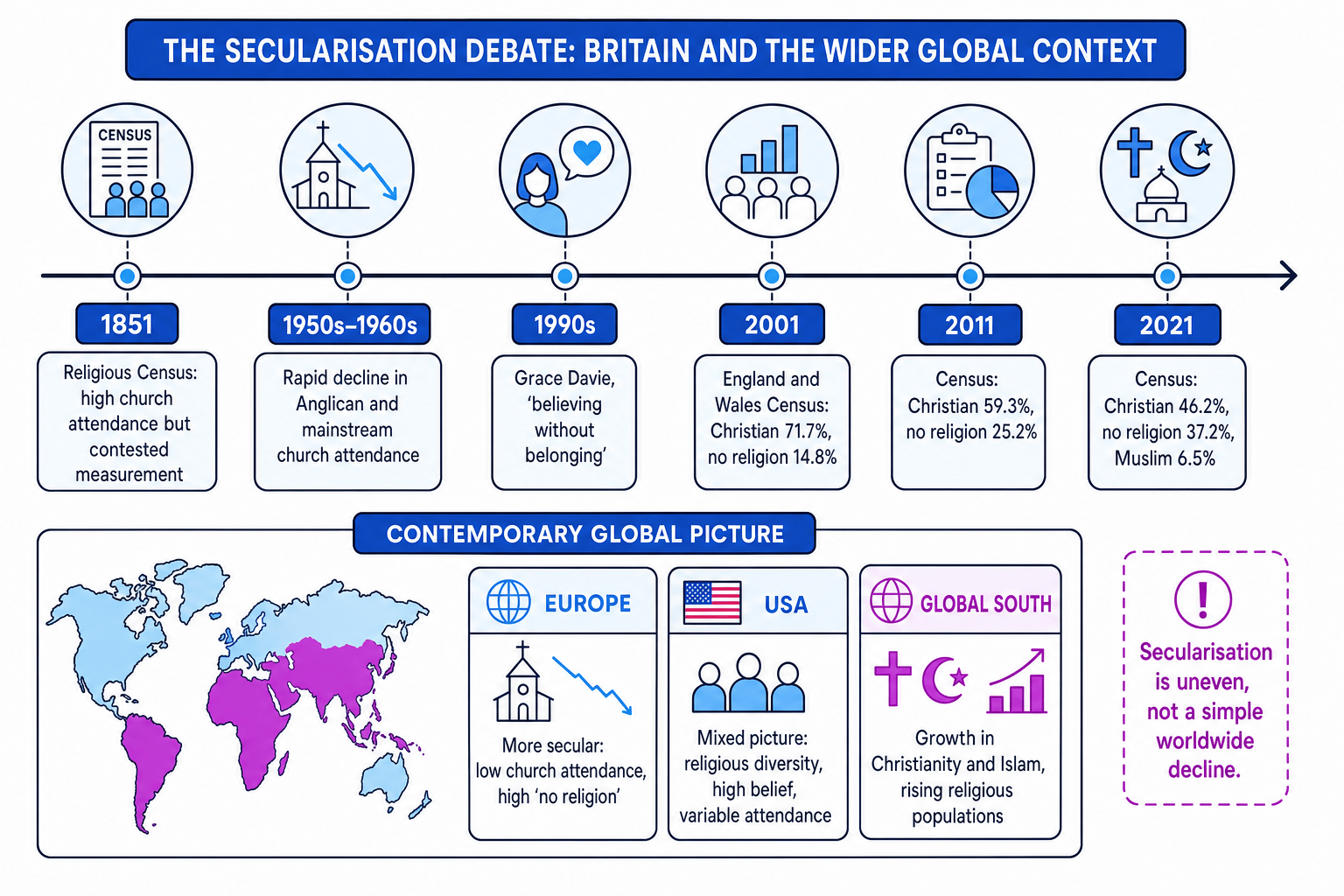
The UK secularisation debate is often taught through a timeline of declining Christian identification, falling mainstream church attendance and competing interpretations of what this means.
Why might secularisation happen?
Rationalisation
Rationalisation is the process where social life becomes organised around science, bureaucracy, calculation and evidence rather than tradition, mystery or magic. Weber called this the “disenchantment” of the world.
For secularisation theorists, modernity weakens religion because science explains events that were once seen as supernatural, and because people increasingly make individual choices rather than simply accepting tradition.
Structural differentiation
Structural differentiation means that institutions become specialised and separate. For example, education, healthcare, welfare and law become run mainly by the state or professionals rather than by religious bodies.
Parsons argued that differentiation does not necessarily destroy religion, but it narrows its role. Religion becomes more private, focused on meaning and morality rather than directly controlling the whole social system.
Bruce also argues that religious pluralism, meaning the existence of many competing religious beliefs in the same society, can weaken certainty. If people are surrounded by multiple truth claims, religion may become more like a choice than an unquestioned authority.
Treating secularisation as atheism
Do not write as if secularisation simply means “everyone becomes atheist”. It means religion loses social power or significance. People may still believe privately, identify culturally, or use religion at key life moments.
3. Evidence for secularisation in Britain
A strong AO1 answer should use evidence carefully. In England and Wales, the 2021 Census recorded Christian identity at 46.2%, down from 59.3% in 2011, while “no religion” rose to 37.2%. This suggests a major decline in Christian cultural identification.
Church attendance and membership in mainstream denominations, especially the Church of England and Methodism, have also fallen over the long term. Sunday schools and traditional church-based community life have become far less central than in the nineteenth and early twentieth centuries.
However, this evidence needs evaluation. Census data measures self-identification, not strength of belief or worship. A person ticking “Christian” may rarely attend church; a person ticking “no religion” may still believe in God, ghosts, fate, karma or spirituality.
Interpreting Census evidence on religion
- Identify what the data measures: the Census mainly measures religious identity, so it tells you how people label themselves, not whether they attend worship or believe strongly.
- Apply the trend: the fall in Christian identification supports the view that Christianity has lost cultural dominance in England and Wales.
- Add evaluation: the rise of “no religion” does not prove religion has vanished, because minority religions have grown and some people practise private or alternative spirituality.
Use the phrase “uneven secularisation”
A balanced judgement is often that Britain shows strong evidence of Christian secularisation, but religion remains significant in minority communities, public rituals, welfare, politics and identity.
4. Challenges to the secularisation thesis
Davie argues that Britain may show believing without belonging: people stop attending church but continue to hold religious or spiritual beliefs. She later used the idea of vicarious religion, where a small religious minority performs rituals on behalf of a wider population, such as funerals, national mourning or royal ceremonies.
Postmodern sociologists argue that religion may be changing form rather than simply declining. Lyon suggests that religion becomes more media-based, consumer-driven and individualised. Hervieu-Léger describes modern believers as “pilgrims” and “converts”, choosing spiritual paths rather than inheriting fixed traditions.
New Age spirituality, mindfulness, yoga, astrology and wellness cultures may show a move from institutional religion to personal spirituality. But Bruce would evaluate this critically: such movements are often small, loosely organised and less socially powerful than traditional churches once were.
Decline or transformation?
The central debate is whether religion is declining, as Wilson and Bruce argue, or relocating and changing form, as Davie, Lyon and Hervieu-Léger suggest.
5. Secularisation in a global context
The global picture is much more complex than the British one. Western Europe is among the most secular regions in the world, but religion remains powerful in many parts of Africa, Latin America, the Middle East, South Asia and the USA.
Desecularisation
Desecularisation means the return, revival or continued public importance of religion in modern societies. Berger, who once supported secularisation theory, later argued that much of the world remains strongly religious.
Norris and Inglehart explain global patterns using existential security theory. This argues that people are more likely to be religious where life feels insecure, for example because of poverty, conflict, weak welfare systems or high inequality. Religion can provide meaning, hope, community and support.
This helps explain why secularisation appears strongest in wealthy welfare societies, especially parts of Europe. But it also needs evaluation: the USA has historically combined wealth with high religiosity, partly because of inequality, religious competition and strong evangelical politics.
Casanova argues that religion has often become de-privatised, meaning it re-enters public life and politics rather than staying private. Examples include evangelical influence in US politics, political Islam, Hindu nationalism in India, and Catholic influence in Poland.
6. Measuring religiosity: methods matter
Sociologists use different evidence to measure religion:
- Official statistics, such as Census data.
- Surveys, such as British Social Attitudes.
- Attendance and membership figures from religious organisations.
- Qualitative interviews and ethnographies of religious communities.
Each method has strengths and weaknesses. Large surveys can be representative and reliable, but may lack validity if questions are too simple. Interviews can reveal meanings and identities in depth, but are harder to generalise from.
Practical issues include access to religious communities, language barriers and inconsistent attendance records. Ethical issues include confidentiality, especially where beliefs are sensitive or minority groups are already stereotyped. Theoretically, positivists may prefer measurable trends, while interpretivists argue that religion must be understood through lived meaning.
Using one measure as total proof
Do not rely on one statistic alone. Church attendance, Census identity, prayer, belief in God and spiritual experience can all move in different directions.
7. Globalisation and the spread of religions
Globalisation
Globalisation is the growing interconnectedness of societies through migration, trade, media, technology, travel and global organisations.
Globalisation spreads religions through migration, diaspora communities, missionary activity, global media, online worship, pilgrimage, religious charities and transnational networks.
Diaspora
A diaspora is a community living outside its ancestral homeland while maintaining cultural, religious or family links across borders.
The concept map below shows how globalisation can spread religion, reshape identities and also produce conflict or revival.
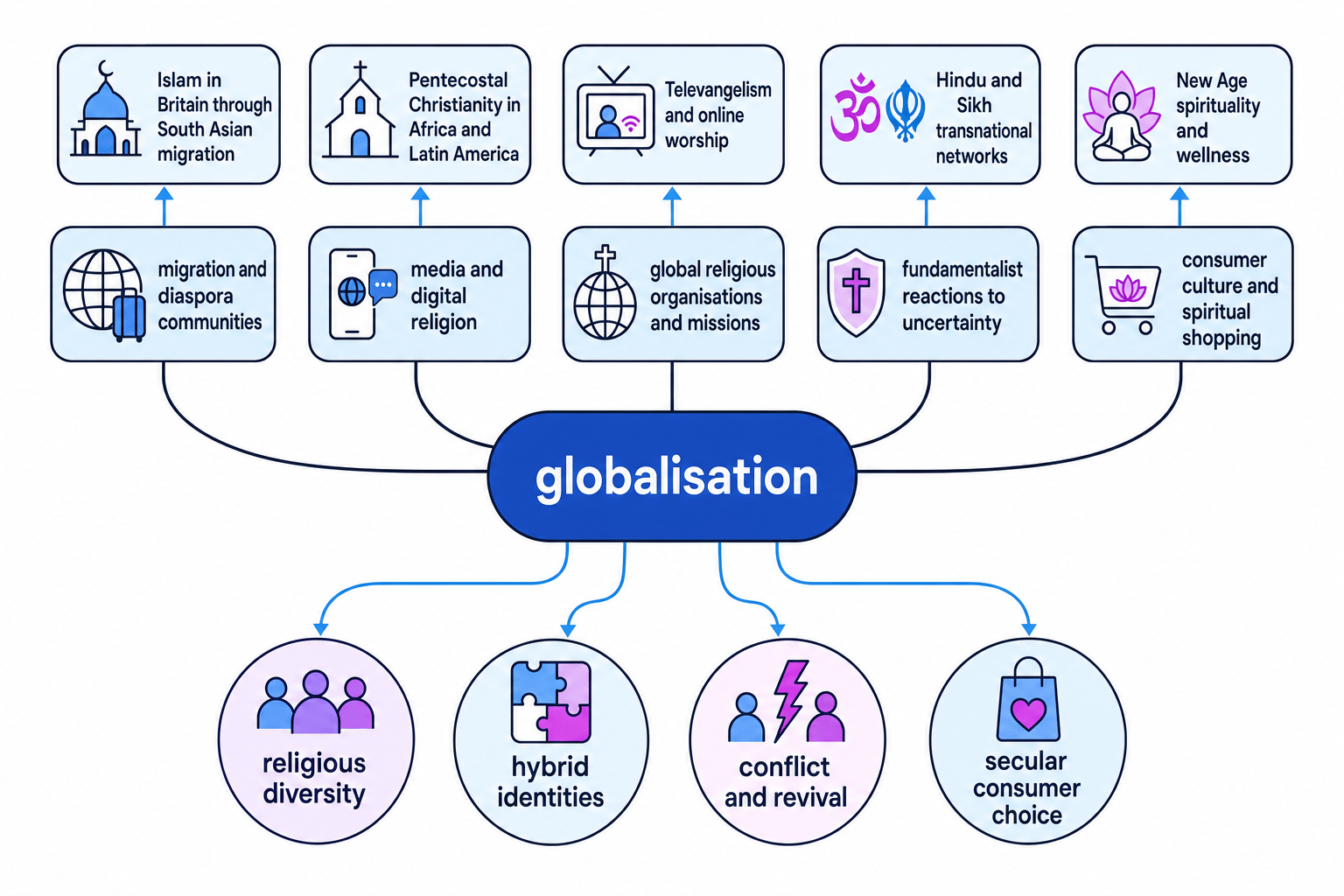
In Britain, post-war migration helped establish larger Muslim, Hindu, Sikh and Pentecostal Christian communities. Mosques, temples, gurdwaras and Black-majority churches are now part of the religious landscape of cities such as London, Birmingham, Leicester and Bradford.
Digital religion also matters. During the COVID-19 pandemic, many churches, mosques, temples and synagogues used livestreams, WhatsApp groups and online study sessions. This shows that globalisation does not simply weaken religion; it can create new forms of religious community.
8. Globalisation, uncertainty and fundamentalism
Fundamentalism
Fundamentalism is a form of religion that claims to return to basic truths, sacred texts and strict moral codes, often as a response to uncertainty or perceived moral decline.
Giddens argues that late modernity creates uncertainty because traditions are questioned and people must constantly make choices. Fundamentalism can offer certainty, authority and identity in a rapidly changing world.
Castells links this to resistance identity, where groups build strong identities in opposition to global capitalism, Westernisation or secular values. Bruce similarly argues that religion can be especially strong in situations of cultural defence, where a group feels threatened, or cultural transition, where migrants use religion to maintain identity in a new society.
Huntington’s “clash of civilisations” thesis claims global conflict increasingly occurs between religious-cultural blocs. This is useful for showing the political significance of religion, but it is often criticised as too simplistic. It ignores diversity within religions and downplays economic inequality, colonial history and state power.
Evaluating globalisation and religious revival
- Apply globalisation: migration and digital media allow religious communities to maintain links across borders, such as British Muslims connecting with a global ummah.
- Add revival: uncertainty, racism or cultural change may make religion more important as a source of identity and solidarity.
- Evaluate both sides: the same globalisation can also expose people to pluralism, secular lifestyles and criticism of religion, which may weaken traditional authority.
9. The overall judgement
For essays, the strongest argument is usually not “religion is declining everywhere” or “religion is coming back everywhere”. The best judgement is that religion is changing unevenly.
In Britain, there is strong evidence of secularisation in relation to traditional Christianity: falling church attendance, weaker Christian identity and less religious control over law and morality. But religion remains significant through minority faiths, public rituals, welfare, education, identity and politics.
Globally, secularisation is not universal. Religion is growing or remaining powerful in many societies, especially where migration, insecurity, inequality, nationalism or global media strengthen religious identity. Globalisation can weaken religion through pluralism and consumer choice, but it can also spread, revive and intensify it.
In the exam
- Define secularisation precisely, then separate belief, belonging, practice and institutional power.
- Use contemporary AO2 evidence, especially the 2021 Census for England and Wales, migration, online worship and faith-based public roles.
- Evaluate with a clear judgement: secularisation is strongest in Western Europe and traditional Christianity, but globally religion is uneven, changing and often politically significant.
Check yourself
- Why is “no religion” in the Census not the same as proving everyone is atheist?
- How can globalisation both weaken and strengthen religion?
- Which theorist would you use to argue “believing without belonging”, and how would Bruce criticise this?
