What you'll learn
- How sociologists distinguish churches, denominations, sects, cults/new religious movements, and New Age movements.
- How religious organisations shape belief, practice, socialisation, culture and identity.
- How to apply examples from contemporary UK society.
- How to evaluate the usefulness and limits of these categories in essays.
Starting point: belief, practice and organisation
Before you learn the types, separate three linked ideas:
- Religious belief means ideas about the sacred, God, gods, spirits, salvation, morality or ultimate meaning.
- Religious practice means what people do: worship, prayer, rituals, festivals, dress codes, meditation, pilgrimage, charity work.
- Religious organisation means the social structure that holds beliefs and practices together.
Religious organisation
A religious organisation is a group, institution or network that gives religious or spiritual beliefs a social form, for example through leadership, membership, rules, rituals, buildings, online communities or shared identities.
Religious organisations matter because they are agencies of socialisation: they teach members what is sacred, how to behave, who “we” are, and who counts as outside the group. They also connect to power and stratification, because some organisations have more influence, wealth, status and state recognition than others.
Organisation shapes belief
Sociologists do not only ask “what do people believe?” They also ask “how is that belief organised, who controls it, and how does it affect people’s identity and social position?”
Ideal types: a map, not a perfect reality
Sociologists often use ideal types. This does not mean “perfect”. It means a simplified model that highlights key features so you can compare messy real-world cases.
Ideal type
An ideal type is an analytical model used to compare social phenomena. Real examples may only partly fit the model.
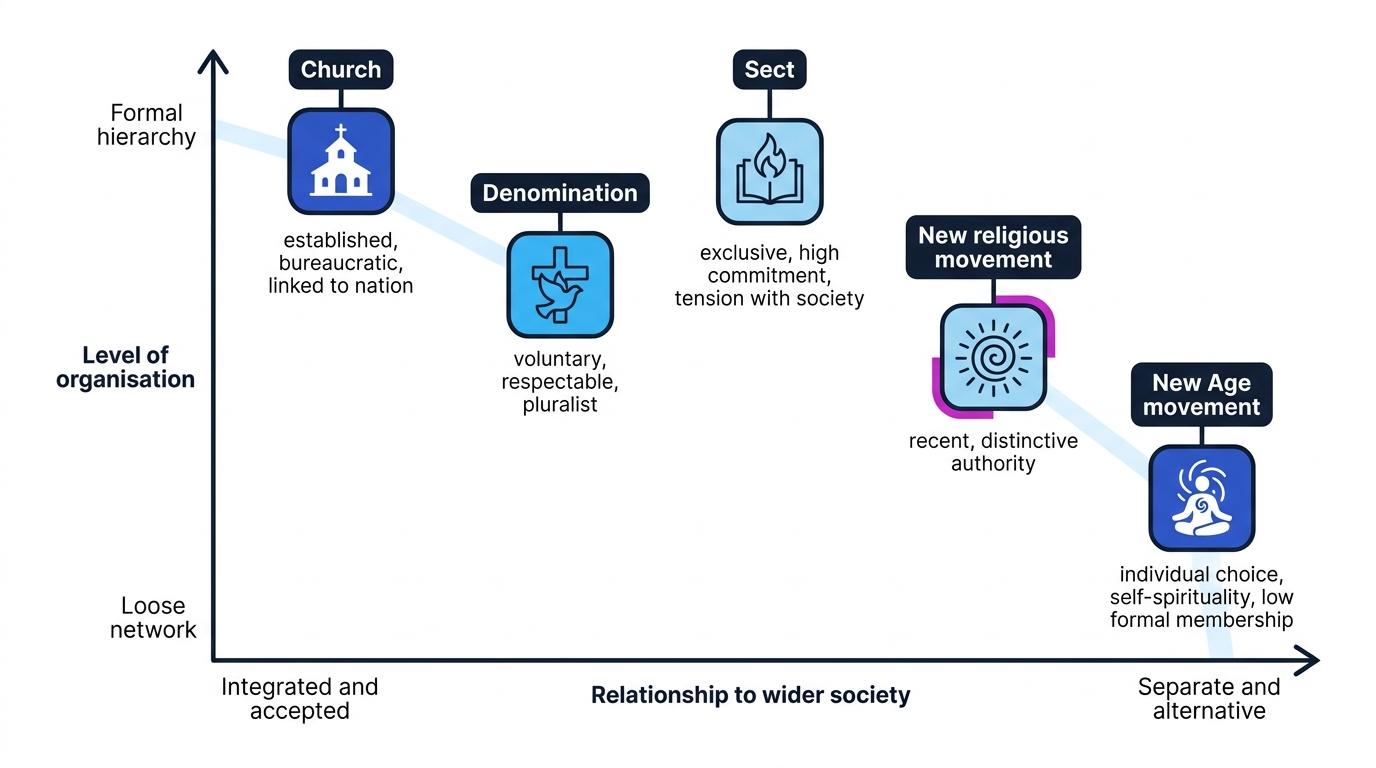
A helpful way to remember religious organisations is to compare them by:
- their relationship to wider society: accepting, accommodating or rejecting;
- their level of organisation: formal hierarchy or loose network;
- their demands on members: low, moderate or high commitment;
- their source of authority: tradition, clergy, scripture, charisma, personal experience or consumer choice.
A quick classification checklist
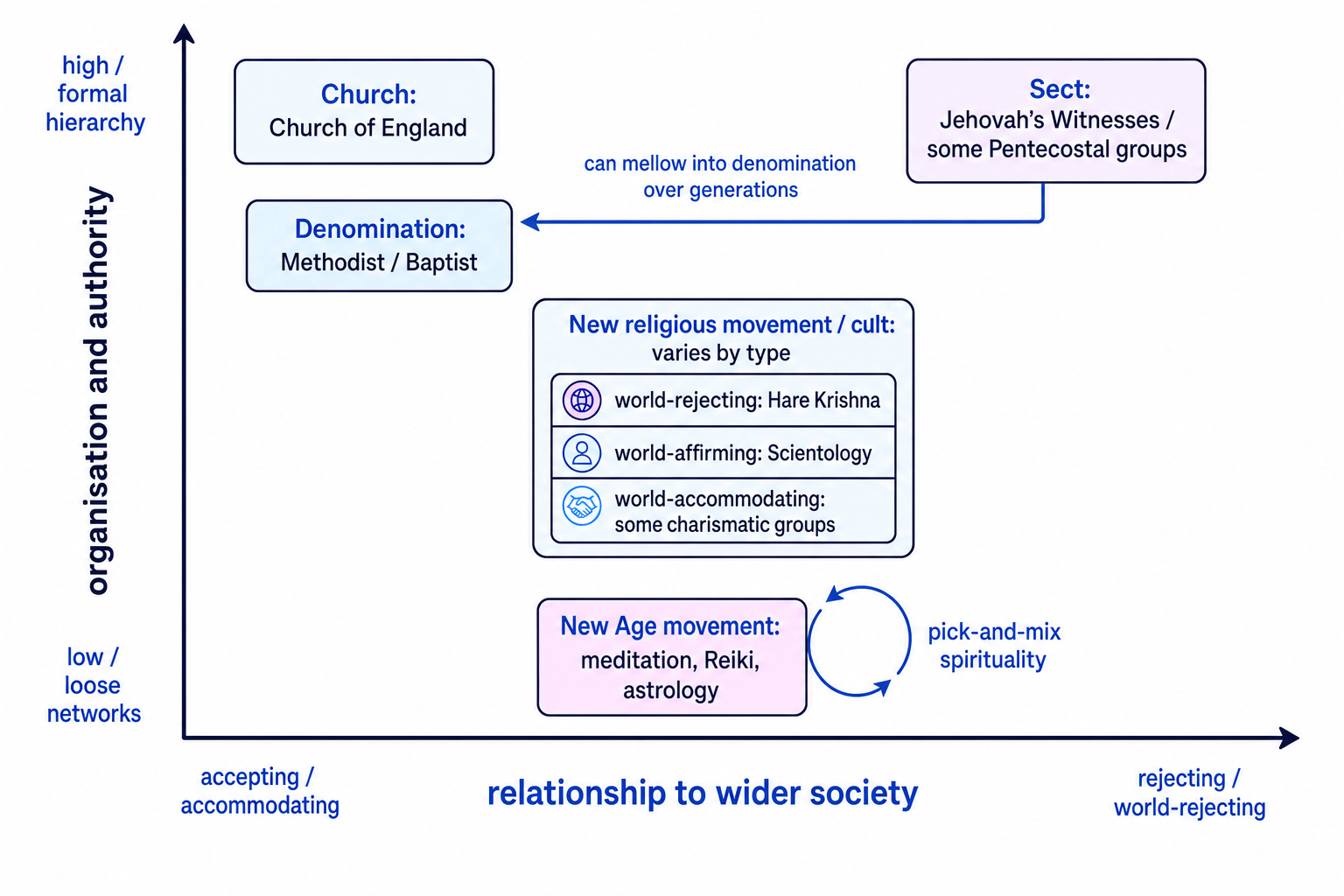
Use four questions: How formal is it? How separate is it from wider society? How much commitment does it demand? Where does its authority come from?
Treating the categories as fixed boxes
Do not write as if every group fits neatly forever. Organisations can change over time, and the same group may look different in different societies.
Churches
Troeltsch identified the church as a large, established religious organisation with a formal hierarchy and a close relationship with wider society.
Church
A church is a large, inclusive, bureaucratic religious organisation that usually claims broad moral authority and is often linked to the state or national culture.
The clearest UK example is the Church of England. It is an established church: the monarch is its Supreme Governor, bishops sit in the House of Lords, and it still plays a role in national ceremonies such as coronations, remembrance services and royal weddings.
Churches usually have professional clergy, official doctrines and recognised rituals. They often socialise people through rites of passage such as baptism, marriage and funerals. Even people who rarely attend may use the church for cultural identity. Davie calls this believing without belonging: religious belief or attachment may remain even when regular attendance declines.
AO3 evaluation: the church model is useful for understanding historical power, but secularisation has weakened church authority. The 2021 Census for England and Wales recorded “no religion” as a major and growing category, while Christian identification fell below half of the population. This suggests that church influence remains visible but is no longer socially taken for granted.
Denominations
Niebuhr developed the idea of the denomination, which sits between a church and a sect.
Denomination
A denomination is a mainstream religious organisation that is voluntary, relatively respectable, tolerant of other religions, and less closely tied to the state than a church.
Examples in Britain include Methodists, Baptists and Quakers. Denominations tend to accept religious pluralism, meaning they recognise that other religious groups can legitimately exist. They usually have organised leadership and regular worship, but they do not claim to represent the whole nation in the way a church may.
Denominations often fit modern multicultural society because they allow religion to become one identity choice among others. For AO2, think of a Baptist congregation in a UK town: members may attend weekly services, youth groups and charity work, while also participating in mainstream education, employment and politics.
AO3 evaluation: “denomination” can be context-dependent. Roman Catholicism is a global church with a formal hierarchy, but in Britain it can function sociologically like a denomination because it exists alongside other faiths rather than as the state church.
Sects
Troeltsch contrasted churches with sects. Sects are usually smaller, more exclusive and more critical of wider society.
Sect
A sect is a small, high-commitment religious organisation that often claims exclusive access to truth, separates itself from wider society, and demands strong discipline from members.
Examples often discussed include Jehovah’s Witnesses, the Plymouth Brethren, and some highly separatist Pentecostal groups. Be careful: not all Pentecostal churches are sects. Many are mainstream denominations or community churches.
Weber argued that sects may attract groups experiencing deprivation, meaning disadvantage or lack of status, because they offer dignity, certainty and a religious explanation of suffering. This links directly to social differentiation and power: marginalised groups may use sect membership to gain solidarity and identity when they feel excluded from mainstream society.
Explaining why sects may appeal to marginalised groups
Imagine an item describes a small religious group that rejects mainstream values, expects strict moral behaviour, and attracts people who feel ignored by wider society.
- Classify the organisation by its features: small size, strict discipline and separation from wider society point towards a sect rather than a denomination.
- Apply Weber’s idea of deprivation: if members feel economically, socially or culturally excluded, the sect can offer status, belonging and moral certainty.
- Link belief to practice: beliefs about being a chosen or morally pure group may produce practices such as strict dress codes, intense worship or limited contact with outsiders.
- Add evaluation: this explanation may fit some groups, but not all sect members are materially deprived; some may be attracted by certainty, community or spiritual intensity.
The sect-to-denomination cycle
Niebuhr argued that sects can become denominations over time. A sect may begin as a protest against an established church. But as members’ children are born into the group, and as the group becomes more respectable, its tension with wider society may reduce. This process is sometimes called denominationalisation.
This is useful for essays because it shows that religious organisations are not static. They respond to generational change, class mobility and wider cultural acceptance.
AO3 evaluation: the cycle does not always happen. Some sects maintain strong boundaries for long periods, especially if separation is central to their identity. Others may decline rather than become denominations.
Cults and new religious movements
The word cult is tricky because everyday language often uses it negatively. In sociology, it has a more technical meaning.
Use “cult” carefully
In sociology, cult does not automatically mean dangerous or irrational. However, because the word is loaded, many sociologists prefer new religious movement or NRM.
New religious movement
A new religious movement is a relatively recent religious or spiritual organisation, often outside older mainstream traditions, with distinctive beliefs, practices or forms of authority.
Stark and Bainbridge distinguish cults from sects by origin: sects usually break away from an existing religion, while cults offer more novel or imported beliefs. Examples often discussed include Scientology, Hare Krishna and the Unification Church.
Wallis classified new religious movements by their relationship to the world:
- World-rejecting movements separate members from mainstream society, for example some communal movements.
- World-accommodating movements offer spiritual renewal while allowing members to remain in ordinary life.
- World-affirming movements promise techniques for success, confidence or self-development, such as some forms of Scientology or Transcendental Meditation.
Barker’s study of the Unification Church, often called the “Moonies”, challenged the idea that converts were simply “brainwashed”. Her research found that most people exposed to the movement did not join permanently. Methodologically, this shows the value of detailed qualitative research, but also raises issues of access, researcher safety and whether findings from one group can be generalised.
New Age movements
New Age movements are usually much looser than churches, sects or denominations. They are often networks of practices rather than single organisations.
New Age movement
A New Age movement is a loose spiritual network that emphasises personal growth, healing, self-discovery, holism and individual choice rather than fixed doctrine or formal membership.
Examples include meditation, Reiki, astrology, crystal healing, tarot, yoga spirituality, pagan festivals, retreats and online spiritual coaching. New Age spirituality often fits postmodern society because people “pick and mix” beliefs rather than accepting one official truth.
Heelas describes this as self-spirituality: the sacred is found within the individual self. Hervieu-Léger uses the idea of spiritual “pilgrims” and “converts” to show that modern religious identity can be chosen, revised and personalised.
Applying New Age ideas to contemporary practice
Consider someone who uses a meditation app, reads astrology online, attends occasional yoga retreats and does not belong to a formal religion.
- Identify the organisational form: there is no single church, clergy or fixed membership, so this fits a loose New Age-style network.
- Connect belief to identity: the person constructs a personal spiritual identity through choice and self-development.
- Apply postmodern analysis: this supports the idea that religion may shift from obligation to consumption, with individuals selecting practices that feel meaningful.
- Evaluate with secularisation theory: Bruce would argue this is weak commitment and does not replace declining church religion; Heelas and Woodhead suggest it still shows continuing spiritual interest.
Heelas and Woodhead’s Kendal Project found growth in the holistic milieu, but not enough to compensate for decline in traditional congregational religion. This is a strong AO3 point: New Age may show a change in religion rather than a full religious revival.
Overall evaluation: how useful are these categories?
The church–sect–denomination–cult typology is useful because it gives you clear AO1 concepts and helps you compare authority, commitment and social acceptance.
However, it has limits.
First, it can be Christian-centred. Terms like church, sect and denomination fit Christianity more easily than mosques, gurdwaras, mandirs or synagogues. In a multicultural UK, applying the typology too rigidly can distort non-Christian religions.
Second, it can stigmatise minority groups. Calling a group a “cult” may reflect media panic more than sociological evidence.
Third, religious life is increasingly hybrid. People may attend a church at Christmas, identify as “spiritual not religious”, use mindfulness at work, and follow astrology online. This supports Davie’s view that belief may continue outside formal belonging, but it also supports Bruce’s argument that weak private spirituality may lack the social power of organised religion.
Best essay judgement
The typology is most useful when you treat it as a flexible tool, not a rigid ranking. Always link the organisation type to belief, practice, identity and power.
In the exam
- Define the organisation type first, then give a UK or contemporary example.
- Apply it to belief and practice: explain how the organisation shapes commitment, identity, rituals, rules or authority.
- Evaluate by comparison: ask whether another category fits better, whether the group has changed over time, and whether the typology is too Western or outdated.
Check yourself
- What is the difference between a sect and a denomination?
- Why might New Age spirituality support both postmodern and secularisation arguments?
- Why should sociologists be cautious when using the word “cult”?