What you'll learn
- How crime and deviance appear to vary by ethnicity, gender and social class.
- Why official crime patterns may reflect both real behaviour and criminal justice processes.
- How key sociological perspectives explain unequal patterns of offending, victimisation and punishment.
- How to use recent UK trends carefully in essays.
Starting point: what is “social distribution”?
Social distribution of crime
The social distribution of crime means the pattern of crime, deviance, victimisation and criminal justice outcomes across different social groups, such as gender, ethnicity and class.
Crime and deviance
Crime is behaviour that breaks the formal law. Deviance is behaviour that breaks social norms, even if it is not illegal.
This topic is not just asking, “Who commits crime?” A stronger sociological question is:
Who is more likely to be reported, policed, labelled, convicted, imprisoned or victimised — and why?
That means you must link this topic to the two big AQA themes:
- Socialisation, culture and identity: people learn gender roles, class expectations and ethnic identities.
- Social differentiation, power and stratification: some groups have more power to define, hide or punish deviance.
Measuring crime: the statistics are filtered
Official statistics
Official statistics are crime data produced by state agencies, such as police recorded crime, court conviction data and prison population statistics.
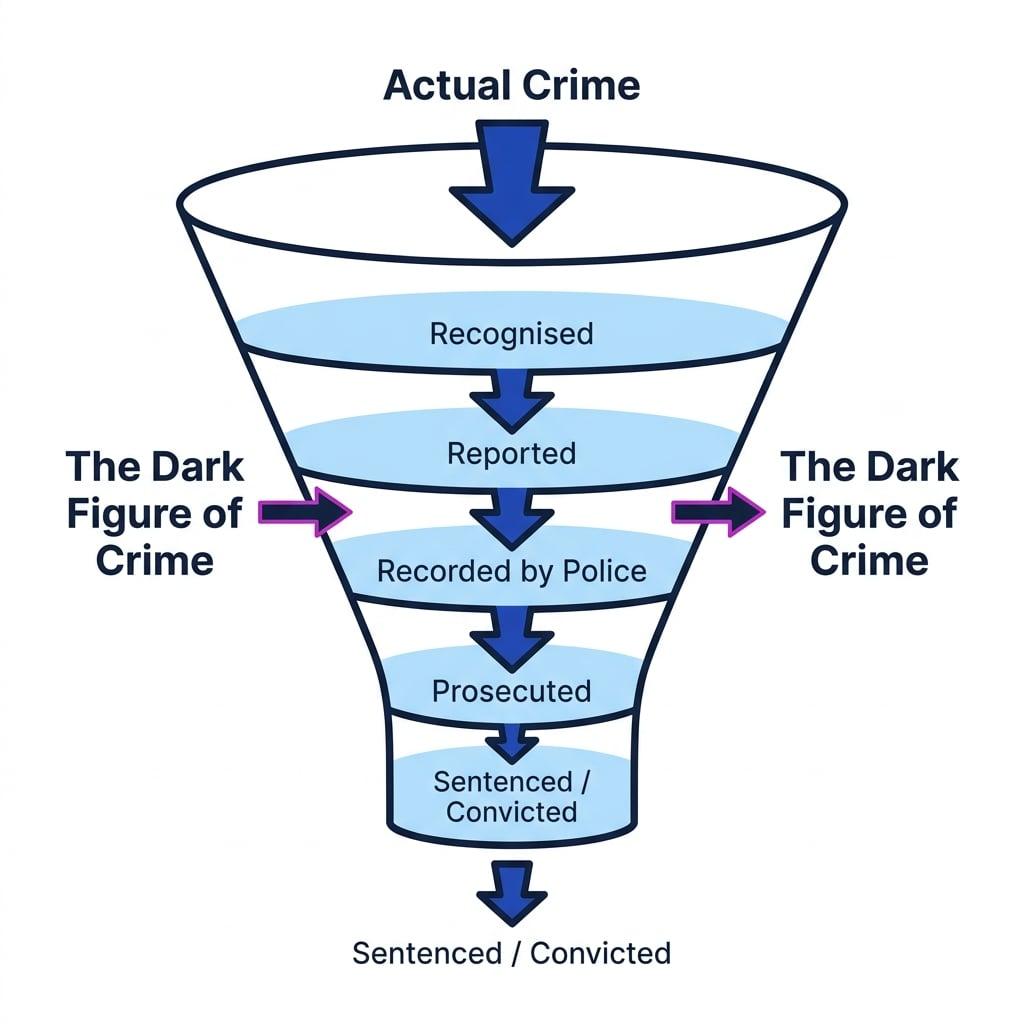
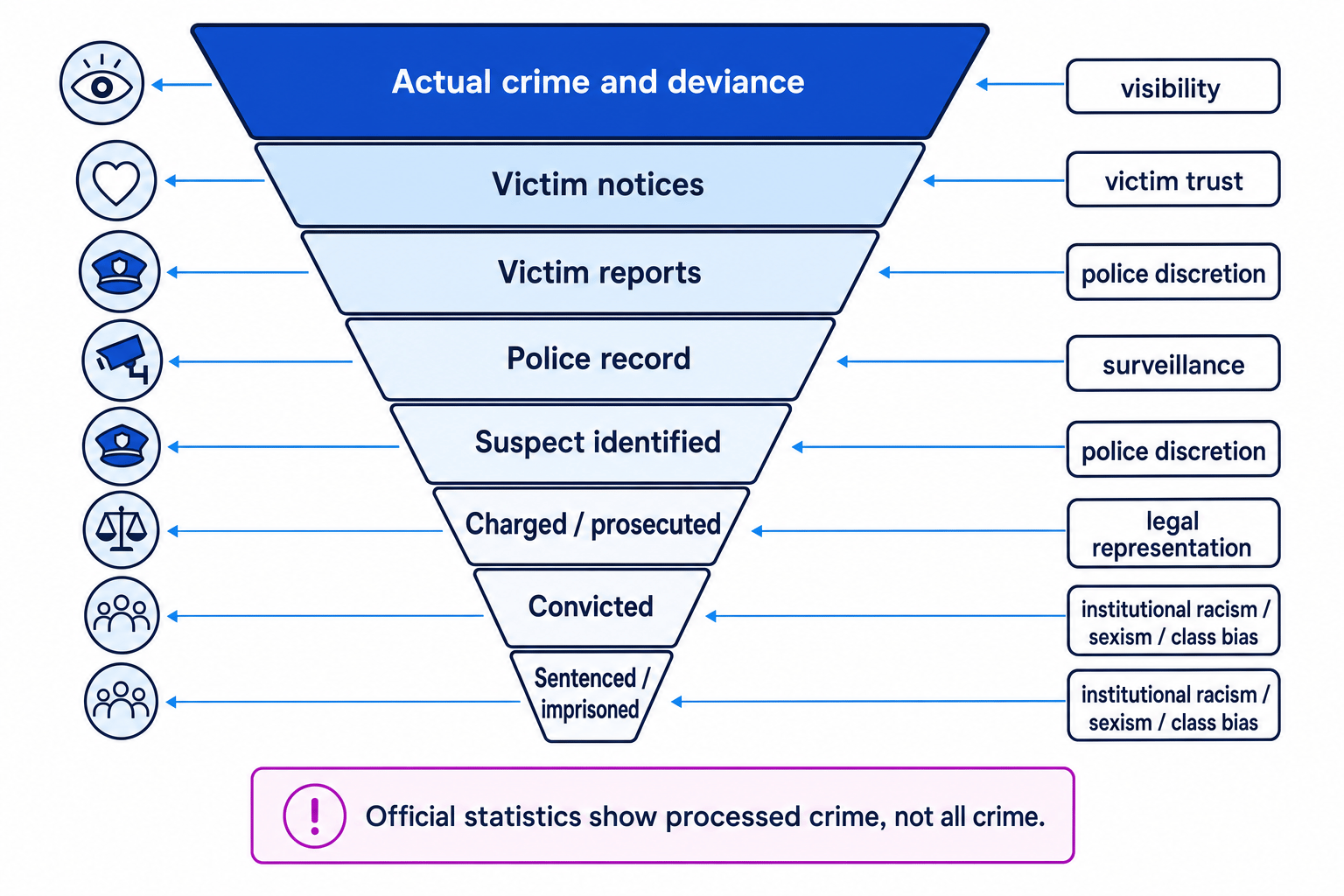
Official statistics are useful because they are large-scale and regularly collected. However, they do not show all crime. They show crimes that have passed through several filters: someone notices, reports, police record it, a suspect is identified, and the case may reach court.
Dark figure of crime
The dark figure of crime refers to offences that happen but do not appear in official statistics because they are not reported, recorded or detected.
The Crime Survey for England and Wales, often shortened to CSEW, asks a sample of people about their experiences of crime, including some crimes not reported to police. It is useful for estimating victimisation, but it still misses some groups and offences, such as crimes against businesses, people in institutions, and some hidden domestic or sexual offences.
Interpreting over-representation cautiously
-
Compare the statistic with the group’s share of the wider population. If a group forms a small percentage of the population but a larger percentage of prisoners, there is over-representation.
-
Identify the stage of the criminal justice process. Stop and search data may show police discretion more strongly than conviction data.
-
Consider both behaviour and social reaction. A pattern may reflect real offending, selective policing, differences in reporting, or a mixture.
-
Link to theory. For example, labelling theory focuses on police stereotypes, while left realism also considers relative deprivation and real victimisation.
Processed crime, not all crime
Official statistics show processed crime. They are shaped by reporting, policing and punishment, not just by the amount of offending.
Gender and crime
The main pattern
The clearest pattern in crime statistics is that men are much more likely than women to be convicted of crime, especially serious violence, sexual offences and robbery. Men also make up the overwhelming majority of the prison population in England and Wales.
Women’s recorded offending is usually lower and is more often linked to offences such as theft, fraud, handling stolen goods, minor drug offences or offences connected to poverty and dependency. However, you should avoid suggesting that women are “naturally” less criminal. Sociology asks how gender is socially produced.
Gender socialisation
Gender socialisation
Gender socialisation is the process through which people learn the norms, expectations and behaviours associated with being male or female in society.
Boys may be encouraged to be tough, risk-taking and competitive. Girls may be encouraged to be caring, respectable and controlled. This can help explain why young men are over-represented in street violence, risk-taking and public disorder.
Messerschmidt argues that some men may use crime as a way of “doing masculinity”, especially when they lack legitimate ways to achieve status, money or respect.
Feminist explanations
Heidensohn argues that women commit less crime partly because they are subject to greater patriarchal control. This control operates:
- at home, through domestic responsibilities and surveillance;
- in public, through fear of male violence and reputational judgement;
- at work, through limited opportunities and supervision.
Carlen’s study of working-class women offenders argued that women are encouraged to conform through a class deal and a gender deal. If these deals fail — for example, if work is poorly paid and family life is abusive — some women may see less reason to conform.
Chivalry and double deviance
The chivalry thesis, associated with Pollak, argues that the criminal justice system treats women more leniently because police, judges and magistrates are often protective towards them.
Feminists criticise this as too simple. Some women may be punished harshly if they are seen as doubly deviant: breaking the law and breaking expectations of femininity, motherhood or sexual respectability.
Assuming women are always treated leniently
The criminal justice system may treat some women leniently, but it may punish others harshly for failing to fit “respectable” feminine roles. Always consider class, ethnicity and the type of offence.
Applying gender explanations to male violence
-
Start with the pattern: young men are more likely than women to be involved in public violence and serious youth violence.
-
Apply gender socialisation: norms of toughness, honour and risk-taking can make violence a way of gaining status.
-
Add Messerschmidt: where legitimate routes to masculine success are blocked, crime may become an alternative performance of masculinity.
-
Evaluate with feminism: this explains male offending well, but it also needs class and ethnicity because not all men experience the same opportunities or policing.
Ethnicity and crime
The main pattern
In England and Wales, Black and mixed ethnicity groups are over-represented at some stages of the criminal justice system, especially stop and search, arrest and imprisonment. However, White people still form the largest number of offenders and prisoners because they are the largest ethnic group in the population.
You must be careful: “ethnicity” is not a biological cause of crime. Ethnic categories are broad social categories, and patterns are strongly affected by class, age, gender, area, racism and policing.
Institutional racism and labelling
Institutional racism
Institutional racism means discrimination built into the routines, assumptions and practices of organisations, even when individuals do not openly express racist views.
The Macpherson Report into the police handling of the Stephen Lawrence case described the Metropolitan Police as institutionally racist. This is often applied to stop and search, where Black people have historically been searched at much higher rates than White people.
Interactionists argue that police may use typifications — stereotypes of the “typical offender”. Cicourel showed that police decisions can be shaped by assumptions about class, ethnicity, age and appearance. This can create a self-fulfilling prophecy: groups policed more heavily appear more criminal in official statistics.
Neo-Marxist and left realist views
Hall et al. in Policing the Crisis argued that the 1970s moral panic over “mugging” constructed young Black men as a threat. They linked this to capitalism, unemployment and the state’s need to manage crisis through policing.
Gilroy argued that the idea of “Black criminality” is partly a myth created by racist policing and the criminalisation of resistance to racism and colonialism.
Lea and Young, as left realists, accepted that racist policing matters but argued it cannot explain everything. They argued that some ethnic minority crime may also be linked to relative deprivation, marginalisation and subcultures formed in response to blocked opportunities.
Explaining a stop-and-search pattern
-
Identify the pattern: if Black people are stopped and searched at a higher rate than White people, this shows disproportionality.
-
Apply institutional racism: police practices may focus suspicion on racialised groups, even without openly racist intentions.
-
Apply labelling theory: repeated police attention can make a group appear more criminal in official statistics.
-
Evaluate using left realism: some communities also face real problems of poverty, victimisation and exclusion, so analysis should include both policing and social conditions.
Use ethnicity carefully
Never write as if ethnicity itself causes crime. Write about racism, policing, deprivation, marginalisation, victimisation and social context.
Social class and crime
The main pattern
Official statistics tend to show working-class people as more involved in recorded street crime, such as burglary, robbery, vehicle crime and some violence. Working-class people are also over-represented in prisons.
But this pattern is incomplete. Middle-class and upper-class crime is often less visible. White-collar crime refers to offences committed by people in professional or high-status occupations, such as fraud, insider trading or tax evasion. Corporate crime refers to illegal or harmful actions by companies, such as environmental offences, unsafe working practices or financial misconduct.
Strain and subcultural theories
Merton’s strain theory argues that society encourages everyone to seek success, especially money and status, but not everyone has equal legitimate opportunities. Some people adapt through innovation: accepting the goal of success but using illegitimate means.
Cohen argued that working-class boys may experience status frustration when they fail by middle-class school standards. They may form delinquent subcultures where they gain status through deviance.
Cloward and Ohlin added that access to criminal opportunities is also unequal. Not everyone can become a successful criminal; this depends on local illegitimate opportunity structures.
Marxist and interactionist explanations
Marxists argue that capitalism is criminogenic, meaning it creates crime by promoting inequality, competition and materialism. They also argue that the law protects ruling-class interests, while working-class crime is more heavily policed.
Interactionists add that working-class youth may be labelled as suspicious because of their clothing, speech, area or school record. This links to Cicourel’s argument that police stereotypes shape official statistics.
Comparing class explanations
-
Take working-class burglary: Merton might explain it through blocked opportunities to achieve material success legally.
-
Add Cohen: if school failure damages status, deviant peer groups may offer alternative respect.
-
Compare with Marxism: the focus shifts from individual adaptation to capitalism, inequality and selective law enforcement.
-
Evaluate using white-collar crime: if fraud and corporate harm are under-recorded, official statistics may exaggerate the criminality of the working class.
Equating crime with street crime
Street crime is only one part of crime. Fraud, cybercrime, tax evasion, health and safety offences and corporate harm can be extremely damaging but less visible in official statistics.
Recent patterns and trends
Since the mid-1990s, many traditional volume crimes measured by the CSEW, such as burglary and vehicle crime, have generally fallen. However, this does not mean crime has simply “gone away”. Crime has partly changed form.
Recent trends include:
- Fraud and computer misuse becoming major parts of the crime picture.
- Increased recording and reporting of sexual offences, domestic abuse and hate crime.
- Continued concern about serious youth violence, knife crime and county lines drug markets.
- Ongoing debate about disproportionality in stop and search, sentencing and imprisonment.
- Greater attention to violence against women and girls, especially after high-profile cases and policy debates.
These trends affect social distribution. For example, online fraud may not fit older stereotypes of working-class street crime. Increased reporting of sexual offences may reveal hidden male violence rather than a simple rise in offending. Stop and search trends may reflect policing priorities as well as crime rates.
Trends depend on the data source
Police recorded crime may rise because police record offences more accurately or victims become more willing to report. CSEW trends are often better for long-term victimisation, but the survey also has limits.
Intersectionality: groups overlap
Intersectionality
Intersectionality means that social categories such as class, gender and ethnicity overlap, creating different experiences of power, identity, policing and victimisation.
A young working-class Black man may experience crime control differently from a middle-class White woman. A working-class woman may face both poverty and patriarchal control. A wealthy corporate offender may have resources to avoid detection, prosecution or severe punishment.
So, the best essays do not treat ethnicity, gender and class as separate boxes. They show how these categories interact.
The strongest argument
Patterns of crime are shaped by both social behaviour and social control. Sociologists ask who offends, who is victimised, who is labelled, and who has the power to avoid being labelled.
In the exam
-
Separate AO1, AO2 and AO3: define the pattern, apply it to UK examples, then evaluate the data source or theory.
-
Use phrases like “official statistics suggest…” rather than “this proves…”, because crime data is filtered through reporting and policing.
-
Compare perspectives: for example, use left realism to recognise real victimisation, then use labelling or Marxism to question selective enforcement.
Check yourself
- Why might official statistics exaggerate working-class criminality?
- How can both racism and relative deprivation be used to explain ethnic differences in crime statistics?
- Why do feminist sociologists reject simple biological explanations of male and female crime patterns?