Welcome to one of the most dynamic, contemporary, and politically charged topics in your A-Level Sociology course. In this unit, we move beyond traditional street crime to examine how the modern world is interconnected, how media shapes our perception of deviance, and how some of the most destructive crimes on Earth are committed by states and global corporations.
What you'll learn
- How globalisation has transformed the scale and nature of crime, creating a "global criminal economy".
- The role of media in representing, exaggerating, and actively generating crime and deviance.
- The differences between traditional and green criminology, and why environmental harm is a sociological issue.
- How states commit crimes against their own citizens and how they use language to deny or justify human rights abuses.
1. Globalisation and Crime
To understand modern crime, we must first look at how the world has shrunk. Globalisation refers to the increasing interconnectedness of societies across the globe, driven by rapid technological advances, global trade, and easier travel.
Globalisation
Globalisation is the widening, deepening, and speeding up of worldwide interconnectedness across all aspects of contemporary social life, from the cultural to the criminal.
The Global Criminal Economy
Sociologist Manuel Castells (1998) argues that globalisation has created a global criminal economy worth over £1 trillion per year. Crime is no longer confined within national borders; it operates in fluid, transnational networks.
Key forms of global crime include:
- Trafficking of arms, drugs, and humans: Illegal goods and desperate people are smuggled across borders to meet demands in wealthier nations.
- Cybercrime: Computer-mediated crimes like phishing, identity theft, and ransomware attacks that can be launched from anywhere in the world.
- Green crimes: Transnational environmental damage, such as illegal logging or dumping toxic waste in developing countries.
- Money laundering: Hiding the origins of "dirty" money using complex offshore bank accounts.
The "Glocal" Nature of Crime
While crime has gone global, its impact is always felt locally. Hobbs and Dunningham (1998) coined the term "glocal" to describe how local criminal networks are linked to and dependent on global connections.
For example, a local drug dealer operating in a UK estate relies on a global supply chain stretching back to poppy fields in Afghanistan or cocaine cartels in Colombia. The business model is local, but the supply chain is entirely global.
The local-global link
Do not think of global crime as something happening "over there". Globalisation means that local criminal opportunities are shaped by global networks. Crime is "glocal".
Global Risk Consciousness
According to Ulrich Beck (1992), we now live in a "risk society". Globalisation and technological progress have created new, man-made "manufactured risks" (such as global warming or cyber warfare) that threaten all of humanity. The media often fuels a global risk consciousness, raising public anxiety about threats like international terrorism, global pandemics, and immigration, which in turn leads to calls for tougher border controls and state surveillance.
2. The Media and Crime
The media is our primary window into the world of crime. However, sociologists argue that this window is heavily distorted.
Media Representations of Crime
The media does not offer a mirror image of reality; it constructs crime. Ditton and Duffy (1983) found that the media over-represents violent and sexual crimes. While these make up an incredibly small percentage of actual crimes recorded by the police, they dominate newspaper headlines and television news.
This distortion is driven by news values—the criteria journalists and editors use to decide if a story is "newsworthy". Key news values include:
- Dramatisation: High excitement and action.
- Personalisation: Human-interest stories focusing on individual victims or villains.
- Violence: Graphic or shocking events.
- Simplification: Presenting situations in black-and-white terms (e.g., "pure evil" vs. "innocent victim").
The Deviancy Amplification Spiral and Moral Panics
One of the most famous concepts in sociology is Stanley Cohen's (1972) study of moral panics and the deviancy amplification spiral.
Moral Panic
A moral panic is an exaggerated, irrational over-reaction by society—often fueled by sensationalist media reporting—to a group or behaviour seen as a threat to societal values.
When studying the clashes between two youth subcultures—the "Mods" and the "Rockers"—in the 1960s, Cohen tracked how media sensationalism actually increased the very deviance it reported on:
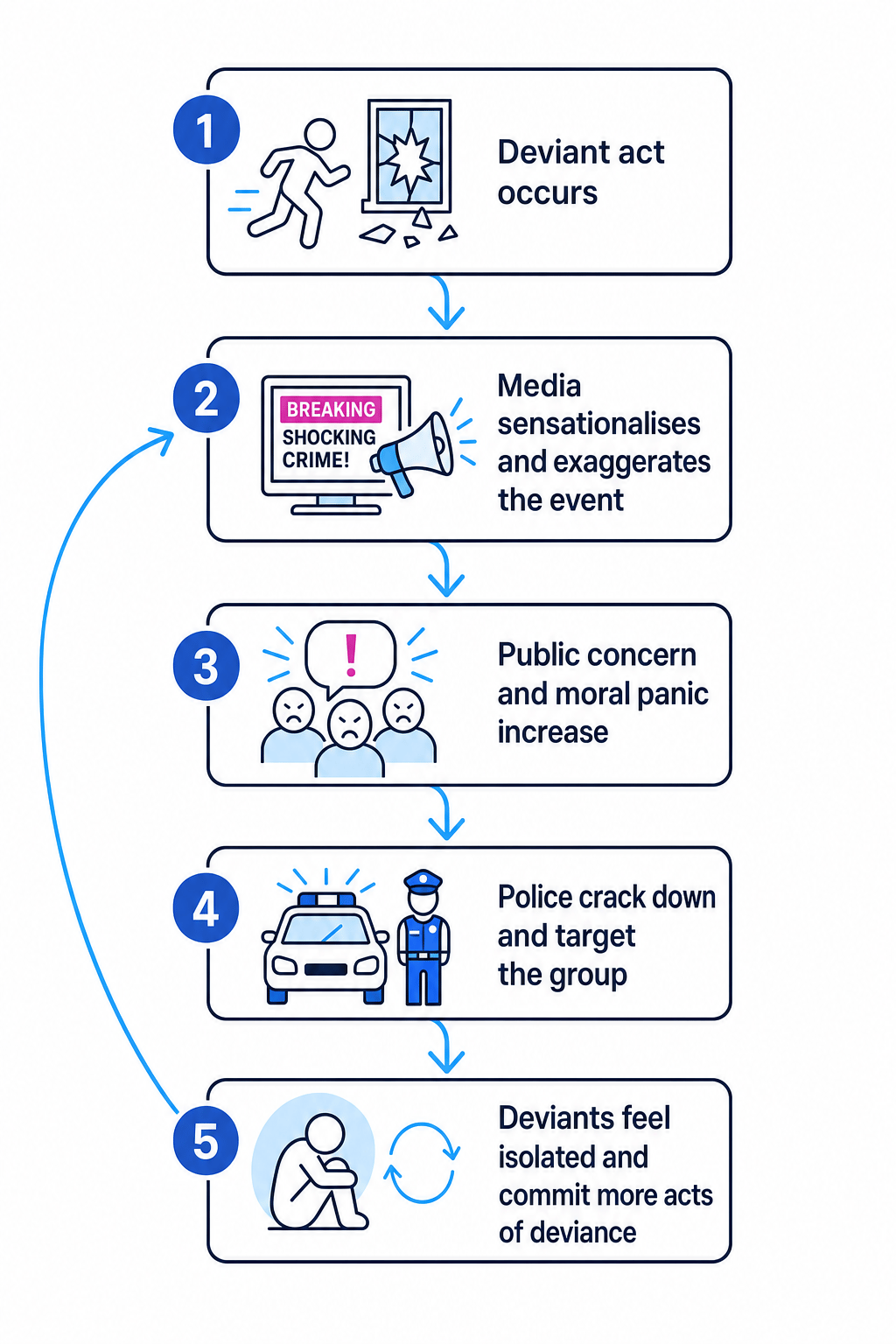
- A minor deviant act occurs: A small scuffle breaks out between rival youth groups on a bank holiday weekend.
- Media reporting exaggerates and distorts: The media reports on "riots" and "chaos", using dramatic headlines and predicting future violence.
- Public concern increases: The public demands action; a moral panic is generated.
- Police crack down: Under public pressure, the police arrest more youths, targeting anyone fitting the "Mod" or "Rocker" style.
- Deviants feel isolated: This heavy-handed policing forces the youths into more defensive, deviant positions, confirming the media's original predictions. The spiral continues.
Confusing moral panics with high crime rates
Students often write that moral panics happen because crime is rapidly rising. This is incorrect. A moral panic is characterized by an exaggerated reaction where the public anxiety is wildly disproportionate to the actual level of threat or crime.
3. Green Crime
Traditional criminology focuses on laws that are broken. However, green criminology takes a radically different approach, moving beyond legal boundaries to focus on environmental harm.
Traditional vs. Green Criminology
- Traditional Criminology (Legalistic): Only studies environmental actions that violate national or international laws. If a government allows a company to cut down a rainforest legally, traditional criminologists do not classify it as a crime.
- Green Criminology (Radical/Zemiological): Focuses on zemiology (the study of social and environmental harms). Green criminologists argue that if an action harms the planet, humans, or non-human animals, it is a green crime—regardless of whether a specific law has been broken.
Zemiology over legality
Green criminology is "radical" because it argues that powerful corporations and governments often shape laws to ensure their own environmentally damaging practices remain perfectly legal.
Types of Green Crime
Nigel South (2014) distinguishes between two main types of green crime:
| Type of Green Crime | Definition | Examples |
|---|---|---|
| Primary Green Crime | Crimes that result directly from the destruction and degradation of the Earth's resources. | Air pollution, deforestation, species extinction, and water pollution. |
| Secondary Green Crime | Crimes that arise from flouting rules aimed at preventing environmental disaster (often involving state complicity or cover-ups). | Illegal hazardous waste dumping, or state violence against environmental activists (e.g., the French secret service bombing the Greenpeace ship Rainbow Warrior). |
4. Human Rights and State Crimes
State crimes are arguably the most serious crimes of all. Because states are responsible for making and enforcing laws, they have the power to commit massive atrocities while hiding behind their own legal systems.
State Crime
Green and Ward (2012) define state crime as "illegal or deviant activities perpetrated by, or with the complicity of, state agencies." This includes war crimes, torture, genocide, and state-sponsored assassination.
Why is State Crime so Serious?
- The Scale: States control vast resources and military power. This allows them to commit harm on a scale that ordinary criminals could never dream of (e.g., the Rwandan Genocide in 1994, which killed around 800,000 people in 100 days).
- The Monopoly on Legitimacy: The state has the power to define what is legal. They can rewrite national laws to make their own criminal acts legal and prosecute their opponents instead.
Human Rights and the Law
To bypass the problem of states defining their own actions as "legal", Herman and Julia Schwendinger (1970) argue that we should define crime as the violation of basic human rights rather than the breaking of national laws.
If a state denies its citizens basic rights—such as the right to life, freedom from torture, or gender equality—it is committing a crime. This shifts the focus away from state-defined "legality" and towards international moral standards.
The Spiral of Denial
How do states get away with massive human rights abuses? Stanley Cohen (2001) argues that states follow a predictable "spiral of denial" when accused of human rights violations:
- Stage 1: "It didn't happen." The state claims the atrocity never occurred (e.g., denying that a massacre took place).
- Stage 2: "If it did happen, it's something else." The state redefines the event. They might claim civilian casualties were "collateral damage" or that they acted in "self-defence".
- Stage 3: "It was justified." The state argues that the action was necessary to protect national security or fight terrorism.
Applying the Techniques of Neutralisation to State Crime
Cohen applies Sykes and Matza's (1957) "techniques of neutralisation"—originally developed to explain how juvenile delinquents justify their crimes—to show how states justify human rights violations. Let's walk through how a state might neutralise the accusation of torturing political prisoners.
- Denial of Victim: The state argues that the victims are not innocent; they are "terrorists", "extremists", or "subversives" who brought the treatment upon themselves.
- Denial of Injury: The state claims that no real harm was done, or rebrands the abuse with soft, clinical language (e.g., calling torture "enhanced interrogation techniques" or "moderate physical pressure").
- Denial of Responsibility: State actors claim they were "only following orders" from superiors, shifting individual blame up the chain of command.
- Condemning the Condemners: The state attacks those pointing out the abuse, accusing international NGOs (like Amnesty International) or foreign governments of hypocrisy, bias, or political interference.
- Appeal to Higher Loyalties: The state argues that their actions were done for a "greater good"—such as national security, protecting the homeland, or winning the war on terror.
Integrating Social Class and Power
When writing about state and green crimes, link your analysis to Marxism. Marxists argue that these crimes are "crimes of the powerful". The ruling class owns the means of production and controls state institutions, allowing them to exploit the environment and commit state violence with relative impunity, while the criminal justice system focuses on policing the working class.
In the exam
- Define your terms early: In 10- or 30-mark questions, ensure you explicitly define terms like "glocal", "zemiology", "moral panic", or "state crime" in your opening paragraphs. This secures your AO1 marks immediately.
- Evaluate the definition of crime: A fantastic AO3 evaluation point for any essay on state or green crime is the debate between legalistic definitions (what the law says) and harm-based definitions (Schwendinger's human rights approach). Point out that if we only use legalistic definitions, we allow powerful states and corporations to dictate what sociologists can investigate.
- Use contemporary examples: AQA examiners love to see up-to-date application (AO2). Refer to real-world examples like cybercrimes, the dumping of e-waste in developing nations, or specific historical and modern state conflicts to ground your theoretical arguments.
Check yourself
- How does the concept of "glocal" crime challenge the traditional view that crimes are either purely domestic or purely international?
- What is the difference between a primary green crime and a secondary green crime according to Nigel South?
- How do states use "techniques of neutralisation" to justify human rights abuses?
