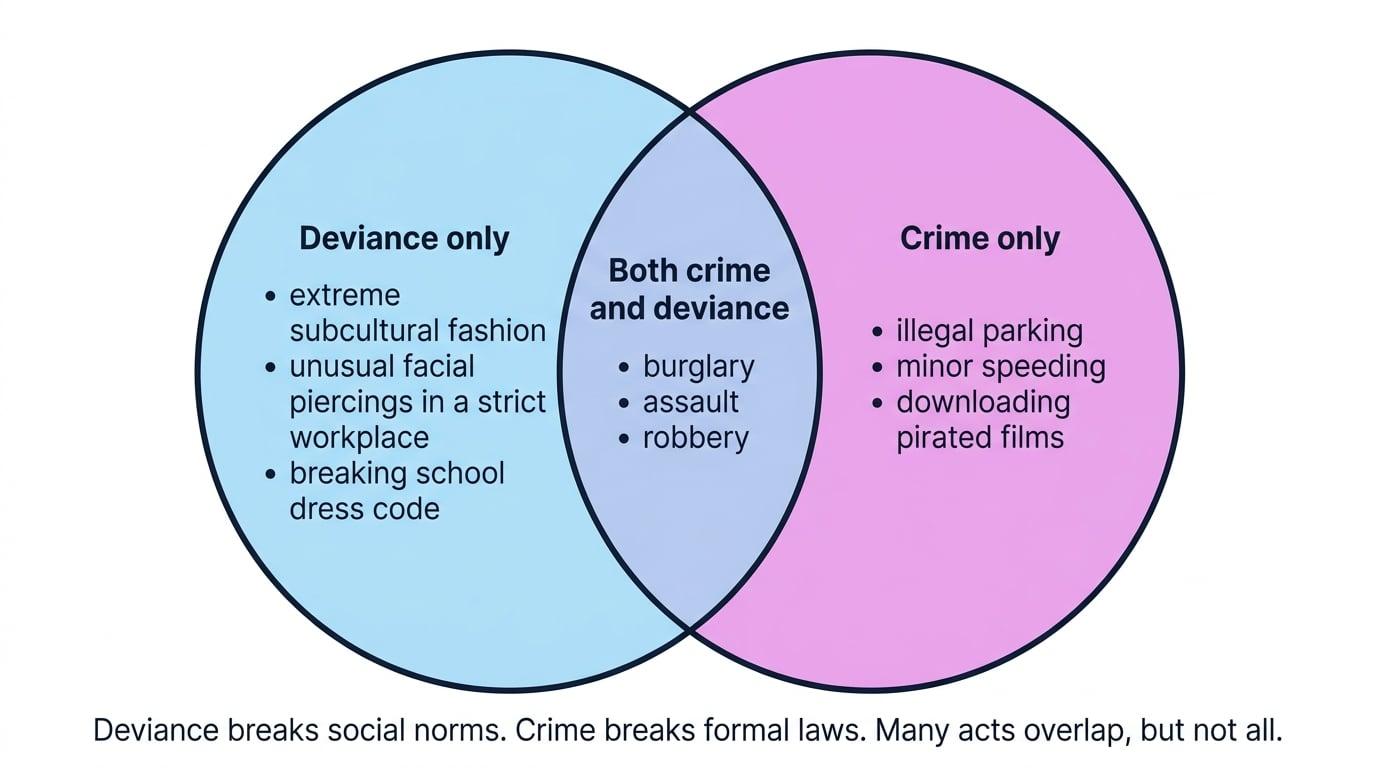
Welcome to your first topic in Crime and Deviance! This is one of the most exciting and highly debated areas of A-Level Sociology. Here, we investigate why people break rules, how society decides what those rules are, and how power shapes who gets punished.
What you'll learn
- The crucial distinctions between crime and deviance, and why both are socially constructed.
- How society maintains social order using formal and informal social control.
- How different sociological perspectives (like Functionalism and Marxism) explain the role of social control in modern Britain.
1. Defining Crime and Deviance
Before we can look at why people commit crimes, we must establish what counts as "wrong" behaviour. In sociology, we split this into two distinct but overlapping concepts: deviance and crime.
Deviance
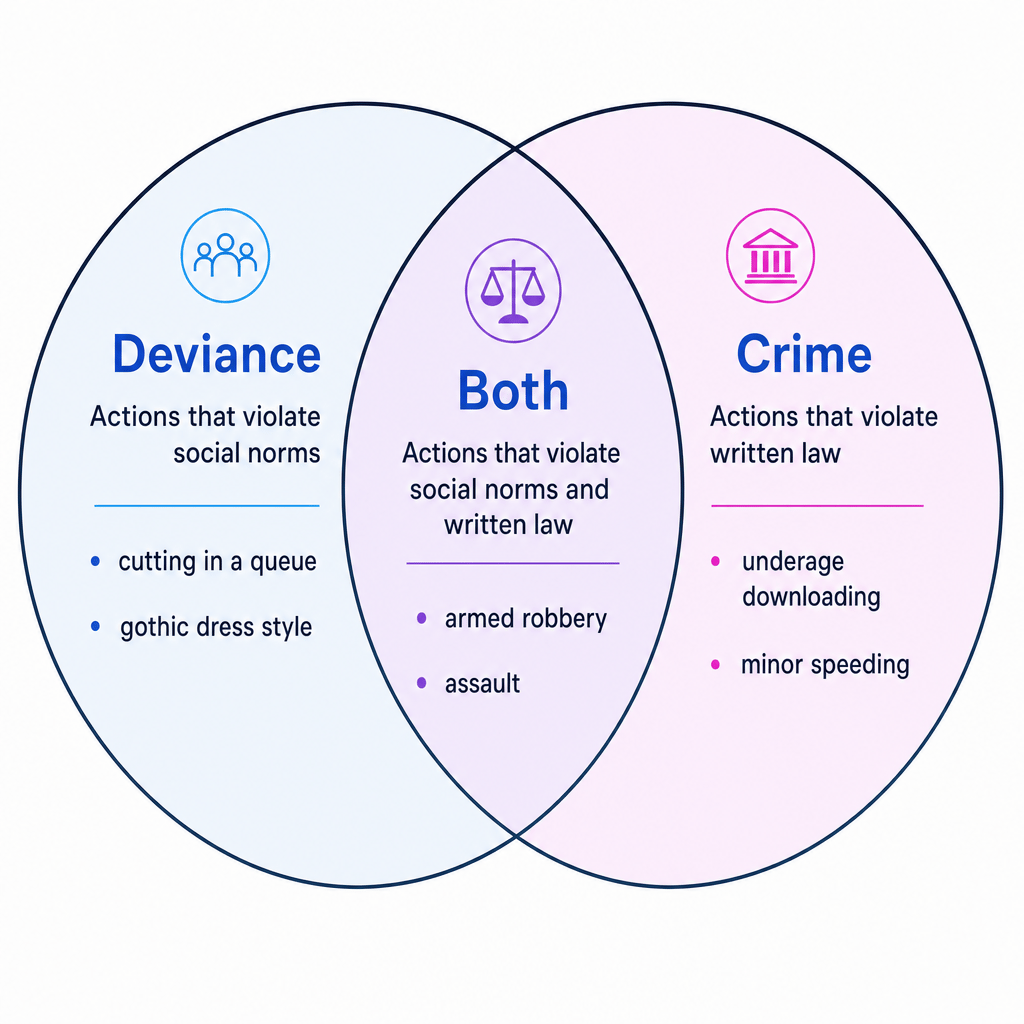
Deviance refers to any behaviour that violates the shared norms, values, and expectations of a social group or society. Deviance is not always illegal, but it always attracts some form of social disapproval or sanction.
Crime
Crime is any act that violates the written, formal laws of a society and is officially punishable by the state (for example, through fines, community service, or imprisonment).
The Relativity of Deviance
Unlike scientists studying gravity, sociologists cannot define deviance as a fixed physical law. What is considered deviant is relative—meaning it changes based on the context. Deviance is a social construct: it is created and defined by the society in which it occurs.
We can see this relativity across three main dimensions:
- Relativity over time: Homosexuality was illegal in England and Wales until 1967. Today, same-sex marriage is legally recognized, and homophobia is widely condemned as deviant.
- Relativity across cultures: In some Middle Eastern countries, drinking alcohol is strictly illegal and viewed as highly deviant. In the UK, alcohol consumption is a normalised social ritual.
- Relativity depending on the situation: Killing someone in self-defence or during active military combat is legally and socially accepted. Doing so in a street fight is murder.
The diagram below helps illustrate how these two concepts overlap, showing that while some actions are both criminal and deviant, others are only one or the other.
Confusing 'Deviant' with 'Bad'
Students often assume that deviance only refers to harmful or malicious acts. Remember that deviance can be positive or neutral. For example, "gothic" fashion or being an exceptionally gifted young child who goes to university at age 12 is technically deviant because it departs from the statistical norm, but it is not harmful.
How to Analyse the Relativity of an Action
To do well in your exams, you must be able to apply the concept of relativity to real-world scenarios. This shifts your writing from simple description (AO1) to high-level analysis (AO3).
Analysing the relativity of a social action
Consider the act of vaping (using electronic cigarettes). Walk through how a sociologist analyses whether this act is deviant or normal.
- Analyse the historical context (time): Contrast current attitudes with those of twenty years ago. Before the mid-2000s, vaping did not exist, and smoking cigarettes indoors was legally and socially acceptable in UK pubs and offices. Today, smoking is legally banned indoors, and vaping has emerged as a socially tolerated alternative but is increasingly restricted in public spaces due to changing health regulations.
- Analyse the situational context (place): Look at where the action occurs. Vaping while walking down a public street is generally accepted as non-deviant. However, vaping during an A-Level Sociology exam or on a commercial flight is highly deviant, violating institutional rules and inviting formal sanctions.
- Analyse the cultural/demographic context (social group): Examine who is performing the action. If a 30-year-old adult vapes outside a workplace, it is viewed as a normal habit. If an 11-year-old child vapes in a school playground, it is viewed as highly deviant, triggering shock and disciplinary action due to norms surrounding childhood innocence and health.
2. Social Order and Social Control
How is it that most people, most of the time, follow the rules? Sociologists refer to this stable, predictable state of affairs as social order. To keep society stable, we use mechanisms called social control.
Social Control
Social control is the process by which society encourages conformity to its norms and values, and discourages deviant or criminal behaviour.
We can split social control into two distinct types: formal and informal.
                         ┌─────────────────────────┐
                         │     Social Control      │
                         └────────────┬────────────┘
                                      │
              ┌───────────────────────┴───────────────────────┐
              ▼                                               ▼
┌───────────────────────────┐                   ┌───────────────────────────┐
│   Formal Social Control   │                   │  Informal Social Control  │
│                           │                   │                           │
│ • Written laws & rules    │                   │ • Unwritten social norms  │
│ • Official institutions   │                   │ • Everyday interactions   │
│ • e.g., Police, Courts,   │                   │ • e.g., Family, Peers,    │
│   Prisons, Employers      │                   │   Media, Education        │
└───────────────────────────┘                   └───────────────────────────┘
Formal Social Control
This is carried out by official agencies specifically set up to enforce the law and maintain order.
- The Police: Responsible for investigating crimes, arresting suspects, and enforcing the peace.
- The Criminal Justice System (CJS): Courts, judges, and prosecutors who determine guilt and hand down official punishments.
- Prisons and Probation: Penal institutions designed to punish, deter, and rehabilitate offenders.
Formal control relies on written rules and explicit sanctions (such as prison sentences or fines).
Informal Social Control
This is carried out by ordinary people in everyday life, often without us even realizing it.
- The Family: Parents use positive reinforcement (praise) and negative sanctions (grounding) to teach children right from wrong. This is the foundation of primary socialisation.
- Peer Groups: Friends enforce conformity through peer pressure, inclusion, or exclusion. If you dress or act in a way your friends dislike, they may tease you (an informal negative sanction).
- The Media: Television, news, and social media platforms praise certain behaviours while publicly shaming others, acting as a powerful moral compass.
The Power of Informal Control
Do not underestimate informal social control! While the police can only catch a small percentage of criminals, informal social control surrounds us 24 hours a day. It shapes our internal identity, meaning we self-regulate our behaviour because we want to fit in.
3. Sociological Perspectives on Social Order
Why do we have social control, and who does it actually benefit? This is where our core sociology perspectives disagree.
A. The Functionalist Perspective (Consensus Theory)
Functionalists like Émile Durkheim argue that social order is built on a shared value consensus—a common agreement on what is right and wrong.
- The Role of Socialisation: From birth, institutions like the family and education system socialise us into these shared values.
- Boundary Maintenance: Durkheim argued that a small amount of crime is actually functional for society. When a crime is committed and publicly punished, it reinforces the collective conscience and reminds everyone of the boundaries of acceptable behaviour.
- Social Cohesion: Think of how a community unites in shock and grief after a horrific crime. This collective reaction strengthens social solidarity.
Mnemonic for Durkheim's Functions of Crime
Remember B-A-S-H:
- Boundary maintenance (reaffirming social rules).
- Adaptation and change (test cases that allow laws to modernise).
- Safety valve (minor deviance prevents bigger explosions).
- Healing/Social solidarity (bringing communities together).
B. The Marxist Perspective (Conflict Theory)
Marxists completely reject the functionalist idea of value consensus. They argue that social order is maintained by the ruling class (bourgeoisie) to protect their wealth and exploit the working class (proletariat).
- Criminogenic Capitalism: Karl Marx argued that capitalism is inherently criminogenic (it naturally causes crime). By encouraging greed, consumerism, and competition, while leaving the working class in poverty, crime becomes a rational response to survive or achieve status.
- Selective Law Enforcement: Marxists argue that the laws themselves are not neutral. They protect private property. Furthermore, the police and courts focus heavily on working-class street crimes, while largely ignoring "white-collar" corporate crimes (such as tax evasion or health and safety violations by major businesses).
- Ideological Social Control: Institutions like the media and education system act as ideological state apparatuses (Althusser). They brainwash the working class into accepting the capitalist system, presenting the police as neutral protectors when they are actually protecting the rich.
4. Evaluating the Perspectives (AO3)
To secure the highest marks in your 30-mark essays, you must contrast these viewpoints and evaluate their strengths and weaknesses.
| Perspective | Strengths | Weaknesses |
|---|---|---|
| Functionalism | • Explains why society remains remarkably stable most of the time. • Identifies how crime can sometimes lead to positive social changes (e.g., the Suffragette movement). | • Extremely optimistic; ignores the pain and suffering of victims. • Assumes the law benefits everyone equally, ignoring power imbalances. |
| Marxism | • Highlights the impact of poverty, inequality, and power on crime. • Exposes how corporate and white-collar crime are under-policed. | • Over-emphasises class; ignores other key social divisions like gender and ethnicity. • Cannot easily explain why communist countries also have crime and prisons. |
In the exam
- Never treat crime and deviance as identical terms. If a question asks about "deviance", make sure your examples include non-criminal deviant acts (like body modification or subcultures) alongside crimes to show a deep conceptual understanding.
- Link back to the core themes. When discussing informal social control, explicitly reference socialisation, culture, and identity. When discussing formal social control and Marxism, link it directly to power, stratification, and social class differences.
- Use the term "social construct". This is a key sociological term. Whenever you explain how laws change over time or across cultures, use this phrase to show the examiner you are thinking like a sociologist.
Check yourself
- Why is it accurate to say that crime is always deviant, but deviance is not always criminal?
- What is the difference between a formal sanction and an informal sanction? Give one UK-based example of each.
- How would a Marxist and a Functionalist disagree on why the police exist?