When you think of "health" and "illness", you probably think of pure biology: a virus invading a cell, a broken bone on an X-ray, or a chemical imbalance in the brain. However, sociologists argue that health and illness are not just biological facts. They are socially constructed. This means their definitions, meanings, and treatment are created by human society, shifting across different cultures, time periods, and power structures.
In these study notes, we will explore the different ways sociologists understand health, illness, disability, and the body, moving from biological models to deeply critical social perspectives.
What you'll learn
- The crucial differences between the Biomedical and Social models of health and illness.
- How conditions become medicalised and how medical power operates as a form of social control.
- The distinction between impairment and disability through the social model of disability.
- How the physical human body is constructed by social practices, discourses, and expectations.
1. Models of Health and Illness
To understand how health is socially constructed, we first need to look at the two competing frameworks that define how medicine is practiced and understood: the Biomedical Model and the Social Model.
The Biomedical Model
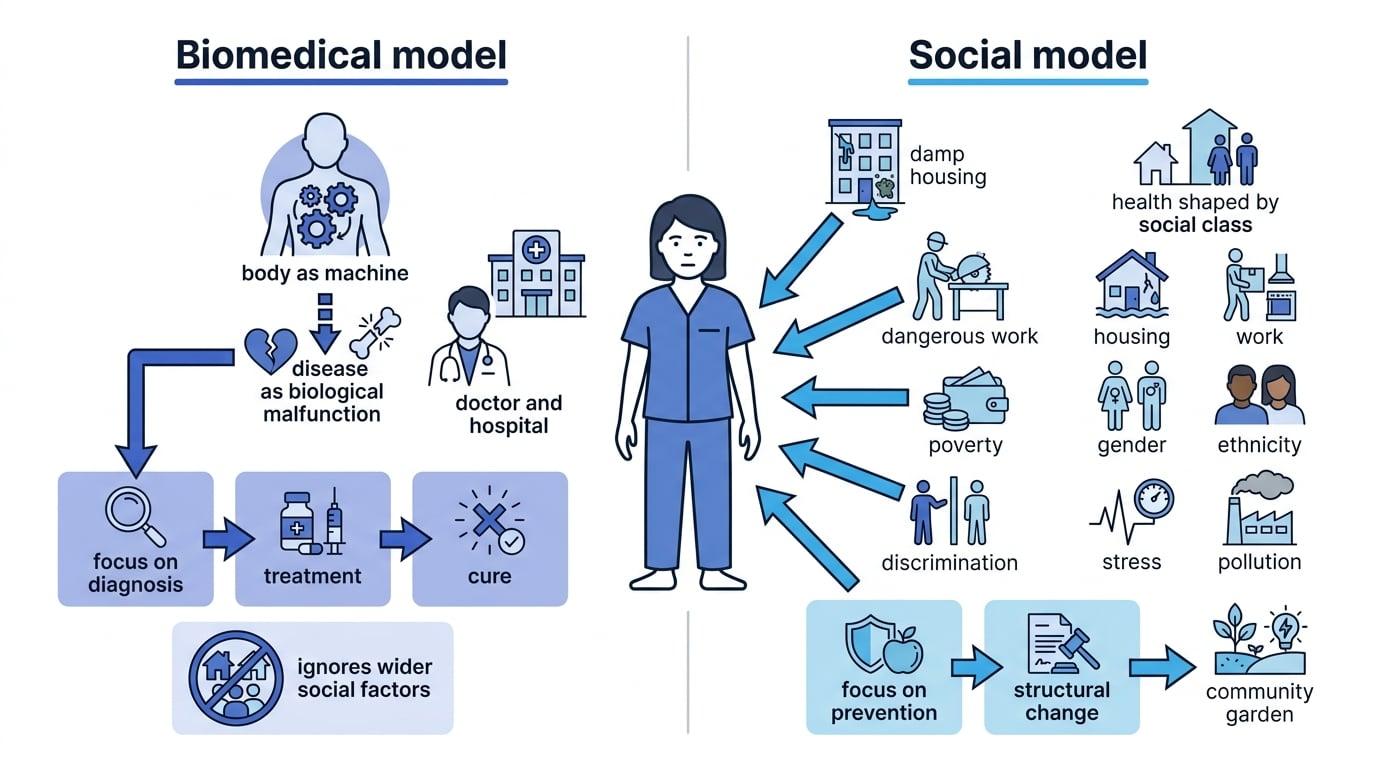
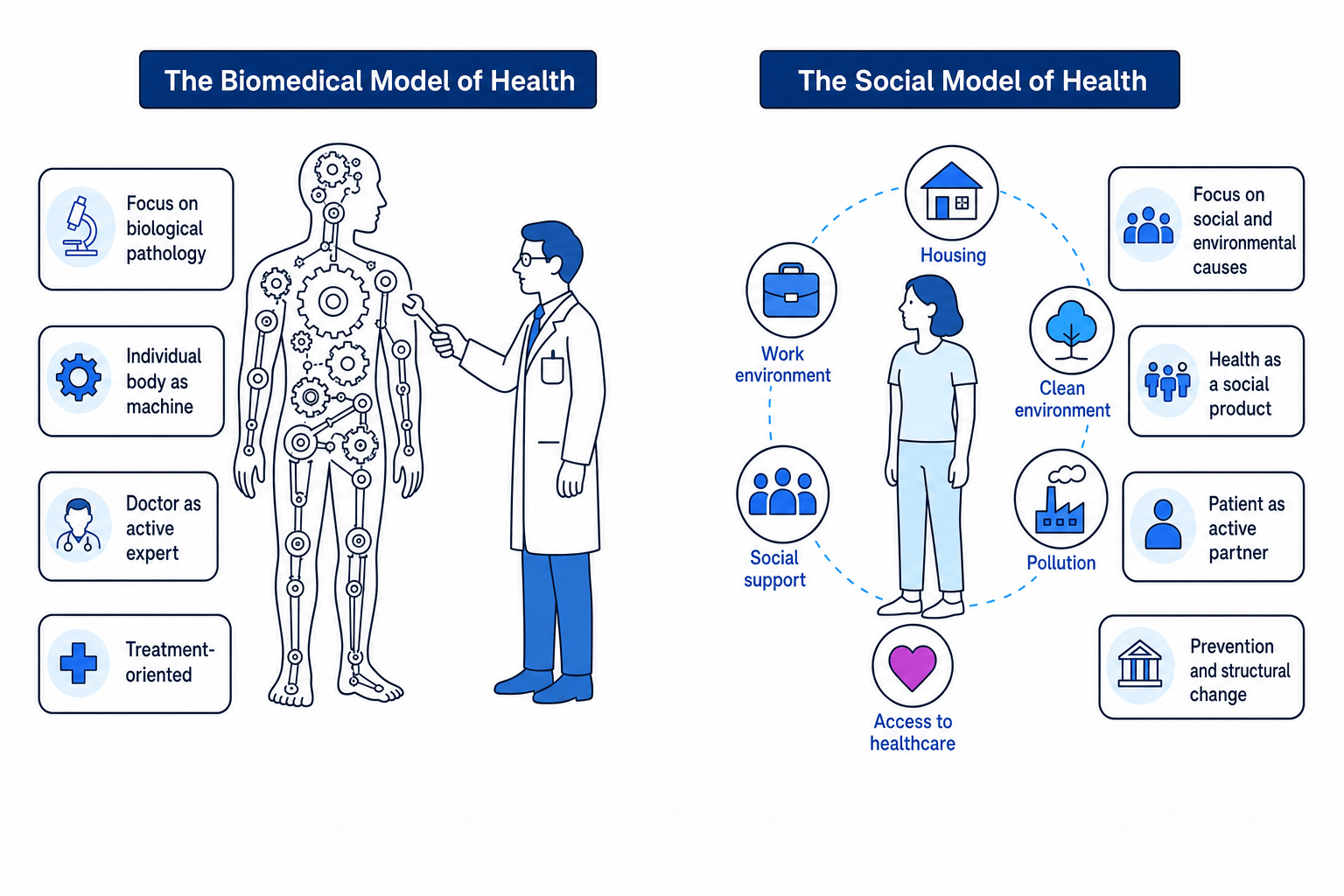
For over a century, Western medicine has been dominated by the biomedical model. This model treats the human body like a biological machine.
Biomedical Model of Health
An approach to health that views illness as a purely physical, biological malfunction of the human body. It focuses on diagnosing, treating, and curing disease through clinical interventions.
Under this model:
- The body is a machine: When it breaks down (illness), a specialist mechanic (the doctor) must fix it.
- Scientific objectivity: Disease is viewed as an objective, measurable biological pathology.
- Individual focus: The focus is on the individual's biology, largely ignoring their social position, poverty levels, or employment stress.
The Social Model
Sociologists argue that the biomedical model is too narrow. They propose the Social Model of Health, which shifts the focus from the microscope to the wider social structure.
The Social Model of Health
Health and illness are social products. A person’s health is deeply influenced by social factors—such as social class, gender, ethnicity, housing, and working conditions—not just their biological makeup.
Instead of simply prescribing medicine to treat a chronic lung condition, a social model practitioner asks: Is this patient living in a damp, moldy, rented flat? This approach views prevention and structural change (like better housing policies and reducing wealth inequality) as more important than post-illness clinical cures.
Confusing the models in essays
Don't fall into the trap of arguing that the social model claims biology "isn't real." Sociologists do not deny that viruses, tumors, or physical pain exist. Instead, they argue that the experience of these physical states, their distribution across the population, and how we categorise them are socially patterned.
2. The Social Construction of Illness
If illness is socially constructed, then what is considered "sick" or "healthy" is not fixed. It changes depending on time, place, and who holds the power to define it.
Deviance and the Sick Role
Functionalist sociologist Talcott Parsons (1951) was one of the first to argue that illness is a social state, not just a physical one. Parsons argued that being sick is a form of deviance because it disrupts the smooth running of society. To keep society stable, Parsons introduced the concept of the Sick Role.
According to Parsons, when you are sick, society grants you two rights:
- You are exempt from normal social duties (like going to school or work).
- You are not held responsible for your condition (it’s not your "fault").
However, these rights come with two strict obligations:
- You must actively want to get better.
- You must seek professional help (cooperate with doctors) to recover.
Using Parsons for AO3 Evaluation
Marxists and feminists criticize Parsons' Sick Role for assuming everyone has equal access to it. A low-paid zero-hours contract worker cannot easily "take the sick role" without facing severe financial precarity or job loss. The sick role is highly stratified by class, gender, and ethnicity.
Medicalisation and Social Control
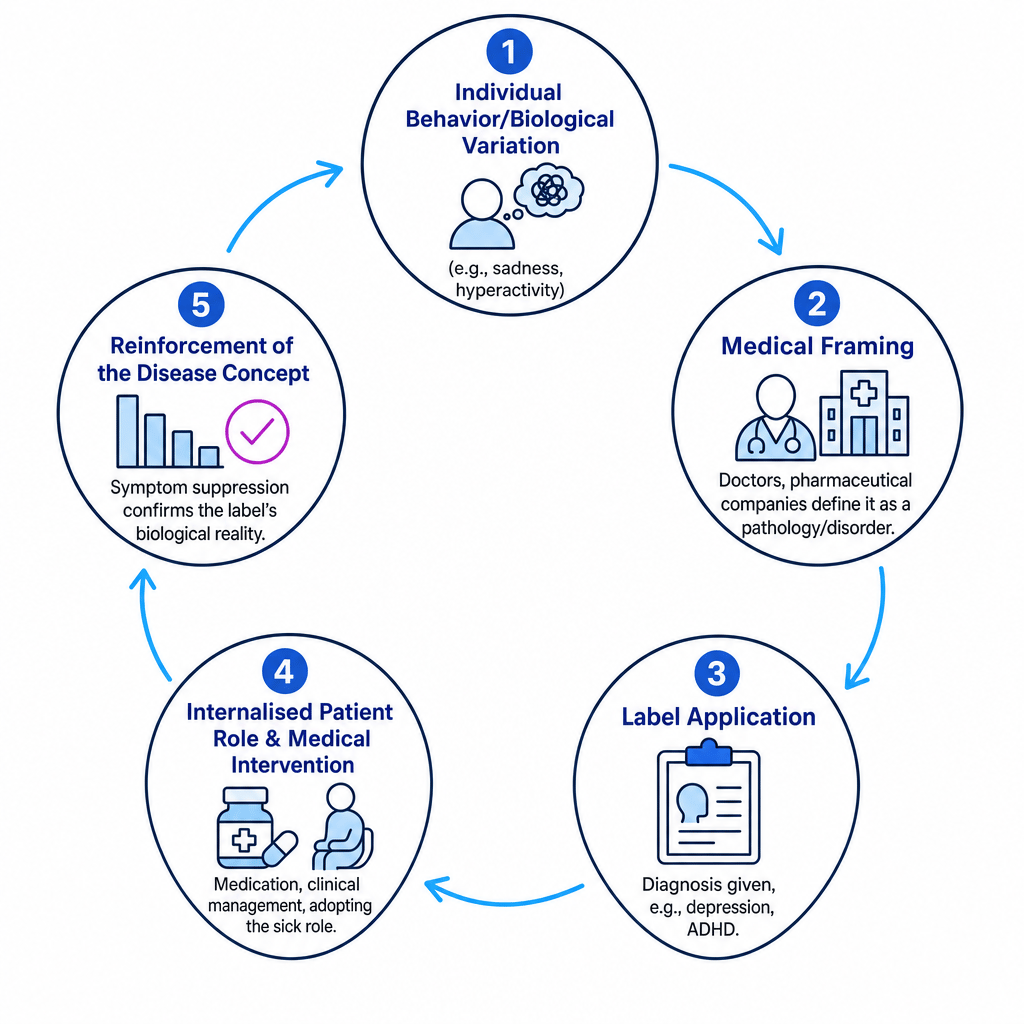
As society has secularised, the medical profession has taken over from religion as a major agent of social control. Behavior that used to be defined as "sinful" or "immoral" is now defined as a "medical condition." This process is called medicalisation.
Medicalisation
The process by which non-medical, social, or behavioral conditions come to be defined and treated as medical disorders or illnesses.
Sociologists like Peter Conrad argue that medicalisation is driven by pharmaceutical companies, the medical profession, and insurance companies who benefit from turning normal human variations into treatable pathologies.
Think about how the following have transitioned over time:
- ADHD: Children who were once labeled "disruptive" or "naughty" are now diagnosed with Attention Deficit Hyperactivity Disorder and prescribed stimulants.
- Mental Illness: Normal processes of grief or sadness are increasingly categorized as clinical depression requiring medical intervention.
- Homosexuality: Historically treated as a criminal offense, it was then medicalised as a psychiatric disorder in early versions of the DSM (Diagnostic and Statistical Manual of Mental Disorders), and only later de-medicalised as a normal variation of human sexuality.
Critical Perspectives on Medical Power
- Ivan Illich (1975) coined the term iatrogenesis to describe the harm caused by medical interventions. He argued that modern medicine actually creates illness. This can be clinical iatrogenesis (side effects of drugs, hospital-acquired infections) or social iatrogenesis (the medicalisation of life stages like birth, aging, and dying, which robs people of their autonomy).
- Thomas Szasz famously argued that many mental illnesses are "myths"—they are merely labels used by the powerful to control socially disruptive or non-conforming behavior.
3. The Social Construction of Disability
The way we understand disability has undergone a massive paradigm shift. Sociologist Michael Oliver (1983) argued that disability is entirely a social construction, and he drew a sharp distinction between two concepts:
- Impairment: A physical, sensory, or cognitive limitation of an individual's body (e.g., being unable to walk, being blind). This is a biological fact.
- Disability: The disadvantage, restriction of activity, or social exclusion caused by a society that fails to accommodate people with impairments. This is a social construction.
The Individual (Medical) Model vs. The Social Model of Disability
The Medical Model views disability as a personal tragedy. The "problem" lies entirely within the individual's broken body, and the solution is to cure, rehabilitate, or adjust the individual to fit into society.
The Social Model completely reverses this. It argues that people are not disabled by their impairments, but by society's barriers. These barriers can be:
- Physical barriers: Buildings with stairs but no ramps, narrow doorways, inaccessible public transport.
- Systemic barriers: Rigid working hours, lack of sign-language interpreters.
- Attitudinal barriers: Prejudice, patronising assumptions, and discrimination from employers.
The Fish Out of Water
Imagine a fish. If you put a fish on dry land, it cannot breathe or move. Under a medical model, you would diagnose the fish with a "pulmonary breathing pathology" and try to genetically engineer lungs for it. Under the social model, you recognize that the fish is perfectly fine; it is the dry-land environment that is hostile to its survival. The solution is to put it back in the water.
4. The Social Construction of the Body
Even the physical body itself is not a simple biological entity. Poststructuralist sociologists, most notably Michel Foucault, argue that our bodies are shaped, disciplined, and constructed by power and knowledge.
Foucault: The Clinical Gaze and Biopower
Foucault argued that in the 18th century, medicine developed what he called the clinical gaze (le regard medical). Doctors began to look at patients not as whole human beings, but as collections of organs to be observed, categorised, and monitored.
Through this medical discourse, bodies became objects of surveillance and biopower—the state's use of medical knowledge to regulate, manage, and control populations (e.g., vaccination campaigns, fertility policies, obesity guidelines).
Feminism and the Body
Feminist sociologists argue that women's bodies are particularly targeted by social construction:
- Medicalisation of female life cycles: Pregnancy, childbirth, and the menopause have been taken out of women's hands and placed under the control of male-dominated medical institutions.
- The Beauty Myth: Sociologists like Susie Orbach point out that the female body is socially constructed through media and capitalism to fit unrealistic, highly commodified ideals (e.g., diet culture, cosmetic surgery), leading to high rates of eating disorders which are then medicalised.
Worked Example
Applying the social model of disability to a school exclusion scenario
Analyse how a UK high school student who uses a manual wheelchair can be understood through both the Medical Model and the Social Model of Disability, highlighting why the Social Model is a social constructionist perspective.
-
Identify the biological impairment: The student has a physical impairment (paraplegia, requiring a wheelchair for mobility). This is the biological reality of their physical body.
-
Apply the Medical Model perspective: Under this model, the school views the student's inability to access the science laboratories on the second floor as a result of their personal biological deficit. The student is seen as "confined" to a wheelchair. The suggested solutions would involve therapy to improve physical strength, or placing the student in a specialized "special education" unit because their body "cannot cope" with the mainstream building.
-
Apply the Social Model (Social Constructionist) perspective: Under this model, the student is not disabled by their spinal injury, but by the school’s architecture. The disability is constructed by the school's failure to install a working lift, ramps, or adjustable-height science benches. The impairment is biological, but the disability is socially constructed by the structural design of the school and the institutional neglect of accessibility.
-
Formulate the sociological conclusion: By shifting the focus from the individual’s physical limitations to the environment’s structural barriers, the social model demonstrates that "disability" is a product of social power dynamics, architectural choices, and economic priorities, rather than a necessary consequence of biology.
In the exam
- Differentiate biological reality from social construction: Always start your essays by clarifying that sociologists do not deny physical pain or biology, but rather focus on how society defines, tracks, and treats these biological states.
- Deploy your key terms accurately: Examiners love precise use of terms like iatrogenesis (Illich), the clinical gaze (Foucault), medicalisation (Conrad), and the sick role (Parsons).
- Use contemporary UK examples: If you are discussing medicalisation, mention real-world debates such as the rising rates of antidepressant prescriptions in the UK or the medicalisation of ADHD. If discussing disability, mention the UK Equality Act 2010 and how physical barriers (like lack of step-free access on the London Underground) construct disability.
- Evaluate with nuance: Balance your critique. While the social model of disability is empowering, some disabled sociologists argue it can sometimes minimize the very real, unavoidable physical pain and exhaustion of physical impairments, which cannot be cured solely by removing social barriers.
Check yourself
- Can you explain why Ivan Illich believes modern medicine is "iatrogenic"?
- What is the fundamental difference between an impairment and a disability under the social model of disability?
- How does the historical change in how medicine categorized homosexuality prove that health and illness are social constructions?